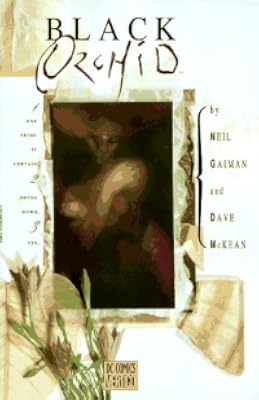
Black Orchid: The Deluxe Edition
by Neil Gaiman (Author), Dave McKean (Illustrator)
Black Orchid (Collections and Selections — TPB of 0.1-0.3)
On This Page
Description
A NEW YORK TIMES Bestseller! Before introducing the modern version of The Sandman, Neil Gaiman wrote this dark tale that reinvented a strange DC Comics super hero in the Vertigo mold. Featuring spectacular art by Gaiman's frequent collaborator, DaveMcKean, BLACK ORCHID. After being viciously murdered, Susan Linden is reborn fully grown as the Black Orchid, a hybrid of plant and human, destined to avenge her own death. Now, as this demigoddessattempts to reconcile human memory and botanical show more origins, she must untangle the webs of deception and secrets that led to her death. Beginning in the cold streets of a heartless metropolis and ending in the Amazon rainforest, this book takes thereader on a journey through secrets, suffering and self-rediscovery. show lessTags
Recommendations


Member Reviews
Still one of my favourite graphic novels of all time. It has dated more respectably (orig. pub. date 1990) than gracefully, and is not perfect by any stretch, but it's just so different. It proudly eschews the usual superhero tropes and sets off in a kinda mood piece direction, propelled by Gaiman's whimsy and McKean's sumptuous yet suffocating artwork. The characters and plot are almost incidental, although you'd have a stony heart if you're not drawn in by the tale. I quite enjoyed meeting several of the DC marquee players along the way, particularly the botanically gifted, and get an insight to some of their origin stories.
It evokes certain feelings in me, whilst reading it, that I find hard to describe. This is a gift that is common show more to Gaiman & McKean collaborations but feels so much more concentrated in this story. It's the feeling you get when you see a captive panther pacing the boundaries of its cage. Melancholy? Futility? Agitation? Pent-up kinetic energy?
It's probably the non-traditional story arc that creates this feeling of unspent energy - we're so used to the violent denouement in this format that we're left feeling slightly unsatisfied (this probably also explains the less than stellar reception the book got when it was first published).
Highly recommended if you like Gaiman & McKean's Death and Sandman stories and aren't expecting explosionswhich, funnily enough, is how the story starts . show less
It evokes certain feelings in me, whilst reading it, that I find hard to describe. This is a gift that is common show more to Gaiman & McKean collaborations but feels so much more concentrated in this story. It's the feeling you get when you see a captive panther pacing the boundaries of its cage. Melancholy? Futility? Agitation? Pent-up kinetic energy?
It's probably the non-traditional story arc that creates this feeling of unspent energy - we're so used to the violent denouement in this format that we're left feeling slightly unsatisfied (this probably also explains the less than stellar reception the book got when it was first published).
Highly recommended if you like Gaiman & McKean's Death and Sandman stories and aren't expecting explosions
I don't know who Mikal Gilmore is, but he wrote the introduction this collected edition of Black Orchid. Gilmore seems very impressed with all the "unanticipated" things that the book does-- so impressed, in fact, that he tells you what they all are before you get to read them yourself. Which is why I don't feel bad about discussing them, but it's not like you were going to read the book anyway. I don't even think Neil Gaiman fans read Black Orchid, even if my front cover does try to grab the dozens of people who watched MirrorMask. (Seriously, I forgot that film even existed until I saw it mentioned here.)
Gilmore cites Black Orchid as "one of those books that has helped break modern comics history in two and signalled the rise of a new show more courage and a new spirit of aspiration within the medium," placing it alongside Frank Miller's The Dark Knight Returns, Alan Moore's Miracleman, and Alan Moore's Watchmen. Frankly, I never thought I'd see The Dark Knight Returns described as having "a new spirit of aspiration," but I think there's a reason we don't remember Black Orchid alongside the potent critique of fantasized superhero and state violence that is Watchmen. Gilmore says it's one of the only comic books that critiques violence without being forced to resort to violence anyway, like Watchmen is... but that's not true. Or rather, it's a very defanged critique.
One of the primary villains is Carl Thorne, a disgraced LexCorp employee who Luthor has dumped off the docks. But the Black Orchid saves him, saying "too many have died today." But she doesn't do anything with him, leaving the man free to go on to murder people up as he pleases. Huzzah for pacifism? And then, at the end, Lex Luthor dispatches a squad of bad guys to capture the Black Orchid so he can science her up or whatever. Black Orchid doesn't battle this squad... but she doesn't have to, since most of them are conveniently killed by Thorne, and they conveniently kill him. Sure, she lets the last three go and they let her go, but it's hardly a damning indictment of comics violence.
I don't think it has to be, though. In Black Orchid, Gaiman and McKean take an obscure DC character, providing her with a fascinating and strange origin story and killing her off. The Black Orchid we follow is not the original, but another plant-creature grown from the same source, with fragmentary versions of her memories-- plus there's another one, a little girl version of the same. We discover the Black Orchid's origin at the same time that she discovers it herself, but here I think is where Gaiman really shines. The Black Orchid learns her origin story... but that doesn't actually tell her anything. I mean, we all know where we come from, but none of us know who we are either, right? So the Black Orchid (I wish I could call her by her name, but she's a plant-lady-- she doesn't have one) makes her way through Metropolis, Gotham City, the Louisiana swamps, and the Amazon rainforest, trying to find someone who will tell her what she needs to know. But there's no one, and so she (and her miniature clone-self) have to find their own way in the world.
Of course, the own way turns out to be hanging out in the rainforest talking about how great plants are, but I suppose you can't have everything.
The book's plot is disjointed, but it should be, and though Gaiman's villains are a little too thuggish to be interesting (and even his Luthor isn't great), the rest of the characters-- all the Black Orchids, Phillip Sylvain (her sort-of-creator), Poison Ivy, Batman, the Mad Hatter-- feel real. Thankfully, since the story isn't going to get you to the end. And then there's Dave McKean's jarring, gorgeous, disconcerting, brutal, realistic art, a perfect match for Gaiman's similarly so writing. He either manipulates photos or traces them, I don't know, but he's an artist who really makes that work as a technique.
Black Orchid is an interesting and intriguing read, all the more so because it is not an origin story where someone ends up deciding to fight injustice at the end. Once the story's over, the Black Orchid still doesn't know what to do with herself other than that she misses people-- so she returns to civilization. I like that it's open-ended, because it works well with what Gaiman's been doing. The Black Orchid doesn't know what she's up to any more than the rest of us. Apparently, this miniseries spawned an ongoing (not by Gaiman) about the Black Orchid, but I can't see what it would actually be about that wouldn't be hugely disappointing.
Neil Gaiman's The Sandman Spin-Offs: « Previous in sequence | Next in sequence » show less
Gilmore cites Black Orchid as "one of those books that has helped break modern comics history in two and signalled the rise of a new show more courage and a new spirit of aspiration within the medium," placing it alongside Frank Miller's The Dark Knight Returns, Alan Moore's Miracleman, and Alan Moore's Watchmen. Frankly, I never thought I'd see The Dark Knight Returns described as having "a new spirit of aspiration," but I think there's a reason we don't remember Black Orchid alongside the potent critique of fantasized superhero and state violence that is Watchmen. Gilmore says it's one of the only comic books that critiques violence without being forced to resort to violence anyway, like Watchmen is... but that's not true. Or rather, it's a very defanged critique.
One of the primary villains is Carl Thorne, a disgraced LexCorp employee who Luthor has dumped off the docks. But the Black Orchid saves him, saying "too many have died today." But she doesn't do anything with him, leaving the man free to go on to murder people up as he pleases. Huzzah for pacifism? And then, at the end, Lex Luthor dispatches a squad of bad guys to capture the Black Orchid so he can science her up or whatever. Black Orchid doesn't battle this squad... but she doesn't have to, since most of them are conveniently killed by Thorne, and they conveniently kill him. Sure, she lets the last three go and they let her go, but it's hardly a damning indictment of comics violence.
I don't think it has to be, though. In Black Orchid, Gaiman and McKean take an obscure DC character, providing her with a fascinating and strange origin story and killing her off. The Black Orchid we follow is not the original, but another plant-creature grown from the same source, with fragmentary versions of her memories-- plus there's another one, a little girl version of the same. We discover the Black Orchid's origin at the same time that she discovers it herself, but here I think is where Gaiman really shines. The Black Orchid learns her origin story... but that doesn't actually tell her anything. I mean, we all know where we come from, but none of us know who we are either, right? So the Black Orchid (I wish I could call her by her name, but she's a plant-lady-- she doesn't have one) makes her way through Metropolis, Gotham City, the Louisiana swamps, and the Amazon rainforest, trying to find someone who will tell her what she needs to know. But there's no one, and so she (and her miniature clone-self) have to find their own way in the world.
Of course, the own way turns out to be hanging out in the rainforest talking about how great plants are, but I suppose you can't have everything.
The book's plot is disjointed, but it should be, and though Gaiman's villains are a little too thuggish to be interesting (and even his Luthor isn't great), the rest of the characters-- all the Black Orchids, Phillip Sylvain (her sort-of-creator), Poison Ivy, Batman, the Mad Hatter-- feel real. Thankfully, since the story isn't going to get you to the end. And then there's Dave McKean's jarring, gorgeous, disconcerting, brutal, realistic art, a perfect match for Gaiman's similarly so writing. He either manipulates photos or traces them, I don't know, but he's an artist who really makes that work as a technique.
Black Orchid is an interesting and intriguing read, all the more so because it is not an origin story where someone ends up deciding to fight injustice at the end. Once the story's over, the Black Orchid still doesn't know what to do with herself other than that she misses people-- so she returns to civilization. I like that it's open-ended, because it works well with what Gaiman's been doing. The Black Orchid doesn't know what she's up to any more than the rest of us. Apparently, this miniseries spawned an ongoing (not by Gaiman) about the Black Orchid, but I can't see what it would actually be about that wouldn't be hugely disappointing.
Neil Gaiman's The Sandman Spin-Offs: « Previous in sequence | Next in sequence » show less
The first time I read this was when it was originally published, thirty-ish years ago and I literally remembered nothing of it. I likely picked it up because it was the same team that had done [b:Violent Cases|428658|Violent Cases|Neil Gaiman|https://d.gr-assets.com/books/1174672498s/428658.jpg|5880439], that I remember loving at the time.
So, it's a typical Gaiman book, long on deep thoughts and short on full explanations, with a typically less-violent-than-usual ending. The writing...as I find most of Gaiman's...is very good if, at times a touch overindulgent. The art, by Dave McKean, is suitably stunning, with a mix of media to set various tones and emotions.
Overall, the story is okay, but the overall journey isn't a bad one, with show more some fun cameos. show less
So, it's a typical Gaiman book, long on deep thoughts and short on full explanations, with a typically less-violent-than-usual ending. The writing...as I find most of Gaiman's...is very good if, at times a touch overindulgent. The art, by Dave McKean, is suitably stunning, with a mix of media to set various tones and emotions.
Overall, the story is okay, but the overall journey isn't a bad one, with show more some fun cameos. show less
I enjoyed this book much more than I thought I would. I wasn't sure, at the beginning, if I would be able to follow the storyline. It took a while, but then I began to get who was who and what the characters were trying to do. The lifelike drawings of the humans sometimes made identifying the characters a bit harder than in more cartoonlike graphic novels, but their full and detailed facial features made them more lifelike and...well, gruesome. The orchid peple were great. I wouldn't mind having a few of theme right here where I live. I need some of those seeds!
This book gathers the three part graphic novel story arc of Black Orchid into one paperback. Originally published around 1990, this the origin story of a DC character that had been around for years but little used. The original character was a woman of mystery; she never even had a secret identity given to her. This book explains why: she had no human identity, but was created by placing the genes of a specific woman, Susan Linden, into an orchid plant. Black Orchid was not born, but grown.
It’s a very violent story of vengeance and greed; film noir meets superhero story. Other characters from the DC universe are in it; Lex Luthor places a large part, while others make only brief appearances. It’s very different from what I would show more have expected from DC comics in that era; it’s not just a superhero story, it’s a very personal one. Black Orchid’s relationship with the plant world in the Amazon is almost spiritual. The art is stunning; McKean’s use of light and dark is beautiful. show less
It’s a very violent story of vengeance and greed; film noir meets superhero story. Other characters from the DC universe are in it; Lex Luthor places a large part, while others make only brief appearances. It’s very different from what I would show more have expected from DC comics in that era; it’s not just a superhero story, it’s a very personal one. Black Orchid’s relationship with the plant world in the Amazon is almost spiritual. The art is stunning; McKean’s use of light and dark is beautiful. show less
An important example of the re-creation and reimagining of comics by British authors during the mid eighties, Black Orchid combines Gaiman's mythology with McKean's powerful artistic visions in the series which made their careers.
Like Moore's 'Swamp Thing' or Morrison's 'Animal Man', Gaiman was given the opportunity to place his stamp on a pre-existing hero; and like the others, by betraying cliche and embracing a suitably mystic sense of realism, succeeds admirably. (as an aside, Watchmen was supposed to be such a recreation of old heroes, but was dubbed too far a difference from the original; of course, that decision is questionable as Watchmen is the most well-considered comic there has ever been)
From the very beginning of the three show more chapter series, Gaiman powerfully informs the reader of his intent to leave behind tradition and embark on a psychological exploration of the limits of the genre. This brave errancy is ably illustrated by the higher art aesthetic of McKean's, whose own sense of both magic and realistic depicion provides Gaiman's words an excellent partner.
In this highly experimental attempt, Gaiman does not fall to the usual high-falutin storylines, which is instead replaced with the vague and spiritual. Likewise, his often choiceless stories become less recognizeable in the emotional and intellectual extremes of Black Orchid.
The story does often move at a vague and paceless rate, and denies the simple morality or causal chain which we are so used to even out of comics. He also moves along a dangerous path: that of the romanticization of ecology and tribal life; however, he does not quite fall to it.
His story is emotional and personal in a way that super hero comics rarely attain, and part of this is because of the absolute denial of standard methods which McKean makes available to him by an alternate artistic representation. If it doesn't look like comics, is it still comics? Gaiman would say yes--so would McCloud--and so do I; but we are all a bit odd for it.
Gaiman also does proud the old comic fan with a score of intertwined heroes and villains of the past, though a reader without the foreknowledge may have to take his word a bit too often. The superior plan is to begin with Alan Moore's aforementioned Swamp Thing before tackling Black Orchid.
Though Sandman will undeniably reign as Gaiman's signature series, it is sometimes preferable to boldly make your 'X' and move along, rather than dither over the serif. In Black Orchid, Gaiman makes his mark. show less
Like Moore's 'Swamp Thing' or Morrison's 'Animal Man', Gaiman was given the opportunity to place his stamp on a pre-existing hero; and like the others, by betraying cliche and embracing a suitably mystic sense of realism, succeeds admirably. (as an aside, Watchmen was supposed to be such a recreation of old heroes, but was dubbed too far a difference from the original; of course, that decision is questionable as Watchmen is the most well-considered comic there has ever been)
From the very beginning of the three show more chapter series, Gaiman powerfully informs the reader of his intent to leave behind tradition and embark on a psychological exploration of the limits of the genre. This brave errancy is ably illustrated by the higher art aesthetic of McKean's, whose own sense of both magic and realistic depicion provides Gaiman's words an excellent partner.
In this highly experimental attempt, Gaiman does not fall to the usual high-falutin storylines, which is instead replaced with the vague and spiritual. Likewise, his often choiceless stories become less recognizeable in the emotional and intellectual extremes of Black Orchid.
The story does often move at a vague and paceless rate, and denies the simple morality or causal chain which we are so used to even out of comics. He also moves along a dangerous path: that of the romanticization of ecology and tribal life; however, he does not quite fall to it.
His story is emotional and personal in a way that super hero comics rarely attain, and part of this is because of the absolute denial of standard methods which McKean makes available to him by an alternate artistic representation. If it doesn't look like comics, is it still comics? Gaiman would say yes--so would McCloud--and so do I; but we are all a bit odd for it.
Gaiman also does proud the old comic fan with a score of intertwined heroes and villains of the past, though a reader without the foreknowledge may have to take his word a bit too often. The superior plan is to begin with Alan Moore's aforementioned Swamp Thing before tackling Black Orchid.
Though Sandman will undeniably reign as Gaiman's signature series, it is sometimes preferable to boldly make your 'X' and move along, rather than dither over the serif. In Black Orchid, Gaiman makes his mark. show less
Neil Gaiman's graphic novels have consistently redefined the comic book genre, from his fantastic sandman right through to this lesser known work, Black Orchid. The first impression on opening the book is the artwork by Dave McKean. It is absolutely amazing, it takes realism to a whole new level. Anyone familiar with Neil's work has no doubt come across Dave's artwork before, which usually takes the form of quite surreal imagery which is quite unlike anything else I've ever come across. This is unrecognisable as his artwork, and he really shows off his artistic ability in this novel. It is at times breathtaking
Then we get onto the story itself. It doesn't take long before Neil has drawn you into this comic book world, with a difference. show more Almost straight away we have the villian holding the hero prisoner. But here there is no monologuing whilst the hero figures out a way to escape and save the day. No, quite the opposite in fact. I don't want to spoil the introduction for anyone with what actually happens, all I will say is that right away the reader is confronted with a twist they don't see coming, which really sets the scene for what is still to come in this tale.
Interspersed throughout the novel are familiar comic book characters, most notably Lex Luther. I suspect there were a lot of references and characters that were above my head, not being overly familiar with comic's from that era (In my defence this was originally released the year after I was born) however I don't think no prior knowledge detracts from the story, it's enough to know that Lex Luther is a villian. Indeed, if you didn't know it wouldn't take a genius to figure it out. And any extra knowledge would only seek to enhance your enjoyment of the story.
This was originally released in three installments. After I finished the novel my first thought was were's the next part? I have since read that this was a common thought after finishing the third installment, many readers eagerly awaited the fourth, but were to be disappointed. In another move which bucked the trend in comic books the heroine, Susan, didn't seek revenge for an early on act of violence. Which is where the story appeared to be heading. But after having a little bit of time to think about the work as a whole, and let its impact sink in, I realised that this was intentional. It wasn't a tale of revenge, in fact it was quite the opposite.
I would highly recommend this book to anyone who likes comics, or indeed those who don't but are fans of Neil Gaiman, in fact I would even go as far as to say I would recommend it to anyone who enjoys a well told story. show less
Then we get onto the story itself. It doesn't take long before Neil has drawn you into this comic book world, with a difference. show more Almost straight away we have the villian holding the hero prisoner. But here there is no monologuing whilst the hero figures out a way to escape and save the day. No, quite the opposite in fact. I don't want to spoil the introduction for anyone with what actually happens, all I will say is that right away the reader is confronted with a twist they don't see coming, which really sets the scene for what is still to come in this tale.
Interspersed throughout the novel are familiar comic book characters, most notably Lex Luther. I suspect there were a lot of references and characters that were above my head, not being overly familiar with comic's from that era (In my defence this was originally released the year after I was born) however I don't think no prior knowledge detracts from the story, it's enough to know that Lex Luther is a villian. Indeed, if you didn't know it wouldn't take a genius to figure it out. And any extra knowledge would only seek to enhance your enjoyment of the story.
This was originally released in three installments. After I finished the novel my first thought was were's the next part? I have since read that this was a common thought after finishing the third installment, many readers eagerly awaited the fourth, but were to be disappointed. In another move which bucked the trend in comic books the heroine, Susan, didn't seek revenge for an early on act of violence. Which is where the story appeared to be heading. But after having a little bit of time to think about the work as a whole, and let its impact sink in, I realised that this was intentional. It wasn't a tale of revenge, in fact it was quite the opposite.
I would highly recommend this book to anyone who likes comics, or indeed those who don't but are fans of Neil Gaiman, in fact I would even go as far as to say I would recommend it to anyone who enjoys a well told story. show less
Members
- Recently Added By
Lists

Recommended Comics / Graphic Novels
595 works; 121 members

Books Read in 2014
2,344 works; 89 members
Author Information

Neil Gaiman was born in Portchester, England on November 10, 1960. He worked as a journalist and freelance writer for a time, before deciding to try his hand at comic books. Some of his work has appeared in publications such as Time Out, The Sunday Times, Punch, and The Observer. His first comic endeavor was the graphic novel series The Sandman. show more The series has won every major industry award including nine Will Eisner Comic Industry Awards, three Harvey Awards, and the 1991 World Fantasy Award for best short story, making it the first comic ever to win a literary award. He writes both children and adult books. His adult books include The Ocean at the End of the Lane, which won a British National Book Awards, and the Locus Award for Best Fantasy Novel for 2014; Stardust, which won the Mythopoeic Award as best novel for adults in 1999; American Gods, which won the Hugo, Nebula, Bram Stoker, SFX, and Locus awards; Anansi Boys; Trigger Warning: Short Fictions and Disturbances; and The View from the Cheap Seats: Selected Nonfiction, which is a New York Times Bestseller. His children's books include The Day I Swapped My Dad for Two Goldfish; Coraline, which won the Elizabeth Burr/Worzalla, the BSFA, the Hugo, the Nebula, and the Bram Stoker awards; The Wolves in the Walls; Odd and the Frost Giants; The Graveyard Book, which won the Newbery Award in 2009 and The Sandman: Overture which won the 2016 Hugo Awards Best Graphic Story. (Bowker Author Biography) show less

Dave McKean was born on December 29, 1963 in Maidenhead, England. He is an illustrator, photographer, comic book artist, filmmaker and musician. McKean is best known for his regular collaboration with Neil Gaiman. MirrorMask, McKean's first feature film as director and visual designer, premiered at the Sundance Film Festival in January 2005. The show more screenplay was written by Neil Gaiman. (Bowker Author Biography) show less
All Editions
Series

Belongs to Publisher Series
Work Relationships
Common Knowledge
- Canonical title
- Black Orchid: The Deluxe Edition
- Original publication date
- 1988-11-01 (Issue #1) (Issue #1); 1988-12-06 (Issue #2) (Issue #2); 1989-01-10 (Issue #3) (Issue #3)
- People/Characters
- Black Orchid; Susan Linden-Thorne; Suzy; Carl Thorne; Philip Sylvian; Lex Luthor (show all 10); Poison Ivy; Batman; Mad Hatter; Swamp Thing
- Important places
- Gotham City, New Jersey, USA; Amazon; Arkham Asylum
- Epigraph
- There is no such thing as a black orchid.
- Dedication
- To Mary and Clare
with all our love. - First words
- Like so many of the tales that make up our complex webwork of modern myths and contemporary entertainment, the tale you are about to read begins in violence.
--Introduction
One thing is certain … winter is coming.
--Body text - Quotations
- i thank You God for most this amazing
day: for the leaping greenly spirits of trees
and a blue true dream of sky; and for everything
which is natural which is infinite which is yes
(i who have died a... (show all)m alive again today,
and this is the sun's birthday; this is the birth
day of life and love and wings: and of the gay
great happening illimitably earth)
e. e. cummings - Last words
- (Click to show. Warning: May contain spoilers.)Into the sun.
- Publisher's editor
- Berger, Karen
- Blurbers
- King, Stephen
- Original language
- English
Classifications
Statistics
- Members
- 1,631
- Popularity
- 13,908
- Reviews
- 31
- Rating
- (3.58)
- Languages
- 10 — Danish, English, French, German, Hungarian, Italian, Norwegian, Polish, Portuguese, Spanish
- Media
- Paper, Ebook
- ISBNs
- 28
- ASINs
- 5