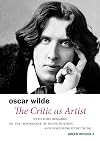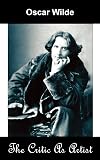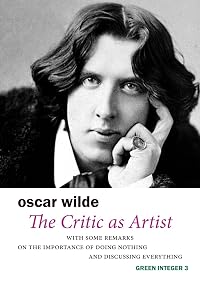
The Critic as Artist
by Oscar Wilde 
On This Page
Description
In The Critic as Artist, arguably the most complete exploration of his aesthetic thinking, and certainly the most entertaining, Oscar Wilde harnesses his famous wit to demolish the supposed boundary between art and criticism. Subtitled Upon the Importance of Doing Nothing and Discussing Everything, the essay takes the form of a leisurely dialogue between two characters: Ernest, who insists upon Wilde's own belief in art's freedom from societal mandates and values, and a quizzical show more Gilbert. With his playwright's ear for dialogue, Wilde champions idleness and contemplation as prerequisites to artistic cultivation. Beyond the well-known dictum of art for art's sake, Wilde's originality lays argument for the equality of criticism and art. For him, criticism is not subject to the work of art, but can in fact precede it: the artist cannot create without engaging his or her critical faculties first. And, as Wilde writes, "To the critic the work of art is simply a suggestion for a new work of his own." The field of art and criticism should be open to the free play of the mind, but Wilde plays seriously, even prophetically. Writing in 1891, he foresaw that criticism would have an increasingly important role as the need to make sense of what we see increases with the complexities of modern life. It is only the fine perception and explication of beauty, Wilde suggests, that will allow us to create meaning, joy, empathy, and peace out of the chaos of facts and reality. show lessTags
Recommendations











Member Reviews
Oscar Wilde's aesthetic philosophy is set out as a dialogue between Ernest (isn't it always?) and Gilbert (didn't Gilbert and Sullivan fund his lecture tour of the United States?). Of course, Plato used this method to convey his philosophical teachings. Here, Wilde uses the dialogue format to convey his aesthetic philosophy but touches on ethics, virtues, pedagogy, and spirituality. However, with Plato, I expect a dialogue. With Wilde, I couldn't help but think of the poor actors who had to remember all of lines! But of course, this was not meant to be a play. Wilde's interlocutors encompass many of the great thinkers, poets, and critics of the late 1800s, including Darwin, Matthew Arnold, Walter Pater, Dante Gabriel Rossetti, Robert show more Browning, and many other of his contemporaries, almost all of whom I had to look up. Dante, "Lionardo", numerous great French and Italian Renaissance and Ancient Greek and Roman all feature in the work. I was pleased to find that my reading is holding me in good stead, but there is still so much to catch up on. Wilde's own reading must have been vast, yet why wouldn't it? He studied the classics at Trinity College, and later won a scholarship to Magdalen College at Oxford. Regrettable me, poor sod, with a large chip on my shoulder, have to wait until death is in my region before I get my act together! Would I be so bold as to recall that "the dullness of tutors and professors matter very little when one can loiter in the grey cloisters of Magdalen, and listen to some flute-like voice singing in Waynfleete's chapel"? Oh, poor Oscar! That he was a genius is obvious, and there are many lessons to draw from this work. For instance, I am learning to "draw" at the moment, and it is a truism that "in every sphere of life Form is the beginning of things... Start with the worship of form, and there is no secret in art that will not be revealed to you". Based on my own reading, and avoiding the myriad things written by others, there is an element of tongue-in-cheek-edness about the role of the critic. For instance, "without the critical faculty, there is no artistic creation at all, worthy of the name" and "criticism demands infinitely more cultivation than creation does", culminating in:
Each new school, as it appears, cries out against criticism, but it is the critical faculty in man that owes its origin. The mere creative instinct does not innovate, but reproduces.In effect, criticism leads to change. And critics do not need to read or view everything to criticise, for:
To know the vintage and quality of a wine it is not necessary to drink the whole cask.In the other extreme, the artist's finished work then takes on:
...an independent life of its own, and may deliver a message far other than that which was put into its lips to say.That is not to say that "the critic" is anybody who opens their mouth to pour scorn on the creative spirit. Indeed, the critic is not:
...the nuisance of the intellectual sphere... the man who is so occupied in trying to educate others , that he has never had any time to educate himself... [Indeed,] self-culture is the true ideal man.There is likely much packed into Wilde's philosophy that is not explicitly stated, and I can hear echoes of Nietzsche in Wilde's statement that all art is "immoral". Most of Nietzsche's work pre-dates Wilde's Critic as Artist, so it is not improbable that there was some influence there. And finally, criticism will allow (drawing on Goethe) a cosmopolitan society, free of racial prejudice. From what I have read of others' interpretations of Wilde, he seems to propose the very opposite of Nietzsche (with God in absentia): That Apollo (order/criticism) must triumph over Dionysus (chaos/creating). show less
Oscar's take on Plato's Symposium paved the way for young contemplative writers of the last century and beyond. It’s a shame that to be influenced and to take to his words is now a cliché because Wilde should have no negative connotations, just the affirmation that he is as great as any Hesse, Salinger, or Kerouac could dream of being. This is a bible of sorts.
To be honest, the examples could have been 100 pages less and still would have proved his point.
My own response to this text is long, and likely tedious, so I will save my "review" for the classroom. In place of a personal response I would like to share the response of Ernest from page 112:
You have told me many strange things to-night, Gilbert. You have told me that it is more difficult to talk about a thing than to do it, and that to do nothing at all is the most difficult thing in the world; you have told me that all Art is immoral, and all thought dangerous; that criticism is more creative than creation, and that the highest criticism is that which reveals in the work of Art what the artist had not put there; that it is exactly because a man cannot do a thing that he is the proper judge of it; and that the true critic is show more unfair, insincere, and not rational. My friend, you are a dreamer. show less
You have told me many strange things to-night, Gilbert. You have told me that it is more difficult to talk about a thing than to do it, and that to do nothing at all is the most difficult thing in the world; you have told me that all Art is immoral, and all thought dangerous; that criticism is more creative than creation, and that the highest criticism is that which reveals in the work of Art what the artist had not put there; that it is exactly because a man cannot do a thing that he is the proper judge of it; and that the true critic is show more unfair, insincere, and not rational. My friend, you are a dreamer. show less
Ratings
Members
- Recently Added By
Author Information

1,765+ Works 120,996 Members
Flamboyant man-about-town, Oscar Wilde had a reputation that preceded him, especially in his early career. He was born to a middle-class Irish family (his father was a surgeon) and was trained as a scholarship boy at Trinity College, Dublin. He subsequently won a scholarship to Magdalen College, Oxford, where he was heavily influenced by John show more Ruskin and Walter Pater, whose aestheticism was taken to its radical extreme in Wilde's work. By 1879 he was already known as a wit and a dandy; soon after, in fact, he was satirized in Gilbert and Sullivan's Patience. Largely on the strength of his public persona, Wilde undertook a lecture tour to the United States in 1882, where he saw his play Vera open---unsuccessfully---in New York. His first published volume, Poems, which met with some degree of approbation, appeared at this time. In 1884 he married Constance Lloyd, the daughter of an Irish lawyer, and within two years they had two sons. During this period he wrote, among others, The Picture of Dorian Gray (1891), his only novel, which scandalized many readers and was widely denounced as immoral. Wilde simultaneously dismissed and encouraged such criticism with his statement in the preface, "There is no such thing as a moral or an immoral book. Books are well written or badly written. That is all." In 1891 Wilde published A House of Pomegranates, a collection of fantasy tales, and in 1892 gained commercial and critical success with his play, Lady Windermere's Fan He followed this comedy with A Woman of No Importance (1893), An Ideal Husband (1895), and his most famous play, The Importance of Being Earnest (1895). During this period he also wrote Salome, in French, but was unable to obtain a license for it in England. Performed in Paris in 1896, the play was translated and published in England in 1894 by Lord Alfred Douglas and was illustrated by Aubrey Beardsley. Lord Alfred was the son of the Marquess of Queensbury, who objected to his son's spending so much time with Wilde because of Wilde's flamboyant behavior and homosexual relationships. In 1895, after being publicly insulted by the marquess, Wilde brought an unsuccessful slander suit against the peer. The result of his inability to prove slander was his own trial on charges of sodomy, of which he was found guilty and sentenced to two years of hard labor. During his time in prison, he wrote a scathing rebuke to Lord Alfred, published in 1905 as De Profundis. In it he argues that his conduct was a result of his standing "in symbolic relations to the art and culture" of his time. After his release, Wilde left England for Paris, where he wrote what may be his most famous poem, The Ballad of Reading Gaol (1898), drawn from his prison experiences. Among his other notable writing is The Soul of Man under Socialism (1891), which argues for individualism and freedom of artistic expression. There has been a revived interest in Wilde's work; among the best recent volumes are Richard Ellmann's, Oscar Wilde and Regenia Gagnier's Idylls of the Marketplace , two works that vary widely in their critical assumptions and approach to Wilde but that offer rich insights into his complex character. (Bowker Author Biography) show less
Oscar Wilde has a Legacy Library. Legacy libraries are the personal libraries of famous readers, entered by LibraryThing members from the Legacy Libraries group.
Series
Belongs to Publisher Series
Green Integer (3)
Stichting De Roos (41)
Work Relationships
Common Knowledge
- Canonical title
- The Critic as Artist
- First words
- Persons: Gilbert and Ernest. Scene: The library of a house in Piccadilly, overlooking Green Park.
- Original language*
- Engels
*Some information comes from Common Knowledge in other languages. Click "Edit" for more information.
Classifications
Statistics
- Members
- 126
- Popularity
- 258,779
- Reviews
- 4
- Rating
- (3.79)
- Languages
- English, German, Hungarian, Italian
- Media
- Paper, Ebook
- ISBNs
- 12
- ASINs
- 3