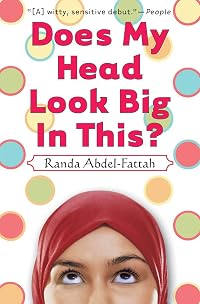
Does My Head Look Big In This?
by Randa Abdel-Fattah
On This Page
Description
Year Eleven at an exclusive prep school in the suburbs of Melbourne, Australia, would be tough enough, but it is further complicated for Amal when she decides to wear the hijab, the Muslim head scarf, full-time as a badge of her faith--without losing her identity or sense of style.Tags
Recommendations












Member Recommendations
Member Reviews
Honestly, this would have probably been a 3/5 except the narrator was bloody brilliant! This was a coming of age story, with a twist, in which the themes of identity (whether culture, self-image, external/internal) and community (familial, cultural, societal) are explored in a number of different ways. I enjoyed seeing how Amal grew but at times, the story seemed heavy-handed. The audio-recording was top-notch, and Rebecca Macauley did a fantastic job giving everybody their own unique voice (and accent, tone, timbre...). She really brought the story to life for me.
Contemporary Young Adult fiction has developed a greater sense of sophistication and maturity in its approach to a wide range of issues that concern adolescents in meaningful ways—race, ethnicity, gender, sexual orientation, violence, domestic abuse, and sexual abuse (among other themes) are examined sensitively and plausibly in any number of well written works of Young Adult literature. The topic of religion, however, consistently challenges writers of YA fiction. I’ve yet to come across a novel that features religion and faith as integral narrative elements and issues that profoundly affect characters in ways that compel them to develop and think independently. *Does My Head Look Big in This?* comes pretty close but falls somewhat show more short.
The novel focuses on Amal, a high school junior living in Australia. At the start of the final term of the school year, Amal decides to begin wearing the hijab full-time as an expression of her Islamic faith. The novel follows her through some quite typical high school experiences—she and her friends develop crushes on boys, contend with bullying “mean girls,” deal with body image issues, worry about upcoming exams, and cope with overbearing/controlling/unsympathetic/embarrassing parents. Amal has a fairly diverse group of friends—some are Islamic, some are Jewish, some are Palestinian-Australians (like Amal), others hail from other parts of the world, including Mrs. Vaselli, Amal’s elderly Greek-Australian neighbor who reluctantly befriends Amal. Throughout all of these encounters and the rest of the minor conflicts that arise throughout the course of the plot, Amal’s decision to wear the hijab—which seems to be the driving force behind the novel’s primary conflict—increasingly fades into the background. Until the latter portion of the novel, when Amal’s friend Leila runs away from home because of her mother’s strict opposition to her desire for education and independence.
Ultimately, Amal’s assertion of her faith creates few problems for her. It does, however, provide her with an enlightened perspective on the actions of others. It seems as though once Amal has resolved her feelings about her own faith and becomes comfortable with her decision (she even rejects a mere kiss from Adam, her crush, and explains that any form of intimacy is forbidden before marriage)—only then can she develop insight and understand the beliefs and action of others, particularly Mrs. Vaselli and Leila.
Although the novel is rather lighthearted and avoids serious drama, it sends a powerful albeit tangential message about faith in oneself and the value of empathy. show less
The novel focuses on Amal, a high school junior living in Australia. At the start of the final term of the school year, Amal decides to begin wearing the hijab full-time as an expression of her Islamic faith. The novel follows her through some quite typical high school experiences—she and her friends develop crushes on boys, contend with bullying “mean girls,” deal with body image issues, worry about upcoming exams, and cope with overbearing/controlling/unsympathetic/embarrassing parents. Amal has a fairly diverse group of friends—some are Islamic, some are Jewish, some are Palestinian-Australians (like Amal), others hail from other parts of the world, including Mrs. Vaselli, Amal’s elderly Greek-Australian neighbor who reluctantly befriends Amal. Throughout all of these encounters and the rest of the minor conflicts that arise throughout the course of the plot, Amal’s decision to wear the hijab—which seems to be the driving force behind the novel’s primary conflict—increasingly fades into the background. Until the latter portion of the novel, when Amal’s friend Leila runs away from home because of her mother’s strict opposition to her desire for education and independence.
Ultimately, Amal’s assertion of her faith creates few problems for her. It does, however, provide her with an enlightened perspective on the actions of others. It seems as though once Amal has resolved her feelings about her own faith and becomes comfortable with her decision (she even rejects a mere kiss from Adam, her crush, and explains that any form of intimacy is forbidden before marriage)—only then can she develop insight and understand the beliefs and action of others, particularly Mrs. Vaselli and Leila.
Although the novel is rather lighthearted and avoids serious drama, it sends a powerful albeit tangential message about faith in oneself and the value of empathy. show less
When Australian-Palestinian high schooler Amal decides to wear the hijab full-time, she struggles with the reaction at her private school (where she is the only Muslim), and her identity as both a Muslim and an Australian.
Amal narrates the story with a voice that teenage girls will find authentic and familiar, regardless of religious background. She hangs out with her friends, agonizes over exams, and has a huge crush on a boy in her class. She loves her parents, but also considers them to be mortifyingly embarrassing. Her religious faith and ideals are strong, but she realistically struggles to uphold them-- she judges her friend's uneducated mother, lies, and can be quick to anger. Like most teens, she is hyper aware of the faults of show more others, but blind to her own, and as the book and Amal's journey of faith progresses, Amal's character develops, learning more about herself and her religion. The book is full of humor and pop culture references, and would be enjoyed by high school girls. show less
Amal narrates the story with a voice that teenage girls will find authentic and familiar, regardless of religious background. She hangs out with her friends, agonizes over exams, and has a huge crush on a boy in her class. She loves her parents, but also considers them to be mortifyingly embarrassing. Her religious faith and ideals are strong, but she realistically struggles to uphold them-- she judges her friend's uneducated mother, lies, and can be quick to anger. Like most teens, she is hyper aware of the faults of show more others, but blind to her own, and as the book and Amal's journey of faith progresses, Amal's character develops, learning more about herself and her religion. The book is full of humor and pop culture references, and would be enjoyed by high school girls. show less
Sixteen-year-old Amal makes the decision to start wearing the hijab full-time and everyone has a reaction. Her parents, her teachers, her friends, people on the street. But she stands by her decision to embrace her faith and all that it is, even if it does make her a little different from everyone else.
Can she handle the taunts of "towel head," the prejudice of her classmates, and still attract the cutest boy in school? Brilliantly funny and poignant, Randa Abdel-Fattah's debut novel will strike a chord in all teenage readers, no matter what their beliefs.
Can she handle the taunts of "towel head," the prejudice of her classmates, and still attract the cutest boy in school? Brilliantly funny and poignant, Randa Abdel-Fattah's debut novel will strike a chord in all teenage readers, no matter what their beliefs.
I thought this was a great book to help open the mind of some who have either 1) not thought about it or 2) some seriously messed up ideas or prejudices. I loved her determination and her devotion to her faith. Not many would have the same love to wear something with so much pride and love and understanding.
However, this was a little too "back to school special" for me. The kids, just a little too nice. The boys, totally unrealistic. While I want to think all of the kids at her rich prep school would be stunned and mostly silent and the perfect boy, just stunned speechless, we all know not everything works out all flowers and roses in real life.
However, this was a little too "back to school special" for me. The kids, just a little too nice. The boys, totally unrealistic. While I want to think all of the kids at her rich prep school would be stunned and mostly silent and the perfect boy, just stunned speechless, we all know not everything works out all flowers and roses in real life.
This is a YA coming-of-age story that follows sixteen-year-old Palestinian-Australian Amal as she decides to wear the hijab full-time, deals with the reactions of her schoolmates and family, supports friends through varying problems, and works out who she is as a woman, an Australian and a Muslim. It's not the slickest piece of writing, but the voice and is strong and it tackles some interesting and difficult themes. Less fluffy than the title sounds, especially in the second half. If the theme sounds even remotely interesting and you like YA lit, then I recommend it. 4/5.
Sixteen-year-old Australian, Amal Abdul-Hakim, makes the decision to start wearing the hijab (the head scarf worn by Muslim women)full- time. This is just after September 11 - not a time to be openly declaring you're Muslim in a non-Muslim country. Everyone has an opinion - her parents, her teachers, her friends, and people on the street. She is a normal teenager who has crushes on boys, reads Cosmopolitan, shops for clothes, gossip with her friends by phone or SMS, and argues with her parents. Amal's life is changed drastically when she starts to wear her hijab. She is subjected to racism and discrimination by people whose experience with Muslims is influenced by what they see in the media. Amal has made a choice, it is a personal, show more religious decision, to show her devotion to God; it's not about being oppressed as some of her classmates seem to think.
I could not put this book down once I started it. The book is witty, well-written and Amal is a wonderful role model for teens who are too scared to fight peer pressure. Some of Amal's friends have problems too - and not just her Muslim pals - these problems form part of the back stories in this novel. I really recommend this one. show less
I could not put this book down once I started it. The book is witty, well-written and Amal is a wonderful role model for teens who are too scared to fight peer pressure. Some of Amal's friends have problems too - and not just her Muslim pals - these problems form part of the back stories in this novel. I really recommend this one. show less
Members
- Recently Added By
Lists

Most Popular Books Tagged Australia
35 works; 5 members

KayStJ's to-read list
1,616 works; 11 members
Author Information

21+ Works 2,897 Members
Randa Abdel-Fattah was born on July 6 1979 in Sydney Australia. She is an Australian Muslim writer of Palestinian and Egyptian decent. Her first novel Does My Head Look Big in This? was published in 2005. Abdel-Fattah studied a Bachelor of Arts and Bachelor of Law at the University of Melbourne. During this time, she was the Media Liaison Officer show more at the Islamic Council of Victoria, a role that afforded her the opportunity to write for newspapers and engage with media institutions about their representation of Muslims and Islam. Abdel-Fattah was a passionate human rights advocate and stood in the 1998 federal election as a member of the Unity Party. Her book titles include: Ten Things I Hate about Me, Where the Streets Had a Name, Noah's Law and The Friendship Matchmaker. In 2015 her title Does My Head Look Big in This? will be adapted into a film. (Bowker Author Biography) show less
Some Editions
Awards and Honors
Awards
Distinctions
Work Relationships
Has as a student's study guide
Common Knowledge
- Original title
- Does my head look big in this?
- Original publication date
- 2005
- People/Characters
- Amal Mohamed Nasrullah Abdel-Hakim
- Important places
- Melbourne, Victoria, Australia
- Dedication
- To Mum and Dad for your faith in me. To Nada, my sister, for encouraging me. To Ibrahim, my husband, for supporting me.
- First words
- It hit me when I was power walking on the treadmill at home, watching a Friends rerun for about the nineteenth time.
- Last words
- (Click to show. Warning: May contain spoilers.)Because something tells me that I already know which side is going to win this one.
- Original language
- English
Classifications
Statistics
- Members
- 1,511
- Popularity
- 15,339
- Reviews
- 78
- Rating
- (3.61)
- Languages
- 10 — Arabic, Catalan, Danish, English, Finnish, German, Italian, Russian, Spanish, Swedish
- Media
- Paper, Audiobook, Ebook
- ISBNs
- 41
- ASINs
- 10