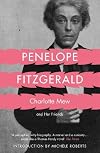
Charlotte Mew and Her Friends
by Penelope Fitzgerald
On This Page
Description
Charlotte Mew was a poet with a formidable reputation. Outwardly, she also was a dutiful daughter living at home with an ogre of a mother. However, proprieties had to be observed and no one could know that they had no money, that two siblings were insane and that Charlotte was a lesbian.Tags
Recommendations

















Member Reviews
There is a moment in Penelope Fitzgerald's sensitive and moving biography of the poet Charlotte Mew (1869 - 1928) when the reader thinks the sadness, disappointment and heartbreak are just too unremitting. But then something cheering happens and she is invited to hear some of her verses read one Tuesday evening in November 1915 at the Poetry Bookshop in Bloomsbury.
'At about five minutes to six the swing door opened and out of the autumn fog came a tiny figure, apparently a maiden aunt, dressed in a hard felt hat and a small-sized man's overcoat. She was asked, 'Are you Charlotte Mew?' and replied, with a slight smile, 'I am sorry to say I am.' From this evening Mew's late flowering begins and this reader at least let out a sigh show more thinking 'she's going to be okay'.
The life that Mew led up to this point was painful and difficult. There was the mixed background with a working-class boy made good architect father and a superior mother who thought she had married down. As Fitzgerald wrote insightfully, 'she was a silly young woman who grew, in time, to be a very silly old one. But she had the great strength of silliness, smallness and prettiness in combination, in that it never occurred to her that she would not be protected and looked after, and she always was.'
There were siblings debilitated by mental instability and shut away in asylums to protect them and preserve the family's reputation. Mew's primary loyalty, as Fitzgerald dissects, was to her conventional middle-class background and the 5 o'clock people who called and took tea.
Her literary talent and sexuality ensured she was forever in conflict with her background and (reminiscent of Stevie Smith and her abiding love of the suburbs) she could not abandon her family's good address and claim, like so many of her female contemporaries, her freedom and a flat of her own. The closest Mew came to this female utopia was, eventually, a shared studio with her sister Anne where they would entertain some of their respectable friends.
In many ways Charlotte Mew would have been horrified by the Bloomsbury's morals and yet when she fell in love - painfully, humiliatingly and ultimately futile - the women she loved were liberated, freedom-loving feminists. But each one Ella D'Arcy, 'office help', general factotum and unparalleled treasure behind The Yellow Book, and novelist May Sinclair rejected Mew. May Sinclair really only loved cats.
If Mew's life was difficult her poetry allowed some intellectual outlet and some fictional resolution of her torn loyalties. Her late flowering included being admired by Thomas Hardy, admired by Sassoon and noticed by Virginia Woolf. She acquired important female friends in Florence Hardy and Kate Cockerell. Lady Ottoline Morrell was defeated by Mew's refusal to be lionised.
A civil list pension (awarded by of all politicians Stanley Baldwin*) resolved her financial problems but, while it helped, it was almost too late as her mother had died and then her sister died from cancer and Charlotte Mew was alone. 'Don't keep me, let me go.' She was survived by her enigmatic and haunting verse.
*Mr Baldwin is of course interesting in his own right being a nephew of Burne-Jones and a fan of Mary Webb. show less
'At about five minutes to six the swing door opened and out of the autumn fog came a tiny figure, apparently a maiden aunt, dressed in a hard felt hat and a small-sized man's overcoat. She was asked, 'Are you Charlotte Mew?' and replied, with a slight smile, 'I am sorry to say I am.' From this evening Mew's late flowering begins and this reader at least let out a sigh show more thinking 'she's going to be okay'.
The life that Mew led up to this point was painful and difficult. There was the mixed background with a working-class boy made good architect father and a superior mother who thought she had married down. As Fitzgerald wrote insightfully, 'she was a silly young woman who grew, in time, to be a very silly old one. But she had the great strength of silliness, smallness and prettiness in combination, in that it never occurred to her that she would not be protected and looked after, and she always was.'
There were siblings debilitated by mental instability and shut away in asylums to protect them and preserve the family's reputation. Mew's primary loyalty, as Fitzgerald dissects, was to her conventional middle-class background and the 5 o'clock people who called and took tea.
Her literary talent and sexuality ensured she was forever in conflict with her background and (reminiscent of Stevie Smith and her abiding love of the suburbs) she could not abandon her family's good address and claim, like so many of her female contemporaries, her freedom and a flat of her own. The closest Mew came to this female utopia was, eventually, a shared studio with her sister Anne where they would entertain some of their respectable friends.
In many ways Charlotte Mew would have been horrified by the Bloomsbury's morals and yet when she fell in love - painfully, humiliatingly and ultimately futile - the women she loved were liberated, freedom-loving feminists. But each one Ella D'Arcy, 'office help', general factotum and unparalleled treasure behind The Yellow Book, and novelist May Sinclair rejected Mew. May Sinclair really only loved cats.
If Mew's life was difficult her poetry allowed some intellectual outlet and some fictional resolution of her torn loyalties. Her late flowering included being admired by Thomas Hardy, admired by Sassoon and noticed by Virginia Woolf. She acquired important female friends in Florence Hardy and Kate Cockerell. Lady Ottoline Morrell was defeated by Mew's refusal to be lionised.
A civil list pension (awarded by of all politicians Stanley Baldwin*) resolved her financial problems but, while it helped, it was almost too late as her mother had died and then her sister died from cancer and Charlotte Mew was alone. 'Don't keep me, let me go.' She was survived by her enigmatic and haunting verse.
*Mr Baldwin is of course interesting in his own right being a nephew of Burne-Jones and a fan of Mary Webb. show less
Ratings
Members
- Recently Added By
Author Information

24+ Works 12,110 Members
In 1997 Penelope Fitzgerald's novel The Blue Flower was named one of the New York Times Book Review's eleven Best Books of the Year. Winner of the 1979 Booker Prize for Offshore, Fitzgerald was also short-listed for the Booker for The Bookshop. The Beginning of Spring, and The Gate of Angels. Penelope Fitzgerald lives in England. (Bowker Author show more Biography) Penelope Fitzgerald, one of England's most-celebrated contemporary writers, is the author of "The Blue Flower," which won the National Book Critics Circle Award. Winner of the 1979 Booker Prize for "Offshore," she was also shortlisted for the Booker for "The Bookshop," "The Beginning of Spring," & "The Gate of Angels." She lives in London. (Bowker Author Biography) Admired by many as one of the leading English novelists of her day, Penelope Fitzgerald (1916-2000) wrote some twelve books of fiction and nonfiction over the course of her writing career; which began at the age of sixty. She won the National Book Critics Circle Award for "The Blue Flower" and the Booker Prize for "Offshore". She died on April 28, 2000, at the age of eighty-three. (Bowker Author Biography) show less
Awards and Honors
Awards
Series
Belongs to Publisher Series
Radcliffe Biography Series (1988)
Harvill (108)
Common Knowledge
- Canonical title
- Charlotte Mew and Her Friends
- Original publication date
- 2013
- People/Characters
- Charlotte Mew; Thomas Hardy
Classifications
Statistics
- Members
- 104
- Popularity
- 312,369
- Reviews
- 1
- Rating
- (3.30)
- Languages
- English
- Media
- Paper, Ebook
- ISBNs
- 6
- ASINs
- 2