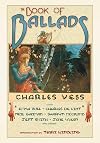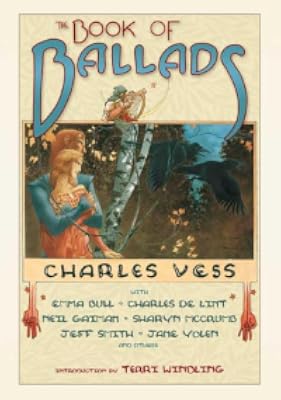
The Book of Ballads
by Charles Vess, Teresa Nielsen Hayden (Editor)
On This Page
Description
A collection of traditional English, Irish, and Scottish songs and folktales, retold in graphic novel form by some of today's top fantasy writers, includes Neil Gaiman's "The False Knight on the Road," Sharyn McCrumb's "Thomas the Rhymer," and Jane Yolen's "King Henry" and "The Great Selchie of Sule Skerrie."Tags
Recommendations





Member Reviews
A collection of thirteen traditional ballads, retold in graphic form.
I've tried very, very hard to love this book, and I just can't.
The artwork is breathtaking. And when I say breathtaking, I mean breathtaking. Vess does beautiful work. Each panel is so detailed you feel like you could step straight into it, and his use of line is so ethereal you almost expect the characters to start moving. Vess brings each image to life.
But when you get right down to it, the book isn't about the images. It's about the story. The images play an important role, yes, but they can't carry the story by themselves. The writing needs to do its part... and most of the writing here doesn't quite measure up.
It's a bit surprising, really. Vess has brought show more together a group of stellar writers - Emma Bull, Charles de Lint, Neil Gaiman, Elaine Lee, Sharyn McCrumb, Delia Sherman, Jeff Smith, Lee Smith, Midori Snyder and Jane Yolen - and I expected only the best from them. Unfortunately, few of them fully deliver. The writing isn't bad, but I think the authors have taken the wrong approach to the material. In most cases, they intersperse large chunks of the ballad's original text with dialogue and expository blurbs. The shifts from lyrical ballad to prose blurb are jarring; they disrupt the natural flow of the text and make it difficult for the reader to fully lose herself in the story.
It's important to remember, too, that ballad lyrics aren't full stories. They're the bones of the tale, but it's the music that adds the motivation and meaning to the story. When you take the music away, you need to add another element that can fill in the gaps and tell the reader how the story feels. Vess's art is great, but I don't think it quite manages to stand in for the music.
The best of the stories - those penned by Charles de Lint, Jeff Smith and Emma Bull - either use the ballads sparingly or embrace them fully. There's no awkward mix of original text and new material; they give us either a full-on adaptation or a cleverly panelled interpretation. And it works really, really well. The stories come to life; we've got motivation, meaning, and a durned good plot.
The book is still worth reading if you have any interest in ballads or folklore, and if you like Charles Vess's art it's an absolute gem. But it's not nearly as good as it could've been, and you're probably better off borrowing it than buying it.
(Longer, ramblier review available on my blog, Stella Matutina). show less
I've tried very, very hard to love this book, and I just can't.
The artwork is breathtaking. And when I say breathtaking, I mean breathtaking. Vess does beautiful work. Each panel is so detailed you feel like you could step straight into it, and his use of line is so ethereal you almost expect the characters to start moving. Vess brings each image to life.
But when you get right down to it, the book isn't about the images. It's about the story. The images play an important role, yes, but they can't carry the story by themselves. The writing needs to do its part... and most of the writing here doesn't quite measure up.
It's a bit surprising, really. Vess has brought show more together a group of stellar writers - Emma Bull, Charles de Lint, Neil Gaiman, Elaine Lee, Sharyn McCrumb, Delia Sherman, Jeff Smith, Lee Smith, Midori Snyder and Jane Yolen - and I expected only the best from them. Unfortunately, few of them fully deliver. The writing isn't bad, but I think the authors have taken the wrong approach to the material. In most cases, they intersperse large chunks of the ballad's original text with dialogue and expository blurbs. The shifts from lyrical ballad to prose blurb are jarring; they disrupt the natural flow of the text and make it difficult for the reader to fully lose herself in the story.
It's important to remember, too, that ballad lyrics aren't full stories. They're the bones of the tale, but it's the music that adds the motivation and meaning to the story. When you take the music away, you need to add another element that can fill in the gaps and tell the reader how the story feels. Vess's art is great, but I don't think it quite manages to stand in for the music.
The best of the stories - those penned by Charles de Lint, Jeff Smith and Emma Bull - either use the ballads sparingly or embrace them fully. There's no awkward mix of original text and new material; they give us either a full-on adaptation or a cleverly panelled interpretation. And it works really, really well. The stories come to life; we've got motivation, meaning, and a durned good plot.
The book is still worth reading if you have any interest in ballads or folklore, and if you like Charles Vess's art it's an absolute gem. But it's not nearly as good as it could've been, and you're probably better off borrowing it than buying it.
(Longer, ramblier review available on my blog, Stella Matutina). show less
Summary: The Book of Ballads is not your typical graphic novel - maybe a graphic poetry collection? In any case, there are thirteen entries, each based around a traditional British or Scottish ballad. For each, a different author wrote the text of the story, and the inimitable Charles Vess provided the artwork. The text of the original ballad is included for each, as well. There's also an introduction explaining the sources and history of ballads in general, and a discography providing listings of artists who have recorded versions of each of the ballads in this collection, for those who want the music to go along with the words and pictures.
Review: Some of the stories in this collection worked better than others for me; a fact that's show more likely to be true for every collection, but which is unique here, because what worked for me was not the writing or the story or the characters, but the degree to which the author reinterpreted the ballad into an actual story. Ballads are almost always little out-of-context chunks of story lacking most of their history and motivation; we don't know what the lady fair was doing riding alone, how the knight came to be keeping consort with a witch, or why the witch was feeling so witchy in the first place. In the better stories in this collection, the authors created a backstory for us, making it a re-telling of the ballad instead of just a telling.
The ones that didn't work so well for me were the tellings. Several of them even made extensive use of the original text of the ballad within the story, without even re-writing them... and at that point, I had to wonder what the point of having an author collaborator even was - surely Vess could have storyboarded them on his own, if that was all that was required? Vess's illustrations are wonderful, full of emotion, hope and fear and love and hate and life and death and horrible dark things and wonderful bright things... all of the things contained in the ballads themselves, basically. They're not quite enough to carry the weaker stories on their own, but they're lovely, and definitely make this book worth seeking out. 4 out of 5 stars.
Recommendation: Recommended to fans of fantasy, fairy tales, folklore, poetry, and graphic novels.
Also, I highly recommend reading it (or re-reading it) along with some of the music listed in the discography - this is an interesting idea for a book, but it's hard to take the music away from an art form that's inherently musical and still make the same impact. show less
Review: Some of the stories in this collection worked better than others for me; a fact that's show more likely to be true for every collection, but which is unique here, because what worked for me was not the writing or the story or the characters, but the degree to which the author reinterpreted the ballad into an actual story. Ballads are almost always little out-of-context chunks of story lacking most of their history and motivation; we don't know what the lady fair was doing riding alone, how the knight came to be keeping consort with a witch, or why the witch was feeling so witchy in the first place. In the better stories in this collection, the authors created a backstory for us, making it a re-telling of the ballad instead of just a telling.
The ones that didn't work so well for me were the tellings. Several of them even made extensive use of the original text of the ballad within the story, without even re-writing them... and at that point, I had to wonder what the point of having an author collaborator even was - surely Vess could have storyboarded them on his own, if that was all that was required? Vess's illustrations are wonderful, full of emotion, hope and fear and love and hate and life and death and horrible dark things and wonderful bright things... all of the things contained in the ballads themselves, basically. They're not quite enough to carry the weaker stories on their own, but they're lovely, and definitely make this book worth seeking out. 4 out of 5 stars.
Recommendation: Recommended to fans of fantasy, fairy tales, folklore, poetry, and graphic novels.
Also, I highly recommend reading it (or re-reading it) along with some of the music listed in the discography - this is an interesting idea for a book, but it's hard to take the music away from an art form that's inherently musical and still make the same impact. show less
Charles Vess' The Book of Ballads is a unique collection of Scottish, English and Irish ballads and folktales that have been reimagined into sequential art form with illustrations throughout by Vess and stories rewritten by Neil Gaiman, Charles de Lint, Jane Yolen, Jeff Smith, Emma Bull, Sharyn McCrumb, among other, and with an introduction by Terri Windling. The source ballads and folktales are also presented with each story. It is interesting to see how each author reinterprets the story, either by creating a story that follows the original most faithfully, or taking it and using simply as a guideline to tell his or her own unique story. Vess' illustrations are gorgeous throughout. They really are the main focus of each and every show more tale. I found myself reading through each tale and then going back and pouring over each page again, simply looking at the art. If you are a fan of either ballads of or Vess' art, you will not be disappointed in this book. show less
I have had this graphic novel on my shelf to read forever. I finally got around to reading it; I originally picked this up because I love Charles Vess’s artwork and thought the concept of him illustrating a whole bunch of traditional ballads sounded really awesome. It was a very good read. Some of the ballads were retold in really wonderful ways, others were just excerpts from the original ballads.
This book consists of a series of traditional ballads. The ballads are first told via graphic novel format. Some are retellings and some are pretty much word for word from the original ballads. Then after the graphic retelling, the ballad is printed in its entirety.
A lot of these were just the ballads with pictures without much retelling show more done by the authors. There were a couple that really stood out though with excellent retellings done by the authors. The Two Corbies by Charles de Lint was a very well done retelling and delivered a fantastic story while still referencing the original ballad. The Black Fox by Emma Bull was also very well done, Bull gave an American twist to this traditional ballad.
Most of the Ballads feature supernatural being like fey or witches. All of the Ballads have fantasy or faerie tale bent to them.
Charles Vess’s artwork is as stunning as always. I was a bit disappointed that everything was in black and white, because I love what Vess does with color. Still the drawings were wonderful and did an excellent job of portraying the mood of the story. His artwork ranges from cartoonish (in the Galtee Farmer), to stunningly beautiful (in Tam-Lin and Savoy), and even to disturbingly ugly (in Alison Cross).
I also really enjoyed reading the poems in their original format. I love epic poetry and folklore and these were fun and interesting to read.
Overall an enjoyable read. I was a bit disappointed that so many of the “retellings” were just excerpts of the original ballads/poems. Still there were some excellent retellings in here as well. Charles Vess’s illustration was absolutely stunning and really set the mood for the stories. Recommended to those who enjoy fantasy graphic novels or are interested in folklore/fantasy poetry. show less
This book consists of a series of traditional ballads. The ballads are first told via graphic novel format. Some are retellings and some are pretty much word for word from the original ballads. Then after the graphic retelling, the ballad is printed in its entirety.
A lot of these were just the ballads with pictures without much retelling show more done by the authors. There were a couple that really stood out though with excellent retellings done by the authors. The Two Corbies by Charles de Lint was a very well done retelling and delivered a fantastic story while still referencing the original ballad. The Black Fox by Emma Bull was also very well done, Bull gave an American twist to this traditional ballad.
Most of the Ballads feature supernatural being like fey or witches. All of the Ballads have fantasy or faerie tale bent to them.
Charles Vess’s artwork is as stunning as always. I was a bit disappointed that everything was in black and white, because I love what Vess does with color. Still the drawings were wonderful and did an excellent job of portraying the mood of the story. His artwork ranges from cartoonish (in the Galtee Farmer), to stunningly beautiful (in Tam-Lin and Savoy), and even to disturbingly ugly (in Alison Cross).
I also really enjoyed reading the poems in their original format. I love epic poetry and folklore and these were fun and interesting to read.
Overall an enjoyable read. I was a bit disappointed that so many of the “retellings” were just excerpts of the original ballads/poems. Still there were some excellent retellings in here as well. Charles Vess’s illustration was absolutely stunning and really set the mood for the stories. Recommended to those who enjoy fantasy graphic novels or are interested in folklore/fantasy poetry. show less
This is a collection of thirteen re-tellings of ballads by world-renowned fantasy authors. It has been lovingly put together by Charles Vess who does all of the art work inside (as well as the cover) and also collaborated with some of the writing.It reads like a graphic novel, beautifully drawn and each story ends with the ballad that inspired it in full.
Famous ballads like Tam Lin and Thomas the Rhymer are included in this collection as well as a series of ballads I was unfamilliar with. Some were light-hearted and funny, others were disturbing and violent. Authors included in the project are Jane Yolen, Neil Gaiman, Charles de Lint, Midori Snyder, Delia Sharman and Charles Vess himself. A brilliant and fascinating introduction by show more Terri WIndling sets the scene and gives you are a graet overview of ballads and their use in storytelling.
My favourite was "Two Corbies" by Charles de Lint. He really made the story his own by using his Newford setting and having the Crow Sisters be in the story. "The Galtee Farmer" by Jeff Smith was probably the funniest in the colletion "The Great Selchie of Sule Skerry" by Jane Yolen was possibly the saddest.
Such a stunning collection, highly recommended to anyone with a love of the arts in any form. A delight to all the senses, I can't believe it took me so long to get around to reading it. show less
Famous ballads like Tam Lin and Thomas the Rhymer are included in this collection as well as a series of ballads I was unfamilliar with. Some were light-hearted and funny, others were disturbing and violent. Authors included in the project are Jane Yolen, Neil Gaiman, Charles de Lint, Midori Snyder, Delia Sharman and Charles Vess himself. A brilliant and fascinating introduction by show more Terri WIndling sets the scene and gives you are a graet overview of ballads and their use in storytelling.
My favourite was "Two Corbies" by Charles de Lint. He really made the story his own by using his Newford setting and having the Crow Sisters be in the story. "The Galtee Farmer" by Jeff Smith was probably the funniest in the colletion "The Great Selchie of Sule Skerry" by Jane Yolen was possibly the saddest.
Such a stunning collection, highly recommended to anyone with a love of the arts in any form. A delight to all the senses, I can't believe it took me so long to get around to reading it. show less
Very meh. There seems to be little value added by the graphic treatment to most of the ballads presented, although the artwork is nice overall.
Lovely and worth rereading. Artistic renditions and retellings of traditional ballads. I recommend this for any fantasy fan.
Members
- Recently Added By
Lists

Favorite Fairy Tales
269 works; 103 members
Author Information

61+ Works 8,613 Members
All Editions
Work Relationships
Is contained in
Contains
Common Knowledge
- Original publication date
- 2004
- Dedication
- TO
Jacqui McShee, Sandy Denny, and Maddy Prior,
whose singing first brought these old songs
to vivid life for me
AND TO
all those other singers and musicians
that carry on the folk tradition,
I affec... (show all)tionately dedicate this volume.
Charles Vess
Abingdon, Virginia
April 2004 - First words
- A tale from Scotland’s Isle of Skye relates how music first came to those lands.
- Last words
- (Click to show. Warning: May contain spoilers.)In Norway there sits a maid:
"Bye-loo, my baby," she begins,
"Little know I my child's father
Or if land or sea he's living in." - Publisher's editor
- Nielsen Hayden, Teresa
Classifications
- Genres
- Poetry, Graphic Novels & Comics
- DDC/MDS
- 741.5973 — Arts & recreation Drawing & decorative arts Drawing Comic books, graphic novels, fotonovelas, cartoons, caricatures, comic strips History, geographic treatment, biography North American United States (General)
- LCC
- PN6727 .V47 .B66 — Language and Literature Literature (General) Literature (General) Collections of general literature Comic books, strips, etc.
- BISAC
Statistics
- Members
- 581
- Popularity
- 50,513
- Reviews
- 10
- Rating
- (4.05)
- Languages
- English, Italian
- Media
- Paper
- ISBNs
- 4
- ASINs
- 1