On This Page
Description
Describes Theodore Roosevelt's presidency as he faced the challenges of a new century in which the United States would become a world power, and discusses his accomplishments and failures, the enemies he made, and his family life.Tags
Recommendations






Member Reviews
Like the first book in Morris's series, this volume is massive. It may be a long and slow read, but it's absolutely fascinating--an intimate portrait of a complex yet brilliant man. This covers his terms as president, beginning with McKinley's assassination and ending with Taft ascending to office. Roosevelt made many grand strides in conservation, diplomacy, and establishing America's Navy, but nothing is ever in black or white. I had no idea of the drama that went into the Panama Canal, complete with an American-sponsored rebellion to create Panama. Roosevelt's views on race seem backward to our modern thinking, but he was a man of his time and did treat minorities with more fairness than others... and suffered politically for it. He show more was the first president to invite a black man, Booker T. Washington, to dinner at the White House, and it caused an outrage. He greatly admired the Japanese as a growing military power and saw them as a potential threat to American interests in the Philippines and Hawaii, and so he sent out a Great White Fleet to show off American naval power. He also contributed to a horrible injustice in Brownsville, Texas, when black troops were accused of a riot based on very false evidence and sheer racial stereotype.
Morris's portrayal is fair. He shows the brilliance and the belligerence of Roosevelt. As an author doing research, I found the book to be fantastic. I took many, many notes. show less
Morris's portrayal is fair. He shows the brilliance and the belligerence of Roosevelt. As an author doing research, I found the book to be fantastic. I took many, many notes. show less
Second volume of Edmund Morris's three-volume biography of Theodore Roosevelt--two volumes down, and this is still the best biography I've ever read. Period. Morris not only has a mastery of detail and organization, he is also a fabulous stylist, his sentences flowing and colorful and filled with delicious but not arcane wordplay. It's hard to imagine reading a biography by someone else now, after experiencing the thrill of reading Morris. This volume details Roosevelt's amazing presidency, from its first day to its last, and does so with an immediacy and clarity that are stunning. My highest recommendation.
This is excellent. Theodore Roosevelt is one of the most complex, intriguing and ultimately enigmatic characters in American history. HIs larger than life persona and tendency to active exploits masks his thoughtfulness, and deep intellect. Morris does an excellent job of sorting through the mass of data thrown off by this one-man hurricane and providing a clear narrative of the important themes and events of this slice of Roosevelt's life.
This is helped by his decision to follow many different threads chronologically. Rather than have a section on the Panama Canal, another on financial policy, another on foreign policy, etc., all these are interleaved, along with many others. This gives an idea of what it was like for those living with show more Roosevelt, to have all kinds of different things going on around them all the time. It also helps to bring depth to Roosevelt's character, because he dealt with all this and much more, usually deftly.
Two things struck me. First, the racial politics. I was amazed at how often this was a real issue. Partly, this was because the Republican party of Roosevelt's time was dependent on black votes, and yet white Southerners were an powerful block in Congress. It was really surprising to me how often these two political realities came into conflict.
Second, there is an incident where the US almost went to war with Imperial Germany, and only Roosevelt's tact and quick thinking averted this. Historians have flatly said that he lied about this, until very recently, when previously classified and secret documents from multiple sources have come to light. I have another Roosevelt book in my queue, The River of Doubt. The cover copy mentions that many contemporaries flatly refused to believe his adventure and said that he lied, until recent studies have verified his account. It's amazing to me that, given Roosevelt's history and character, so many people have been so willing to dismiss his statements. How many other presidents have been so insulted, and then vindicated? show less
This is helped by his decision to follow many different threads chronologically. Rather than have a section on the Panama Canal, another on financial policy, another on foreign policy, etc., all these are interleaved, along with many others. This gives an idea of what it was like for those living with show more Roosevelt, to have all kinds of different things going on around them all the time. It also helps to bring depth to Roosevelt's character, because he dealt with all this and much more, usually deftly.
Two things struck me. First, the racial politics. I was amazed at how often this was a real issue. Partly, this was because the Republican party of Roosevelt's time was dependent on black votes, and yet white Southerners were an powerful block in Congress. It was really surprising to me how often these two political realities came into conflict.
Second, there is an incident where the US almost went to war with Imperial Germany, and only Roosevelt's tact and quick thinking averted this. Historians have flatly said that he lied about this, until very recently, when previously classified and secret documents from multiple sources have come to light. I have another Roosevelt book in my queue, The River of Doubt. The cover copy mentions that many contemporaries flatly refused to believe his adventure and said that he lied, until recent studies have verified his account. It's amazing to me that, given Roosevelt's history and character, so many people have been so willing to dismiss his statements. How many other presidents have been so insulted, and then vindicated? show less
This is the second book in Morris' trilogy on Roosevelt's life. I read the first, The Rise of Theodore Roosevelt, a few years ago and rated it 4.5 stars. This one didn't reach that height for me. The impressive research, attention to detail, and smooth writing are all the same, but as this volume dealt with Roosevelt's time as President, there was a lot of information I couldn't keep straight about various bills, Executive Orders, politicians, etc. Still, Morris paints a vivid portrait of T.R. as a transformative figure not only for his party but for the nation. And I very much enjoyed the glimpses into his private life and family.
I look forward to reading the final volume, following T.R. post-Presidential years, later this year.
3.75 stars
I look forward to reading the final volume, following T.R. post-Presidential years, later this year.
3.75 stars
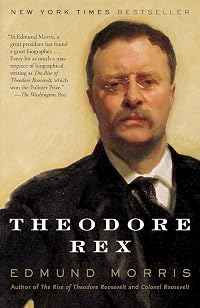
3571. Theodore Rex, by Edmund Morris (read 22 Apr 2002) Little did I know that when on June 16, 1979, I finished the prize-winning and excellent The Rise of Theodore Roosevelt I would have to wait till now to read volume 2 of the biography. But I felt this volume is maybe better than the first. The period from Sept 1901 to March 4, 1909, comes fully alive, and things one usually considers less than exciting (e.g., ending the Russo-Japanese War, sending the fleet around the world, etc.) are told in a way that arouses one's interest. This is a great work, and not nearly as heavy as the book looks, since over 170 pages are notes, with only 555 pages of text. A highlight of this month's reading indeed.
[When I finished this book I wondered show more how long I would have to wait to read the final volume--the answer: I read the third volume on 29 Nov 2010.] show less
[When I finished this book I wondered show more how long I would have to wait to read the final volume--the answer: I read the third volume on 29 Nov 2010.] show less
One of the things I love about studying history and it's greatest personas is the way I am reminded that many of the challenges we face in today's society/politics/etc are nothing new. They may take slightly different forms, but one thing is clear; even our greatest, most beloved leaders faced tremendous opposition.
This is my first book by Edmund Morris (I'm reading the set in reverse for some reason) and I really liked his approach. Rather than history being told like you were reading it from a text book, it's told like you're reading a real, in the moment story. Lots of descriptive words to draw a picture helping you envision the particular point in time that the scene is taking place. Lots of dialog. Another added feature is the show more over 50 pages of bibliographical references and sources, so you get a feeling this is a fairly accurate representation of the real story.
This book covers Roosevelt's time in the Presidency and starts with him racing down a snow covered mountain being rushed to Washington to assume the role of the Presidency after William McKinnley's death, and ends with him riding out of Washington D.C. after Taft is sworn in. It's a story full of a larger than life character who treated things like antitrust agreements and foreign policy with much the same gusto and vigor as he did hunting bear and chopping firewood at Sagamore Hill.
If you're a fan of history then this is a great book to check out. And if you're a fan of Roosevelt, this is a no brainer show less
This is my first book by Edmund Morris (I'm reading the set in reverse for some reason) and I really liked his approach. Rather than history being told like you were reading it from a text book, it's told like you're reading a real, in the moment story. Lots of descriptive words to draw a picture helping you envision the particular point in time that the scene is taking place. Lots of dialog. Another added feature is the show more over 50 pages of bibliographical references and sources, so you get a feeling this is a fairly accurate representation of the real story.
This book covers Roosevelt's time in the Presidency and starts with him racing down a snow covered mountain being rushed to Washington to assume the role of the Presidency after William McKinnley's death, and ends with him riding out of Washington D.C. after Taft is sworn in. It's a story full of a larger than life character who treated things like antitrust agreements and foreign policy with much the same gusto and vigor as he did hunting bear and chopping firewood at Sagamore Hill.
If you're a fan of history then this is a great book to check out. And if you're a fan of Roosevelt, this is a no brainer show less
To read the first in Edmund Morris' biographical series on Theodore Roosevelt ("The Rise of Theodore Roosevelt"), one might be left with the feeling that it was inevitable that Teddy someday become President. Individuals from his German tutor while he studied abroad to those who came into contact with him while he fought policy corruption in New York City, not to mention the men who served with him in the Spanish-American War.
With "Theodore Rex," though, we see a man who is thrust into the Presidency without the opportunity to prepare mentally, as others had through the fire and course of a national campaign.
And yet, after a first term as Governor of New York, it became apparent that those who controlled New York's political machine show more would not allow Roosevelt another reform minded term. His name bandied around as a candidate for Vice President, Roosevelt was flattered, but convinced that he would be useless, bored, and stagnate. To Roosevelt, a man who above all was in perpetual motion, becoming Vice-President would doom him to irrellivence and uselessness. Unlike today, when Dick Cheney and Joe Biden have exercised greater responsibility and power than any Vice President in memory, the Office of the Vice President at the turn of the 19th century wasn't "worth a bucket of spit," at least to Roosevelt. It took wounded pride to change his mind--hearing that Senator Mark Hanna and President William McKinley did not want him on the ticket, he let supporters know he that he would serve if the Convention selected him.
Little did he know how short his term as Vice President would be. In the ides of September, President McKinley was shot by an assassin and Theodore Roosevelt became the 26th President of the United States.
That's almost before the book even gets started.
Morris' writing is, as in the first book in the series, novel-like. Theodore strides through his world like a giant, negotiating peace between the Japanese and Russians, supporting the secession of Panama in order to obtain a shorter path for the Panama, building and sending the Great White Fleet, ending a miners strike involving a quarter of a million workers, appointing three Supreme Court Justices, including the great dissenter, Oliver Wendell Holmes, and hosting Booker T. Washington, the first time a black had been invited to dinner with a President at the White House.. Perhaps the only difference between this and the first book is that in feeling. Where the first tells was the life of an ambitious adventurer, "Theodore Rex" is the story of a man under constant scrutiny, on whom the stakes are significantly increased. At times I couldn't help but wonder if it was also the change in the type of documents that Morris is able to rely upon, utilizing more official and government documents than in "The Rise of Theodore Roosevelt."
Ultimately, "Theodore Rex" is a fascinating look at one of America's most ambitious, most popular, and most effective Presidents. Coming to power at at time when American power and wealth was growing and as yet unfathomed, Roosevelt took every advantage given to him to expand American power and influence. Morris' "Theodore Rex" is entertaining, education, and compelling, especially for a Presidential biography. show less
With "Theodore Rex," though, we see a man who is thrust into the Presidency without the opportunity to prepare mentally, as others had through the fire and course of a national campaign.
And yet, after a first term as Governor of New York, it became apparent that those who controlled New York's political machine show more would not allow Roosevelt another reform minded term. His name bandied around as a candidate for Vice President, Roosevelt was flattered, but convinced that he would be useless, bored, and stagnate. To Roosevelt, a man who above all was in perpetual motion, becoming Vice-President would doom him to irrellivence and uselessness. Unlike today, when Dick Cheney and Joe Biden have exercised greater responsibility and power than any Vice President in memory, the Office of the Vice President at the turn of the 19th century wasn't "worth a bucket of spit," at least to Roosevelt. It took wounded pride to change his mind--hearing that Senator Mark Hanna and President William McKinley did not want him on the ticket, he let supporters know he that he would serve if the Convention selected him.
Little did he know how short his term as Vice President would be. In the ides of September, President McKinley was shot by an assassin and Theodore Roosevelt became the 26th President of the United States.
That's almost before the book even gets started.
Morris' writing is, as in the first book in the series, novel-like. Theodore strides through his world like a giant, negotiating peace between the Japanese and Russians, supporting the secession of Panama in order to obtain a shorter path for the Panama, building and sending the Great White Fleet, ending a miners strike involving a quarter of a million workers, appointing three Supreme Court Justices, including the great dissenter, Oliver Wendell Holmes, and hosting Booker T. Washington, the first time a black had been invited to dinner with a President at the White House.. Perhaps the only difference between this and the first book is that in feeling. Where the first tells was the life of an ambitious adventurer, "Theodore Rex" is the story of a man under constant scrutiny, on whom the stakes are significantly increased. At times I couldn't help but wonder if it was also the change in the type of documents that Morris is able to rely upon, utilizing more official and government documents than in "The Rise of Theodore Roosevelt."
Ultimately, "Theodore Rex" is a fascinating look at one of America's most ambitious, most popular, and most effective Presidents. Coming to power at at time when American power and wealth was growing and as yet unfathomed, Roosevelt took every advantage given to him to expand American power and influence. Morris' "Theodore Rex" is entertaining, education, and compelling, especially for a Presidential biography. show less
Members
- Recently Added By
Lists

The Presidents
42 works; 2 members

The Art of Manliness' 100+ Books Every Man Should Read
108 works; 2 members

r/History Recommended Reading List
603 works; 12 members
Biographies of American Presidents
39 works; 4 members
Author Information

10+ Works 13,752 Members
Arthur Edmund Morris was born in Nairobi, Kenya on May 27, 1940. He studied literature, art, and music at Rhodes University in South Africa before leaving in 1961. He worked in the advertising department of a men's clothing store in South Africa and as an advertising copywriter in London before immigrating to the United States in 1968. He won the show more Pulitzer Prize and the National Book Award in 1980 for The Rise of Theodore Roosevelt. His other books included Theodore Rex, Beethoven: The Universal Composer, Colonel Roosevelt, and Edison. He was best known for Dutch: A Memoir of Ronald Reagan, where he inserted himself as a fictional narrator. He also wrote about travel and the arts for numerous publications including The New Yorker, The New York Times, and Harper's Magazine. He died after a stroke on May 24, 2019 at the age of 78. (Bowker Author Biography) Edmund Morris was born in Kenya and educated at Rhodes University, Grahamstown, South Africa. He immigrated to the United States in 1968. In 1985 he was appointed Ronald Reagan's authorized biographer. He lives in New York and Washington, D.C., with his wife and fellow biographer, Sylvia Jukes Morris. (Publisher Provided) show less
Some Editions
Awards and Honors
Awards
Distinctions
Notable Lists
Series

Belongs to Publisher Series
Work Relationships
Common Knowledge
- Canonical title
- Theodore Rex
- Alternate titles
- Theodore Rex
- Original publication date
- 2001
- People/Characters
- Theodore Roosevelt
- Important places
- Central America; New York, USA; New York, New York, USA; North America; Panama; Panama Canal, Panama (show all 8); USA; Washington, D.C., USA
- Important events
- Spanish-American War (1898)
- Dedication
- To my Mother and Father
- First words
- THE0D0RE ROOSEVELT became President of the United States without knowing it, at 2:15 in the morning of 14 September 1901.
- Quotations
- 'It is necessary patiently to wait,' Bunau-Varilla replied, 'until the spring of the imagination of the wicked is dried up, and until truth dissipates the mist of mendacity.'
- Last words
- (Click to show. Warning: May contain spoilers.)Uncounted men, women, and children who had crowded around the presidential caboose to stare and listen to him now carried, forever etched in memory, the image of his receding grin and wave.
- Original language
- English
Classifications
- Genres
- Biography & Memoir, History, General Nonfiction, Nonfiction
- DDC/MDS
- 973.911 — History & geography History of North America United States 1901- World Wars and Depression Era (1901-1953) Theodore Roosevelt (1901-1909) Panama Canal Construction, Pure Food and Drug Act
- LCC
- E757 .M885 — History of the United States United States Twentieth century Theodore Roosevelt's administrations,
- BISAC
Statistics
- Members
- 4,912
- Popularity
- 2,862
- Reviews
- 45
- Rating
- (4.18)
- Languages
- English
- Media
- Paper, Audiobook, Ebook
- ISBNs
- 20
- ASINs
- 18