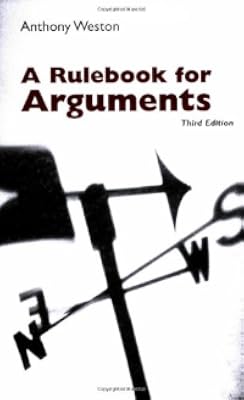
A Rulebook for Arguments
by Anthony Weston
On This Page
Description
"From academic writing to personal and public discourse, the need for good arguments and better ways of arguing is greater than ever before. This timely fifth edition of A Rulebook for Arguments sharpens an already-classic text, adding updated examples and a new chapter on public debates that provides rules for the etiquette and ethics of sound public dialogue as well as clear and sound thinking in general."--EBSCOhost.Tags
Recommendations



Member Reviews
I enjoyed it. Lots of ideas I have been previously exposed to, but all gathered under one roof with the hope of helping people reach an understanding. The table of contents serves as a good resource to review when making an important argument. Other points I liked include:
- You begin with an issue but not necessarily a position. Do not feel that you must immediately embrace some position and then try to shore it up with arguments. Likewise, even if you have a position, do not just dash off the first argument that occurs to you. You are not being asked for the first opinion that occurs to you. You are being asked to arrive at a well-informed opinion that you can defend with solid arguments.
- Encourage your readers to be critical, and show more commit yourself to being a critical reader for them in turn. If need be, you might even assign your readers a quota of specific criticisms and suggestions to make, so they don’t fear hurting your feelings by suggesting some.
- Try for a more open-minded approach—before you “come back” with your own views. Your job is not only to understand other debaters’ conclusions, but also to understand their premises, their reasons—to listen for their arguments. This means much more than passively waiting out someone’s statement of their views. You need to actively seek out their reasons, and understand why they find those reasons so compelling.
- Raise good arguments, then, as openly and thoughtfully as you can. Offer something positive. Hear the other side out, and respond and connect as best you can. But recognize that the debate will continue. Life is short, the debate is long. There are also many worthwhile and constructive things to do besides debate, both in and out of public discourse. At some point you will need to step away. Just leave them thinking when you go! show less
- You begin with an issue but not necessarily a position. Do not feel that you must immediately embrace some position and then try to shore it up with arguments. Likewise, even if you have a position, do not just dash off the first argument that occurs to you. You are not being asked for the first opinion that occurs to you. You are being asked to arrive at a well-informed opinion that you can defend with solid arguments.
- Encourage your readers to be critical, and show more commit yourself to being a critical reader for them in turn. If need be, you might even assign your readers a quota of specific criticisms and suggestions to make, so they don’t fear hurting your feelings by suggesting some.
- Try for a more open-minded approach—before you “come back” with your own views. Your job is not only to understand other debaters’ conclusions, but also to understand their premises, their reasons—to listen for their arguments. This means much more than passively waiting out someone’s statement of their views. You need to actively seek out their reasons, and understand why they find those reasons so compelling.
- Raise good arguments, then, as openly and thoughtfully as you can. Offer something positive. Hear the other side out, and respond and connect as best you can. But recognize that the debate will continue. Life is short, the debate is long. There are also many worthwhile and constructive things to do besides debate, both in and out of public discourse. At some point you will need to step away. Just leave them thinking when you go! show less
Concise and Precise
This concise introduction to critical thinking presents rules for clear thinking, valid communications, and creating and assessing persuasive arguments. Its 87 brief pages are readily accessible to high school students, and useful to anyone interested in offering correct evidence and valid reasons to support conclusions. When so much of what we read, hear, and see is intended to persuade us, or even mislead us, it is important to distinguish valid arguments from careless or manipulative ones.
If good writing is clear thinking made visible, then this book provides excellent advice for writers. As a rulebook, it begins by presenting 30 rules for clearly constructing a valid case supporting your conclusion. It then turns show more to applying these rules for writing argumentative essays. It also treats fallacies and includes an appendix on correct use of definitions. The author recognizes this book is only an introduction to these topics and provides a good list of further reading.
Fallacies are seductive and often go unnoticed and unchallenged. In this book, many fallacies are described alongside the rules they violate. A short chapter then names and briefly describes many types of fallacies. I would have liked to see this expanded. We have long recognized sexist and racist language and work to purge it from use. I look forward to a time when a broader set of fallacies will be routinely recognized and corrected in everyday conversation. Perhaps then it will be common to interrupt the speaker to say something like: "Excuse me, but you just used the fallacy of modus ponens by affirming the consequent. Please correct that logic error before proceeding." show less
This concise introduction to critical thinking presents rules for clear thinking, valid communications, and creating and assessing persuasive arguments. Its 87 brief pages are readily accessible to high school students, and useful to anyone interested in offering correct evidence and valid reasons to support conclusions. When so much of what we read, hear, and see is intended to persuade us, or even mislead us, it is important to distinguish valid arguments from careless or manipulative ones.
If good writing is clear thinking made visible, then this book provides excellent advice for writers. As a rulebook, it begins by presenting 30 rules for clearly constructing a valid case supporting your conclusion. It then turns show more to applying these rules for writing argumentative essays. It also treats fallacies and includes an appendix on correct use of definitions. The author recognizes this book is only an introduction to these topics and provides a good list of further reading.
Fallacies are seductive and often go unnoticed and unchallenged. In this book, many fallacies are described alongside the rules they violate. A short chapter then names and briefly describes many types of fallacies. I would have liked to see this expanded. We have long recognized sexist and racist language and work to purge it from use. I look forward to a time when a broader set of fallacies will be routinely recognized and corrected in everyday conversation. Perhaps then it will be common to interrupt the speaker to say something like: "Excuse me, but you just used the fallacy of modus ponens by affirming the consequent. Please correct that logic error before proceeding." show less
Anthony Weston created an indispensable handbook here. It's small, easy to carry, easy to read, and is incredibly useful as a resource to help one hone his or her skills in analyzing the logic of arguments. I strongly recommend keeping a copy of 'A Rulebook for Arguments' around and handy, it could be more frequently useful than one might imagine. Now, to be clear, Weston doesn't go much into giving a list of fallacies. Rather, he delves into structure of arguments and the ways to scrutinize their logic. It is a book of vital lessons in logic.
Anthony Weston encourages the use of representative examples and counterexamples, warns of the hazards of statistics (like I recently have), imparts the importance of impartial and reliable sources, explains the correlational relationship between cause and effect, presents deductive reasoning in the words of Sherlock Holmes, preaches the value of librarians, and can teach a thing or two to Badly Behaving Authors.
The Some Common Fallacies chapter is excellent. The examples I run into the most:
ad hominem
On the Big Benefits Row Live, Katie Hopkins (a vile woman) responded to Annabel Giles's well-reasoned argument with a personal insult instead of refuting the argument: "All I hear is somebody that wanted to be a model, but didn't make it." (Er, she was the face of Max Factor, I think she 'made it'.)
ad misericordiam
One word: X-Factor. The sob stories 'appealing to pity as an argument for special treatment.'
ad populum
"Everyone's doing it!" Sex (for teenagers). Brazilian waxes. iPhones. '...appealing to a person to go along with the crowd.'
As the author invites criticism, I have only one complaint: No forms of cognitive bias were included. Bias is explicitly mentioned once, during the introduction of section IV on Sources. I've tried to find a book that does include them and this was, in the end, the most likely candidate to cover this topic, so I'm a tad disappointed.
A Rulebook for Arguments really is what it says, a short and concise, but easy to understand, list of rules on how to construct a solid argument.
Recommended to everyone 12 , including authors of both fiction and non-fiction, for everything from a short and simple discussion to essays, oral presentations, and dissertations. show less
Criticisms and suggestions, as always, are welcome. ~ Page x, from the Prefaceshow more
Writers --at all levels--need feedback. It is through others' eyes that you can see best where you are unclear or hasty of just plain implausible. Feedback improves your logic too. Objections may come up that you hadn't expected. Premises you thought
were secure may turn out to need defending, while other premises may turn out to be more secure than they seemed. You may even pick up a dew new facts or examples. Feedback is a "reality check" all the way around --welcome it. ~ page 64, Rule 38
The Some Common Fallacies chapter is excellent. The examples I run into the most:
ad hominem
On the Big Benefits Row Live, Katie Hopkins (a vile woman) responded to Annabel Giles's well-reasoned argument with a personal insult instead of refuting the argument: "All I hear is somebody that wanted to be a model, but didn't make it." (Er, she was the face of Max Factor, I think she 'made it'.)
ad misericordiam
One word: X-Factor. The sob stories 'appealing to pity as an argument for special treatment.'
ad populum
"Everyone's doing it!" Sex (for teenagers). Brazilian waxes. iPhones. '...appealing to a person to go along with the crowd.'
As the author invites criticism, I have only one complaint: No forms of cognitive bias were included. Bias is explicitly mentioned once, during the introduction of section IV on Sources. I've tried to find a book that does include them and this was, in the end, the most likely candidate to cover this topic, so I'm a tad disappointed.
A Rulebook for Arguments really is what it says, a short and concise, but easy to understand, list of rules on how to construct a solid argument.
Recommended to everyone 12 , including authors of both fiction and non-fiction, for everything from a short and simple discussion to essays, oral presentations, and dissertations. show less
A Rulebook For Arguments by Anthony Weston is a veritable entry-level book for those seeking information on how to employ critical thinking.
The book is quite short, but the value of the information this book provides more than makes up for the size considering the quality of information.
For those seeking a practical rulebook on the applications of logic, argumentation, fallacies and more, this book gives an easy to follow but robust approach.
Given the breath of the information, page for page, this book is a high-value item, especially considering it also offers a synopsis on some of the more common fallacies employed by people.
Some additional of the elements discussed in the book are generalizations, sources, deductive arguments, oral show more arguments, argumentative essays, arguments by analogy, and more.
The other benefit is that this book can be read by people of all ages, and it will aid them immensely. From adults, to young children, this book would fine-tune anyone’s repertoire.
To finalize, as a book to keep in hand to quickly reference this book will be crucial given the latitude that it offers individuals willing to apply its rules. show less
The book is quite short, but the value of the information this book provides more than makes up for the size considering the quality of information.
For those seeking a practical rulebook on the applications of logic, argumentation, fallacies and more, this book gives an easy to follow but robust approach.
Given the breath of the information, page for page, this book is a high-value item, especially considering it also offers a synopsis on some of the more common fallacies employed by people.
Some additional of the elements discussed in the book are generalizations, sources, deductive arguments, oral show more arguments, argumentative essays, arguments by analogy, and more.
The other benefit is that this book can be read by people of all ages, and it will aid them immensely. From adults, to young children, this book would fine-tune anyone’s repertoire.
To finalize, as a book to keep in hand to quickly reference this book will be crucial given the latitude that it offers individuals willing to apply its rules. show less
A necessity for anyone writing a persuasive essay. It is clearly laid out, easy to follow and very informative. An excellent reference piece for all college students and very inexpensive. I was pleased to have this book after the class that required it was over. I still have 2 chapters left unread so I'll be rereading this for next semester most likely when I take another writing class.
Very concise and easy to understand reference when it comes to understanding and forming arguments.
Members
- Recently Added By
Lists

Wisdom
31 works; 5 members

STR's Recommended Reading List
34 works; 2 members
Recommendations by Stand To Reason
34 works; 1 member
Author Information

21 Works 2,522 Members
Anthony Weston is Professor of Philosophy and Environmental Studies at Elon University. He is the author of more than a dozen books, including Mobilizing the Green Imagination (2012) and A Practical Companion to Ethics, Fourth Edition (OUP, 2010).
Common Knowledge
- Canonical title
- A Rulebook for Arguments
- Original publication date
- 1987
- First words
- This book is a brief introduction to the art of writing and assessing arguments. (Preface)
Some people think that arguing is simply stating their prejudices in a new form. (Introduction)
[Note to the Fourth Edition] Logic doesn't change, but the times do.
Arguments begin by marshaling reasons and organizing them in a clear and fair way. - Last words
- (Click to show. Warning: May contain spoilers.)As with the abortion issue, we are well advised not to expect such questions to be settled by definition alone.
(Click to show. Warning: May contain spoilers.)[Preface] This book is one attempt to suggest how.
(Click to show. Warning: May contain spoilers.)[Note to the Fourth Edition] Criticisms and suggestions, as always, are welcome.
(Click to show. Warning: May contain spoilers.)[Introduction] Use them when you need them!
(Click to show. Warning: May contain spoilers.)I thank you for your attention, my friends, and naturally wish you all the greatest happiness yourselves! - Blurbers
- Feinberg, Joel; Nails, Debra; Cahill, Ann J.
- Canonical DDC/MDS
- 168
Classifications
Statistics
- Members
- 2,021
- Popularity
- 10,363
- Reviews
- 11
- Rating
- (3.86)
- Languages
- English, German, Portuguese, Spanish
- Media
- Paper, Ebook
- ISBNs
- 28
- ASINs
- 11