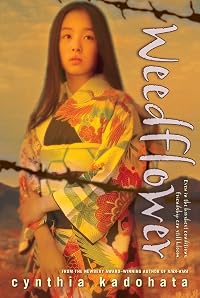
Weedflower
by Cynthia Kadohata
On This Page
Description
After twelve-year-old Sumiko and her Japanese-American family are relocated from their flower farm in southern California to an internment camp on a Mojave Indian reservation in Arizona, she helps her family and neighbors, becomes friends with a local Indian boy, and tries to hold on to her dream of owning a flower shop.Tags
Recommendations






Member Reviews
Twelve-year-old Sumiko feels her life has been made up of two parts: before Pearl Harbor and after it. The good part and the bad part. Raised on a flower farm in California, Sumiko is used to being the only Japanese girl in her class. Even when the other kids tease her, she always has had her flowers and family to go home to.
That all changes after the horrific events of Pearl Harbor. Other Americans start to suspect that all Japanese people are spies for the emperor, even if, like Sumiko, they were born in the United States! As suspicions grow, Sumiko and her family find themselves being shipped to an internment camp in one of the hottest deserts in the United States. The vivid color of her previous life is gone forever, and now dust show more storms regularly choke the sky and seep into every crack of the military barrack that is her new "home."
Sumiko soon discovers that the camp is on an Indian reservation and that the Japanese are as unwanted there as they'd been at home. But then she meets a young Mohave boy who might just become her first real friend...if he can ever stop being angry about the fact that the internment camp is on his tribe's land.
With searing insight and clarity, Newbery Medal-winning author Cynthia Kadohata explores an important and painful topic through the eyes of a young girl who yearns to belong. Weedflower is the story of the rewards and challenges of a friendship across the racial divide, as well as the based-on-real-life story of how the meeting of Japanese Americans and Native Americans changed the future of both. show less
That all changes after the horrific events of Pearl Harbor. Other Americans start to suspect that all Japanese people are spies for the emperor, even if, like Sumiko, they were born in the United States! As suspicions grow, Sumiko and her family find themselves being shipped to an internment camp in one of the hottest deserts in the United States. The vivid color of her previous life is gone forever, and now dust show more storms regularly choke the sky and seep into every crack of the military barrack that is her new "home."
Sumiko soon discovers that the camp is on an Indian reservation and that the Japanese are as unwanted there as they'd been at home. But then she meets a young Mohave boy who might just become her first real friend...if he can ever stop being angry about the fact that the internment camp is on his tribe's land.
With searing insight and clarity, Newbery Medal-winning author Cynthia Kadohata explores an important and painful topic through the eyes of a young girl who yearns to belong. Weedflower is the story of the rewards and challenges of a friendship across the racial divide, as well as the based-on-real-life story of how the meeting of Japanese Americans and Native Americans changed the future of both. show less
I hated for this book to end, and, in fact, the ending is the only place I would quibble with it.. I felt like it was kind of abrupt and a bit dissatisfying (sequel coming maybe?).
Other than that, it was another showcase for Kadohata's mastery as a storyteller and word weaver. Although the story is told in third person, we are IN Sumiko's head, and we see the world so poignantly and honestly, with her eyes.
Even the least consequential characters are clear and real, and Kadohata has managed to tackle one of the most difficult, shameful chapters in American history with brushstrokes of beauty and light. When they say writers should "show not tell," this is the perfect example. She avoids being preachy, or maudlin manipulation. Instead, show more she lets the telling detail reveal the truth. I think this should be required reading for all middle school American children. show less
Other than that, it was another showcase for Kadohata's mastery as a storyteller and word weaver. Although the story is told in third person, we are IN Sumiko's head, and we see the world so poignantly and honestly, with her eyes.
Even the least consequential characters are clear and real, and Kadohata has managed to tackle one of the most difficult, shameful chapters in American history with brushstrokes of beauty and light. When they say writers should "show not tell," this is the perfect example. She avoids being preachy, or maudlin manipulation. Instead, show more she lets the telling detail reveal the truth. I think this should be required reading for all middle school American children. show less
The story of Sumiko and her family, Japanese Americans interned during WWII. Covers the whole experience -- from rejection by her community to reluctance to leave when they are allowed to go, to the uncomfortable relationship between the Native tribes already on the reservation where the internment camp, Poston, was eastablished. Very thorough, very well researched, and Sumiko's often awkward navigation of friendships and family are compelling.
Personal Response:
I enjoyed the interaction between Sumiko and Frank and the parallels drawn between treatment of the Native American tribes and Japanese Americans in American history-a subject that is often glossed over. I appreciated that these character grew to be friends after learning about one another and how similar they really are, while respecting their unique knowledge and experiences.
I also liked Sumiko's battle against what her grandfather calls "the ultimate boredom" or the loss of a person's hopes and dreams to despair. Sumiko was on the brink of giving up on her dream of owning a flower shop one day, but a packet of seeds she rescued from her uncle's shed before coming to the camp helped motivate her to face each show more day.
Curricular Connections:
This book would be a great in a discussion of how prejudice can blind people and make them act in irrational ways toward one another. It would also be interesting to discuss how discrimination is visible today and connect the lessons of the story with modern times, rather than viewing this prejudice as an historical note. This book also connects very well with the events of 9/11 and how Arab-Americans were treated following the attack. show less
I enjoyed the interaction between Sumiko and Frank and the parallels drawn between treatment of the Native American tribes and Japanese Americans in American history-a subject that is often glossed over. I appreciated that these character grew to be friends after learning about one another and how similar they really are, while respecting their unique knowledge and experiences.
I also liked Sumiko's battle against what her grandfather calls "the ultimate boredom" or the loss of a person's hopes and dreams to despair. Sumiko was on the brink of giving up on her dream of owning a flower shop one day, but a packet of seeds she rescued from her uncle's shed before coming to the camp helped motivate her to face each show more day.
Curricular Connections:
This book would be a great in a discussion of how prejudice can blind people and make them act in irrational ways toward one another. It would also be interesting to discuss how discrimination is visible today and connect the lessons of the story with modern times, rather than viewing this prejudice as an historical note. This book also connects very well with the events of 9/11 and how Arab-Americans were treated following the attack. show less
Twelve year old Sumiko and her Japanese-American family are relocated to an internment camp. This forces them to give up the flower growing business that is an integral part of who they are. Prior to Pearl Harbor and war breaking out, the section where Sumiko is uninvited to the birthday party by the mother (pg. 34 - 37) is heart breaking and would be a great hook for many readers. It feels incredibly real in its cruelty.
I absolutely loved this book, and I think it is because the ending was completely different than the beginning. It was as if the whole story was evolving and rotating without the reader really taking notice, and I loved that. The main message of the story is, no matter what happens you will always have those that will mean the most to you. Sumiko truly gained a friendship from the war that she wasn't even expecting to have gained. I also liked how the author painted the war with flowers. She took a negative concept of history, and covered it with something beautiful and positive. There was so much beauty in this book that I could not put it down at all.
Twelve-year-old Sumiko feels her life has been made up of two parts: before Pearl Harbor and after it. The good part and the bad part. Raised on a flower farm in California, Sumiko is used to being the only Japanese girl in her class. Even when the other kids tease her, she always has had her flowers and family to go home to. That all changes after the horrific events of Pearl Harbor. Other Americans start to suspect that all Japanese people are spies for the emperor, even if, like Sumiko, they were born in the United States! As suspicions grow, Sumiko and her family find themselves being shipped to an internment camp in one of the hottest deserts in the United States.
Members
- Recently Added By
Published Reviews
Starred Review. Grade 5-8–When Pearl Harbor is attacked, the lives of a Japanese-American girl and her family are thrown into chaos. Sumiko, 12, and her younger brother, Tak-Tak, live with their aunt and uncle, grandfather Jiichan, and adult cousins on a flower farm in Southern California. Though often busy with chores, Sumiko enjoys working with the blossoms, particularly stock, or show more weedflowers (fragrant plants grown in a field). In the difficult days that follow the bombing, the family members fear for their safety and destroy many of their belongings. Then Uncle and Jiichan are taken to a prison camp, and the others are eventually sent to an assembly center at a racetrack, where they live in a horse stable. When they're moved to the Arizona desert, Sumiko misses the routine of her old life and struggles with despair. New friends help; she grows a garden with her neighbor and develops a tender relationship with a Mohave boy. She learns from him that the camp is on land taken from the Mohave reservation and finds that the tribe's plight parallels that of the incarcerated Japanese Americans. Kadohata brings into play some complex issues, but they realistically dovetail with Sumiko's growth from child to young woman. She is a sympathetic heroine, surrounded by well-crafted, fascinating people. The concise yet lyrical prose conveys her story in a compelling narrative that will resonate with a wide audience.–Marilyn Taniguchi, Beverly Hills Public Library, CA show less
added by cvosshans
Kadohata combines impressive research and a lucent touch, bringing to life the confusion of dislocation....
added by cvosshans
"Kadohata clearly and eloquently conveys her heroine's mixture of shame, anger and courage. Readers will be inspired...."
added by cvosshans
Lists

Must-Read Books About the Southwest
98 works; 2 members

Newbery Adjacent
747 works; 3 members
Author Information

15+ Works 7,774 Members
Cynthia Kadohata was born on July 2, 1956. She is a Japanese American author of children's books. Kadohata won the Newbery Medal in 2005 for her title, Kira-Kira. She also won a PEN award in 2006 for Weedflower and in 2013 she won the U.S. National Book Award for The Thing About Luck. Kadohata was born in Chicago, Illinois, and was a high school show more drop out. She attained a BA in Journalism from the University of Southern California and went on to attend graduate programs at the University of Pittsburgh and Columbia University. (Bowker Author Biography) show less
Awards and Honors
Awards
Distinctions
Notable Lists
Common Knowledge
- Original publication date
- 2006
- People/Characters
- Sumiko; Jiichan; Uncle; Auntie; Ichiro; Bull (show all 9); Frank "Huula" Butler; Mr. Moto; Sachi
- Important places
- Arizona, USA; California, USA; Poston, Arizona, USA
- Important events
- World War II (1939 | 1945); World War II, Pacific Theater (1941-12-07 | 1945-09-02); Attack on Pearl Harbor (1941-12-07); Japanese-American Internment (1942 | 1945)
- Dedication
- For my father
- First words
- This is what it felt like to be lonely:
- Last words
- (Click to show. Warning: May contain spoilers.)5. Like maybe you might own a flower shop...someday.
Classifications
- Genres
- Fiction and Literature, Kids, Tween
- DDC/MDS
- 813.54 — Literature & rhetoric American literature in English American fiction in English 1900-1999 1945-1999
- LCC
- PZ7 .K1166 .W — Language and Literature Fiction and juvenile belles lettres Fiction and juvenile belles lettres Juvenile belles lettres
- BISAC
Statistics
- Members
- 1,035
- Popularity
- 25,130
- Reviews
- 45
- Rating
- (3.98)
- Languages
- English
- Media
- Paper, Audiobook, Ebook
- ISBNs
- 15
- ASINs
- 3