On This Page
Description
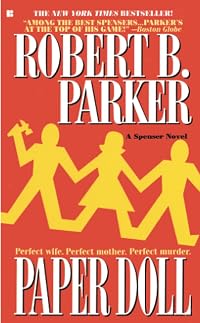
Hired by an aggrieved Boston aristocrat who believes his wife's brutal slaying to be something other than random violence, Spenser immediately senses that his client's picture-perfect portrayal of his family life is false. For starters, the victim's reputation is too saintly, her house is as lived-in as stage set, and her troubled children don't appear to be products of a happy home. Spenser plungers into a world of grand illusion, peopled with cardboard cutouts, including a distinguished show more public servant with plenty to hide, a wealthy executive whose checks bounce, a sleepy Southern town seething with scandal, and a victim who may or may not be really dead. show lessTags
Recommendations





Member Reviews
“Quirk flashed his badge, and put it away. It could have said Baker Street Irregulars on it, for all the clerk had a chance to read it.”
Falling where this does within the Spenser canon, two books down the road from Pastime — where you could sense an undercurrent of Parker’s regret at changing the focus of the series to Spenser’s relationship with the perpetually annoying and snobbish Susan Silverman, rather than the mystery and plotting — Paper Doll is shockingly good. It is also shocking in that here, we get a backhand acknowledgement that something has gone askew. What is more, Parker does something about it, as though openly — if alas, only briefly — revolting against himself.
It’s been quite some time since I’d show more tackled this one, and found it marvelous. Though Spenser’s cloying interactions with the vain Susan Silverman are scattered throughout the narrative, they are lower-key than usual, and feel less intrusive. In fact, she doesn’t even appear until around chapter ten, because Parker has remembered what the Spenser series once was, and decided to write an homage — to himself. How do we know it was deliberate, and that Parker was revolting? Within the narrative of looking into the death of Loudon Tripp’s wife, Spenser finds they had been leading separate lives, while still living together. It bothers Spenser that the Tripps had separate bedrooms, for example. He is telling Silverman how something about the couple’s relationship feels all wrong. And then we get this gem of unadulterated irony —
SPENSER: “They’re perfect. She was perfect. His love was all-encompassing. His devotion is unflagging.”
SUSAN: “And there’s a legal limit to the snow here.”
SPENSER: “Yeah.”
Wow. Freud, heal thyself. It’s as if Parker is telling readers — no, he’s screaming at his readers — “I know, already!” And at least briefly, it creates a watershed moment, and a return to the kind of plotting and mystery we hadn’t seen in a long time in this series, so devoted was it to the snow job Parker had laid on with a scoop shovel. Parker acknowledged it, then he did something about it, and gave us Paper Doll.
While Paper Doll isn’t perfect, with elements of the case solving themselves, rather than being solved by good detective work, it’s still excellent compared to what the series had become. And while something is unresolved at the end of Paper Doll — another failing of later entries in the Spenser canon — this time it’s intentional, and as morally ambiguous as Spenser’s solution to April Kyle’s problem in Ceremony.
Loudon Tripp wants to know why his perfect wife was killed. With limited resources and high profile pressure because of who Tripp is, the seemingly random attack, is written off as just that. But Tripp doesn’t buy it, and Quirk sends him Spenser’s way, knowing no one can be more annoying than Spenser in his pursuit of the truth. And Spenser gets annoying real fast. Loudon’s teenage kids are brats, and everything Spenser discovers contradicts the glowing image of the important couple in Boston society. When he decides to go at it from the other end, looking into Olivia’s background, in case someone may have wanted to do her harm, things get suddenly ugly, and Spenser finds himself locked up and threatened.
Enter Martin Quirk, in what might be his finest moment of the entire series. Why Spenser and Hawk place Quirk in the same stratosphere of potential violence as themselves becomes all too clear. Though it’s only a flash, what had only been implied about Quirk within the series is shown here. Though the violence is left to Spenser, it’s clear that Quirk is just as formidable as Spenser, Hawk, and Vinnie, just as had been suggested time and again in earlier books. It’s Quirk’s moment to shine, and probably his most memorable appearance in the long-running series.
There is a lot going on here, plot-wise, from powerful political forces, to decades-old infidelities, and a husband in complete denial. And there turns out to be even more in this tough, violent and well-plotted entry more reminiscent of earlier books than post Valediction entries. Gay cop Lee Farrell is introduced in this one, Quirk having him liaison with Spenser. Again, in a return to earlier Spenser books, there is depth here, rather than preachy espousals. Farrell’s lover is dying of AIDS, and it affects his ability to focus. Parker handles it in a low-key way, even when Spenser and Susan attend the funeral, adding quiet poignancy to Farrell’s pain, rather than using flippant monologue to make it about how liberally cool Spenser and Susan were. Again, a return to the old Spenser books.
Rich and satisfying, with an almost out-of-the-blue revelation we should have seen coming due to someone’s odd behavior, and an ending as unresolved as we as readers guiltily hoped it might be, this is — almost — a return to greatness for this series. There are still some excellent ones to come in this series, though they were scattered among the weeds. But here, Parker seems to tackle the problems — both in the case, and with fans who were growing weary of the series — head-on. The result is a Spenser entry like we hadn’t gotten in a very long time. Sharp, crisp, moving and sometimes violent, this is a great read, and highly recommended. show less
Falling where this does within the Spenser canon, two books down the road from Pastime — where you could sense an undercurrent of Parker’s regret at changing the focus of the series to Spenser’s relationship with the perpetually annoying and snobbish Susan Silverman, rather than the mystery and plotting — Paper Doll is shockingly good. It is also shocking in that here, we get a backhand acknowledgement that something has gone askew. What is more, Parker does something about it, as though openly — if alas, only briefly — revolting against himself.
It’s been quite some time since I’d show more tackled this one, and found it marvelous. Though Spenser’s cloying interactions with the vain Susan Silverman are scattered throughout the narrative, they are lower-key than usual, and feel less intrusive. In fact, she doesn’t even appear until around chapter ten, because Parker has remembered what the Spenser series once was, and decided to write an homage — to himself. How do we know it was deliberate, and that Parker was revolting? Within the narrative of looking into the death of Loudon Tripp’s wife, Spenser finds they had been leading separate lives, while still living together. It bothers Spenser that the Tripps had separate bedrooms, for example. He is telling Silverman how something about the couple’s relationship feels all wrong. And then we get this gem of unadulterated irony —
SPENSER: “They’re perfect. She was perfect. His love was all-encompassing. His devotion is unflagging.”
SUSAN: “And there’s a legal limit to the snow here.”
SPENSER: “Yeah.”
Wow. Freud, heal thyself. It’s as if Parker is telling readers — no, he’s screaming at his readers — “I know, already!” And at least briefly, it creates a watershed moment, and a return to the kind of plotting and mystery we hadn’t seen in a long time in this series, so devoted was it to the snow job Parker had laid on with a scoop shovel. Parker acknowledged it, then he did something about it, and gave us Paper Doll.
While Paper Doll isn’t perfect, with elements of the case solving themselves, rather than being solved by good detective work, it’s still excellent compared to what the series had become. And while something is unresolved at the end of Paper Doll — another failing of later entries in the Spenser canon — this time it’s intentional, and as morally ambiguous as Spenser’s solution to April Kyle’s problem in Ceremony.
Loudon Tripp wants to know why his perfect wife was killed. With limited resources and high profile pressure because of who Tripp is, the seemingly random attack, is written off as just that. But Tripp doesn’t buy it, and Quirk sends him Spenser’s way, knowing no one can be more annoying than Spenser in his pursuit of the truth. And Spenser gets annoying real fast. Loudon’s teenage kids are brats, and everything Spenser discovers contradicts the glowing image of the important couple in Boston society. When he decides to go at it from the other end, looking into Olivia’s background, in case someone may have wanted to do her harm, things get suddenly ugly, and Spenser finds himself locked up and threatened.
Enter Martin Quirk, in what might be his finest moment of the entire series. Why Spenser and Hawk place Quirk in the same stratosphere of potential violence as themselves becomes all too clear. Though it’s only a flash, what had only been implied about Quirk within the series is shown here. Though the violence is left to Spenser, it’s clear that Quirk is just as formidable as Spenser, Hawk, and Vinnie, just as had been suggested time and again in earlier books. It’s Quirk’s moment to shine, and probably his most memorable appearance in the long-running series.
There is a lot going on here, plot-wise, from powerful political forces, to decades-old infidelities, and a husband in complete denial. And there turns out to be even more in this tough, violent and well-plotted entry more reminiscent of earlier books than post Valediction entries. Gay cop Lee Farrell is introduced in this one, Quirk having him liaison with Spenser. Again, in a return to earlier Spenser books, there is depth here, rather than preachy espousals. Farrell’s lover is dying of AIDS, and it affects his ability to focus. Parker handles it in a low-key way, even when Spenser and Susan attend the funeral, adding quiet poignancy to Farrell’s pain, rather than using flippant monologue to make it about how liberally cool Spenser and Susan were. Again, a return to the old Spenser books.
Rich and satisfying, with an almost out-of-the-blue revelation we should have seen coming due to someone’s odd behavior, and an ending as unresolved as we as readers guiltily hoped it might be, this is — almost — a return to greatness for this series. There are still some excellent ones to come in this series, though they were scattered among the weeds. But here, Parker seems to tackle the problems — both in the case, and with fans who were growing weary of the series — head-on. The result is a Spenser entry like we hadn’t gotten in a very long time. Sharp, crisp, moving and sometimes violent, this is a great read, and highly recommended. show less
Parker had never shied away from the social commentary (via actions and murders mainly) in his novels and this novel is not an exception. If anything, he decided to throw more than the usual - from gay policemen and AIDS to racism and the attitudes of a small town deep in the South.
4 months ago Olivia was killed - apparently without a reason. Her husband is not ready to accept the lack of explanation so he hires Spenser. So our favorite detective starts investigating - and ends up being in real trouble in South Carolina. Which is not exactly surprising. Parker decided to leave Hawk out from the action (he shows up for a second but stays strictly on the periphery) and it made sense - it is the Boston police that is the partner here - show more both the known faces and a new detective that everyone seems to have issues with (for being gay mainly).
By the end, Spenser has to make one of those decisions that define a person - is truth the most important thing or does human dignity still matter. Somewhere in the heart of the deep South, where the people that know the answers are always invisible albeit always being there, an old mystery becomes the answer to the new one.
I wish Parker had also decided to cut the scenes with Susan - the novel would not have lost anything if they are not there. Where she is usually insightful and helps with random remarks or by simply being there, here she is just there...
At the end I really enjoyed the novel - both the main story and the sideline story exploring the attitudes in the police (both in Boston and in the South). I am not sure how that sounded when it was written and how up-to-date it was but it works - and adds another layer to Spenser.
I am not sure if that works as a standalone - the mystery will work but a lot of the things that are said and done can be misread without the back story. show less
4 months ago Olivia was killed - apparently without a reason. Her husband is not ready to accept the lack of explanation so he hires Spenser. So our favorite detective starts investigating - and ends up being in real trouble in South Carolina. Which is not exactly surprising. Parker decided to leave Hawk out from the action (he shows up for a second but stays strictly on the periphery) and it made sense - it is the Boston police that is the partner here - show more both the known faces and a new detective that everyone seems to have issues with (for being gay mainly).
By the end, Spenser has to make one of those decisions that define a person - is truth the most important thing or does human dignity still matter. Somewhere in the heart of the deep South, where the people that know the answers are always invisible albeit always being there, an old mystery becomes the answer to the new one.
I wish Parker had also decided to cut the scenes with Susan - the novel would not have lost anything if they are not there. Where she is usually insightful and helps with random remarks or by simply being there, here she is just there...
At the end I really enjoyed the novel - both the main story and the sideline story exploring the attitudes in the police (both in Boston and in the South). I am not sure how that sounded when it was written and how up-to-date it was but it works - and adds another layer to Spenser.
I am not sure if that works as a standalone - the mystery will work but a lot of the things that are said and done can be misread without the back story. show less
Good fun little P.I. book. I loved the ridiculous one-liners, the silly slang and banter. The outrageous police and security brutality and the dirty playing. It was all so funny and enthralling. This held my attention. I'm sad #20 something is the first book in this series I'm trying out. I didn't feel like NOT having read the first books in the series held me back at all.
His relationship with his girlfriend was interesting too. I like that, although he seemed to objectify every other woman in the book, he did seem to really respect and love her and listen to her when she talked.
His relationship with his girlfriend was interesting too. I like that, although he seemed to objectify every other woman in the book, he did seem to really respect and love her and listen to her when she talked.
A model wife and mother is beaten to death using a framing hammer and the police have concluded that she was selected at random by an unknown assailant. The husband is not satisfied and hires Spenser to investigate further. Spenser hardly knows where to begin; there are no suspects and the police were unable to uncover any motive for the crime.
I’ve faithfully followed Parker’s series featuring ‘Jesse Stone’ and ‘Cole and Hitch’, but only occasionally picked up a copy of his Spenser series. Paper Doll is one of his earliest entries in the Spenser series but it is easy to see why this and Parker’s other series have been so successful. Parker has the ability to capture the reader’s interest from the very beginning and show more maintain it throughout. A slow reader, I nevertheless read this book in little more than a single day.
Parker’s is adept at drawing clear, interesting word pictures of people and places using an accessible style. He intersperses an occasional chapter focusing on Spenser’s love interest to provide context to Spenser’s life. These short chapters do not slow the movement of the plot and sometimes even offer a snippet that advances Spenser’s investigation. The use of short chapters make it easy to keep reading, even when you have to do “something else” in a couple of minutes, because as a reader you are never more than 3-4 pages from a convenient stopping place.
My only complaint with Paper Doll concerns the unsatisfying conclusion. Spenser’s final decision is understandable only if you decide that some people’s lives are not as important as those of others. Spenser’s resolution of the ethical dilemma he faced is based on a flawed concept of morality.
Despite that sour note, Paper Doll is entertaining and fun to read and the ethical issues raised by the ending would be great fodder for a book club discussion. show less
I’ve faithfully followed Parker’s series featuring ‘Jesse Stone’ and ‘Cole and Hitch’, but only occasionally picked up a copy of his Spenser series. Paper Doll is one of his earliest entries in the Spenser series but it is easy to see why this and Parker’s other series have been so successful. Parker has the ability to capture the reader’s interest from the very beginning and show more maintain it throughout. A slow reader, I nevertheless read this book in little more than a single day.
Parker’s is adept at drawing clear, interesting word pictures of people and places using an accessible style. He intersperses an occasional chapter focusing on Spenser’s love interest to provide context to Spenser’s life. These short chapters do not slow the movement of the plot and sometimes even offer a snippet that advances Spenser’s investigation. The use of short chapters make it easy to keep reading, even when you have to do “something else” in a couple of minutes, because as a reader you are never more than 3-4 pages from a convenient stopping place.
My only complaint with Paper Doll concerns the unsatisfying conclusion. Spenser’s final decision is understandable only if you decide that some people’s lives are not as important as those of others. Spenser’s resolution of the ethical dilemma he faced is based on a flawed concept of morality.
Despite that sour note, Paper Doll is entertaining and fun to read and the ethical issues raised by the ending would be great fodder for a book club discussion. show less
It's hard to say what makes me so happy about this series. But whenever I spend time with Spencer, I wind up really enjoying it. The dialogue is just magnificent. Yes, the storylines are not the most complex and there is an air of unreality about the whole thing...
But, each Spencer novel serves as a bit of a bit of a repreive. I know the world doesn't work the way it does in these novels. People aren't this principled and good doesn't win most of the time. But, when I've finished with something dense and dark, I often need a reminder that good exists and can win. Spenser is about the best there is for that.
Paper Doll was perhaps not as complex as some of his other stories. But, I did find the human emotions around the several families show more destroyed in the story very real. It also stands as a simplistic, but truthful, look at how people hide from the truth and recreate themselves out of trauma.
It's not going to change your life, but it might make you smile and find a bit of hope. It did for me... show less
But, each Spencer novel serves as a bit of a bit of a repreive. I know the world doesn't work the way it does in these novels. People aren't this principled and good doesn't win most of the time. But, when I've finished with something dense and dark, I often need a reminder that good exists and can win. Spenser is about the best there is for that.
Paper Doll was perhaps not as complex as some of his other stories. But, I did find the human emotions around the several families show more destroyed in the story very real. It also stands as a simplistic, but truthful, look at how people hide from the truth and recreate themselves out of trauma.
It's not going to change your life, but it might make you smile and find a bit of hope. It did for me... show less
Paper Doll, first published in 1993, is the twentieth of Robert B. Parker’s novels featuring Spenser, the one-named Boston based detective, and several of his usual friends, lover (singular), and other allies.
A Boston Brahmin hires Spenser to find the killer of his ostensibly perfect wife, who appears to have been viciously murdered with a large framing hammer (i.e., one with a long handle for driving nails with only two taps). The police can identify no one with a trace of a motive, and so the case is classified as random urban violence. Nevertheless, Martin Quirk, head of Boston homicide, is uneasy about the case and agrees to cooperate with Spenser’s independent investigation.
Unlike many Spenser novels, this one is a genuine show more mystery in which the identity of the killer is not revealed until the very end. In fact, the identity of the victim turns out to be a surprise to her own family about half way through the book. Unlike many detective novels, the police here are quite competent, if somewhat constrained by budgetary considerations, and are instrumental in bringing a bad guy to justice and saving Spenser’s bacon, even if they don’t quite solve the original crime. Indeed, Lt. Quirk turns out to be just about as tough as Spenser, and Detective Lee Farrell is at least as thorough in his investigating.
As in any Spenser novel, there are numerous snappy one-liners and delightful similes:
"I am trustworthy, loyal, and helpful. But I struggle with obedient."
"How old were you when you dropped out of charm school?"
“…a receptionist with the efficiency of a Russian farm collective.”
Parker also engages in some social commentary. Detective Lee Farrell is portrayed sympathetically: he is not only competent; he is also gay, with a lover suffering from AIDS—remember, this was 1993. Moreover, Farrell is somewhat slovenly, while his macho boss, Quirk, is neurotically well-dressed and neat.
This book measures up to others in the series, which is to say that it is pretty entertaining.
(JAB) show less
A Boston Brahmin hires Spenser to find the killer of his ostensibly perfect wife, who appears to have been viciously murdered with a large framing hammer (i.e., one with a long handle for driving nails with only two taps). The police can identify no one with a trace of a motive, and so the case is classified as random urban violence. Nevertheless, Martin Quirk, head of Boston homicide, is uneasy about the case and agrees to cooperate with Spenser’s independent investigation.
Unlike many Spenser novels, this one is a genuine show more mystery in which the identity of the killer is not revealed until the very end. In fact, the identity of the victim turns out to be a surprise to her own family about half way through the book. Unlike many detective novels, the police here are quite competent, if somewhat constrained by budgetary considerations, and are instrumental in bringing a bad guy to justice and saving Spenser’s bacon, even if they don’t quite solve the original crime. Indeed, Lt. Quirk turns out to be just about as tough as Spenser, and Detective Lee Farrell is at least as thorough in his investigating.
As in any Spenser novel, there are numerous snappy one-liners and delightful similes:
"I am trustworthy, loyal, and helpful. But I struggle with obedient."
"How old were you when you dropped out of charm school?"
“…a receptionist with the efficiency of a Russian farm collective.”
Parker also engages in some social commentary. Detective Lee Farrell is portrayed sympathetically: he is not only competent; he is also gay, with a lover suffering from AIDS—remember, this was 1993. Moreover, Farrell is somewhat slovenly, while his macho boss, Quirk, is neurotically well-dressed and neat.
This book measures up to others in the series, which is to say that it is pretty entertaining.
(JAB) show less
In one of my English classes we just learned about the word "camp" -- and not the tent in the woods kind of "camp". I'm sure at one point this book was ... cutting-edge? At this point, this book is pure, wonderful camp. It was fantastic : ) And it wasn't fantastic just because it was camp.
I loved that things were not clearly spelled out. A lot of the "plot" was developed through dialogue. There was very little full paragraphs of "plot development". Again, it was fantastic. I really enjoy excellent dialogue in a novel!
I can't decide if I want to keep this novel for future re-reading or donate it some where. It was so fantastic in it's "campiness" that I think it would be a fun re-read at a (much?) later date!! I just might have to keep show more it.
Adrianne show less
I loved that things were not clearly spelled out. A lot of the "plot" was developed through dialogue. There was very little full paragraphs of "plot development". Again, it was fantastic. I really enjoy excellent dialogue in a novel!
I can't decide if I want to keep this novel for future re-reading or donate it some where. It was so fantastic in it's "campiness" that I think it would be a fun re-read at a (much?) later date!! I just might have to keep show more it.
Adrianne show less
Members
- Recently Added By
Author Information

126+ Works 72,849 Members
Robert Brown Parker is an American fiction writer of mysteries. He was born in Springfield, Massachusetts and earned his BA degree from Colby College in Waterville, Maine. He went on to earn his master's degree in English literature from Boston University. He started his career working in advertising. After some years, he went back to school to show more earn his PhD in English from Boston University in 1971. He then began his writng career while teaching at Northeastern University. He decided to become a full-time writer in 1979. His most popular works were the 40 novels written about the private detective Spenser. The ABC Television Network developed the television series "Spenser: For Hire", based on the character in the mid-1980s. Parker also wrote nine novels based on the character Jesse Stone and six novels based on the character Sunny Randall. On January 18, 2010, Robert Parker died suddenly of a heart attack at his home in Cambridge Massachusetts. (Bowker Author Biography) show less
Awards and Honors
Distinctions
Series

Work Relationships
Common Knowledge
- Canonical title
- Paper Doll
- Original publication date
- 1993
- People/Characters
- Spenser; Susan Silverman; Martin Quirk
- Important places
- Boston, Massachusetts, USA
- Dedication
- For Joan: Music all around me.
- First words
- London Tripp, wearing a seersucker suit and a Harvard tie. sat in my office on a very nice day in September and told me he'd looked into my background and might hire me.
- Last words
- (Click to show. Warning: May contain spoilers.)"I think I'll let them lie."
Classifications
Statistics
- Members
- 1,167
- Popularity
- 21,608
- Reviews
- 17
- Rating
- (3.65)
- Languages
- Czech, English, German, Swedish
- Media
- Paper, Audiobook, Ebook
- ISBNs
- 27
- ASINs
- 9