Small Things Considered: Why There Is No Perfect Design
by Henry Petroski
On This Page
Description
Why has the durable paper shopping bag been largely replaced by its flimsy plastic counterpart? What circuitous chain of improvements led to such innovations as the automobile cup holder and the swiveling vegetable peeler? With the same relentless curiosity and lucid, witty prose he brought to his earlier books, Henry Petroski looks at some of our most familiar objects and reveals that they are, in fact, works in progress. For there can never be an end to the quest for the perfect design. To show more illustrate his thesis, Petroski tells the story of the paper drinking cup, which owes its popularity to the discovery that water glasses could carry germs. He pays tribute to the little plastic tripod that keeps pizza from sticking to the box and analyzes the numerical layouts of telephones and handheld calculators. Small Things Considered is Petroski at his most trenchant and provocative, casting his eye not only on everyday artifacts but on their users as well. show lessTags
Recommendations






























Member Reviews
Every time I read a Henry Petroski book I never see the world the same way again. If you find the natural world exciting and enjoy reading about the wonders of our planet, you should try reading Henry’s books. He does the same for those unimportant items (pencils, paper cups and door knobs) lying around your home or office as the nature writers do for eagles, flowers and mountains. Henry can make you see the beauty and drama in a toothbrush! Just as studying nature gives us a glimpse into the mind of God, studying engineering and design gives us a glimpse into the mind of man…
A very light and fun design book for designers in just about any discipline. The historical accounts he gives of the smallest objects such as the the paper cup to the grocery bag illuminates the beauty of design.
I usually read "deeper" design books but this is a refreshing read because it concentrates on design in its simplest form--away from the digital and mechanical. Every chapter essentially tells a story of the evolution of different products. Though, I did disagree with some of his assessments of "what" design is. For instance, one chapter he explains the act of eating out with a group at a restaurant as being a design choice. I completely disagree as this has more to do with simple decision-making more appropriately described by show more anthropology, sociology and psychology. This particular chapter I felt could have been omitted altogether. Otherwise a very entertaining read. show less
I usually read "deeper" design books but this is a refreshing read because it concentrates on design in its simplest form--away from the digital and mechanical. Every chapter essentially tells a story of the evolution of different products. Though, I did disagree with some of his assessments of "what" design is. For instance, one chapter he explains the act of eating out with a group at a restaurant as being a design choice. I completely disagree as this has more to do with simple decision-making more appropriately described by show more anthropology, sociology and psychology. This particular chapter I felt could have been omitted altogether. Otherwise a very entertaining read. show less
Bleah. I'm not a student of design, but still I am familiar with almost every example discussed. And the constraints he harps on are obvious; for example of course a toothbrush isn't one size fits all, but yet it wouldn't be practical to sell them in sizes, either.
I did not know that, at least in some rewired houses, "all upper receptacles are controlled by the room's light switch, so that lamps plugged into them can all be turned on with the single flick.... lower receptacles are hot-wired...." Maybe this will help me understand some hotel rooms that I've been in, at least.
And I do want to try to use cloves instead of garlic in spaghetti sauce once, because he erred that way when young and his guests liked it. (An acorn-size scoopful show more seems like too much, though!)
So, 1.5 stars rounded up. show less
I did not know that, at least in some rewired houses, "all upper receptacles are controlled by the room's light switch, so that lamps plugged into them can all be turned on with the single flick.... lower receptacles are hot-wired...." Maybe this will help me understand some hotel rooms that I've been in, at least.
And I do want to try to use cloves instead of garlic in spaghetti sauce once, because he erred that way when young and his guests liked it. (An acorn-size scoopful show more seems like too much, though!)
So, 1.5 stars rounded up. show less
Great book on everyday design history of conmon things. Fun to read for anyone.
Ratings
Members
- Recently Added By
Author Information

24+ Works 9,737 Members
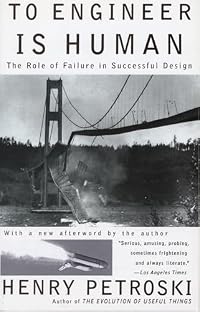
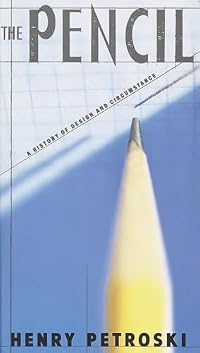
Henry Petroski is an American engineer with wide-ranging historical and sociocultural interests. He earned a Ph.D. in theoretical and applied mechanics from the University of Illinois at Urbana-Champaign in 1968, and became Aleksandar S. Vesic professor and chair of the Department of Civil and Environmental Engineering at Duke University. Petroski show more teaches traditional engineering subjects, as well as courses for nonengineering students, that place the field in a broad social context. One of the major themes that transcends his technical and nontechnical publications is the role of failure and its contribution to successful design. This is the central theme in his study To Engineer Is Human: The Role of Failure in Successful Design, which is accessible to both engineers and general readers. This theme is also incorporated into Petroski's The Pencil: A History of Design and Circumstance (1990), which relates the history of the pencil to broader sociocultural themes. The theme is expanded further, illustrating the relationship of engineering to our everyday life in The Evolution of Useful Things (1992). Petroski's most recent book, Design Paradigms: Case Histories of Error and Judgment in Engineering, is planned for publication in 1994. After that, he will begin a study of the complex interrelationships between engineering and culture. Widely recognized and supported by both the technical and humanities communities, Petroski's work has effectively conveyed the richness and essence of engineering in its societal context for the general reader. (Bowker Author Biography) show less
Common Knowledge
- Original publication date
- 2003
Classifications
- Genres
- Nonfiction, Art & Design, General Nonfiction, Science & Nature, Technology, History
- DDC/MDS
- 620.0042 — Technology Engineering Engineering and allied operations General Engineering Special Topics Design
- LCC
- TA174 .P4738 — Technology Engineering Civil engineering (General). Engineering (General). Civil engineering (General) Engineering design
- BISAC
Statistics
- Members
- 471
- Popularity
- 64,232
- Reviews
- 4
- Rating
- (3.31)
- Languages
- Chinese, English
- Media
- Paper, Ebook
- ISBNs
- 5
- ASINs
- 2