On This Page
Description
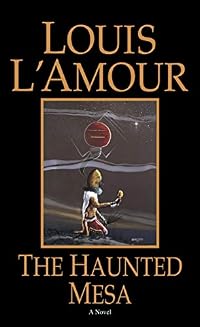
Fiction. Western. Thriller. Historical Fiction. The Navajo called them the Anasazi, the "ancient enemy," and their abandoned cities haunt the canyons and plateaus of the Southwest. For centuries the sudden disappearance of these people baffled historians. Summoned to a dark desert plateau by a desperate letter from an old friend, renowned investigator Mike Raglan is drawn into a world of mystery, violence, and explosive revelations. Crossing a border beyond the laws of man and nature, he show more will learn of the astonishing world of the Anasazi and discover the most extraordinary frontier ever encountered. show lessTags
Recommendations























Member Reviews
As a new fan of western literature (and media in general) I was so, so excited to start reading Louis L'Amour. So all fools me I accidentally chose the singular NON Western book. And one of his Lost Treasures too.
As a result, this review may be entirely unfair. I'm rating what may be an unfinished book, script or just a stitched together collection of notes.
I did not like this book one bit.
I never Enjoy being harsh on books but this one took effort to avoid a DNF.
Every other page, if not every other page, has an obnoxious amount of MC questions. 'What do they mean by evil?' 'What is Eric doing?'. Not just are these questions repeated, but actual lines. Within one page I saw the exact same dialogue repeated in very minutely different show more ways.
It got exhausting. I genuinely found myself rolling my eyes.
There are a ridiculous amount of contradictions. Mike saying he didn't have any friends on one page yet another he gets many letters from friends. A man approaching and saying he is not a man of many words, and yet has 3 pages of dialogue.
And then the convenient plot advancements... Such as when a lady who was taken by guards appears immediately after being mentioned for the first time. Then doesn't explain why she's there. How she escaped or why.
The main character escapes the main climax after being knocked out and his friends explain his dog came through and saved him. After at least 50 pages of figuring how to resolve said conflict.
Plots are left unresolved. Like Kawasis village. Or the archivist.
My main gripe though is how flat the characters felt. For the first 200 pages Mike does nothing but go to and from the mesa, repeating over and over things that the readers know. Mike himself is skilled at most everything, and so there were no stakes. I knew he was going to get through everything! He never faced any conflict himself. No difficulty. He acted like he knew more about the people in the Third Dimension than they did themselves. And this wasnt contested. There was no explanation as to how he felt.
His reuniting with Erik (the main plot might I add) was lackluster. Neither seemed particularly glad to meet each other again and though Erik was starving, Mike did nothing to help this. He even goes on ahead.
Dialogue is stilted and every character has the same voice. There is zero emotion- just action. And even then, 200 pages of debating?
I struggled. I really did. I really really really wanted to like this book. I finished it even so I could give it a fair shot. If you want to read Louis L'Amour. Please don't read this one. Find one of his westerns. Which I'm about to do now. show less
As a result, this review may be entirely unfair. I'm rating what may be an unfinished book, script or just a stitched together collection of notes.
I did not like this book one bit.
I never Enjoy being harsh on books but this one took effort to avoid a DNF.
Every other page, if not every other page, has an obnoxious amount of MC questions. 'What do they mean by evil?' 'What is Eric doing?'. Not just are these questions repeated, but actual lines. Within one page I saw the exact same dialogue repeated in very minutely different show more ways.
It got exhausting. I genuinely found myself rolling my eyes.
There are a ridiculous amount of contradictions. Mike saying he didn't have any friends on one page yet another he gets many letters from friends. A man approaching and saying he is not a man of many words, and yet has 3 pages of dialogue.
And then the convenient plot advancements... Such as when a lady who was taken by guards appears immediately after being mentioned for the first time. Then doesn't explain why she's there. How she escaped or why.
The main character escapes the main climax after being knocked out and his friends explain his dog came through and saved him. After at least 50 pages of figuring how to resolve said conflict.
Plots are left unresolved. Like Kawasis village. Or the archivist.
My main gripe though is how flat the characters felt. For the first 200 pages Mike does nothing but go to and from the mesa, repeating over and over things that the readers know. Mike himself is skilled at most everything, and so there were no stakes. I knew he was going to get through everything! He never faced any conflict himself. No difficulty. He acted like he knew more about the people in the Third Dimension than they did themselves. And this wasnt contested. There was no explanation as to how he felt.
His reuniting with Erik (the main plot might I add) was lackluster. Neither seemed particularly glad to meet each other again and though Erik was starving, Mike did nothing to help this. He even goes on ahead.
Dialogue is stilted and every character has the same voice. There is zero emotion- just action. And even then, 200 pages of debating?
I struggled. I really did. I really really really wanted to like this book. I finished it even so I could give it a fair shot. If you want to read Louis L'Amour. Please don't read this one. Find one of his westerns. Which I'm about to do now. show less
Not his best. The story is very repetitive, as the main character (Mike Raglan) dithers and dithers and wonders and wonders about what he should do, and whether there is another world, and if so what is it like. Never mind that he has a young woman RIGHT THERE who comes from the other side and who could tell him a great deal about it, and show him the way if he ever thought to ask her. The premise was interesting, but not the execution.
There is maybe a novella worth of story buried under the re-repetitive speculation and re-retelling of Anasazi lore, and all of a short story's worth of character. But even then it isn't much of a story and no development of character and all sorts of bits and pieces which would have been interesting if they had been put to good use are stuck on like straw on dung. A mess.
Explaining what happened to the Anasazi is an interesting concept and adding the fantastical elements made it more interesting still. Unfortunately the book itself wasn’t very interesting. It started out mysterious and kind of spooky but then it settled into a rut. Mike Raglan goes to save a friend from some unknown danger and he has to think about it a lot. He repeats the few facts that he has over and over, along with all his fears and reservations and all the unanswerable questions he has. Everything is repeated so many times and in almost the exact same words until I felt I was stuck in a loop. I think L’Amour wanted to make a point that Mike was just an ordinary man who got scared like the rest of us but did what had to be done show more anyway. So I understand why L’Amour would have Mike voice his fears and insecurities. Introspection is fine but it just went on too long. There was no new information or new insights and it started to get monotonous. It did pick up in the last 100 pages or so when all of that thinking finally led Mike to a decision and then some actual action. The concept was good and the characters were fine but I think if 100 pages of Mike’s repetitive thoughts were cut out it would have been a better book. show less
Louis L'Amour is famous for his Westerns. However, he wrote quite a few books that were definatly NOT westerns. This is one that is not a western. It sounds like one and even takes place in the SW US.
This is the one forray of his that I read that bordered on the supernatural. I think it would be more closly fit into Sci-Fi either way it is a step outside of his more common writing.
Basically there seems to a hole in the fabric of space/time that opens and closes in relation to certain astrological events. This hole opens up into another world simililar in make up to ours and has a very different people. They seem to know about us but we are clueless about them. I put this on a short list for excellent Louis L'Amour fiction.
This is the one forray of his that I read that bordered on the supernatural. I think it would be more closly fit into Sci-Fi either way it is a step outside of his more common writing.
Basically there seems to a hole in the fabric of space/time that opens and closes in relation to certain astrological events. This hole opens up into another world simililar in make up to ours and has a very different people. They seem to know about us but we are clueless about them. I put this on a short list for excellent Louis L'Amour fiction.
This is the only book in the science fiction genre that Louis L'amour ever wrote... so far as I am aware. It deals with the Anasazi and provides one answer to the burning question among many as to where they went. Basic to the story is that there are methods of getting from one universe or world to another that do not necessarily require any kind of artifact. Jim Butcher calls them "ways", Stephen King calls them "thinnies". I generally call them "wormholes". The idea is also referenced by Lovecraft, Burroughs and likely others I am unaware of. By whatever they are called, they are a sort of portal to another world. Do they exist? I dunno. I am not really a big fan of the Western genre, though I have generally liked Louis L'Amour's show more work. This one perhaps has a few rough spots, which I can forgive. Louis L'Amour was getting on in years by 1987, and in fact, he died the very next year. During his life, he did much more than I am ever likely to do. This is my favorite Louis L'Amour novel. If you like Jim Butcher's stuff or Stephen King's, you will like this one. show less
I've read this book about three times since the 80's... I like the parallel dimension twist on the Anasazi disappearance, and the way L'Amour tied in some of the archaeological theory then prevalent.
The story bogged down quite a bit in the middle, and I felt the main character, Mike Raglan, was a little disorganized and too introspective. For someone with so much experience in researching strange and unexplained events, he spent a lot of time running back and forth between the mesa and town.
Still, the book is a good read.
The story bogged down quite a bit in the middle, and I felt the main character, Mike Raglan, was a little disorganized and too introspective. For someone with so much experience in researching strange and unexplained events, he spent a lot of time running back and forth between the mesa and town.
Still, the book is a good read.
Members
- Recently Added By
Lists

Best Westerns
20 works; 6 members
Author Information

870+ Works 99,414 Members
Born in Jamestown, North Dakota on March 22, 1908, Louis L'Amour's adventurous life could have been the subject of one of his novels. Striking out on his own in 1923, at age 15, L'Amour began a peripatetic existence, taking whatever jobs were available, from skinning dead cattle to being a sailor. L'Amour knew early in life that he wanted to be a show more writer, and the experiences of those years serve as background for some of his later fiction. During the 1930s he published short stories and poetry; his career was interrupted by army service in World War II. After the war, L'Amour began writing for western pulp magazines and wrote several books in the Hopalong Cassidy series using the pseudonym Tex Burns. His first novel, Westward the Tide (1950), serves as an example of L'Amour's frontier fiction, for it is an action-packed adventure story containing the themes and motifs that he uses throughout his career. His fascination with history and his belief in the inevitability of manifest destiny are clear. Also present and typical of L'Amour's work are the strong, capable, beautiful heroine who is immediately attracted to the equally capable hero; a clear moral split between good and evil; reflections on the Native Americans, whose land and ways of life are being disrupted; and a happy ending. Although his work is somewhat less violent than that of other western writers, L'Amour's novels all contain their fair share of action, usually in the form of gunfights or fistfights. L'Amour's major contribution to the western genre is his attempt to create, in 40 or more books, the stories of three families whose histories intertwine as the generations advance across the American frontier. The novels of the Irish Chantry, English Sackett, and French Talon families are L'Amour's most ambitious project, and sadly were left unfinished at his death. Although L'Amour did not complete all of the novels, enough of the series exists to demonstrate his vision. L'Amour's strongest attribute is his ability to tell a compelling story; readers do not mind if the story is similar to one they have read before, for in the telling, L'Amour adds enough small twists of plot and detail to make it worth the reader's while. L'Amour fans also enjoy the bits of information he includes about everything from wilderness survival skills to finding the right person to marry. These lessons give readers the sense that they are getting their money's worth, that there is more to a L'Amour novel than sheer escapism. With over 200 million copies of his books in print worldwide, L'Amour must be counted as one of the most influential writers of westerns in this century. He died from lung cancer on June 10, 1988. (Bowker Author Biography) Louis L'Amour, truly America's favorite storyteller, was the first fiction writer ever to receive the Congressional Gold Medal from the United States Congress in honor of his life's work, & was also awarded the Medal of Freedom. There are over 260 million copies of his books in print worldwide. (Publisher Provided) show less
Awards and Honors
Distinctions
Series

Work Relationships
Common Knowledge
- Canonical title
- The Haunted Mesa
- Original title
- The Haunted Mesa
- Original publication date
- 1987-05
- People/Characters
- Mike Raglan; Kawasi; Erik Hokart; Gallagher; Melisande; Tazzoc (show all 18); Zepecna; Poison Women; Johnny; Saqua, the Hairy Ones; The Hand; The Varanel; Eden Foster; Volkmeer; Artemus Weston; Zipacna; Hunahpu; Camha
- Important places
- Haunted Mesa, Utah, USA.; Arizona, USA; The Other Side, 3rd World, North of The San Juan River, Utah, USA.; Utah, USA; Tamarron, Colorado, USA.; Shibalba, The Other Side, Utah, USA.
- Dedication
- To Gilbert and Charlotte Wenger
To Gilbert and Charlotte Wagner - First words
- It was night, and he was alone upon the desert.
- Last words
- (Click to show. Warning: May contain spoilers.)"I could," he said, "but who'd believe it?"
- Original language*
- Amerikanisch
*Some information comes from Common Knowledge in other languages. Click "Edit" for more information.
Classifications
Statistics
- Members
- 1,597
- Popularity
- 14,135
- Reviews
- 26
- Rating
- (3.62)
- Languages
- 5 — Danish, English, French, German, Swedish
- Media
- Paper, Ebook
- ISBNs
- 21
- UPCs
- 1
- ASINs
- 18