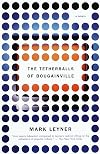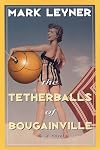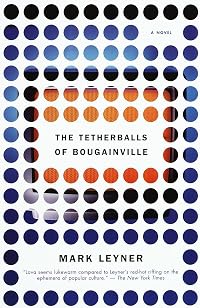
The Tetherballs of Bougainville
by Mark Leyner
On This Page
Description
From his cult classic, I Smell Esther Williams, to his wildly popular and insightful column "Wild Kingdom" appearing in Esquire magazine every month, Mark Leyner has been giving us up close and personal encounters of the most hilarious kind for over a decade. Now, in his new novel The Tetherballs of Bougainville, Leyner shares with us, long last, the quintessential coming of age story that every writer, at some point, is compelled to tell. In the novel we meet young Mark Leyner, show more 13-years-old to be exact, as he waits in a New Jersey prison to witness his father's execution. Adolescence is never easy, and it just so happens that this junior high schooler is on deadline to turn in a screenplay for which he has already been awarded the Vincent and Lenore DiGiacomo/Oshimitsu Polymers America Award. And, as it was for all of us during out teenage years, nothing seems to go as planned. Written as autobiography, screenplay and movie review, The Tetherballs of Bougainville twists three familiar narrative forms into an outlandishly compelling story. Leyner's use of the media-driven formats brilliantly reflects our secret, shameful and hilarious desire to experience our private lives as mass entertainment. The Tetherballs of Bougainville skewers and celebrates American pop culture in the late twentieth century. Leyner's version of our lives is so deeply funny because it is so painfully true. show lessTags
Recommendations












Member Reviews
When I first read The Crying of Lot 49 I thought: well at least an author has found a way to dazzle us with language enough that we don't immediately figure out we're dealing with a cry for attention (a lot). Of course then you read Portnoys Complaint and The Tetherballs of Bougainville and you realize this is common practice. Most of the time there is something to be had in such novels that makes the reading worth while. In Lot 49 there is an interesting plot and in Portnoy we learn much more about mother-son and other family relationships. In Tetherballs we get absolutely nothing but the raw cry for attention by an author. Before we've figured this out we've gone through countless litanies of objects, people, places, situations, and show more anything else you can list or recite.
It's supposed to be funny, and it is for the first fifteen pages or so, but then the constant use of 'clever' metaphors, interlinked symbols, inappropriately yet sophisticated sexual remarks and blatantly in-your-face physicality eventually wears you out. There is a somewhat detectable plot line somewhere and it does seem to involve some of the main characters but it doesn't really matter much. It's not about them, it's about the author. Of course the author himself is clever enough to understand we eventually figure that out. He therefore included a review about his own book/plot in which he explains how self-gratifying his own writing is. Clever, but it doesn't fix much. By then the damage is done.
How does it all work? What I mean by that is, what's the literary device employed here that makes us read this text without wanting to yell at the author? There seems to be a basic rule in public speaking and entertainment that if you want to say something important that people remember, then you have to say it in all seriousness. If on the other hand if you want to say something important and have people pay attention, then you need to say it with humor. In fact if you say anything funny you can make people overlook any offensive content or direct insults you wish to hide. Most stand-up comedians are living proof of this principle. Even though a lot of the content in Tetherballs isn't actually funny, it sounds funny, or we know it should be funny. That keeps our emotional brain busy enough to not see the forest through the trees.
Essentially Mark Leyner is writing about himself. He's writing about all his frustrations, desires, needs and urges. For Leyner it is not enough to weave his own needs into an intricate story with many vivid characters that each evolve and come to grips with the maddening world around them. No, Leyer quite literally screams at us through his words. I find it difficult to label any book or novel offensive because you can always decline to read it. I also find it difficult to call a novel manipulative, because we all know they are and we all willingly participate. So I wouldn't call Tetherballs offensive or manipulative because I willingly read it and I never fell for the surface text. I will call the novel sad though. show less
It's supposed to be funny, and it is for the first fifteen pages or so, but then the constant use of 'clever' metaphors, interlinked symbols, inappropriately yet sophisticated sexual remarks and blatantly in-your-face physicality eventually wears you out. There is a somewhat detectable plot line somewhere and it does seem to involve some of the main characters but it doesn't really matter much. It's not about them, it's about the author. Of course the author himself is clever enough to understand we eventually figure that out. He therefore included a review about his own book/plot in which he explains how self-gratifying his own writing is. Clever, but it doesn't fix much. By then the damage is done.
How does it all work? What I mean by that is, what's the literary device employed here that makes us read this text without wanting to yell at the author? There seems to be a basic rule in public speaking and entertainment that if you want to say something important that people remember, then you have to say it in all seriousness. If on the other hand if you want to say something important and have people pay attention, then you need to say it with humor. In fact if you say anything funny you can make people overlook any offensive content or direct insults you wish to hide. Most stand-up comedians are living proof of this principle. Even though a lot of the content in Tetherballs isn't actually funny, it sounds funny, or we know it should be funny. That keeps our emotional brain busy enough to not see the forest through the trees.
Essentially Mark Leyner is writing about himself. He's writing about all his frustrations, desires, needs and urges. For Leyner it is not enough to weave his own needs into an intricate story with many vivid characters that each evolve and come to grips with the maddening world around them. No, Leyer quite literally screams at us through his words. I find it difficult to label any book or novel offensive because you can always decline to read it. I also find it difficult to call a novel manipulative, because we all know they are and we all willingly participate. So I wouldn't call Tetherballs offensive or manipulative because I willingly read it and I never fell for the surface text. I will call the novel sad though. show less
The thing about early Leyner books is that you can never relax for a second; Joyce and Faulkner are the only two authors I can think of whose books are more intrinsically challenging than this, Leyner's second full-length narrative. Even calling it a narrative understates the complexity of the second half, ostensibly a written review of a non-existent movie that the character, Mark Leyner, must write by some time the next day.
Leyner is just so insanely smart and intellectually funny; he not only posits a island despot building the Petronas towers as, instead, naked lovers, but then creates the New York Times reaction to it and discusses which sections would be featured in German style magazines, all in one throw-away paragraph.
When show more combined with double-backs, curlicues, and recursive prose, it creates the effect of looking into an actual madhouse of creativity. If it's this intense to read, how crazy must it have been to write?
What Leyner hadn't quite gotten a hold of, in these earlier novels, is the need for emotional resonance to make things both more engrossing and less exhausting. Page for page, I can't imagine you'd ever find a more dense hyper-meta-fictional achievement. Also, I'm not sure you'd want to. show less
Leyner is just so insanely smart and intellectually funny; he not only posits a island despot building the Petronas towers as, instead, naked lovers, but then creates the New York Times reaction to it and discusses which sections would be featured in German style magazines, all in one throw-away paragraph.
When show more combined with double-backs, curlicues, and recursive prose, it creates the effect of looking into an actual madhouse of creativity. If it's this intense to read, how crazy must it have been to write?
What Leyner hadn't quite gotten a hold of, in these earlier novels, is the need for emotional resonance to make things both more engrossing and less exhausting. Page for page, I can't imagine you'd ever find a more dense hyper-meta-fictional achievement. Also, I'm not sure you'd want to. show less
I'm pleased to say I understand all of these other, negative reviews, but I still loved this book. I had to stop reading it on the train because I looked like a laughing-until-tearing-up lunatic. You will know after the 5 pages of preface what you're in for. What I don't understand is if the book is so terrible, why read it? If you take a bite out of a rotten apple and get a worm do you keep eating, hoping it's going to get better? "A crow doesn't suddenly start to sing like a canary" as one of Voinovich's characters said in The Fur Hat.
Well could be fancy and say its a post modernist novel with a form that counters the tyranny of the outdated narrative and naturalist tradition. Its plot: son at father's failed execution; father enrolled in the State's lotto prisoner execution programme, son writes a screenplay is merely a rack for lots of streams of conciousness/montage pieces.
I love books that break with conventions but when they engage me and not being just fun for the writer. I loved 253 or The Saddlebag for example. This is supposed to be his most novel like book but it reads like he lacks the discipline to write for the reader. Or at least not the sober drug free reader...it must be a profound read if stoned
I love books that break with conventions but when they engage me and not being just fun for the writer. I loved 253 or The Saddlebag for example. This is supposed to be his most novel like book but it reads like he lacks the discipline to write for the reader. Or at least not the sober drug free reader...it must be a profound read if stoned
This was a horrible book!!! I am hard pressed to not find *something* to like in the books I read, but each page of this "book" was excruciatingly painful to read. Leyner is trying so hard to be witty, outrageous, and funny - but all that came out was "verbal diarrhea", if you will.
This book had rave reviews on the back - but I think the reviewers were on crack. His attempts at humor, satire, or "social criticism" failed miserably. Luckily, the book was a fairly quick read, so I only wasted a few hours on this horrid writing.
This book had rave reviews on the back - but I think the reviewers were on crack. His attempts at humor, satire, or "social criticism" failed miserably. Luckily, the book was a fairly quick read, so I only wasted a few hours on this horrid writing.
Read Et Tu, Babe instead.
It had a few cute ideas. But it got really annoying and stupid. I didn't finish it.
Members
- Recently Added By
Author Information

15+ Works 4,479 Members
Common Knowledge
- Canonical title
- The Tetherballs of Bougainville
- Original publication date
- 1997
Classifications
Statistics
- Members
- 325
- Popularity
- 97,912
- Reviews
- 7
- Rating
- (3.27)
- Languages
- English, French
- Media
- Paper, Ebook
- ISBNs
- 4
- ASINs
- 1