
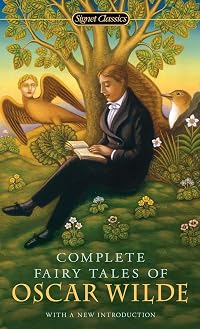
The Complete Fairy Tales of Oscar Wilde
by Oscar Wilde 
On This Page
Description
Published here alongside their evocative original illustrations, these fairy tales, as Oscar Wilde himself explained, were written 'partly for children, and partly for those who have kept the childlike faculties of wonder and joy.'Tags
Recommendations











Member Reviews
I'll admit up front that I've never read anything by Oscar Wilde before now, and I think that I'm sorry that I've waited this long. I thoroughly enjoyed his fairy tales, and even found myself underlining multiple passages in the book for future reference. I felt that his insight into life and love and all the joy and troubles that come with both was quite remarkable and still very relevant for our time, even though these stories were written over 100 years ago. I'm sure that if I were more versed in fairy tales and folklore as a whole I might see more relations between his stories and those that came before, but taking these for what they are I enjoyed them immensely. The particular volume that I have contains both of Wilde's show more collections, The Happy Prince and Other Tales and A House of Pomegranates, in one volume, and I while I enjoyed all the stories, I found that I did enjoy the stories that were from The Happy Prince and Other Tales slightly more.
The stories contained in The Happy Prince and Other Tales are 'The Happy Prince', 'The Nightingale and the Rose' (my favorite), 'The Selfish Giant', 'The Devoted Friend' (probable my next favorite), and 'The Remarkable Rocket'. A House of Pomegranates contains 'The Young King', 'The Birthday of the Infanta', 'The Fisherman and His Soul' (a unique reworking of 'The Little Mermaid'), and 'The Star-Child' (another unique reworking of 'Beauty and the Beast').
The stories can easily be enjoyed just as much by adults as by children, and I think that adults as a whole may actually get more out the stories than children. The tales deal broadly with love and individualism and being true to your self even when others may look down on you. The views of love are both in and out of favor of it, and my favorite passage from the book deals with Love and how it can lead one astray: 'What a silly thing Love is. It is not half as useful as Logic, for it does not prove anything, and it is always telling one of things that are not going to happen, and making one believe things that are not true. In fact, it is quite impractical...' Like I said, the insights that Wilde has on love and life are quite remarkable and I found them very relevant for my life right now. I would highly recommend this book to anyone. show less
The stories contained in The Happy Prince and Other Tales are 'The Happy Prince', 'The Nightingale and the Rose' (my favorite), 'The Selfish Giant', 'The Devoted Friend' (probable my next favorite), and 'The Remarkable Rocket'. A House of Pomegranates contains 'The Young King', 'The Birthday of the Infanta', 'The Fisherman and His Soul' (a unique reworking of 'The Little Mermaid'), and 'The Star-Child' (another unique reworking of 'Beauty and the Beast').
The stories can easily be enjoyed just as much by adults as by children, and I think that adults as a whole may actually get more out the stories than children. The tales deal broadly with love and individualism and being true to your self even when others may look down on you. The views of love are both in and out of favor of it, and my favorite passage from the book deals with Love and how it can lead one astray: 'What a silly thing Love is. It is not half as useful as Logic, for it does not prove anything, and it is always telling one of things that are not going to happen, and making one believe things that are not true. In fact, it is quite impractical...' Like I said, the insights that Wilde has on love and life are quite remarkable and I found them very relevant for my life right now. I would highly recommend this book to anyone. show less
In a Nutshell: A compilation of two of Wilde’s three published short story anthologies. Garnished with illustrations by French illustrator Phillippe Jullian, and an afterword by Wilde's son Vyvyan Holland.
Oscar Wilde is one of my favourite writers, so it goes without saying that I have read almost all of his works. He had published three anthologies in this lifetime. Of these, the stories from ‘The Happy Prince and Other Stories’ (1888) and ‘A House of Pomegranates’ (1891) are included in this special 70th anniversary gift edition.
As modern readers, we assume ‘fairy stories’ to be stories with fairies such as Tinker Bell or Cinderella’s Fairy Godmother. However, the traditional meaning of the term defines a fairy story show more as any traditional story written for children and usually involving imaginary creatures or magic. Wilde make use of his Irish heritage to imbue his stories with a strong sense of lore and an underlying foundation of religious or moral ethics. But there are no actual fairies in his tales, and if you are a newbie to his works, it is better to keep this in mind.
Some of my favourite stories by Wilde are part of the ‘The Happy Prince’ collection. So I was glad to reread ‘The Happy Prince’, ‘The Nightingale and the Rose’, ‘The Selfish Giant’, and ‘The Devoted Friend’ yet again. The fifth story of this anthology – ‘The Remarkable Rocket’ – isn’t a big favourite of mine, but it still has enough to recommend it.
‘A House of Pomegranates’, however, isn’t among my beloved Wilde works. Of the four stories therein, I count only ‘The Birthday of the Infanta’ as a good story. Two of the other three (‘The Young King’ and ‘The Fisherman and His Soul’) are decent but have too many subtracks that serve mainly to showcase Wilde’s descriptive writing. The last story, ‘The Star-Child’, is wonderful except for the ending.
All of the above are stories I have read many times over the years, but I still enjoyed my reread of them through this book. Of the nine stories in the book, four are strong favourites of mine (5 stars each), and two are good enough (3.5-4 stars.)
That said, I am an attuned classics reader, so I know what to expect from Wilde’s works. Some of the content might seem dated to modern eyes, and some of the content is quite religious, which might take secular readers by surprise. I’ll just say, every classic work must be evaluated keeping in mind the writer’s personal beliefs and the societal standards in THAT era, and not by your 21st century perspective.
As these stories are all in the public domain, you do need to have something more in this book to recommend it. There are two things specific to this edition:
Recommended to classic fiction lovers.
3.75 stars, based on the average of my ratings for all the stories.
My thanks to Duckworth Books and NetGalley for the DRC of “The Complete Fairy Stories of Oscar Wilde”. This review is voluntary and contains my honest opinion about the book.
———————————————
Connect with me through:
My Blog | The StoryGraph | Facebook | Twitter show less
Oscar Wilde is one of my favourite writers, so it goes without saying that I have read almost all of his works. He had published three anthologies in this lifetime. Of these, the stories from ‘The Happy Prince and Other Stories’ (1888) and ‘A House of Pomegranates’ (1891) are included in this special 70th anniversary gift edition.
As modern readers, we assume ‘fairy stories’ to be stories with fairies such as Tinker Bell or Cinderella’s Fairy Godmother. However, the traditional meaning of the term defines a fairy story show more as any traditional story written for children and usually involving imaginary creatures or magic. Wilde make use of his Irish heritage to imbue his stories with a strong sense of lore and an underlying foundation of religious or moral ethics. But there are no actual fairies in his tales, and if you are a newbie to his works, it is better to keep this in mind.
Some of my favourite stories by Wilde are part of the ‘The Happy Prince’ collection. So I was glad to reread ‘The Happy Prince’, ‘The Nightingale and the Rose’, ‘The Selfish Giant’, and ‘The Devoted Friend’ yet again. The fifth story of this anthology – ‘The Remarkable Rocket’ – isn’t a big favourite of mine, but it still has enough to recommend it.
‘A House of Pomegranates’, however, isn’t among my beloved Wilde works. Of the four stories therein, I count only ‘The Birthday of the Infanta’ as a good story. Two of the other three (‘The Young King’ and ‘The Fisherman and His Soul’) are decent but have too many subtracks that serve mainly to showcase Wilde’s descriptive writing. The last story, ‘The Star-Child’, is wonderful except for the ending.
All of the above are stories I have read many times over the years, but I still enjoyed my reread of them through this book. Of the nine stories in the book, four are strong favourites of mine (5 stars each), and two are good enough (3.5-4 stars.)
That said, I am an attuned classics reader, so I know what to expect from Wilde’s works. Some of the content might seem dated to modern eyes, and some of the content is quite religious, which might take secular readers by surprise. I’ll just say, every classic work must be evaluated keeping in mind the writer’s personal beliefs and the societal standards in THAT era, and not by your 21st century perspective.
As these stories are all in the public domain, you do need to have something more in this book to recommend it. There are two things specific to this edition:
1. A critical note penned by Oscar Wilde’s son, Vyvyan Holland: This isn’t too lengthy but it offers a nice background to the stories and to Wilde’s belief system.
2. The illustrations by “celebrated twentieth-century artist and aesthete Phillippe Jullian”: I admit, the illustrations were the main reason for my requesting a collection that I had already read every single story of. But the sketches proved to be disappointing. I didn’t find any of them adding value to the story. They look more like children’s scribbles than like something sketched by a popular artist. They might have worked better with colour, or his artistic style might just be an acquired taste, but in the current form, not a single illustration was memorable to me.
Recommended to classic fiction lovers.
3.75 stars, based on the average of my ratings for all the stories.
My thanks to Duckworth Books and NetGalley for the DRC of “The Complete Fairy Stories of Oscar Wilde”. This review is voluntary and contains my honest opinion about the book.
———————————————
Connect with me through:
My Blog | The StoryGraph | Facebook | Twitter show less
In a Nutshell: A compilation of two of Wilde’s three published short story anthologies. Garnished with illustrations by French illustrator Phillippe Jullian, and an afterword by Wilde's son Vyvyan Holland.
Oscar Wilde is one of my favourite writers, so it goes without saying that I have read almost all of his works. He had published three anthologies in this lifetime. Of these, the stories from ‘[b:The Happy Prince and Other Stories|6315424|The Happy Prince and Other Stories|Oscar Wilde|https://i.gr-assets.com/images/S/compressed.photo.goodreads.com/books/1461778186l/6315424._SX50_.jpg|23684401]’ (1888) and ‘[b:A House of Pomegranates|2298136|A House of Pomegranates|Oscar show more Wilde|https://i.gr-assets.com/images/S/compressed.photo.goodreads.com/books/1348671878l/2298136._SY75_.jpg|1419748]’ (1891) are included in this special 70th anniversary gift edition.
As modern readers, we assume ‘fairy stories’ to be stories with fairies such as Tinker Bell or Cinderella’s Fairy Godmother. However, the traditional meaning of the term defines a fairy story as any traditional story written for children and usually involving imaginary creatures or magic. Wilde make use of his Irish heritage to imbue his stories with a strong sense of lore and an underlying foundation of religious or moral ethics. But there are no actual fairies in his tales, and if you are a newbie to his works, it is better to keep this in mind.
Some of my favourite stories by Wilde are part of the ‘The Happy Prince’ collection. So I was glad to reread ‘The Happy Prince’, ‘The Nightingale and the Rose’, ‘The Selfish Giant’, and ‘The Devoted Friend’ yet again. The fifth story of this anthology – ‘The Remarkable Rocket’ – isn’t a big favourite of mine, but it still has enough to recommend it.
‘A House of Pomegranates’, however, isn’t among my beloved Wilde works. Of the four stories therein, I count only ‘The Birthday of the Infanta’ as a good story. Two of the other three (‘The Young King’ and ‘The Fisherman and His Soul’) are decent but have too many subtracks that serve mainly to showcase Wilde’s descriptive writing. The last story, ‘The Star-Child’, is wonderful except for the ending.
All of the above are stories I have read many times over the years, but I still enjoyed my reread of them through this book. Of the nine stories in the book, four are strong favourites of mine (5 stars each), and two are good enough (3.5-4 stars.)
That said, I am an attuned classics reader, so I know what to expect from Wilde’s works. Some of the content might seem dated to modern eyes, and some of the content is quite religious, which might take secular readers by surprise. I’ll just say, every classic work must be evaluated keeping in mind the writer’s personal beliefs and the societal standards in THAT era, and not by your 21st century perspective.
As these stories are all in the public domain, you do need to have something more in this book to recommend it. There are two things specific to this edition:
Recommended to classic fiction lovers.
3.75 stars, based on the average of my ratings for all the stories.
My thanks to Duckworth Books and NetGalley for the DRC of “The Complete Fairy Stories of Oscar Wilde”. This review is voluntary and contains my honest opinion about the book.
———————————————
Connect with me through:
My Blog | The StoryGraph | Facebook | Twitter show less
Oscar Wilde is one of my favourite writers, so it goes without saying that I have read almost all of his works. He had published three anthologies in this lifetime. Of these, the stories from ‘[b:The Happy Prince and Other Stories|6315424|The Happy Prince and Other Stories|Oscar Wilde|https://i.gr-assets.com/images/S/compressed.photo.goodreads.com/books/1461778186l/6315424._SX50_.jpg|23684401]’ (1888) and ‘[b:A House of Pomegranates|2298136|A House of Pomegranates|Oscar show more Wilde|https://i.gr-assets.com/images/S/compressed.photo.goodreads.com/books/1348671878l/2298136._SY75_.jpg|1419748]’ (1891) are included in this special 70th anniversary gift edition.
As modern readers, we assume ‘fairy stories’ to be stories with fairies such as Tinker Bell or Cinderella’s Fairy Godmother. However, the traditional meaning of the term defines a fairy story as any traditional story written for children and usually involving imaginary creatures or magic. Wilde make use of his Irish heritage to imbue his stories with a strong sense of lore and an underlying foundation of religious or moral ethics. But there are no actual fairies in his tales, and if you are a newbie to his works, it is better to keep this in mind.
Some of my favourite stories by Wilde are part of the ‘The Happy Prince’ collection. So I was glad to reread ‘The Happy Prince’, ‘The Nightingale and the Rose’, ‘The Selfish Giant’, and ‘The Devoted Friend’ yet again. The fifth story of this anthology – ‘The Remarkable Rocket’ – isn’t a big favourite of mine, but it still has enough to recommend it.
‘A House of Pomegranates’, however, isn’t among my beloved Wilde works. Of the four stories therein, I count only ‘The Birthday of the Infanta’ as a good story. Two of the other three (‘The Young King’ and ‘The Fisherman and His Soul’) are decent but have too many subtracks that serve mainly to showcase Wilde’s descriptive writing. The last story, ‘The Star-Child’, is wonderful except for the ending.
All of the above are stories I have read many times over the years, but I still enjoyed my reread of them through this book. Of the nine stories in the book, four are strong favourites of mine (5 stars each), and two are good enough (3.5-4 stars.)
That said, I am an attuned classics reader, so I know what to expect from Wilde’s works. Some of the content might seem dated to modern eyes, and some of the content is quite religious, which might take secular readers by surprise. I’ll just say, every classic work must be evaluated keeping in mind the writer’s personal beliefs and the societal standards in THAT era, and not by your 21st century perspective.
As these stories are all in the public domain, you do need to have something more in this book to recommend it. There are two things specific to this edition:
1. A critical note penned by Oscar Wilde’s son, Vyvyan Holland: This isn’t too lengthy but it offers a nice background to the stories and to Wilde’s belief system.
2. The illustrations by “celebrated twentieth-century artist and aesthete Phillippe Jullian”: I admit, the illustrations were the main reason for my requesting a collection that I had already read every single story of. But the sketches proved to be disappointing. I didn’t find any of them adding value to the story. They look more like children’s scribbles than like something sketched by a popular artist. They might have worked better with colour, or his artistic style might just be an acquired taste, but in the current form, not a single illustration was memorable to me.
Recommended to classic fiction lovers.
3.75 stars, based on the average of my ratings for all the stories.
My thanks to Duckworth Books and NetGalley for the DRC of “The Complete Fairy Stories of Oscar Wilde”. This review is voluntary and contains my honest opinion about the book.
———————————————
Connect with me through:
My Blog | The StoryGraph | Facebook | Twitter show less
I get that fairy tales aren't always supposed to be all happiness all the time, but these fairy tales were the saddest you can imagine. I love Wilde and thought that he would bring his wit to life in this format.
He follows a different path, calling out the human condition of his time but hits it hard with a Christian overtone. I understand and can appreciate humility and self-sacrifice, but some of the tales were so painful to read. The Happy Prince was one. I get that he was making the point that individual suffering will never create change, but it does become repetitive over the course of many stories. Maybe if I re-read them later, I will feel differently.
He follows a different path, calling out the human condition of his time but hits it hard with a Christian overtone. I understand and can appreciate humility and self-sacrifice, but some of the tales were so painful to read. The Happy Prince was one. I get that he was making the point that individual suffering will never create change, but it does become repetitive over the course of many stories. Maybe if I re-read them later, I will feel differently.
A combination of Wilde's two fairy tale collections, The Happy Prince and Other Tales and A House of Pomegranates. Great fairy tales, most with a moral, and told in a delightful fashion. Much more than I expected.
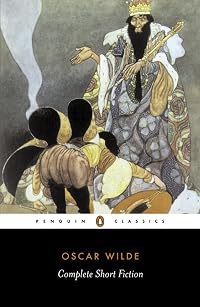
But why is the cover art "Keats and the Nightingale"?
But why is the cover art "Keats and the Nightingale"?
Henry, Louisa and I listened to most of the stories in the recording "In Aid of the Royal Theatrical Fund" with Judi Dench, Derek Jacobi, Jeremy Irons, and others (we skipped two of the stories because they were not readily understandable for them). The performances were excellent. The stories are, of course, wonderful. And although they are not fully age appropriate for the children (ages 5 and 6), they still really enjoyed them and seemed to value that the differences from some of their more standard fare (Louisa observed that they were not like Disney). Plus it is fun for an adult to get all the references the children miss.
For children that age I particularly recommend "The Nightingale and the Rose," "The Happy Prince," "The Devoted show more Friend," and "The Selfish Giant." show less
For children that age I particularly recommend "The Nightingale and the Rose," "The Happy Prince," "The Devoted show more Friend," and "The Selfish Giant." show less
This was a completely different side of Wilde. The collection is very delightful.
Members
- Recently Added By
Author Information

1,763+ Works 120,861 Members
Flamboyant man-about-town, Oscar Wilde had a reputation that preceded him, especially in his early career. He was born to a middle-class Irish family (his father was a surgeon) and was trained as a scholarship boy at Trinity College, Dublin. He subsequently won a scholarship to Magdalen College, Oxford, where he was heavily influenced by John show more Ruskin and Walter Pater, whose aestheticism was taken to its radical extreme in Wilde's work. By 1879 he was already known as a wit and a dandy; soon after, in fact, he was satirized in Gilbert and Sullivan's Patience. Largely on the strength of his public persona, Wilde undertook a lecture tour to the United States in 1882, where he saw his play Vera open---unsuccessfully---in New York. His first published volume, Poems, which met with some degree of approbation, appeared at this time. In 1884 he married Constance Lloyd, the daughter of an Irish lawyer, and within two years they had two sons. During this period he wrote, among others, The Picture of Dorian Gray (1891), his only novel, which scandalized many readers and was widely denounced as immoral. Wilde simultaneously dismissed and encouraged such criticism with his statement in the preface, "There is no such thing as a moral or an immoral book. Books are well written or badly written. That is all." In 1891 Wilde published A House of Pomegranates, a collection of fantasy tales, and in 1892 gained commercial and critical success with his play, Lady Windermere's Fan He followed this comedy with A Woman of No Importance (1893), An Ideal Husband (1895), and his most famous play, The Importance of Being Earnest (1895). During this period he also wrote Salome, in French, but was unable to obtain a license for it in England. Performed in Paris in 1896, the play was translated and published in England in 1894 by Lord Alfred Douglas and was illustrated by Aubrey Beardsley. Lord Alfred was the son of the Marquess of Queensbury, who objected to his son's spending so much time with Wilde because of Wilde's flamboyant behavior and homosexual relationships. In 1895, after being publicly insulted by the marquess, Wilde brought an unsuccessful slander suit against the peer. The result of his inability to prove slander was his own trial on charges of sodomy, of which he was found guilty and sentenced to two years of hard labor. During his time in prison, he wrote a scathing rebuke to Lord Alfred, published in 1905 as De Profundis. In it he argues that his conduct was a result of his standing "in symbolic relations to the art and culture" of his time. After his release, Wilde left England for Paris, where he wrote what may be his most famous poem, The Ballad of Reading Gaol (1898), drawn from his prison experiences. Among his other notable writing is The Soul of Man under Socialism (1891), which argues for individualism and freedom of artistic expression. There has been a revived interest in Wilde's work; among the best recent volumes are Richard Ellmann's, Oscar Wilde and Regenia Gagnier's Idylls of the Marketplace , two works that vary widely in their critical assumptions and approach to Wilde but that offer rich insights into his complex character. (Bowker Author Biography) show less
Oscar Wilde has a Legacy Library. Legacy libraries are the personal libraries of famous readers, entered by LibraryThing members from the Legacy Libraries group.
Some Editions
Series
Belongs to Publisher Series
Common Knowledge
- Original publication date
- 1990
Classifications
Statistics
- Members
- 1,298
- Popularity
- 18,641
- Reviews
- 11
- Rating
- (4.19)
- Languages
- 5 — English, German, Italian, Swedish, Turkish
- Media
- Paper, Audiobook, Ebook
- ISBNs
- 38
- ASINs
- 24