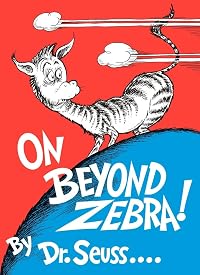
On Beyond Zebra!
by Dr. Seuss
On This Page
Description
A nonsensical alphabet that begins after the letter "Z".Tags
Recommendations






Member Recommendations
Member Reviews
Having mastered the twenty-six letters of the English alphabet, Conrad Cornelius o'Donald o'Dell is surprised to discover that there are other letters out there, beyond Z. Guided by the narrator, who steps in to share this amazing information, he learns about such letters as the Yuzz, used to spell Yuzz-a-ma-Tuzz; or the Thnad, used to spell Thnadners. Following along on a journey of enchanted discovery, Conrad Cornelius learns nineteen new letters, and meets nineteen unusual new creatures, realizing that there is so much to be found, beyond the letter Z...
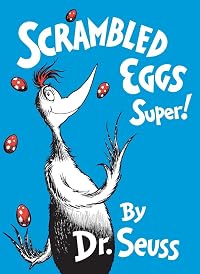
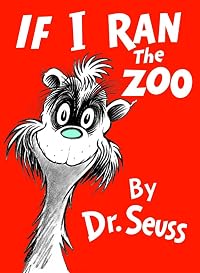
Originally published in 1955, On Beyond Zebra was Dr. Seuss' eleventh picture-book, published the year after Scrambled Eggs Super! and Horton Hears a Who! With its catalogue of show more fantastic fictional creatures, it is reminiscent of earlier Seuss titles like Scrambled Eggs Super!, as well as If I Ran the Zoo and McElligot's Pool. With its alphabetic element however, it is also unlike these earlier books, and does something wonderful and new, introducing the idea, through a wild and wacky story, that there are other kinds of letters, and by extension, other sorts of writing systems out there, beyond the one that young children might know. I never encountered this one as a child - something I now regret - and picked it up as part of my recently undertaken Dr. Seuss retrospective, in which I plan to read and review all forty-four of his classic picture-books, in chronological publication order. It is a project that I began as an act of personal protest against the suppression of six of the author/artist's titles - this one, as well as And to Think That I Saw It on Mulberry Street, McElligot's Pool, If I Ran the Zoo, Scrambled Eggs Super! and The Cat's Quizzer - by Dr. Seuss Enterprises, because they contain outdated and potentially offensive elements.
As a young girl who had a fascination with languages and writing systems, a girl who created her own make-believe kingdom with its own history and elaborate customs, I would have adored On Beyond Zebra!. As it happens, I too created my own letters, just like Dr. Seuss, and my kingdom (Arcania) had its own language, with its own alphabet. Sadly, I have lost all my papers from that period in my life, but I recall that I enjoyed creating the rather ornate letters in my writing system, which was modeled on the Latin alphabet, but which used very different characters to represent upper and lower case letters, and long and short forms of the vowels. Reading this picture-book reminded me of the pleasure I took in creating my own language as a girl, and how that imaginative play led to my interest in real-world languages as an adult. I got a real thrill, therefore, reading this tale of another child discovering such wonders, and perusing the letters Dr. Seuss created, beyond Z:
In thinking of why Dr. Seuss Enterprises chose to suppress this title, I must conclude that it is owing to the letter Spazz, used to spell Spazzim, a camel-like creature ridden by the Nazzim of Bazzim. This fellow looks to be Middle-Eastern, in a sort of vague way - the camel-riding, the headdress - and is no doubt interpreted by critics as an example of Orientalism. For my part, while I see that the depiction is a caricature - something upon which all of Seuss' work rests - I did not perceive anything hateful in it. If anything, it felt like a reference to stories like Aladdin, or other tales from The Arabian Nights. I would imagine that any number of western retellings of the latter could also be accused of Orientalism, so let's hope these self-styled arbiters of morality don't come for those classic stories as well. It strikes me as such a deep shame, that a book like this, which could lead children naturally and creatively into a better awareness of the richness of human language, and of the writing systems of the world, should be suppressed because of one arguably offensive caricature. It is ironic that, in taking steps to (in their own imagination) defend other cultures and peoples, these critics have decided to oppose a story that could be used to teach young children an appreciation for the linguistic diversity of our world, and for the cultural diversity from which it springs. Then again, these people really aren't defenders of culture (their own or anyone else's) at all, but architects of a new uni-culture, to be enforced through bullying and character assassination. One need only look at the specious accusations of far-right racism lobbed at any reader who opposes this move on the part of Dr. Seuss Enterprises, by some of our commentariat, as well as by private citizens online, to see that this is true.
Joshua T. Katz, a professor of linguistics at Princeton University who teaches a freshman seminar entitled "Wordplay: A Wry Plod from Babel to Scrabble" - a course which includes both On Beyond Zebra and James Joyce's Finnegan's Wake on its syllabus - concludes in his recent article in The New Criterion, that this recent censorious move by Dr. Seuss Enterprises is a form of madness. I quite agree. show less
Originally published in 1955, On Beyond Zebra was Dr. Seuss' eleventh picture-book, published the year after Scrambled Eggs Super! and Horton Hears a Who! With its catalogue of show more fantastic fictional creatures, it is reminiscent of earlier Seuss titles like Scrambled Eggs Super!, as well as If I Ran the Zoo and McElligot's Pool. With its alphabetic element however, it is also unlike these earlier books, and does something wonderful and new, introducing the idea, through a wild and wacky story, that there are other kinds of letters, and by extension, other sorts of writing systems out there, beyond the one that young children might know. I never encountered this one as a child - something I now regret - and picked it up as part of my recently undertaken Dr. Seuss retrospective, in which I plan to read and review all forty-four of his classic picture-books, in chronological publication order. It is a project that I began as an act of personal protest against the suppression of six of the author/artist's titles - this one, as well as And to Think That I Saw It on Mulberry Street, McElligot's Pool, If I Ran the Zoo, Scrambled Eggs Super! and The Cat's Quizzer - by Dr. Seuss Enterprises, because they contain outdated and potentially offensive elements.
As a young girl who had a fascination with languages and writing systems, a girl who created her own make-believe kingdom with its own history and elaborate customs, I would have adored On Beyond Zebra!. As it happens, I too created my own letters, just like Dr. Seuss, and my kingdom (Arcania) had its own language, with its own alphabet. Sadly, I have lost all my papers from that period in my life, but I recall that I enjoyed creating the rather ornate letters in my writing system, which was modeled on the Latin alphabet, but which used very different characters to represent upper and lower case letters, and long and short forms of the vowels. Reading this picture-book reminded me of the pleasure I took in creating my own language as a girl, and how that imaginative play led to my interest in real-world languages as an adult. I got a real thrill, therefore, reading this tale of another child discovering such wonders, and perusing the letters Dr. Seuss created, beyond Z:
In thinking of why Dr. Seuss Enterprises chose to suppress this title, I must conclude that it is owing to the letter Spazz, used to spell Spazzim, a camel-like creature ridden by the Nazzim of Bazzim. This fellow looks to be Middle-Eastern, in a sort of vague way - the camel-riding, the headdress - and is no doubt interpreted by critics as an example of Orientalism. For my part, while I see that the depiction is a caricature - something upon which all of Seuss' work rests - I did not perceive anything hateful in it. If anything, it felt like a reference to stories like Aladdin, or other tales from The Arabian Nights. I would imagine that any number of western retellings of the latter could also be accused of Orientalism, so let's hope these self-styled arbiters of morality don't come for those classic stories as well. It strikes me as such a deep shame, that a book like this, which could lead children naturally and creatively into a better awareness of the richness of human language, and of the writing systems of the world, should be suppressed because of one arguably offensive caricature. It is ironic that, in taking steps to (in their own imagination) defend other cultures and peoples, these critics have decided to oppose a story that could be used to teach young children an appreciation for the linguistic diversity of our world, and for the cultural diversity from which it springs. Then again, these people really aren't defenders of culture (their own or anyone else's) at all, but architects of a new uni-culture, to be enforced through bullying and character assassination. One need only look at the specious accusations of far-right racism lobbed at any reader who opposes this move on the part of Dr. Seuss Enterprises, by some of our commentariat, as well as by private citizens online, to see that this is true.
Joshua T. Katz, a professor of linguistics at Princeton University who teaches a freshman seminar entitled "Wordplay: A Wry Plod from Babel to Scrabble" - a course which includes both On Beyond Zebra and James Joyce's Finnegan's Wake on its syllabus - concludes in his recent article in The New Criterion, that this recent censorious move by Dr. Seuss Enterprises is a form of madness. I quite agree. show less
You try reading this aloud and see where you get. The rhyme scheme is awful, but wait, don't sweat! Here are some letters that make absolutely no sense and are actually words, yes. Seuss is that dense. Is this book for kids? Adults? Teens? Please, explain to me, by all means.
Ok, I'm done rhyming. This book is bad for early readers trying to learn their letters. Many of them read like a CAPTCHA prompt.
Ok, I'm done rhyming. This book is bad for early readers trying to learn their letters. Many of them read like a CAPTCHA prompt.
This is almost everything I want in a picture book: Fun to read, entertaining for the kiddo, and best of all easy to skip pages of if you're in a hurry to be done with story time because you've already done half a dozen other books.
If you think the alphabet stops with Z, you are wrong. So wrong. Leave it to Conrad Cornelius o'Donald o'Dell (with a little help from Dr. Seuss) to create an entirely new alphabet beginning with Z! This rhyming picture book introduces twenty new letters and the creatures that one can spell with them.
We loved Dr. Seuss so much growing up, I've been surprised by how many I actually missed! This was is quite funny and sort of an advanced take on There's a Wocket in my Pocket. My 5-year-old didn't get it; just a lot of funny made up words for him. But my 9-year-old was intrigued and it got him thinking creatively.
Not one of Dr. Seuss's greatest hits. It's very similar to [b:There's a Wocket in My Pocket!|310272|There's a Wocket in My Pocket!|Dr. Seuss|http://d.gr-assets.com/books/1327448521s/310272.jpg|2069970], with nonsense just for the sake of nonsense.
The premise is that an older boy is telling a younger boy just learning his letters that there are more exciting letters beyond Z. They all look like crazy combinations of letters already in the alphabet, and their pronunciation is given with letters of the alphabet, as are the words they're used to spell. Even my kindergartener noticed that.
The premise is that an older boy is telling a younger boy just learning his letters that there are more exciting letters beyond Z. They all look like crazy combinations of letters already in the alphabet, and their pronunciation is given with letters of the alphabet, as are the words they're used to spell. Even my kindergartener noticed that.
Esse é um dos livros do Dr Seuss que não serão mais publicados por serem "problemáticos", mas não tenho a mínima ideia do porquê, não encontrei nada que pudesse ferir as suscetibilidades de quaisquer pessoas.
Members
- Recently Added By
Lists

Banned or Challenged Books
400 works; 41 members

Books that are a victim of Cancel Culture
46 works; 3 members

Purged Books
6 works; 1 member

1970s
657 works; 23 members

Cancelled Books
78 works; 2 members

Books That Changed Our Perspective
423 works; 168 members

Written and Illustrated By
805 works; 1 member

Books We Loved As Children
603 works; 252 members

Favorite Childhood Books
1,651 works; 519 members
Author Information

798+ Works 359,402 Members
Theodor Seuss Geisel was born in Springfield, Massachusetts on March 2, 1904. He wrote and illustrated more than 45 picture books under the pseudonym Dr. Seuss. His first picture book, And to Think That I Saw It on Mulberry Street, was published in 1937. His other books included The Cat in the Hat, The Butter-Battle Book, The Lorax, The Bippolo show more Seed and Other Lost Stories, Fox in Socks: Dr. Seuss's Book of Tongue Tanglers, What Pet Should I Get?, and Oh, the Places You'll Go. In 1984, he received a Pulitzer Prize for his contributions to children's literature. He died of oral cancer on September 24, 1991 at the age of 87. (Bowker Author Biography) show less
Series
Belongs to Publisher Series
Work Relationships
Common Knowledge
- Canonical title
- On Beyond Zebra!
- Alternate titles
- On Beyond Zebra!
- Original publication date
- 1955
- Dedication
- To Helen
- First words
- Said Conrad Cornelius o'Donald o'Dell,
My very young friend who is learning to spell:
"The A is for Ape." - Last words
- (Click to show. Warning: May contain spoilers.)...what do YOU think we should call this one, anyhow?
- Original language
- English
Classifications
- Genres
- Children's Books, Picture Books
- DDC/MDS
- 421.1 — Language English & Old English languages Writing system, phonology, phonetics of standard English Writing systems
- LCC
- PZ8.3 .G276 .O — Language and Literature Fiction and juvenile belles lettres Fiction and juvenile belles lettres Juvenile belles lettres
- BISAC
Statistics
- Members
- 1,172
- Popularity
- 21,405
- Reviews
- 16
- Rating
- (4.03)
- Languages
- English
- Media
- Paper, Ebook
- ISBNs
- 16
- UPCs
- 1
- ASINs
- 8