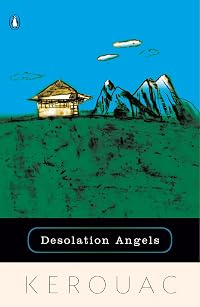
Desolation Angels
by Jack Kerouac 
On This Page
Description
A young man searches for meaning, creates art, and grapples with fame as he traverses the stomping grounds of the Beat Generation-from Mexico City to Manhattan-in Jack Kerouac's semi-autobiographical novel This urgently paced yet deeply introspective novel closely tracks On the Road author Jack Kerouac's own life. Jack Duluoz journeys from the Cascade Mountains to San Francisco, Mexico City, New York, and Tangier. While working as a fire lookout on Desolation Peak in the Cascades, Duluoz show more contemplates his inner void and the distressing isolation brought on by his youthful sense of adventure. In Tangier he suffers a similar feeling of desperation during an opium overdose, and in Mexico City he meets up with a morphine-addicted philosopher and seeks an antidote to his solitude in a whorehouse. As in Kerouac's other novels, Desolation Angels features a lively cast of pseudonymous versions of his fellow Beat poets, including William S. Burroughs (as Bull Hubbard), Neal Cassady (as Cody Pomeray), and Allen Ginsberg (as Irwin Garden). Duluoz draws readers into the trials and tribulations of these literary iconoclasts-from drug-fueled writing frenzies and alcoholic self-realizations to frenetic international road trips and tumultuous love affairs. Achieving literary success comes with its own consequences though, as Duluoz and his friends must face the scrutiny that comes with rising to the national stage. show lessTags
Recommendations


















Member Reviews
At the time Jack Kerouac wrote “Desolation Angels”, it was four years before he would die at 47 in Florida after a lifetime of alcoholism, and eight to nine years since he had lived the adventures in the book. It opens with him alone atop Desolation Peak as a fire lookout, follows him through wild times with his friends in San Francisco, New York, Mexico City, and Tangiers, and ends with the publishing of his book “On the Road”, which had been rejected for years.
Despite what seems like would be a triumphant story, at this point Kerouac has been disillusioned on all fronts: with the ennui of solitude, the monotony of his partying, and with the growing popularity of the ‘beat’ movement with the mainstream who were not genuine show more or true to its roots. One feels through these pages that Kerouac is not much longer for this world, and despite his joy for life, there is a depressing aspect throughout. Kerouac lived his life as he wrote, with abandon, honesty, and a depth of feeling, but at this point he is burnt out and suffering the effects of alcohol and drug abuse.
There are several moments in the book when I cringed and thought “Oh, Jack”, wishing he could have settled down, but at the same time knowing he would not have been who he was had he been able to do that. One of the low points is in Mexico City, and as in the book Tristessa (separately reviewed), I wish he had avoided going down there altogether, although at one point he does explain his motivation, that “these are people who have heart.” However, having him describe sex with a 14 year old prostitute for the equivalent of 24 cents is painful. The book is not always for the faint of heart, but outside of the beginning chapters which are a little slow, it’s a fascinating read.
There is a freedom to Kerouac’s life that is piercing. He rambled through the world without fear of what the next day would bring or how he appeared to others. And he lets it rip in telling the story; it’s full throttle, and with no editing. He doesn’t sugar coat or romanticize his experiences or feelings, yet at the same time displays a tolerance and a purity of heart that is endearing. One of the late chapters explaining his love for his saint of a mother, hardly a “cool” thing to do in an era with the mantra “Don’t trust anyone over 30”, is heart-warming.
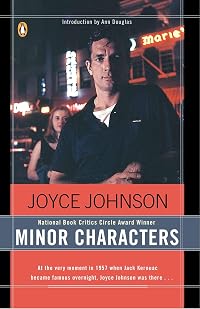
He is also keenly attuned to animals and to his friends who are all here, thinly guised under different names: Allan Ginsberg (Irwin Garden), Neal Cassady (Cody Pomeray), Gregory Corso (Raphael Urso), and William S. Burroughs (Bull Hubbard), among others. It’s not a book about the famous people he runs into by any means, but I found his descriptions of meeting with Salvador Dali and William Carlos Williams in the final chapters very interesting. Aside from Joyce Johnson (Alyce Newman), who is an absolute angel (and who writes the introduction), we see all of Kerouac’s friends as deeply flawed, and yet also see a magic time in America, when this rag-tag group of psychedelic mad poets was a decade ahead of its time. We also see why Kerouac loved these people and the life he chose, even though it led to his sadness, and ultimately destroyed him at an early age.
Quotes:
On the environment:
“As far as I can see and as I am concerned, this so-called Forest Service is nothing but a front, on the one hand a vague Totalitarian governmental effort to restrict the use of the forest to people, telling them they cant camp here or piss there … secondly it’s a front for the lumber interests, the net result of the whole thing being, what with Scott Paper Tissue and such companies logging out these woods year after year with the ‘cooperation’ of the Forest Service which boasts so proudly of the number of board feet in the whole Forest … result, net, is people all over the world are wiping their ass with the beautiful trees…”
On fame:
“I was a hardy son of a sun in those days, only 165 pounds and would walk miles with a full pack on my back, and rolled my own cigarettes, and knew how to hide comfortably in riverbottoms or even how to live on dimes and quarters – Nowadays, after all the horror of my literary notoriety, the bathtubs of booze that have passed through my gullet, the years of hiding at home from hundreds of petitioners for my time … I got to look like a Bourgeois, pot belly and all, that expression on my face of mistrust and affluence … But in those days, only five years ago, I looked wild and rough –They surrounded me with two squad cars.
They put spotlights on me standing there in the road in jeans and workclothes, with the big woeful rucksack a-back, and asked: - ‘Where are you going?’ which is precisely what they asked me a year later under Television floodlights in New York, ‘Where are you going?’ – Just as you cant explain to the police, you cant explain to society ‘Looking for peace.’”
“Later I’m back in New York sitting around with Irwin and Simon and Raphael and Lazarus, and now we’re famous writers more or less, but they wonder why I’m sunk now, so unexcited as we sit among all our published books and poems, tho at least, since I lived with Memiere in a house of her own miles from the city, it’s a peaceful sorrow. A peaceful sorrow at home is the best I’ll ever be able to offer the world, in the end, and so I told my Desolation Angels goodbye. A new life for me.”
On freedom:
“Hold still, man, regain your love of life and go down from this mountain and simply be – be –be the infinite fertilities of the one mind of infinity, make no comments, complaints, criticisms, appraisals, avowals, sayings, shooting stars of thought, just flow, flow, be you all, be you what it is … So shut up, live, travel, adventure, bless and dont be sorry.”
On friendship:
“Funny how Cody never comes to poetry readings or any of these formalities, he only came once, to honor Irwin’s first reading, and when Irwin had finished howling the last poem and there was a dead silence in the hall it was Cody, dressed in his Sunday suit, who stepped up and offered his hand to the poet (his buddy Irwin with whom he’d hitch hiked thru the Texases and Apocalypses of 1947) – I always remember that as a typical humble beautiful act of friendship and good taste…”
On love of fellow man, and the human condition:
“…I only know one thing: everybody in the world is an angel, Charley Chaplin and I have seen their wings, you dont have to be a seraphic little girl with a wistful smile of sadness to be an angel, you can be a broadstriped Bigparty Butch sneering in a cave, in a sewer, you can be monstrous itchy Wallace Beery in a dirty undershirt, you can be an Indian woman squatting in the gutter crazy, you can even be a bright beaming believing American Executive with bright eyes, you can even be a nasty intellectual in the capitals of Europe but I see the big sad invisible wings on all the shoulders and I feel bad they’re invisible and of no earthly use and never were and all we’re doing is fighting to our deaths –
Why?”
On lust:
“(The amazing thing about the Arab prostitute is to see her remove her veil from over her nose and then the long Biblical robes, suddenly leaving nothing but a peachy wench with a lascivious leer and high heels and nothing else – yet on the street they look so mournfully holy, those eyes, those dark eyes alone in all that chastest cloth…)”
On meaninglessness:
“All the saints have gone to the grave with the same pout as the murderer and the hater, the dirt doesn’t discriminate, it’ll eat all lips no matter what they did and that’s because nothing matters and we all know it –
But what we gonna do?”
On nature:
“To sleep is like a prayer, but under the stars, if you wake up at night, at 3 A.M., you’ll see what a big beautiful Heavenly Milky Way room you’re sleeping in, cloudy-milk with a hundred thousand myriads of universes, and more, the number is unbelievably milky, no Univac Machine with the brainwash mind can measure that extent of our reward that we see up there –
And the sleep is delicious under stars, even if the ground is humpy you adjust your limbs to it, and you feel the earth-damp but it only lulls you to sleep, it’s the Paleolithic Indian in all of us – The Cro-Magnon or Grimaldi Man, who slept on the ground, naturally, and often in the open, and looked at the stars on his back and tried to calculate the dipankara number of them…”
On non-conformity:
“And also dont think of me as a simple character – A lecher, a ship-jumper, a loafer, a conner of old women, even of queers, an idiot, nay a drunken baby Indian when drinking – Got socked everywhere and never socked back (except when young tough football player) – In fact, I dont even known what I was – Some kind of fevered being different as a snowflake. … In any case, a wondrous mess of contradictions (good enough, said Whitman) but more fit for Holy Russia of 19th century than for this modern America of crew cuts and sullen faces in Pontiacs…”
On porn:
“In the paper store my God a thousand girlie books showing all the fulsome breasts and thighs in eternity – I realize ‘America’s going sex-mad, they cant get enough, something’s wrong, somewhere, pretty soon these girlie books’ll be impossibly tight, they’ll show you every crease and fold except the hole and nipple, they’re crazy’ – Of course I look too, at the rack, with the other sexfiends.”
On reading:
“The best moment of the day was to slip in bed with bedlamp over book, and read facing the open patio windows, the stars and the sea. I could also hear it sighing out there.”
On sadness:
“Sad understanding is what compassion means – I resign from the attempt to be happy.”
On suffering:
“…Raphael and I go walking down Grant Street in the dusk, bound for different destinations as soon as we see a monster movie on Market Street. ‘I dig what you meant Jack about Cody at the races. It was real funny, we’ll go again Friday. Listen! I’m writing a real great new poem – ‘ then suddenly he sees chickens in crates in the inside dark Chinese store, ‘look, look, they’re all gonna die!’ He stops in the street. ‘How can God make a world like that?’
…
And Raphael’s grimace meaks (sic) me a leak-tear right quick, I see it, I suffer, we all suffer, people die in your arms, it’s too much to bear yet you’ve got to go on as though nothing was happening, right? right, readers?”
“That’s what my father told me the night before he died, ‘Life is too long.’”
On travel:
“Why travel if not like a child?”
On virtue:
“And there’s just no hope anywhere because we’re all disunited and ashamed … The only thing to do is be like my mother: patient, believing, careful, bleak, self-protective, glad for little favors, suspicious of great favors, beware of Greeks bearing Fish, make it your own way, hurt no one, mind your own business, and make your compact with God.”
On work:
“When you’re young you work because you think you need the money: when you’re old you already know you dont need anything but death, so why work?”
On writing:
“Sweet, Raphael, great, you’re a greater poet than ever – you’re really going now – great – dont stop – remember to write without stopping, without thinking, just go, I wanta hear what’s in the bottom of your mind.”
“…Simon and I hurry out just as Randall’s begun his first line … and such, some line that I hear, and dont want to hear more, because in it I hear the craft of his carefully arranged thoughts and not the uncontrollable involuntary thoughts themselves, dig…”
“I was simply writing them because I was an ‘Idealist’ and I believed in ‘Life’ and was going about justifying it with my earnest scribblings … a new way of writing about life, no fiction, no craft, no revising afterthoughts, the heartbreaking discipline of the veritable fire ordeal where you cant go back but have made the vow of ‘speak now or forever hold your tongue’”
“In the kitchen Random takes out the Jack Daniels and says ‘How can you get any refined or well gestured thoughts into a spontaneous flow as you call it? It can all end up gibberish.’ And that was no Harvard lie. But I said:
‘If it’s all gibberish, it’s gibberish. There’s a certain amount of control going on like a man telling a story in a bar without interruptions or even one pause.’
…
‘If I had a Poetry University you know what would be written over the entrance arch?’
‘No, what.’
‘Here Learn That Learning is Ignorance! Gentelmen dont burn my ears! Poetry is lamb dust! I prophesy it! I’ll lead schools in exile! I dont Care!’ They werent bringing me to meet Carl Sandburg whom I’d known anyway seven years ago at several parties where he stood before the fireplace in a tuxedo and talked about freight trains in Illinois 1910. And actually threw his arms around me going ‘Ha ha ha! You’re just like me!’” show less
Despite what seems like would be a triumphant story, at this point Kerouac has been disillusioned on all fronts: with the ennui of solitude, the monotony of his partying, and with the growing popularity of the ‘beat’ movement with the mainstream who were not genuine show more or true to its roots. One feels through these pages that Kerouac is not much longer for this world, and despite his joy for life, there is a depressing aspect throughout. Kerouac lived his life as he wrote, with abandon, honesty, and a depth of feeling, but at this point he is burnt out and suffering the effects of alcohol and drug abuse.
There are several moments in the book when I cringed and thought “Oh, Jack”, wishing he could have settled down, but at the same time knowing he would not have been who he was had he been able to do that. One of the low points is in Mexico City, and as in the book Tristessa (separately reviewed), I wish he had avoided going down there altogether, although at one point he does explain his motivation, that “these are people who have heart.” However, having him describe sex with a 14 year old prostitute for the equivalent of 24 cents is painful. The book is not always for the faint of heart, but outside of the beginning chapters which are a little slow, it’s a fascinating read.
There is a freedom to Kerouac’s life that is piercing. He rambled through the world without fear of what the next day would bring or how he appeared to others. And he lets it rip in telling the story; it’s full throttle, and with no editing. He doesn’t sugar coat or romanticize his experiences or feelings, yet at the same time displays a tolerance and a purity of heart that is endearing. One of the late chapters explaining his love for his saint of a mother, hardly a “cool” thing to do in an era with the mantra “Don’t trust anyone over 30”, is heart-warming.
He is also keenly attuned to animals and to his friends who are all here, thinly guised under different names: Allan Ginsberg (Irwin Garden), Neal Cassady (Cody Pomeray), Gregory Corso (Raphael Urso), and William S. Burroughs (Bull Hubbard), among others. It’s not a book about the famous people he runs into by any means, but I found his descriptions of meeting with Salvador Dali and William Carlos Williams in the final chapters very interesting. Aside from Joyce Johnson (Alyce Newman), who is an absolute angel (and who writes the introduction), we see all of Kerouac’s friends as deeply flawed, and yet also see a magic time in America, when this rag-tag group of psychedelic mad poets was a decade ahead of its time. We also see why Kerouac loved these people and the life he chose, even though it led to his sadness, and ultimately destroyed him at an early age.
Quotes:
On the environment:
“As far as I can see and as I am concerned, this so-called Forest Service is nothing but a front, on the one hand a vague Totalitarian governmental effort to restrict the use of the forest to people, telling them they cant camp here or piss there … secondly it’s a front for the lumber interests, the net result of the whole thing being, what with Scott Paper Tissue and such companies logging out these woods year after year with the ‘cooperation’ of the Forest Service which boasts so proudly of the number of board feet in the whole Forest … result, net, is people all over the world are wiping their ass with the beautiful trees…”
On fame:
“I was a hardy son of a sun in those days, only 165 pounds and would walk miles with a full pack on my back, and rolled my own cigarettes, and knew how to hide comfortably in riverbottoms or even how to live on dimes and quarters – Nowadays, after all the horror of my literary notoriety, the bathtubs of booze that have passed through my gullet, the years of hiding at home from hundreds of petitioners for my time … I got to look like a Bourgeois, pot belly and all, that expression on my face of mistrust and affluence … But in those days, only five years ago, I looked wild and rough –They surrounded me with two squad cars.
They put spotlights on me standing there in the road in jeans and workclothes, with the big woeful rucksack a-back, and asked: - ‘Where are you going?’ which is precisely what they asked me a year later under Television floodlights in New York, ‘Where are you going?’ – Just as you cant explain to the police, you cant explain to society ‘Looking for peace.’”
“Later I’m back in New York sitting around with Irwin and Simon and Raphael and Lazarus, and now we’re famous writers more or less, but they wonder why I’m sunk now, so unexcited as we sit among all our published books and poems, tho at least, since I lived with Memiere in a house of her own miles from the city, it’s a peaceful sorrow. A peaceful sorrow at home is the best I’ll ever be able to offer the world, in the end, and so I told my Desolation Angels goodbye. A new life for me.”
On freedom:
“Hold still, man, regain your love of life and go down from this mountain and simply be – be –be the infinite fertilities of the one mind of infinity, make no comments, complaints, criticisms, appraisals, avowals, sayings, shooting stars of thought, just flow, flow, be you all, be you what it is … So shut up, live, travel, adventure, bless and dont be sorry.”
On friendship:
“Funny how Cody never comes to poetry readings or any of these formalities, he only came once, to honor Irwin’s first reading, and when Irwin had finished howling the last poem and there was a dead silence in the hall it was Cody, dressed in his Sunday suit, who stepped up and offered his hand to the poet (his buddy Irwin with whom he’d hitch hiked thru the Texases and Apocalypses of 1947) – I always remember that as a typical humble beautiful act of friendship and good taste…”
On love of fellow man, and the human condition:
“…I only know one thing: everybody in the world is an angel, Charley Chaplin and I have seen their wings, you dont have to be a seraphic little girl with a wistful smile of sadness to be an angel, you can be a broadstriped Bigparty Butch sneering in a cave, in a sewer, you can be monstrous itchy Wallace Beery in a dirty undershirt, you can be an Indian woman squatting in the gutter crazy, you can even be a bright beaming believing American Executive with bright eyes, you can even be a nasty intellectual in the capitals of Europe but I see the big sad invisible wings on all the shoulders and I feel bad they’re invisible and of no earthly use and never were and all we’re doing is fighting to our deaths –
Why?”
On lust:
“(The amazing thing about the Arab prostitute is to see her remove her veil from over her nose and then the long Biblical robes, suddenly leaving nothing but a peachy wench with a lascivious leer and high heels and nothing else – yet on the street they look so mournfully holy, those eyes, those dark eyes alone in all that chastest cloth…)”
On meaninglessness:
“All the saints have gone to the grave with the same pout as the murderer and the hater, the dirt doesn’t discriminate, it’ll eat all lips no matter what they did and that’s because nothing matters and we all know it –
But what we gonna do?”
On nature:
“To sleep is like a prayer, but under the stars, if you wake up at night, at 3 A.M., you’ll see what a big beautiful Heavenly Milky Way room you’re sleeping in, cloudy-milk with a hundred thousand myriads of universes, and more, the number is unbelievably milky, no Univac Machine with the brainwash mind can measure that extent of our reward that we see up there –
And the sleep is delicious under stars, even if the ground is humpy you adjust your limbs to it, and you feel the earth-damp but it only lulls you to sleep, it’s the Paleolithic Indian in all of us – The Cro-Magnon or Grimaldi Man, who slept on the ground, naturally, and often in the open, and looked at the stars on his back and tried to calculate the dipankara number of them…”
On non-conformity:
“And also dont think of me as a simple character – A lecher, a ship-jumper, a loafer, a conner of old women, even of queers, an idiot, nay a drunken baby Indian when drinking – Got socked everywhere and never socked back (except when young tough football player) – In fact, I dont even known what I was – Some kind of fevered being different as a snowflake. … In any case, a wondrous mess of contradictions (good enough, said Whitman) but more fit for Holy Russia of 19th century than for this modern America of crew cuts and sullen faces in Pontiacs…”
On porn:
“In the paper store my God a thousand girlie books showing all the fulsome breasts and thighs in eternity – I realize ‘America’s going sex-mad, they cant get enough, something’s wrong, somewhere, pretty soon these girlie books’ll be impossibly tight, they’ll show you every crease and fold except the hole and nipple, they’re crazy’ – Of course I look too, at the rack, with the other sexfiends.”
On reading:
“The best moment of the day was to slip in bed with bedlamp over book, and read facing the open patio windows, the stars and the sea. I could also hear it sighing out there.”
On sadness:
“Sad understanding is what compassion means – I resign from the attempt to be happy.”
On suffering:
“…Raphael and I go walking down Grant Street in the dusk, bound for different destinations as soon as we see a monster movie on Market Street. ‘I dig what you meant Jack about Cody at the races. It was real funny, we’ll go again Friday. Listen! I’m writing a real great new poem – ‘ then suddenly he sees chickens in crates in the inside dark Chinese store, ‘look, look, they’re all gonna die!’ He stops in the street. ‘How can God make a world like that?’
…
And Raphael’s grimace meaks (sic) me a leak-tear right quick, I see it, I suffer, we all suffer, people die in your arms, it’s too much to bear yet you’ve got to go on as though nothing was happening, right? right, readers?”
“That’s what my father told me the night before he died, ‘Life is too long.’”
On travel:
“Why travel if not like a child?”
On virtue:
“And there’s just no hope anywhere because we’re all disunited and ashamed … The only thing to do is be like my mother: patient, believing, careful, bleak, self-protective, glad for little favors, suspicious of great favors, beware of Greeks bearing Fish, make it your own way, hurt no one, mind your own business, and make your compact with God.”
On work:
“When you’re young you work because you think you need the money: when you’re old you already know you dont need anything but death, so why work?”
On writing:
“Sweet, Raphael, great, you’re a greater poet than ever – you’re really going now – great – dont stop – remember to write without stopping, without thinking, just go, I wanta hear what’s in the bottom of your mind.”
“…Simon and I hurry out just as Randall’s begun his first line … and such, some line that I hear, and dont want to hear more, because in it I hear the craft of his carefully arranged thoughts and not the uncontrollable involuntary thoughts themselves, dig…”
“I was simply writing them because I was an ‘Idealist’ and I believed in ‘Life’ and was going about justifying it with my earnest scribblings … a new way of writing about life, no fiction, no craft, no revising afterthoughts, the heartbreaking discipline of the veritable fire ordeal where you cant go back but have made the vow of ‘speak now or forever hold your tongue’”
“In the kitchen Random takes out the Jack Daniels and says ‘How can you get any refined or well gestured thoughts into a spontaneous flow as you call it? It can all end up gibberish.’ And that was no Harvard lie. But I said:
‘If it’s all gibberish, it’s gibberish. There’s a certain amount of control going on like a man telling a story in a bar without interruptions or even one pause.’
…
‘If I had a Poetry University you know what would be written over the entrance arch?’
‘No, what.’
‘Here Learn That Learning is Ignorance! Gentelmen dont burn my ears! Poetry is lamb dust! I prophesy it! I’ll lead schools in exile! I dont Care!’ They werent bringing me to meet Carl Sandburg whom I’d known anyway seven years ago at several parties where he stood before the fireplace in a tuxedo and talked about freight trains in Illinois 1910. And actually threw his arms around me going ‘Ha ha ha! You’re just like me!’” show less
Desolation Angels is heaven and hell and the world and America and the Void and his Mom. Kerouac/Duluoz is a despicable, noble, earnest, loving, whiny, brilliant, loyal, weak, irreplaceable, insane jazz poet. As a preamble, listen to Bob Dylan’s Desolation Row and realize how he creates surprisingly linear beauty tangentially, and then crank up the random-o-meter one hundred times for Kerouac. One thousand preliminarily random images turn into a masterful Pointillist painting in prose. Bebop improvisation touching on a particular theme from a million different angles placates those of us requiring a story if we are patient. His prose is so poetic at times that it’s exhausting; infinitely compressed like a neutron star. In Desolation show more Angels he is Dharma Bum, addict, alcoholic, villain, criminal, poet, preacher, seer, mystic and finally Penitente and Bodhisattva having simultaneously reached the gates of Heaven/Nirvana and found himself unforgivable. From Desolation Peak and Seattle to Frisco; to Mexico City and New York; across the Atlantic to Tangiers, Paris and London; from Florida to Berkeley and back again; Desolation Angels is “ontogeny recapitulating phylogeny;” his whole rucksack (lost and found); every work, every poem, every sketch every howl. Ginsberg, Dali, Burroughs are all there, the pantheon of crazy pathetic beat angels. show less
To say the work was "rough" (around the edges or otherwise) is to say it was Kerouac, but I enjoyed these ramblings as much as I've enjoyed any of his works. There's a more "realistic" open-eyed version of Cody/Cassady here and a lot of that world-weariness that follows Kerouac throughout his life and sometimes opens up into quiet brilliance: We all stand on the sad earth throwing long shadows, breath cut with flesh. Amen.
This is really two books – the first book, Desolation Angels, was actually rather tedious, and I was at first regretting I had even started to read this at all. It also didn't help that I’d read about his stint as a fire lookout on Desolation Peak twice before (Lonesome Traveler, Dharma Bums) so I'd more than had my fill already – I was starting to feel (Buddhism, schmuddism) I couldn’t care less. It was Gary Snyder that inspired him to go there (mountains and sutras both, I guess) in the first place, and Kerouac, being his good ol' honest self, here eventually gets disenchanted with that entire Buddhist disenchantment. Not that this is an uninteresting development - it just takes him too many rambling pages to get there.
The show more second book, Passing Through, he had originally intended to publish as a separate book, and if so I'd probably have given it a four star rating. Here Kerouac brings his disenchantment with him to Mexico, back to New York; to Tangiers, Paris and London, again back to New York and from there all through America to San Francisco - and back again.. - In Tangiers: "...there's poor Irwin at midnight calling up to me from the garden 'Come on down Jack-Kee, there’s a big bunch of hipsters and chicks from Paris in Bull's room.' And just like in New York or Frisco or anywhere there they are all hunching around in marijuana smoke, talking, the cool girls with long thin legs in slacks, the men with goatees, all an enormous drag after all and at the time (1957) not even started yet officially with the name of 'Beat Generation.' .... Nothing can be more dreary than 'coolness' (not Irwin's cool, or Bull's or Simon's, which is natural quietness) but postured, actually secretly rigid coolness that covers up the fact that the character is unable to convey anything of force or interest, a kind of sociological coolness soon to become a fad up into the mass of middle-class youth for awhile. There’s even a kind of insultingness, probably unintentional, like when I said to the Paris girl just fresh she said from visiting a Persian Shah for Tiger hunt 'Did you actually shoot the tiger yourself?' she gave me a cold look as tho I’d just tried to kiss her at the window of a Drama School." - (Irwin=Ginsberg, Bull=Burroughs, Simon=Orlovsky) - He leaves and heads to Paris, which isn't much better, and where Raphael Urso (Gregory Corso) takes him to "meet disagreeable American beatniks in apartments and bars and all that’s 'cool' comes on again, only it's Easter and the fantastic candy stores in Paris have chocolate fishes in their windows three feet long." He ends up spending the entire night translating his girlfriends French to him, and further ends up having to pay the bar bill, with just enough money left to get him to London. "I'm mad as hell at Raphael for making me spend all that money and there he is yelling at me again how greedy and nowhere I am. (...) In the morning I sneak out with the excuse a girl is waiting for me in a cafe, and I never come back. I just walk all over Paris with the bag on my back looking so strange even the whores of St Denis dont look at me. I buy my ticket to London and eventually go."
Here’s the Kerouac that I like: "no fiction, no craft, no revising afterthoughts, the heartbreaking discipline of the veritable fire ordeal where you cant go back but have made the vow of "speak now or forever hold your tongue" and all of it innocent go-ahead confession," as he puts it in the first part of Passing Through, and after the dullness (of too much introvert desolation maybe) of the first book, it was a relief to find that the second contained some of the better of his writings.
This work is licensed under a Creative Commons Attribution-NonCommercial-ShareAlike 3.0 Unported License. show less
The show more second book, Passing Through, he had originally intended to publish as a separate book, and if so I'd probably have given it a four star rating. Here Kerouac brings his disenchantment with him to Mexico, back to New York; to Tangiers, Paris and London, again back to New York and from there all through America to San Francisco - and back again.. - In Tangiers: "...there's poor Irwin at midnight calling up to me from the garden 'Come on down Jack-Kee, there’s a big bunch of hipsters and chicks from Paris in Bull's room.' And just like in New York or Frisco or anywhere there they are all hunching around in marijuana smoke, talking, the cool girls with long thin legs in slacks, the men with goatees, all an enormous drag after all and at the time (1957) not even started yet officially with the name of 'Beat Generation.' .... Nothing can be more dreary than 'coolness' (not Irwin's cool, or Bull's or Simon's, which is natural quietness) but postured, actually secretly rigid coolness that covers up the fact that the character is unable to convey anything of force or interest, a kind of sociological coolness soon to become a fad up into the mass of middle-class youth for awhile. There’s even a kind of insultingness, probably unintentional, like when I said to the Paris girl just fresh she said from visiting a Persian Shah for Tiger hunt 'Did you actually shoot the tiger yourself?' she gave me a cold look as tho I’d just tried to kiss her at the window of a Drama School." - (Irwin=Ginsberg, Bull=Burroughs, Simon=Orlovsky) - He leaves and heads to Paris, which isn't much better, and where Raphael Urso (Gregory Corso) takes him to "meet disagreeable American beatniks in apartments and bars and all that’s 'cool' comes on again, only it's Easter and the fantastic candy stores in Paris have chocolate fishes in their windows three feet long." He ends up spending the entire night translating his girlfriends French to him, and further ends up having to pay the bar bill, with just enough money left to get him to London. "I'm mad as hell at Raphael for making me spend all that money and there he is yelling at me again how greedy and nowhere I am. (...) In the morning I sneak out with the excuse a girl is waiting for me in a cafe, and I never come back. I just walk all over Paris with the bag on my back looking so strange even the whores of St Denis dont look at me. I buy my ticket to London and eventually go."
Here’s the Kerouac that I like: "no fiction, no craft, no revising afterthoughts, the heartbreaking discipline of the veritable fire ordeal where you cant go back but have made the vow of "speak now or forever hold your tongue" and all of it innocent go-ahead confession," as he puts it in the first part of Passing Through, and after the dullness (of too much introvert desolation maybe) of the first book, it was a relief to find that the second contained some of the better of his writings.
This work is licensed under a Creative Commons Attribution-NonCommercial-ShareAlike 3.0 Unported License. show less
I had some concerns when I started this book. Concerns such as, "Am I too old for Kerouac? Is all this poet-hipster adventuring sort of pretentious?" So I was surprised by the deep current of melancholy that runs through the book. Jack Duluoz (Kerouac's alter-ego) certainly has his share of adventures in the poet-artist scene, but Kerouac really gives a sense of the madness and precariousness of the scene.
The story starts of with Duluoz' time spent as a fire lookout in the Skagit Valley national park. The solitude and melancholy is in some ways at its strongest here, with no drugs or companionship to take the edge off of it.
Duluoz then hithchikes and rides his way back to San Francisco to spend time with the Beats there. Here we meet show more his regular crew, including the Ginsberg stand-in Irwin Allen, who comes off as a fascinating figure.
One gets the sense of the ferment of the social scene, of how the desire to create and to challenge social norms led to experimenting with art and notions of the self. From here, Duluoz and friends head to Mexico, then Morocco, Europe and back to America.
I wouldn't describe Kerouac's style as my favorite, but it does a good job of capturing the feel of the era and his own spiritual hunger. Kerouac, in fact, seems already somewhat jaded by the reaction to One the Road, frustrated by the empty hipster pose it seems to have inmspired among many.
So, if I had to sum it up, a fascinating narrative of spiritual hunger and frustration, of social ferment and an era when one world of post-WWII conformity was about to break apart. show less
The story starts of with Duluoz' time spent as a fire lookout in the Skagit Valley national park. The solitude and melancholy is in some ways at its strongest here, with no drugs or companionship to take the edge off of it.
Duluoz then hithchikes and rides his way back to San Francisco to spend time with the Beats there. Here we meet show more his regular crew, including the Ginsberg stand-in Irwin Allen, who comes off as a fascinating figure.
One gets the sense of the ferment of the social scene, of how the desire to create and to challenge social norms led to experimenting with art and notions of the self. From here, Duluoz and friends head to Mexico, then Morocco, Europe and back to America.
I wouldn't describe Kerouac's style as my favorite, but it does a good job of capturing the feel of the era and his own spiritual hunger. Kerouac, in fact, seems already somewhat jaded by the reaction to One the Road, frustrated by the empty hipster pose it seems to have inmspired among many.
So, if I had to sum it up, a fascinating narrative of spiritual hunger and frustration, of social ferment and an era when one world of post-WWII conformity was about to break apart. show less
Jack is in northwest Washington for a fire lookout job - with no liquor or drugs! Then, when the job is done, he hitchhikes to Seattle. Then a bus to San Francisco, rucksack still in hand. And then he “…hopped that freight down to L.A. and headed for Old Mexico and a resumption of my solitude in a hovel in the city.” Then, off to NYC! And then, a boat ride across the sea to Tangiers! Over to Europe, back to the U.S., then across the country with his mom. Then back.
Well, I liked this book much more the first time I read it. This time, I just liked it okay. I don't remember Kerouac being so whiny. Even when "On the Road" is published near the end of this novel, he just seems put out. I thought I remembered this book as a fun show more adventure story, but this time around, it felt more like a sad man who is lost and all alone in the fame he thought he wanted. show less
Well, I liked this book much more the first time I read it. This time, I just liked it okay. I don't remember Kerouac being so whiny. Even when "On the Road" is published near the end of this novel, he just seems put out. I thought I remembered this book as a fun show more adventure story, but this time around, it felt more like a sad man who is lost and all alone in the fame he thought he wanted. show less
The first part of Desolation Angels (the book is split into three distinct parts) can be quite difficult. It took me several attempts to get through it. Much of it is verbatim excerpts from Kerouac's journals while he was serving a summer as a fire lookout, alone atop a mountain in the North Cascades. The prose is rambling and abstract, though containing some excellent observations on life, childhood, memory, and dreams. It also documents Kerouac's struggle with Buddhism. I say "struggle" in the best possible way, the adoption of any new faith is not, nor should it ever be, easy.
After Kerouac finally descends from the mountain and heads toward his familiar haunts in San Francisco and on the road, the book becomes slightly more like show more "The Dharma Bums," the novel which chronologically precedes "Desolation Angels" in the grand Vanity of Duluoz arch. Even more than in any of his previous works, Kerouac appears to strain under the pressure of balancing his wine- and people-loving sides with his side that just wants to return to his contemplations in solitude. Solitude and desolation play great roles in this book, contrasting with Jack's sociability, rising fame, and excitement about the ascendancy of the Beat Generation.
Altogether, not always Kerouac's most readable work, but well worth the effort. show less
After Kerouac finally descends from the mountain and heads toward his familiar haunts in San Francisco and on the road, the book becomes slightly more like show more "The Dharma Bums," the novel which chronologically precedes "Desolation Angels" in the grand Vanity of Duluoz arch. Even more than in any of his previous works, Kerouac appears to strain under the pressure of balancing his wine- and people-loving sides with his side that just wants to return to his contemplations in solitude. Solitude and desolation play great roles in this book, contrasting with Jack's sociability, rising fame, and excitement about the ascendancy of the Beat Generation.
Altogether, not always Kerouac's most readable work, but well worth the effort. show less
Members
- Recently Added By
Published Reviews
ThingScore 75
Kerouac, perhaps frightened that we may be bored by the hipster sanctity, tries to paste on a bit of dangerous leanness, but it’s not good. The old prelapsarian Adam beams out, literally incapable of harming a mouse and (when his pilgrimage brings him to London) blessing our filthy wicked city for its love of cats. Real cats that is, like with fur.
Desolation Angels calls itself a novel, but show more it is only that in a very Pickwickian sense. Nothing much happens except taking the road, listening to jazz, calling on old friends, laying some chick in the wholesomest way possible, going to somebody’s pad for a beer and poetry. And the characters are real people wearing pseudonyms like dark glasses: Duluoz is Kerouac himself; Irwin Garden is Allen Ginsberg; Bull Hubbard is Bill Burroughs. The pretence that this is art should be laughed away gently: give the boy a ball of majoun to chew and send him off to read his nice Zen book... His philosophy is homespun American, and not bad either. But then comes the exotic dressing which give Kerouac his flavour. ‘Eternity, and the negation; keep your palate clean for life, all of which (jazz, kif, Zen, poetry, Jell-O) is good. I rather dig this man. show less
Desolation Angels calls itself a novel, but show more it is only that in a very Pickwickian sense. Nothing much happens except taking the road, listening to jazz, calling on old friends, laying some chick in the wholesomest way possible, going to somebody’s pad for a beer and poetry. And the characters are real people wearing pseudonyms like dark glasses: Duluoz is Kerouac himself; Irwin Garden is Allen Ginsberg; Bull Hubbard is Bill Burroughs. The pretence that this is art should be laughed away gently: give the boy a ball of majoun to chew and send him off to read his nice Zen book... His philosophy is homespun American, and not bad either. But then comes the exotic dressing which give Kerouac his flavour. ‘Eternity, and the negation; keep your palate clean for life, all of which (jazz, kif, Zen, poetry, Jell-O) is good. I rather dig this man. show less
added by SnootyBaronet
Lists

Firewatch reading list
14 works; 1 member

Reading LIst
648 works; 1 member
Author Information

217+ Works 68,596 Members
Jack Kerouac was born in Lowell, Massachusetts, in 1922. His first novel, The Town and the City, was published in 1950. He considered all of his "true story novels," including On the Road, to be chapters of "one vast book," his autobiographical Legend of Duluoz. He died in St. Petersburg, Florida, in 1969 at the age of forty-seven. (Publisher show more Provided) show less
Jack Kerouac has a Legacy Library. Legacy libraries are the personal libraries of famous readers, entered by LibraryThing members from the Legacy Libraries group.
Some Editions
Series
Belongs to Publisher Series
Bibliotheca stylorum (2002)
Gallimard, Folio (457)
Work Relationships
Is contained in
Inspired
Common Knowledge
- Canonical title*
- Desolation Angels
- Original title
- Desolation angels
- Alternate titles*
- Ангелы опустошения
- Original publication date
- 1965
- People/Characters
- Jack Duluoz; Irwin Garden; Raphael Urso; Julien; Cody Pomeray; Bull Hubbard (show all 7); Bull Gaines
- Important places
- Desolation Peak; Skagit Valley, Washington, USA; Seattle, Washington, USA; San Francisco, California, USA; Mexico City, Mexico; New York, New York, USA (show all 8); Tangier, Morocco; Big Sur, California, USA
- First words
- Those afternoons, those lazy afternoons, when I used to sit, or lie down, on Desolation Peak, sometimes on the alpine grass, hundreds of miles of snowcovered rock all around, looming Mount Hozomeen on my north, vast snowy Jac... (show all)k to the south, the encharmed picture of the lake below to the west and the snowy hump of Mt. Baker beyond, and to the east the rilled and ridged monstrosities humping to the Cascade Ridge, and after that first time suddenly realizing "It's me that's changed and done all this and come and gone and complained and hurt and joyed and yelled, not the Void" and so that every time I thought of the void I'd be looking at Mt. Hozomeen (because chair and bed and meadowgrass faced north) until I realized "Hozomeen is the Void—at least Hozomeen means the void to my eyes" ...
- Last words
- (Click to show. Warning: May contain spoilers.)A new life for me.
*Some information comes from Common Knowledge in other languages. Click "Edit" for more information.
Classifications
Statistics
- Members
- 2,252
- Popularity
- 8,962
- Reviews
- 17
- Rating
- (3.76)
- Languages
- 11 — Czech, Dutch, English, Finnish, French, German, Hungarian, Italian, Portuguese, Russian, Spanish
- Media
- Paper, Audiobook, Ebook
- ISBNs
- 31
- ASINs
- 30