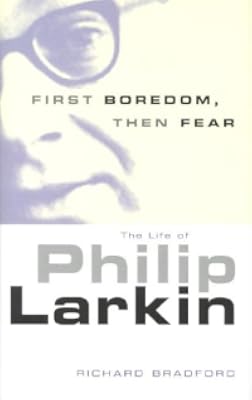
First Boredom, Then Fear: The Life of Philip Larkin
by Richard Bradford
On This Page
Description
When Philip Larkin's "letters" were published in 1992, the poet's enemies seized on the new disclosures with a frenzy unseen since the McCarthy era. What had previously been regarded only as potential inclination hinted at in his poems--misogyny and xenophobia in particular--were now indisputable facts, and since then Larkin's reputation as a poet has been tarnished by his image as a human being. Richard Bradford's acclaimed biography, now in paperback for the first time, reveals that show more Larkin treated his prejudices and peculiarities with detached circumspection. Sometimes he shared them, self-mockingly, self-destructively, with his closest friends. He divided up his life so that some people knew him well but none completely, and it was only in his poems that the parts began to resemble the whole. show lessTags
Member Reviews
It was Jonathan Raban who led me to Phillip Larkin, writing in Coasting of visiting his old friend and ”Don” from Hull University. Larkin became a published and revered poet during the thirty odd years he served as university librarian at the Brynmor Jones Library at the University of Hull , where Raban was an undergrad and tried by various subterfuges to discuss poetry with him – all in vain! Raban describes a reunion, over a Lebanese meal in near-deserted Hull. Larkin is deeply engaged in the role of a slightly loveable, doddery old man insisting on ‘mushy’ food and locking up all of his cars doors at every stop. He was at that time only in his sixties but he died just three years after their meeting. England mourned him show more “they minded his dying’ says Raban, “in a way that seemed strange for a poet’.
Posthumously Larkin letters were published to an immense furor in the media, every politically-correct ‘talking head’ screamed protests at the apparent racism, sexism and downright scandalous side of Larkin they saw in his private correspondence. Particularly his long time letter exchange with Kingsley Amis, where they joked about wenches and blacks and indulged in mutual enjoyment of ‘soft porn’. The obvious humour of this exchange – with Amis mind, one of Britain’s greatest wits – was ignored, the playful escalation of each goading the other, was denied and Larkin’s reputation, at least in the circles of media and academia, suffered severely. Yet in that same group of letters – Larkin to John Betjeman – we read:
"The American Negro is trying to take a step forward that can be compared only to the ending of slavery in the nineteenth century. And despite the dogs, the hosepipes and the burnings, advances have already been made towards giving the Negro his civil rights that would have been inconceivable when Louis Armstrong was a young man. These advances will doubtless continue. They will end only when the Negro is as well-housed, educated and medically cared for as the white man."
Larkin declined the honor and post as Britain’s Poet Laureate, claiming he no longer was capable of crafting good work. Yet the general public admired and loved his poetry.
Richard Bradford’s book gently redresses the excesses of that derogatory period of hateful attack, without softening some of the harder edges of the poet. We read accounts of his affairs and gentle, admiring lusting, his petulant sulking and the role-playing doddering. Larkin’s essential humanity comes through very clearly in this admirable and readable Biography, supporting the general public’s view that Larkin spoke truths we can all relate to in his work. Certainly, as I also dodder into being more elderly Larkin’s words thump me more heavily in the gut, I respond to his words, and my admiration of his work increases.
Life is first boredom, then fear.
Whether or not we use it, it goes,
And leaves what something hidden from us chose,
And age, and then the only end of age
Philip Larkin, “Dockery and Son” from Collected Poems. show less
Posthumously Larkin letters were published to an immense furor in the media, every politically-correct ‘talking head’ screamed protests at the apparent racism, sexism and downright scandalous side of Larkin they saw in his private correspondence. Particularly his long time letter exchange with Kingsley Amis, where they joked about wenches and blacks and indulged in mutual enjoyment of ‘soft porn’. The obvious humour of this exchange – with Amis mind, one of Britain’s greatest wits – was ignored, the playful escalation of each goading the other, was denied and Larkin’s reputation, at least in the circles of media and academia, suffered severely. Yet in that same group of letters – Larkin to John Betjeman – we read:
"The American Negro is trying to take a step forward that can be compared only to the ending of slavery in the nineteenth century. And despite the dogs, the hosepipes and the burnings, advances have already been made towards giving the Negro his civil rights that would have been inconceivable when Louis Armstrong was a young man. These advances will doubtless continue. They will end only when the Negro is as well-housed, educated and medically cared for as the white man."
Larkin declined the honor and post as Britain’s Poet Laureate, claiming he no longer was capable of crafting good work. Yet the general public admired and loved his poetry.
Richard Bradford’s book gently redresses the excesses of that derogatory period of hateful attack, without softening some of the harder edges of the poet. We read accounts of his affairs and gentle, admiring lusting, his petulant sulking and the role-playing doddering. Larkin’s essential humanity comes through very clearly in this admirable and readable Biography, supporting the general public’s view that Larkin spoke truths we can all relate to in his work. Certainly, as I also dodder into being more elderly Larkin’s words thump me more heavily in the gut, I respond to his words, and my admiration of his work increases.
Life is first boredom, then fear.
Whether or not we use it, it goes,
And leaves what something hidden from us chose,
And age, and then the only end of age
Philip Larkin, “Dockery and Son” from Collected Poems. show less
Ratings
Members
- Recently Added By
Published Reviews
These peccadillo-free pundits danced on his grave with a fervour that bordered on the demented. It was even suggested that Larkin's poems should not be studied in schools and universities.
Richard Bradford's elegantly written and cogently argued critical biography is an overdue corrective to that misplaced moralising.... shows him more courteous and considerate than the raincoated demon who show more popped up posthumously. show less
Richard Bradford's elegantly written and cogently argued critical biography is an overdue corrective to that misplaced moralising.... shows him more courteous and considerate than the raincoated demon who show more popped up posthumously. show less
added by John_Vaughan
Lists

Best Biographies
216 works; 26 members
Author Information
28 Works 397 Members
Richard Bradford is Professor of English at the University of Ulster.
Common Knowledge
- People/Characters
- Philip Larkin
Classifications
Statistics
- Members
- 19
- Popularity
- 1,331,479
- Reviews
- 1
- Rating
- (3.00)
- Languages
- English
- Media
- Paper
- ISBNs
- 2