On This Page
Description
The year is 1722. Ruffian for hire, ex-boxer, and master of disguise, Londoner Benjamin Weaver finds himself caught in a deadly game of cat and mouse, pitted against Jerome Cobb, a wealthy and mysterious schemer who needs Weaver's strength and guile for his own treacherous plans. To save his friends and family from Cobb's reach--and more importantly to secure the welfare of England--Weaver must infiltrate the East India Company, navigate its warring factions, and uncover a secret plot of show more corporate rivals, foreign spies, and government operatives. show lessTags
Recommendations














Member Reviews
I don't typically read mysteries or fiction that takes place in previous centuries (I'm generally a CIA and techno-thriller fiction reader), but I really enjoyed this book! David Liss has an incredible grasp of language that really sells the idea that the story takes place in the early 1720s in England (the first person narrative helps). (I also read a LOT about the American Revolution so I feel like I have some authority on the language here given the way in which our Founders wrote.)
Benjamin Weaver is sort of an 18th century private investigator/bounty hunter. He finds folks others are looking for. A mysterious rich gentleman forces Weaver to search for someone associated with the East India Company. If Weaver doesn't do as bid, his show more friends will go to debtor's prison.
The story has some nice twists and turns, but gets a bit convoluted near the end. Nevertheless, as this is the third book in the Weaver series—unbeknownst to me upon starting it—I'm quite encouraged to go back and read the other two. show less
Benjamin Weaver is sort of an 18th century private investigator/bounty hunter. He finds folks others are looking for. A mysterious rich gentleman forces Weaver to search for someone associated with the East India Company. If Weaver doesn't do as bid, his show more friends will go to debtor's prison.
The story has some nice twists and turns, but gets a bit convoluted near the end. Nevertheless, as this is the third book in the Weaver series—unbeknownst to me upon starting it—I'm quite encouraged to go back and read the other two. show less
Once again David Liss has delivered a historical thriller with a contemporary theme. This time, thief-taker Benjamin Weaver (as close to a private investigator as one gets in the early 18th century) is drawn into the world of British commerce via the East India Company and the guild of silk weavers. Tensions between globalism and localism would seem to be nothing new.
This was one of those books that, once I started reading, I had difficulty putting down. I was hooked from the first chapter. Circumstances required Weaver to be constantly alert. With each new discovery, he had to form and test new theories that led to yet more discoveries. There never seemed to be a good place to stop. I kept reading "just one more chapter" before fixing show more dinner or going to sleep, and before I knew it, I had finished the book!
This is the third Benjamin Weaver novel. I recently read the first, but I haven't yet read the second one. (It's still on my TBR pile.) I thought about reading it before I read this one but, since I'm one of those readers who prefers not to read books by the same author back to back, I decided not to. I didn't feel like I was missing vital information by not having read the previous book. However, there were several references to events of the second novel that may have given away some of its surprises. Because of this, I would recommend that the series be read in the order of publication. show less
This was one of those books that, once I started reading, I had difficulty putting down. I was hooked from the first chapter. Circumstances required Weaver to be constantly alert. With each new discovery, he had to form and test new theories that led to yet more discoveries. There never seemed to be a good place to stop. I kept reading "just one more chapter" before fixing show more dinner or going to sleep, and before I knew it, I had finished the book!
This is the third Benjamin Weaver novel. I recently read the first, but I haven't yet read the second one. (It's still on my TBR pile.) I thought about reading it before I read this one but, since I'm one of those readers who prefers not to read books by the same author back to back, I decided not to. I didn't feel like I was missing vital information by not having read the previous book. However, there were several references to events of the second novel that may have given away some of its surprises. Because of this, I would recommend that the series be read in the order of publication. show less
 This review was written for LibraryThing Early Reviewers.
Real Rating: 3.5* of five
The Publisher Says: The year is 1722. Ruffian for hire, ex-boxer, and master of disguise, Weaver finds himself caught in a deadly game of cat and mouse, pitted against Jerome Cobb, a wealthy and mysterious schemer who needs Weaver’s strength and guile for his own treacherous plans.
Weaver is blackmailed into stealing documents from England’s most heavily guarded estate, the headquarters of the ruthless British East India Company, but the theft of corporate secrets is only the first move in a daring conspiracy within the eighteenth century’s most powerful corporation. To save his friends and family from Cobb’s reach, Weaver must infiltrate the Company, navigate its warring factions, and uncover a secret show more plot of corporate rivals, foreign spies, and government operatives. With millions of pounds and the security of the nation at stake, Weaver will find himself in a labyrinth of hidden agendas, daring enemies, and unexpected allies.
With the explosive action and scrupulous period research that are David Liss’s trademarks, The Devil’s Company, depicting the birth of the modern corporation, is the most impressive achievement yet from an author who continues to set ever higher standards for historical suspense.
I RECEIVED AN ARC FROM THE PUBLISHER. THANK YOU.
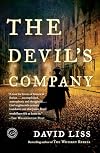
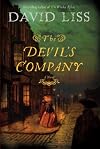
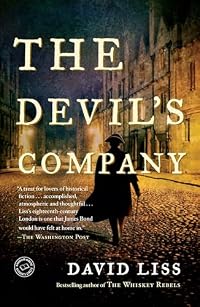
My Review: Seriously ugly jacket.
Book is, well, book is...really well plotted, filled with characters whose ideas and motivations I get and even support, and told in a very engaging way.
Liss's trademark business angle is very much in evidence in this book. It's set partially within the confines of the East India Company, and quite a lot of the action takes place around the various business concerns of the characters; all handled in such a way as to make it clear that this story arises from those concerns, driving each actor to his or her next action. It's enviable, the way Liss can see the story in the business and not just the business in the story.
I like this book. I like the hero. I like the way early capitalist London is presented to our senses, and how the author brings us along in our readerly sense of how the sleuth is going to develop across the series.
So why a mingy three-and-a-half?
Because: 1) Several people die, one of whom I know to be a real blow to the future of the series, and in each case the event with its aftermath is curiously flat. The sleuth's response is well-enough drawn, but it's not...the stakes aren't *there* for the (or this) reader. And the quite, quite startling aftermath of one quite important death is announced and left for later, while some very exciting other plot stuff happens.
See? I shouldn't be able to type that sentence without the Nasty Fairy whackin' me a good one, sayin' "too far, boy!" But his whackin' wand is not raised.
2) A surprise reveal late in the chase portion of the story falls sort of flat as well, and a character whose character we are given no reason to admire is revealed to be so amoral as to have—gasp, say it isn't so—slept with men and women both, and for profit! Wouldn't even cause an eyeblink if this were not a) the only time this concept has ever been brought up in the series, and b) a trait presented as somehow amplifying the character's extant perceived vileness.
Full marks for fairness: Benjamin, the sleuth and a self-described vigorously straight man (yawn) does some surprising soul-searching about his sodomitical revulsion. The whorehouse madam makes a pretty good case for the sodomites she serves being pretty much just like the rest of the world. And in the end, a straight man who doesn't write pure scary-o-types when discussing the more fluid borders of sexuality is more to be praised than not. It just doesn't sit right in this case.
3) The Love Interest. Oh god. We now reach the portion of our series where the sleuth must Fall In Love, and with a worthy adversary. Just once, one lousy time, I'd like to see a likable hero like Benjamin Weaver make it through an entire series without a Love Interest. I know it's what the market likes, but yeesh. I content myself with observing that she's a interesting character in her own right.
I like the sleuth, I like the series, and I will buy the next one. You should too.
Recommended for Anglomanes, for business buffs, and for puzzle people; historical fanciers will hyperventilate at some of Liss's more atmospheric passages; and international intrigue fans...stay tuned.... show less
The Publisher Says: The year is 1722. Ruffian for hire, ex-boxer, and master of disguise, Weaver finds himself caught in a deadly game of cat and mouse, pitted against Jerome Cobb, a wealthy and mysterious schemer who needs Weaver’s strength and guile for his own treacherous plans.
Weaver is blackmailed into stealing documents from England’s most heavily guarded estate, the headquarters of the ruthless British East India Company, but the theft of corporate secrets is only the first move in a daring conspiracy within the eighteenth century’s most powerful corporation. To save his friends and family from Cobb’s reach, Weaver must infiltrate the Company, navigate its warring factions, and uncover a secret show more plot of corporate rivals, foreign spies, and government operatives. With millions of pounds and the security of the nation at stake, Weaver will find himself in a labyrinth of hidden agendas, daring enemies, and unexpected allies.
With the explosive action and scrupulous period research that are David Liss’s trademarks, The Devil’s Company, depicting the birth of the modern corporation, is the most impressive achievement yet from an author who continues to set ever higher standards for historical suspense.
I RECEIVED AN ARC FROM THE PUBLISHER. THANK YOU.
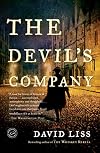
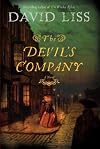
My Review: Seriously ugly jacket.
Book is, well, book is...really well plotted, filled with characters whose ideas and motivations I get and even support, and told in a very engaging way.
Liss's trademark business angle is very much in evidence in this book. It's set partially within the confines of the East India Company, and quite a lot of the action takes place around the various business concerns of the characters; all handled in such a way as to make it clear that this story arises from those concerns, driving each actor to his or her next action. It's enviable, the way Liss can see the story in the business and not just the business in the story.
I like this book. I like the hero. I like the way early capitalist London is presented to our senses, and how the author brings us along in our readerly sense of how the sleuth is going to develop across the series.
So why a mingy three-and-a-half?
Because: 1) Several people die, one of whom I know to be a real blow to the future of the series, and in each case the event with its aftermath is curiously flat. The sleuth's response is well-enough drawn, but it's not...the stakes aren't *there* for the (or this) reader. And the quite, quite startling aftermath of one quite important death is announced and left for later, while some very exciting other plot stuff happens.
See? I shouldn't be able to type that sentence without the Nasty Fairy whackin' me a good one, sayin' "too far, boy!" But his whackin' wand is not raised.
2) A surprise reveal late in the chase portion of the story falls sort of flat as well, and a character whose character we are given no reason to admire is revealed to be so amoral as to have—gasp, say it isn't so—slept with men and women both, and for profit! Wouldn't even cause an eyeblink if this were not a) the only time this concept has ever been brought up in the series, and b) a trait presented as somehow amplifying the character's extant perceived vileness.
Full marks for fairness: Benjamin, the sleuth and a self-described vigorously straight man (yawn) does some surprising soul-searching about his sodomitical revulsion. The whorehouse madam makes a pretty good case for the sodomites she serves being pretty much just like the rest of the world. And in the end, a straight man who doesn't write pure scary-o-types when discussing the more fluid borders of sexuality is more to be praised than not. It just doesn't sit right in this case.
3) The Love Interest. Oh god. We now reach the portion of our series where the sleuth must Fall In Love, and with a worthy adversary. Just once, one lousy time, I'd like to see a likable hero like Benjamin Weaver make it through an entire series without a Love Interest. I know it's what the market likes, but yeesh. I content myself with observing that she's a interesting character in her own right.
I like the sleuth, I like the series, and I will buy the next one. You should too.
Recommended for Anglomanes, for business buffs, and for puzzle people; historical fanciers will hyperventilate at some of Liss's more atmospheric passages; and international intrigue fans...stay tuned.... show less
I was fortunate to win an ARC of this book in the Good Reads giveaways.
David Liss spins another rolicking tale of murder, blackmail, intrigue, espionage, and phaeton chases. I was caught in the action in the first few pages and could barely put the book down until I was done! Often times I peg the plot in a book like this quite a while before the ending, but this book kept me guessing right up to the end.
Thiefcatcher Benjamin Weaver is the Sherlock Holmes of the 1720s. In Liss's latest tale, Mr. Weaver has been put into service against his will and must discover what his employer wants before it is too late for his friends.
The 1700s are one of my favorite eras, and I applaud Liss for the effort he puts into making 18th century London show more come alive. From the squalor of the street urchins to the foppish high-society dandies, David Liss just "gets it right".
I was also impressed by Liss's Conspiracy of Paper, he seems to have only gotten better with time. show less
David Liss spins another rolicking tale of murder, blackmail, intrigue, espionage, and phaeton chases. I was caught in the action in the first few pages and could barely put the book down until I was done! Often times I peg the plot in a book like this quite a while before the ending, but this book kept me guessing right up to the end.
Thiefcatcher Benjamin Weaver is the Sherlock Holmes of the 1720s. In Liss's latest tale, Mr. Weaver has been put into service against his will and must discover what his employer wants before it is too late for his friends.
The 1700s are one of my favorite eras, and I applaud Liss for the effort he puts into making 18th century London show more come alive. From the squalor of the street urchins to the foppish high-society dandies, David Liss just "gets it right".
I was also impressed by Liss's Conspiracy of Paper, he seems to have only gotten better with time. show less
This book was SO MUCH FUN. Our hero, Benjamin Weaver, battles the East India Company and about sixteen different agendas within it. The details got incredibly convoluted but were never too hard to follow, and the action kept me riveted. Weaver is sympathetic while being realistically flawed, and buckles are swashed, while at the same time I learned a fair amount about trade and eighteenth-century London. I will definitely be seeking out Liss' other books.
This review was written for LibraryThing Early Reviewers.Lots of cloak and dagger intrigue, strong plot, great characters, excellent timing and settings. Ben Weaver is a wonderfully clever, caring and strong hero.
Enjoyable read.
Enjoyable read.
I thoroughly enjoyed David Liss's previous books featuring Benjamin Weaver, a Jewish ex-boxer making his way as a detective in London. (And yes, I mention the religion for a reason. Judaism is part of all Liss's novels historical novels, and while it is never at the forefront of the plot, it is definitely a key component of the background.) I admit I don't remember the first two very well at all- I read them some years ago- but I do remember liking them. So I was really excited to get this book through LibraryThing's Early Reviewers program, and I wasn't disappointed at all.
David Liss knows early 18th century England well, from London's neighborhoods to the political maneuverings of the East India Company. He is also very realistic in show more his portrayal of characters. He does not give his characters modern sensibilities. I really appreciate that in a historical novel because frankly, that's the point of reading them. I don't need to read about 18th century London if everyone populating the book's pages has the same thought process that I do.
One thing that did seem to ring false, though, was the East India Company corporate slant. I understand that the East India Company was the first multi-national corporation complete with stockholders. I also understand that the directors of the firm, and people further down the ladder, were ruthless in their methods to get as much profit as possible. However, I think that Liss put a slightly too modern slant on the way everyone reacted to the company in the book. It was pretty clear that Liss was writing to an audience that is currently going through a global recession in which corporate greed features prominently. It's all well to assume people now should know about corporate responsibility and the effects capitalism can have in many sectors. But I don't quite buy into the way everyone in 1722 seemed just to know what would happen to the East India Company, Britain, and the world, when it was the first-ever corporation.
That concern didn't hamper my enjoyment of the novel, though. It is fast-paced, populated with interesting characters, and fun to read. Another historical mystery winner.
http://aartichapati.blogspot.com/2009/07/devils-company.html show less
David Liss knows early 18th century England well, from London's neighborhoods to the political maneuverings of the East India Company. He is also very realistic in show more his portrayal of characters. He does not give his characters modern sensibilities. I really appreciate that in a historical novel because frankly, that's the point of reading them. I don't need to read about 18th century London if everyone populating the book's pages has the same thought process that I do.
One thing that did seem to ring false, though, was the East India Company corporate slant. I understand that the East India Company was the first multi-national corporation complete with stockholders. I also understand that the directors of the firm, and people further down the ladder, were ruthless in their methods to get as much profit as possible. However, I think that Liss put a slightly too modern slant on the way everyone reacted to the company in the book. It was pretty clear that Liss was writing to an audience that is currently going through a global recession in which corporate greed features prominently. It's all well to assume people now should know about corporate responsibility and the effects capitalism can have in many sectors. But I don't quite buy into the way everyone in 1722 seemed just to know what would happen to the East India Company, Britain, and the world, when it was the first-ever corporation.
That concern didn't hamper my enjoyment of the novel, though. It is fast-paced, populated with interesting characters, and fun to read. Another historical mystery winner.
http://aartichapati.blogspot.com/2009/07/devils-company.html show less
This review was written for LibraryThing Early Reviewers.Members
- Recently Added By
Lists

Historical Fiction
889 works; 91 members
Author Information

71+ Works 9,894 Members
David Liss was born in New Jersey in 1966. He received an B.A. from Syracuse University, an M.A. from Georgia State University, and an M.Phil from Columbia University. His debut novel, A Conspiracy of Paper (2000), won the 2001 Barry, MacAvity, and Edgar awards for Best First Novel. His other works include The Coffee Trader (2003), A Spectacle of show more Corruption (2004), The Ethical Assassin (2006), The Whiskey Rebels (2008), and The Devil's Company (2009). (Bowker Author Biography) show less
Awards and Honors
Distinctions
Series

Common Knowledge
- Canonical title
- The Devil's Company
- Original publication date
- 2009-07-07
- People/Characters
- Benjamin Weaver; Jerome Cobb; Elias
- Important places
- London, England, UK
- First words
- In my youth I suffered from too close a proximity to gaming tables of all descriptions, and I watched in horror as Lady Fortune delivered money, sometimes not precisely my own, into another's hands.
- Last words
- (Click to show. Warning: May contain spoilers.)If a man had a delicate enough instrument, he might be able to measure the effect, but the storm would still rage according to its inclination; it would do its damage, and the world would never know that someone had exerted his will, perhaps all of his will, in the effort to lessen its force.
Classifications
Statistics
- Members
- 809
- Popularity
- 34,010
- Reviews
- 43
- Rating
- (3.79)
- Languages
- English, German, Russian, Spanish
- Media
- Paper, Audiobook, Ebook
- ISBNs
- 17
- ASINs
- 6