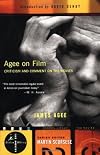
Agee on film : criticism and comment on the movies
by James Agee
On This Page
Description
Collects reviews of the movie critic who wrote for Time magazine and The Nation during the 1940s.Tags
Recommendations
















Member Reviews
James Agee was a very good writer with a very good novel "A Death in the Family" to his credit, and three film scripts produced. He is reasonably lauded for his efforts. The USA of his times, the 1940's and 50's did not give him his due and this volume contains his essay on silent film comedies, and the film reviews he wrote for "The Nation" and "Time" magazines. His reviews set a very high standard of readability and sound analysis and are an education for those of us laying down reviews for Library thing. And all of us should read them. My copy is Grosset's universal Library, 1969.
Ratings
Members
- Recently Added By
Published Reviews
ThingScore 100
Was Agee’s moviegoing so virtuous, or did he, perhaps, now and then, like the rest of us, enjoy decadent, sleazy, slick commercial pictures? We ought to be able to see a reasonably lousy picture without feeling we’ve been violated. Agee always seemed to feel personally betrayed by synthetic elements in a movie, by “sophistication.”
Because Agee was so great a critic, there is a tendency show more to take over his terms, but his excessive virtue may have been his worst critical vice. Agee’s demands were, in some ways, both impossibly high for the movie medium and peculiarly childlike... I don’t think we would be expected to respond to this sort of thing in literature, but, possibly because of Agee’s influence, we are expected to have very simple tastes when it comes to movies. Yet simple people in simple stories made some of us yawn even as children — which is probably why we started going to the movies. The place for goodness is in life, not on the screen. I realize that Agee used words like “love” and “purity” in order to get away from clever language and professional jargon — that he wanted language as well as movies cleansed — but though movies need cleansing more than ever, we mustn’t throw the whore out with the bath water. show less
Because Agee was so great a critic, there is a tendency show more to take over his terms, but his excessive virtue may have been his worst critical vice. Agee’s demands were, in some ways, both impossibly high for the movie medium and peculiarly childlike... I don’t think we would be expected to respond to this sort of thing in literature, but, possibly because of Agee’s influence, we are expected to have very simple tastes when it comes to movies. Yet simple people in simple stories made some of us yawn even as children — which is probably why we started going to the movies. The place for goodness is in life, not on the screen. I realize that Agee used words like “love” and “purity” in order to get away from clever language and professional jargon — that he wanted language as well as movies cleansed — but though movies need cleansing more than ever, we mustn’t throw the whore out with the bath water. show less
added by SnootyBaronet
Lists

Sight and Sound's Best Film Books
34 works; 1 member

Film
114 works; 1 member
Author Information

42+ Works 7,944 Members
Born in Knoxville, Tennessee, on November 27, 1909 and educated at Harvard, James Agee crowded versatile literary activity into his short and troubled life. In addition to two novels, he wrote short stories, essays, poetry, and screenplays; he worked professionally as a journalist and film critic. Appropriately, he is best remembered for a work show more that combines several genres and literary approaches. Let Us Now Praise Famous Men, a documentary report on sharecropper life accompanied by vividly realistic photographs by Walker Evans, has been called "a great Moby Dick of a book" (New York Times Book Review). It may be considered an important precursor of the so-called nonfiction novel that was to gain prominence during the 1960s. The Morning Watch (1954), a novel in the tradition of portraits of artists-to-be, and A Death in the Family, a moving account of domestic life based on the loss of Agee's father belong to more conventional types of fiction. The 1960 dramatization of All the Way Home by Tad Mosel, won a Pulitizer Prize and the New York Drama Critics Circle Award; it was also cited by Life as the "Best American Play of the Season." Agee's work for the screen included his scripts for The African Queen and The Night of the Hunter. Agee on Film (1958-60) consists of a gathering of reviews and comments as well as five scripts. Prior to Laurence Bergreen's well-received 1984 biography of Agee, the principal source of information about his life was Letters of James Agee to Father Flye, a collection of seventy letters written by Agee to his instructor at St. Andrew's School and trusted friend throughout his life. The letters show Agee most often in a reflective, self-condemning mood. The final letters, written from the hospital where he was battling daily heart attacks, are touching, as are his sad reflections on the work he yet wanted to do. Agee died in New York of a heart attack on May 16, 1955. He was posthumously awarded a Pulitzer Prize in 1957 for A Death in the Family. (Bowker Author Biography) show less
Some Editions
Awards and Honors
Work Relationships
Is contained in
Is abridged in
Common Knowledge
- Canonical title
- Agee on film : criticism and comment on the movies
- Original title
- Agee on film: Reviews and comments
- Original publication date
- 1958
- Quotations
- The picture deserves, like four out of five other movies, to walk alone, tinkle a little bell, and cry “Unclean, unclean.”
Classifications
- Genres
- Nonfiction, General Nonfiction
- DDC/MDS
- 791.4309 — Arts & recreation Recreation, sports, and performing arts Public performances Motion pictures, radio, television, podcasting Motion pictures Standard subdivisions History, geographic treatment, biography; description, critical appraisal of specific companies and studios {for specific films see 791.437}
- LCC
- PN1993.5 .A1 .A35 — Language and Literature Literature (General) Literature (General) Drama Motion pictures
- BISAC
Statistics
- Members
- 298
- Popularity
- 107,409
- Reviews
- 1
- Rating
- (4.13)
- Languages
- English, French, Spanish
- Media
- Paper
- ISBNs
- 6
- ASINs
- 15