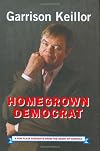
Homegrown Democrat: A Few Plain Thoughts from the Heart of America
by Garrison Keillor
On This Page
Description
In his inimitable style, Keillor draws on a lifetime of experience amongst the hardworking, God-fearing people of the Midwest and pays homage to the common code of civic necessities that arose from the left: Protect the social compact. Defend the powerless. Maintain government as a necessary force for good. As Keillor tells it, these are articles of faith that are being attacked by hard-ass Republican tax cutters who believe that human misery is a Dickensian fiction. In a blend of nostalgic show more reminiscence, humorous meditation, and articulate ire, Keillor asserts the value of his boyhood, the values of Lake Wobegon, that do not square with the ugly narcissistic agenda at work in the country today. show lessTags
Recommendations
































Member Reviews
So, from now on, when people in the Bible Belt and Southern California ask me how I can possibly be a Democrat (capital 'D'), I will hand them a copy of this book. It does no good for me to tell them simply that I am a Democrat (capital "D') because I went to church and read the bible. When I quote that Jesus instructed us to 1) love God above all else, and 2) love your neighbor as yourself and that 3) these two sum up the teachings of the whole, I get blank stares from righteous, bible-thumping, redneck, blowhards. It doesn't compute. Thank the Lord there is Garrison Keillor who just plain gets me.
"This is Democratic bedrock: we don't let people lie in the ditch and drive past and pretend not to see them dying" (Keillor, 2004, p. show more 137)...The child's suffering has nothing to do with them. So the kid goes to relatives who also have a history of abuse. It's no skin off the redneck's nose. He's got a giant TV, 99 channels of cable, a snowmobile, a Hummer, a collection of guns, a boat, Jet Skis, he's sitting pretty. The demise of somebody else's kid at the hands of a drunken uncle is nothing but roadkill to him. This is the screw-you philosophy that festers under cover of modern Republicanism" (Keillor, 2004, p. 138).
One reviewer stated that this book is part polemic. I beg to differ. It is a full polemic. Keillor had some things to get off his chest, and being a writer, he took recourse through the gift given him: he wrote a book. What a comfort to see what is rolling around in my head set down in print. Keillor offers gems of sardonic entertainment at the expense of Republicans. But, let's face it, Republicans deserve it. Republicans enjoy the fruits of the government Democrats created...from public education to public roads, from freedom of religion to capitalism, but they refuse to foster the principles and tools that keep these things functioning. I have lived outside the U.S. in places where security is privatized because the local police cannot be trusted...where it's every man for himself and screw you otherwise, where a person lying dying in the road is a curiosity to pass the lunch hour instead of the loss of a precious human life that deserves help and urgency. I do not want America to be that type of place. ((God help us.)) As long as there are people like Keillor and myself...plus a multitude of other fair-minded, hard-working, Democrats (capital 'D')...we just might be able to combat the arrogance, selfishness, dystopian incivility that hallmarks the modern Republican (capital 'R') party. show less
"This is Democratic bedrock: we don't let people lie in the ditch and drive past and pretend not to see them dying" (Keillor, 2004, p. show more 137)...The child's suffering has nothing to do with them. So the kid goes to relatives who also have a history of abuse. It's no skin off the redneck's nose. He's got a giant TV, 99 channels of cable, a snowmobile, a Hummer, a collection of guns, a boat, Jet Skis, he's sitting pretty. The demise of somebody else's kid at the hands of a drunken uncle is nothing but roadkill to him. This is the screw-you philosophy that festers under cover of modern Republicanism" (Keillor, 2004, p. 138).
One reviewer stated that this book is part polemic. I beg to differ. It is a full polemic. Keillor had some things to get off his chest, and being a writer, he took recourse through the gift given him: he wrote a book. What a comfort to see what is rolling around in my head set down in print. Keillor offers gems of sardonic entertainment at the expense of Republicans. But, let's face it, Republicans deserve it. Republicans enjoy the fruits of the government Democrats created...from public education to public roads, from freedom of religion to capitalism, but they refuse to foster the principles and tools that keep these things functioning. I have lived outside the U.S. in places where security is privatized because the local police cannot be trusted...where it's every man for himself and screw you otherwise, where a person lying dying in the road is a curiosity to pass the lunch hour instead of the loss of a precious human life that deserves help and urgency. I do not want America to be that type of place. ((God help us.)) As long as there are people like Keillor and myself...plus a multitude of other fair-minded, hard-working, Democrats (capital 'D')...we just might be able to combat the arrogance, selfishness, dystopian incivility that hallmarks the modern Republican (capital 'R') party. show less
I became a Democrat because I was eager and hopeful, not because I was angry. Anger makes for amusing radio shows but it's got a short shelf life. It's a crummy way to live. Your mother was right: forgive and forget. Live in the present and you'll be happier.
So says Garrison Keillor in his 2004 book [Homegrown Democrat]. I bought and read it a dozen years ago. Having just re-read it, I think the book is more relevant than ever. It's part memoir, part civics lesson. And it's couched in that calm, passionate, and compassionate voice of Lake Wobegone's creator. I recommend it highly.
What Keillor does is explain many of the dominant characteristics of Democrats through examples from his life and his home region. He describes the sort of show more behavior his parents expected of him, the impact of his education in public schools, and his experiences, inside the lecture halls and out, at the University of Minnesota. He describes too the blessings that government programs and services have brought to him and his family. Here are some quotes from the book:
Liberalism is the politics of kindness.
And…
Republicans are all about Old Glory and school prayer and the sanctity of marriage and the Fatherhood of God but when it comes to actually needing help from them, you shouldn't get your hopes up. They might send an ambulance or they might just send a Get Well card.
And…
Three years ago after I suddenly turned into a wheezy old man who woke up in the night feeling suffocated, Dr. Orczulak at Mayo opened up my thorax and sewed a leaky valve in my heart, a dramatic procedure whose perfection over the past fifty years was heavily subsidized by the taxpaying public….Thank you, America. How could I, whose life has been extended by this largesse, turn into an angry right-winger, a knee-jerk tax cutter, flogging public employees and the very idea of public service?
And…
We [Democrats] care less about symbolism and enacting our own theology into law...and we care more about the ordinary essentials of life. The New Deal put real people to work. My uncle Don was 18 in Wausau, Wisconsin, a big red-haired football star with no prospects, and got a job with the Civilian Conservation Corps and went off to build paths in national parks, a big experience for him. The Rural Electrification Act extended electric power to farms and villages that couldn't afford the capital investment: good old American socialism. The Keillor farm was one of them. They wired the barn so Uncle Jim had steady light to milk the cows by on winter mornings and a fluorescent light in the kitchen so he could read the Bible at night. Democrats brought about the school lunch program and the Public Health Service and integrated the armed forces, which then became a model of how Americans can be not so hung up on race. Democrats produced Head Start and food stamps and funded the college buildings to house the wave of boomers in the Seventies. The goal of Democrats has been to make this a nation of the middle class—educated people who own property and have a stake in the community and aren't easily bullied—and the most dramatic program was the GI Bill of Rights, which boosted a whole generation into the ranks of white-collar professionals.
And…
I wish that Republicans had a little more genuine love of this country …
They denounce government as if it had only repressed them and civilization frustrated their noblest instincts, to which I say: "Wyoming. Go there. Try western North Dakota." Go find a tanktown on the old N.P. line and wrest your living from the dry soil and be as paranoid and angry as you like. It's a big country; the principles of Republicans may work very well on a 5000-acre ranch. But you can't run cities that way and cities are where most people live.
Both thumbs up, sez I. show less
In Homegrown Democrat, Garrison Keillor offers a deeply personal and insightful take on the values he associates with the Democratic party. Notable for his wit and affectionate depiction of Midwestern life, Keillor ventures into the realm of political ideology in this book. The central attraction for me lies in Chapter 11, where Keillor enumerates what he believes to be the ten defining values of “The Good Democrat”:
Changes in Democratic Values
Nearly two decades have passed since the publication of this work. In that time, the political landscape has evolved significantly. While Keillor's ten values may still resonate with some, there has been a perceptible shift within the Democratic party. The emphasis on social justice, environmental sustainability, and wealth inequality have become more pronounced. A new generation of Democrats, often referred to as the progressive wing, has also emerged, advocating for more sweeping reforms such as Medicare for All and the Green New Deal. The party now appears to be a more complex tapestry of ideologies and priorities than Keillor depicted in 2004.
Comparison to Classical Liberalism
I came across this book while doing some research on Classical Liberalism (belief in individual liberty, limited government, the rule of law, and free markets). When comparing Keillor's Democrat values to the principles of Classical Liberalism, there are some intriguing parallels as well as distinctions.
In essence, while Keillor's Democratic values and Classical Liberalism share a belief in individualism and a skepticism of unchecked authority, they differ in their approaches to social issues and the role of government in addressing inequalities.
Key Takeaways for a Student of Politics
For students of politics, Homegrown Democrat serves as a snapshot of Democratic values as seen by a Midwestern Democrat in the early 2000s. It provides a window into the core principles that have historically guided the party. Students can use this as a basis to examine the evolution of the Democratic party and to understand the internal diversification of political beliefs within the party. Moreover, comparing these values to different political ideologies, such as Classical Liberalism, can provide insights into the shifting alliances and priorities within American political parties over time. Lastly, it's a reminder that political values are deeply personal and can be grounded in cultural and geographical identities.
All in all, a good read. show less
- Democrats distrust privilege and power.
- Equality is a democratic bedrock.
- We Democrats are inclusive and integrationist to the core.
- Democrats are city people at heart, even if we love the country and small-town life, as I do, nonetheless the city is the crowning achievement of society.
- Democrats believe in
- individualism.
- Democrats are union guys.
- A Democrat begins with sympathy for the helpless, especially children and the elderly.
- Democrats are diehard teachers.
- Democrats are realists.
- The values of Democrats are rooted in courtesy and kindness.
Changes in Democratic Values
Nearly two decades have passed since the publication of this work. In that time, the political landscape has evolved significantly. While Keillor's ten values may still resonate with some, there has been a perceptible shift within the Democratic party. The emphasis on social justice, environmental sustainability, and wealth inequality have become more pronounced. A new generation of Democrats, often referred to as the progressive wing, has also emerged, advocating for more sweeping reforms such as Medicare for All and the Green New Deal. The party now appears to be a more complex tapestry of ideologies and priorities than Keillor depicted in 2004.
Comparison to Classical Liberalism
I came across this book while doing some research on Classical Liberalism (belief in individual liberty, limited government, the rule of law, and free markets). When comparing Keillor's Democrat values to the principles of Classical Liberalism, there are some intriguing parallels as well as distinctions.
- Both Keillor's Democrats and Classical Liberals uphold the value of individualism. However, where Keillor places emphasis on community support and unionism, Classical Liberals are more focused on the primacy of individual rights and minimizing state interference.
- Keillor’s emphasis on inclusivity and integration has echoes in Classical Liberalism's advocacy for equality under the law. However, Classical Liberalism traditionally focused more on legal equality rather than addressing social inequalities.
- Democrats’ skepticism of privilege and power as highlighted by Keillor has a parallel in Classical Liberalism's wariness of unchecked authority. Nonetheless, Keillor’s Democrats may be more inclined to utilize government as a tool to redress social inequalities, whereas Classical Liberals would be cautious of expanding government power.
- Keillor’s emphasis on sympathy for the helpless is a more socially oriented principle. In contrast, Classical Liberals might advocate for charitable and community solutions rather than government intervention to aid the needy.
- The Democratic value of being diehard teachers, as Keillor mentions, signifies an emphasis on education and knowledge dissemination, which can be aligned with the Classical Liberal belief in an informed citizenry as vital for a functioning democracy.
In essence, while Keillor's Democratic values and Classical Liberalism share a belief in individualism and a skepticism of unchecked authority, they differ in their approaches to social issues and the role of government in addressing inequalities.
Key Takeaways for a Student of Politics
For students of politics, Homegrown Democrat serves as a snapshot of Democratic values as seen by a Midwestern Democrat in the early 2000s. It provides a window into the core principles that have historically guided the party. Students can use this as a basis to examine the evolution of the Democratic party and to understand the internal diversification of political beliefs within the party. Moreover, comparing these values to different political ideologies, such as Classical Liberalism, can provide insights into the shifting alliances and priorities within American political parties over time. Lastly, it's a reminder that political values are deeply personal and can be grounded in cultural and geographical identities.
All in all, a good read. show less
I have mixed feelings about this book which someone left in my own Little Free Library. I had always seen many books by this author but never felt compelled to read any of them. I noticed the word Democrat in the title so I started to browse through it. It seemed interesting enough so I started reading it. Then I got a creepy feeling when I learned that the author was one of those men who was recently accused of sexual harassment. I decided to finish reading the book anyway.
Basically the book glorifies Democrats and bashes Republicans. I was surprised at the hateful rhetoric used in this book against Republicans because this book was published in 2004. The venom is just the same as now (2018) regardless of which side of the fence one show more stands on. I did not know this partisan hatred had been so deep for so long. I felt depressed after reading this book, not relieved.
One thing that did surprise me, however, was that the author, who is from rural Minnesota, is such a staunch Democrat. So much for stereotypes (although I personally don't believe in them).
I probably would not recommend this book, more because it is dated than anything else. However, I'm glad I had the chance to read it. show less
Basically the book glorifies Democrats and bashes Republicans. I was surprised at the hateful rhetoric used in this book against Republicans because this book was published in 2004. The venom is just the same as now (2018) regardless of which side of the fence one show more stands on. I did not know this partisan hatred had been so deep for so long. I felt depressed after reading this book, not relieved.
One thing that did surprise me, however, was that the author, who is from rural Minnesota, is such a staunch Democrat. So much for stereotypes (although I personally don't believe in them).
I probably would not recommend this book, more because it is dated than anything else. However, I'm glad I had the chance to read it. show less
I love Keillor, the way he writes, what he
has to say, and this book didn't disappoint. It's completely unlike his
other books, though. He's written novels, anthologies, poetry, essays,
columns and articles, and I've read all of them (I think) but this one
was different. This one came from his heart and you could tell it.
The book was written before the 2004 election, but that hardly matters. This
isn't a diatribe against Republicans or against Bush, so it is pretty
much timeless, I think. Keillor's upbringing was a lot like mine, from
a place and time where people who worked hard for a living and believed
in helping their neighbors were all Democrats because that's who
Democrats ARE. Keillor spends about half the book discussing the show more basic
philosophical differences between Democrats and Republicans with a
directness and great insight into what it is, exactly, that makes them
tick. Personally, I feel he nailed it right on the head. He tells it
in such a way that the reader discovers that the label "liberal" isn't
something to be ashamed of at all.
A lot of the book is spent in his own personal memories of the 1950s
through the 1980s as this country went through massive changes and young
adults of the baby boomer generation formed their own political
opinions. I found this interesting because I'd had a lot of the same
thoughts and reactions to things like Kennedy's assassination, the war
in Vietnam, Nixon's resignation, etc.
I enjoyed this book a bunch and my only complaint is that it was far too
short. Like any other Keillor work, I was sorry to see it end. I give
it a 5. show less
has to say, and this book didn't disappoint. It's completely unlike his
other books, though. He's written novels, anthologies, poetry, essays,
columns and articles, and I've read all of them (I think) but this one
was different. This one came from his heart and you could tell it.
The book was written before the 2004 election, but that hardly matters. This
isn't a diatribe against Republicans or against Bush, so it is pretty
much timeless, I think. Keillor's upbringing was a lot like mine, from
a place and time where people who worked hard for a living and believed
in helping their neighbors were all Democrats because that's who
Democrats ARE. Keillor spends about half the book discussing the show more basic
philosophical differences between Democrats and Republicans with a
directness and great insight into what it is, exactly, that makes them
tick. Personally, I feel he nailed it right on the head. He tells it
in such a way that the reader discovers that the label "liberal" isn't
something to be ashamed of at all.
A lot of the book is spent in his own personal memories of the 1950s
through the 1980s as this country went through massive changes and young
adults of the baby boomer generation formed their own political
opinions. I found this interesting because I'd had a lot of the same
thoughts and reactions to things like Kennedy's assassination, the war
in Vietnam, Nixon's resignation, etc.
I enjoyed this book a bunch and my only complaint is that it was far too
short. Like any other Keillor work, I was sorry to see it end. I give
it a 5. show less
I love Garrison Keillor's wry sense of humor. He does an admirable job tempering his disdain for neo-con politics, delivering a very common sense description of his upbringing and why he believes as he does. Hearing his melodic voice in the audio-book was a much calmer experience than watching, say, a Michael Moore film.
I recommend hearing him out on this book. His mid-western honesty is refreshing and encouraging. It renewed my party non-affiliation. While I agreed with his attack on typical Republican politics, I see many of the same errors in Obama's lack of action. He proudly discusses the local coffee shop and does indicate that it is supporting local small business over corporate interests that he holds close to his heart. My show more viewpoints align very much with his. I guess I would have just tried not to exclude so many readers with the title he chose. show less
I recommend hearing him out on this book. His mid-western honesty is refreshing and encouraging. It renewed my party non-affiliation. While I agreed with his attack on typical Republican politics, I see many of the same errors in Obama's lack of action. He proudly discusses the local coffee shop and does indicate that it is supporting local small business over corporate interests that he holds close to his heart. My show more viewpoints align very much with his. I guess I would have just tried not to exclude so many readers with the title he chose. show less
From his books and stories on the radio, I always guessed that Garrison Keillor was a reasonable and civil man who stood for the role of government in protecting the weak and helpless. And lo and behold, he writes a political book making just that case. Keillor's position is that the Democratic party is responsible for most of the legislation that has protected the rights of average (and not-so-average) Americans, and that the current meanness and forced conformity of the Republican party are detrimental to America. And as always, he writes with a folksy and earnest charm that makes it plain that he welcomes informed and civil discourse, and disagreement. Rush Limbaugh and Ann Coulter should read this book, although I doubt that it show more would make any difference. show less
Members
- Recently Added By
Author Information

188+ Works 23,128 Members
Humorist Garrison Keillor was born Gary Edward Keillor in Anoka, Minnesota on August 7, 1942. He began using the pen name Garrison at the age of thirteen. He received a B.A. from the University of Minnesota in 1966 and paid for his tuition by working at the campus radio station. In 1974, he wrote an essay for the New Yorker about the Grand Ole show more Opry, which led to his live radio program, A Prairie Home Companion. Stories from Prairie Home were collected and published, but his debut as a novelist was in 1985 with Lake Wobegon Days. His other novels include WLT: A Radio Romance, The Book of Guys, Wobegon Boy, Me by Jimmy (Big Boy) Valente, and Good Poems, American Places. He has also written the children's books Cat, You Better Come Home, The Old Man Who Loved Cheese, and The Sandy Bottom Orchestra. He won a Grammy Award for his recording of Lake Wobegon Days and was inducted into the National Radio Hall of Fame in 1994. Keillor received a National Humanities Medal from the National Endowment for the Humanities in 1999. In September 2007, Keillor was awarded the John Steinbeck Award. (Bowker Author Biography) show less
Awards and Honors
Distinctions
Common Knowledge
- Original publication date
- 2004
- Dedication
- To all the good Democratic-Farmer-Laborites of Minnesota
- First words
- I am a Democrat, which was nothing I decided for myself but simply the way I was brought up, starting with the idea of Do unto others as you would have them do unto you, which is the basis of the simple social compact ... (show all)by which we live and also You are not so different from other people so don't give yourself airs, which was drummed into us children back in the old days when everyone went to public schools.
- Last words
- (Click to show. Warning: May contain spoilers.)If you see me, come sit down, there is more to talk about.
- Canonical DDC/MDS
- 320.973
- Canonical LCC
- JK1726
Classifications
- Genres
- Nonfiction, General Nonfiction, Politics and Government, Biography & Memoir
- DDC/MDS
- 320.973 — Society, government, & culture Political science Types of Government Political situation and conditions North America United States
- LCC
- JK1726 — Political Science Political institutions and public administration (United States) Political institutions and public administration United States Political rights. Practical politics
- BISAC
Statistics
- Members
- 580
- Popularity
- 51,040
- Reviews
- 10
- Rating
- (3.76)
- Languages
- English
- Media
- Paper, Audiobook, Ebook
- ISBNs
- 8
- UPCs
- 2
- ASINs
- 2