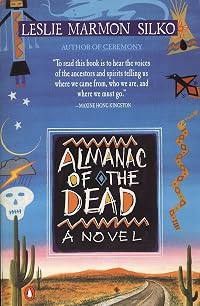
Almanac of the Dead
by Leslie Marmon Silko
On This Page
Description
A tour de force examination of the historical conflict between Native and Anglo Americans by critically acclaimed author Leslie Marmon Silko, under the hot desert sun of the American Southwest.In this virtuoso symphony of character and culture, Leslie Marmon Silko's breathtaking novel interweaves ideas and lives, fate and history, passion and conquest in an attempt to re-create the moral history of the Americas as told from the point of view of the conquered, not the conquerors. Touching on show more issues as disparate as the borderlands drug wars, ecological devastation committed for the benefit of agriculture, and the omnipresence of talking heads on American daytime television, The Almanac of the Dead is fiction on the grand scale, a sweeping epic of displacement, intrigue, and violent redemption. show less
Tags
Recommendations





Member Reviews
This was a really difficult book to read. It is very long, but somehow it's also very slow. I couldn't read a lot of it at one sitting and ended up having to borrow it from the library three times in order to finish it!
In many ways it seems prescient - we're hearing about migrants crossing the Mediterranean from Africa every day now, so the book's focus on mass waves of human movement from south to north seems to be true. The reliance of people on technology and electricity has only got worse in the twenty-something years since the book was published.
With the exception of Sterling and (to some extent) Seese, the characters outlined in the story are so unsympathetic that their stories are hard to read. They seem to be dispatched from the show more story very casually - almost as an afterthought in some cases.
For me the central message was about our connection or disconnection with the land. As a European living in North America I can't help but feel uncomfortable with some of the generalisations about white settlers - but then I can hardly complain about that when white settlers have been happily making much more crass generalisation about people of African and Native American origin for centuries. show less
In many ways it seems prescient - we're hearing about migrants crossing the Mediterranean from Africa every day now, so the book's focus on mass waves of human movement from south to north seems to be true. The reliance of people on technology and electricity has only got worse in the twenty-something years since the book was published.
With the exception of Sterling and (to some extent) Seese, the characters outlined in the story are so unsympathetic that their stories are hard to read. They seem to be dispatched from the show more story very casually - almost as an afterthought in some cases.
For me the central message was about our connection or disconnection with the land. As a European living in North America I can't help but feel uncomfortable with some of the generalisations about white settlers - but then I can hardly complain about that when white settlers have been happily making much more crass generalisation about people of African and Native American origin for centuries. show less
Most of the reviews on LT about this book all mention the length, and the disconnectedness of the narrative - both criticisms are on the money, but shouldn't keep you from reading the book. Length shouldn't matter if the book is good enough. The disconnectedness of the narrative did feel taxing about midway through the book, as I wasn't invested in some of the characters and stories - the early story, which loops back in is easily the best. But Silko is so far underappreciated in the literary world that I didn't waver in my conviction to continue. And, even in the darkest and most difficult pages, Silko always rewards the convicted reader with something. The mystical air and social justice foundation is evocative, especially as it's set show more in the Hispanic and Native communities, which is relatively unusual. The narrative follows different strands of those communities, spiraling back into the historical context of each. show less
Silko's meganovel is about people as dry of morality as Arizona deserts are of water—shriveled sanity is often eclipsed by mania, obsession, or sadism. For almost all of Almanac's characters, their entire motivation can be narrowed down to one overwhelming, rational or irrational force. For used, wrung-out, cocaine addict Seese, it is the search for her kidnapped infant son. For brooding, bitter Ferro, it is his attachment to the blond and beautiful Jamie as a replacement for his mother's early abandonment of him. For corrupt judge Arne, it is nightly sex with his basset hounds. The Americans she writes about are a spiritually hollow people, whether they are born spiritually malnourished and wanting like crack babies, or savagely show more carved out by society's greed and cruelty.
Almanac is written in such a way that the novel itself is a kind of almanac: the book is free of judgment, stylistic charisma, and authorial intent. The prose is undecorated and indiscriminate, which works both for and against it. We are fed human isolation, neurosis, and beautiful weirdness in a well-balanced diet and Silko is one of those rare authors who seems to be able to show us human actions with no agenda. However, because of this you can almost feel her getting bored with some of the characters' banal, one-note cruelties and fetishes. The novel's passages also swing from past to present tense, often from one paragraph to another, with no reasoning I could detect.
There is very little of what I'd call "redemption" in this book. Few characters "develop," but I wouldn't call this a novel about character development. It seems coldly sadistic at times, until you take a moment to realize that the bizarre evils are firmly based on true human tendencies. This is what made it a truly chilling read to me. At times it feels more like a record of America's spiritual sickness and many readers would probably find it inconclusive. Silko creates far too many characters to pull them all together in the end, but the overall feeling is still one of humming, suriving life-force and the resilliance of human beauty even within such thick, hopeless social disease. show less
Almanac is written in such a way that the novel itself is a kind of almanac: the book is free of judgment, stylistic charisma, and authorial intent. The prose is undecorated and indiscriminate, which works both for and against it. We are fed human isolation, neurosis, and beautiful weirdness in a well-balanced diet and Silko is one of those rare authors who seems to be able to show us human actions with no agenda. However, because of this you can almost feel her getting bored with some of the characters' banal, one-note cruelties and fetishes. The novel's passages also swing from past to present tense, often from one paragraph to another, with no reasoning I could detect.
There is very little of what I'd call "redemption" in this book. Few characters "develop," but I wouldn't call this a novel about character development. It seems coldly sadistic at times, until you take a moment to realize that the bizarre evils are firmly based on true human tendencies. This is what made it a truly chilling read to me. At times it feels more like a record of America's spiritual sickness and many readers would probably find it inconclusive. Silko creates far too many characters to pull them all together in the end, but the overall feeling is still one of humming, suriving life-force and the resilliance of human beauty even within such thick, hopeless social disease. show less
Before I read it, I heard this book was long, and BOY IS IT FUCKIN' LONG, Y'ALL. It's so, so long, and I would say the last third sort of feels like you're circling around a drain, slowly. It's certainly a beast to behold, and Silko does a great job of building up to her climax. It's also uh graphic as HELL--at one point, I described it as "indigenous Game of Thrones in Tucson" and I honestly stand by that, so please be wary as you approach this. If there's a trigger warning you can think of, this book has it. But it was definitely an adventure, and one that I will be chewing on for a while to come.
A prescient and complex tale of interconnected criminal and American Indian families around Tuscon Arizona, 'city of thieves'. A theme of the book is European injustice and violence towards Indians, and a prophesied end of European influence in the Americas.
Written in 1991 there are references to cybercrime, increasing natural disasters, ecoterrorism, water shortages and economic depression, the absolute callousness of the rich to the poor, increasing psychosis among white people. It could have been written about today (2023); if anything it has become more relevant over time.
Written in 1991 there are references to cybercrime, increasing natural disasters, ecoterrorism, water shortages and economic depression, the absolute callousness of the rich to the poor, increasing psychosis among white people. It could have been written about today (2023); if anything it has become more relevant over time.
Not the greatest book I have ever read, but certainly worth the time it took to get through it. Silko has a bad habit of being incredibly reductive about some very polarizing issues, not to mention seemingly quite ignorant about histories and peoples relations to it. Not to forget her borderline homophobia and racism at times. But with as much wrong with this book as there is (and there's a lot) I really enjoyed it. The discussion of revolution and all the conspiracy theories was interesting, but it is telling that Silko didn't feel the need to go further and actually SHOW us the revolution she spent almost eight hundred pages building up. A good (and surprisingly fast) read that will probably offend but also entertain, and maybe even show more inform. But probably not in the way the writer intended. Oh, and don't expect resolution/closure aside from -spoiler- character death, that would be a bit too conclusive for the kind of story written here. show less
Ceremony is one of the best books I've ever read--unique, stark, true. For that reason alone I wanted to give Almanac of the Dead every chance and I read it to the end--otherwise I would have given up after the first 100 pages or so. Even now I'm trying to give this book every possible excuse and to not judge and yet I still, after wracking my mind for all possible redemptive reasons for this book to be written as it is, find it without merit, a slog of words that are purposeless other than for their ability to shock, and then for their ability to surpass that shock with some new, greater shock, and to continue in this manner to continuously top itself with an ever increasing pile of grotesque bland pointless crap. Someone needed to show more stop Silko and get her on another path with this novel--she wasted far too many years on this book. Now and then come glimpses of the great writer she can be but the hope blinks out after a few sentences and I'm left once more with a mass of shit that keeps on coming. I don't buy the excuse that this novel's style has anything at all to do with non-European storytelling. It's just "bad" storytelling. show less
Members
- Recently Added By
Lists

50 Tough Books for Extreme Readers
71 works; 39 members

Most difficult novels
68 works; 27 members

Literary Witches
86 works; 4 members

Top 100 books by Indigenous Masters
134 works; 7 members

Myth (Reuse and Retelling)
188 works; 24 members

Indigenous America Reader
145 works; 12 members

Native American Heritage
52 works; 2 members
Author Information

22+ Works 6,879 Members
Leslie Marmon Silko was born in 1948 in Albuquerque, New Mexico. Growing up on a reservation, she went to Bureau of Indian Affairs schools before attending the University of New Mexico. She taught at the Navajo Community College in Arizona and is a professor of English at the University of Arizona, Tucson. Marmon has written short stories, poetry, show more plays and novels. Her books include Laguna Woman, Ceremony and Yellow Woman. (Bowker Author Biography) show less
Awards and Honors
Common Knowledge
- Original publication date
- 1991
- People/Characters
- Pueblo
- Important places
- New Mexico, USA
- Dedication
- To Larry, For all the Love
- First words
- The old woman stands at the stove stirring the simmering brown liquid with great concentration. Occasionally Zeta smiles as she stares into the big blue enamel pot. She glances up through the rising veil of team at the young ... (show all)blond woman pouring pills from brown plastic prescription vials. -Book One, Tucson, Unanswered Questions
- Canonical DDC/MDS
- 813.54
- Canonical LCC
- PS3569.I44 A79
Classifications
Statistics
- Members
- 1,061
- Popularity
- 24,343
- Reviews
- 17
- Rating
- (3.86)
- Languages
- English, German, Norwegian
- Media
- Paper, Ebook
- ISBNs
- 7
- ASINs
- 3