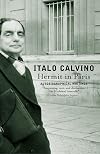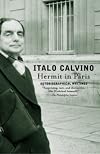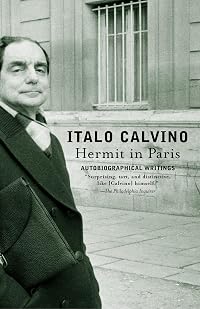
Hermit in Paris: Autobiographical Writings
by Italo Calvino
On This Page
Description
"As for my books, I regret not having published each one under a different nom de plume: that way I would feel freer to start again from scratch each time, just as I always try to do anyway." - from Hermit in Paris This posthumously published collection offers a unique, puzzle-like portrait of one of the postwar era's most inventive and mercurial writers. In letters and journals, occasional pieces and interviews, Italo Calvino recalls growing up in seaside Italy and fighting in the show more antifascist resistance during World War II, traces the course of his literary career, and reflects on his many travels, including a journey through the United States in 1959 and 1960 that brings out his droll wit at its best. Sparkling with wisdom and unexpected delights, Hermit in Paris is an autobiography like no other. "Surprising, tart, and distinctive, like [Calvino] himself." - Philadelphia Inquirer show lessTags
Recommendations




Member Reviews
Hermit in Paris is not really a memoir or autobiography; more it is a collection of diary entries, letters, essays and interviews that help to build a picture of Italo Calvino. At least half of the book is taken up with Calvino's American journey, in which he travelled all around the country, from New York to Texas with lots of stop-offs in-between. It was also interesting to read his perspective of the violent clashes and racial tensions in the South in the early 1960s. He recalls being horrified by the scenes he witnessed where white thugs laughed and joked with each other while they taunted black church goers leaving their church; blocking the paths of young women and spitting on the ground in front of them.
My favourite chapter was show more the title essay 'Hermit in Paris.' Calvino lived there with his wife and daughter in later years, despite still owning a home in Italy which he would commute to and from. His observations about the city, the traffic and his daily routine were insightful and entertaining to read. This is an essay I look forward to re-reading in the future.
Overall rating: 4/5 stars show less
My favourite chapter was show more the title essay 'Hermit in Paris.' Calvino lived there with his wife and daughter in later years, despite still owning a home in Italy which he would commute to and from. His observations about the city, the traffic and his daily routine were insightful and entertaining to read. This is an essay I look forward to re-reading in the future.
Overall rating: 4/5 stars show less
This collection of pieces eschews the literary. It is also rather depressing, more on that later. Divided between a six month trip to the US in 1959-60 and a lengthy exposition on Calvino’s political development Hermit in Paris doesn't dodge punches nor does it whitewash.
Calvino's American endeavor is an odd affair. He appears most aware of alcohol and homosexuals. The size of automobiles frightens him, until he lusts to drive. He winds up at a "beatnik" party in San Francisco where he runs into Graham Greene. Wait, what? This struck me as extremely unlikely, though Calvino glosses over the affair by bemoaning that the only attractive women were lesbians. Oh well. There is a solid meditation on race and the South but the previous show more hijinks left a smear on such.
The pieces are collected from over 25 years and there is a great deal of repetition as a result. [a:Cesare Pavese|76241|Cesare Pavese|http://d202m5krfqbpi5.cloudfront.net/authors/1322415801p2/76241.jpg] is readily acknowledged as Calvino's guiding presence. That said, Calvino remained in the Communist Party until Budapest '56 which sounds strange to my fat ass in 2013. I wasn't there. Calvino addresses this situation at length in essay about whether he was a Stalinist while in the party(he was).
I read this over two days, reflecting on how Calvino’s contacts in the American literary world have all vanished from favor. His political ideas he later found juvenile and dangerous. This resonated with me. I recently celebrated my 20th Anniversary at my job which strikes me as absurd on occasion. My birthday is also on the horizon which historically leaves metrics and confessions equally combative and painful. show less
Calvino's American endeavor is an odd affair. He appears most aware of alcohol and homosexuals. The size of automobiles frightens him, until he lusts to drive. He winds up at a "beatnik" party in San Francisco where he runs into Graham Greene. Wait, what? This struck me as extremely unlikely, though Calvino glosses over the affair by bemoaning that the only attractive women were lesbians. Oh well. There is a solid meditation on race and the South but the previous show more hijinks left a smear on such.
The pieces are collected from over 25 years and there is a great deal of repetition as a result. [a:Cesare Pavese|76241|Cesare Pavese|http://d202m5krfqbpi5.cloudfront.net/authors/1322415801p2/76241.jpg] is readily acknowledged as Calvino's guiding presence. That said, Calvino remained in the Communist Party until Budapest '56 which sounds strange to my fat ass in 2013. I wasn't there. Calvino addresses this situation at length in essay about whether he was a Stalinist while in the party(he was).
I read this over two days, reflecting on how Calvino’s contacts in the American literary world have all vanished from favor. His political ideas he later found juvenile and dangerous. This resonated with me. I recently celebrated my 20th Anniversary at my job which strikes me as absurd on occasion. My birthday is also on the horizon which historically leaves metrics and confessions equally combative and painful. show less
"Vorrei essere Mercuzio. Delle sue qualità ammiro soprattutto la leggerezza, in un mondo pieno di brutalità, la fantasia sognante - come poeta della Regina Mab - e al tempo stesso la saggezza, la voce della ragione in mezzo agli odii fanatici fra Capuleti e Montecchi. Egli si attiene al vecchio codice della cavalleria a prezzo della vita forse solo per ragioni di stile, eppure è un uomo moderno, scettico e ironico: un Don Chisciotte che sa benissimo che cosa sono i sogni e che cos'è la realtà, e li vive entrambi a occhi aperti".Rileggere Calvino è sempre per me momento ristoratore. Mi riappacifica ogni volta con la scrittura e con il pensiero lieve ma profondo assieme.
There is usually a reason for scraps of writing to be published posthumously; the author probably did not deem them of publishable quality when he was alive. This an uneven collection of letters, newspaper articles and written interviews that shed some insight into Calvino the man, but not much into his books. He is capable of cogent criticism except when it comes to himself. The diary of his trip to the US in 1959-60 is enjoyable. He explains his joining of the Communist Party, and his decision to quit. He never comes to grip with the fact that in practice, communism has led to some of the most miserable and totalitarian states in history. As an intellectual he would never have survived in those societies. Except for a brief apologia show more for being a believer in Stalin, at least in some sense, Calvino never explains what it is he found good about communism. Moreover, despite his valid criticisms of US society he is quiet concerning the cultural bankruptcy of his own country. show less
Ratings
Members
- Recently Added By
Lists

Italian Literature
558 works; 43 members
Author Information

404+ Works 70,508 Members
Italo Calvino 1923-1984 Novelist and short story writer Italo Calvino was born in Cuba on October 15, 1923, and grew up in Italy, graduating from the University of Turin in 1947. He is remembered for his distinctive style of fables. Much of his first work was political, including Il Sentiero dei Nidi di Ragno (The Path of the Nest Spiders, 1947), show more considered one of the main novels of neorealism. In the 1950s, Calvino began to explore fantasy and myth as extensions of realism. Il Visconte Dimezzato (The Cloven Knight, 1952), concerns a knight split in two in combat who continues to live on as two separates, one good and one bad, deprived of the link which made them a moral whole. In Il Barone Rampante (Baron in the Trees, 1957), a boy takes to the trees to avoid eating snail soup and lives an entire, fulfilled life without ever coming back down. Calvino was awarded an honorary degree from Mount Holyoke College in 1984 and died in 1985, following a cerebral hemorrhage. At the time of his death, he was the most translated contemporary Italian writer and a contender for the Nobel Prize for Literature. (Bowker Author Biography) show less
Common Knowledge
- Original title
- Eremita a Parigi. Pagine autobiografiche
- Original publication date
- 1994
- First words
- Stranger in Turin
I do not think that those of us who - in the field of literature - are Turinese by adoption are very numerous.
Classifications
- Genres
- Biography & Memoir, Literature Studies and Criticism
- DDC/MDS
- 853.914 — Literature & rhetoric Italian, Romanian & related literatures Italian fiction 1900- 20th Century 1945-1999
- LCC
- PQ4809 .A45 .Z46513 — Language and Literature French, Italian, Spanish and Portuguese literatures Italian literature Individual authors, 1900-1960
- BISAC
Statistics
- Members
- 589
- Popularity
- 50,125
- Reviews
- 4
- Rating
- (3.51)
- Languages
- 7 — English, French, German, Italian, Portuguese, Spanish, Turkish
- Media
- Paper, Ebook
- ISBNs
- 26
- ASINs
- 5