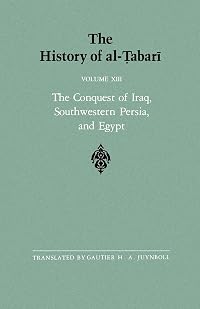
The History of al-Tabari Vol. 13. The Conquest of Iraq, Southwestern Persia, and Egypt: The Middle Years of 'Umar's Caliphate A.D. 636-642/A.H. 15-21
by Abu Ja'far Muhammad ibn Jarir al-Tabari (Author), G. H. A. Juynboll (Translator)
The History of al-Tabari (13)
On This Page
Description
This volume deals with the aftermath of the decisive battle at al-Q♯disiyyah described in the previous volume. First, the conquest of southern Iraq is consolidated; in rapid succession there follow the accounts of the battles at Burs and B♯bil. Then in 16/637 the Muslim warriors make for the capital al-Mada'in, ancient Ctesiphon, which they conquer after a brief siege. The Persian king seeks refuge in ı̀Þulw♯n, leaving behind most of his riches, which are catalogued in great detail. show more In the same year the Muslim army deals the withdrawing Persians another crushing blow at the battle of Jal¿±l♯'.This volume is important in that it describes how the newly conquered territories are at first administered. As the climate of al-Mada'in is felt to be unwholesome, a new city is planned on the Tigris. This is al-K¿±fah, which is destined to play an important role as the capital city of the fourth caliph, 'Al♯±. The planning of al-K¿±fah is set forth in considerable detail, as is the building of its main features ́the citadel and the great congregational mosque.After this interlude there follow accounts of the conquests of a string of towns in northern Mesopotamia, which bring the Muslim fighters near the border with al-Jazirah. That region is conquered in 17/638. The history of its conquest is preceded by an account of the Byzantines' siege of the city of ı̀Þim£̀Đ. Also in this year, 'Umar is recorded to have made a journey to Syria, from which he is driven back by a sudden outbreak of the plague, the so-called Plague of 'Amaw♯s.The scene then shifts back to southwestern Iran, where a number of cities are taken one after another. The Persian general al-Hurmuz♯n is captured and sent to Medina. After this, the conquest of Egypt ́said to have taken place in 20/641 ́is recorded.The volume concludes with a lengthy account of the crucial battle at Nihawand of 21/642. Here the Persians receive a blow that breaks their resistance definitively.This volume abounds in sometimes very amusing anecdotes of man-to-man battles, acts of heroism, and bizarre, at times even miraculous events. The narrative style is fast-moving, and the recurrence of similar motifs in the historical expose lends them authenticity. Many of the stories in this volume may have begun as yarns spun around campfires. It is not difficult to visualize an early Islamic storyteller regaling his audience with accounts that ultimately found their way to the file on conquest history collected by Sayf ibn 'Umar, al-£̀Ơabar♯±'s main authority for this volume.A discounted price is available when purchasing the entire 39-volume History of al-£̀Ơabar♯± set. Contact SUNY Press for more information. show lessTags
Members
- Recently Added By
Author Information
Series

Belongs to Publisher Series
Common Knowledge
- Canonical title
- The History of al-Tabari Vol. 13. The Conquest of Iraq, Southwestern Persia, and Egypt: The Middle Years of 'Umar's Caliphate A.D. 636-642/A.H. 15-21
Classifications
Statistics
- Members
- 14
- Popularity
- 1,682,974
- Languages
- English
- Media
- Paper, Ebook
- ISBNs
- 3