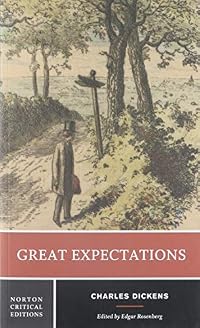
Great Expectations [Norton Critical Edition]
by Charles Dickens
On This Page
Description
Presents a critical edition of Dickens's story of a poor orphan boy educated as a gentleman in Victorian England, with textual notes, essays on the context of the novel, and critical readings of the work, its characters, and its significance.Tags
Recommendations








Member Reviews
The success is not mine, the failure is not mine, but the two together make me.
Many people consider „Great Expectations“ to be Charles Dickens‘ masterpiece, his greatest work with the most impressive cast of characters. And while I cannot comment on its quality in comparison to other well-known Dickens novels like „A Tale of Two Cities“ or „David Copperfield“, it certainly managed to live up to my expectations and even more: to make me feel part of Pip Pirrip’s life, of his relations to Miss Havisham and Estella and Joe and Herbert and all the other memorable cast members of this novel.
Great Expectations accompanies the protagonist, a young boy called Pip, during his journey through life, his struggling and his attempts show more to overcome the obstacles life has thrown into his path. Being raised as an orphan by his elder sister and her kind-hearted and generous husband Joe, Pip faces the scales of fate, unease and love when being introduced to the eccentric Miss Havisham, a wealthy woman and one of the most memorable characters of the entire novel. Pip falls in love with Miss Havisham’s adopted daughter Estella, and several years later, a mysterious benefactor finances Pip’s climbing into the higher parts of English society. Confronted with dangerous secrets, friendships and enmities alike and a love foredoomed to failure, Pip is forced to find his place in life, to grow up and stand on his own feet – a task which proves to be more difficult than he would ever have imagined.
According to my experience, the conventional notion of a lover cannot be always true. The unqualified truth is, that when I loved Estella with the love of a man, I loved her simply because I found her irresistible. Once for all; I knew to my sorror, often and often, if not always, that I loved her against reason, against promise, against peace, against hope, against happiness, against all discouragement that could be. Once for all; I loved her none the less because I knew it, and it had no more influence in restraining me than if I had devoutly believed her to be human perfection.
Apart from the perfect way Dickens weaves the words he chooses in, he also manages to characterize his protagonists in such an easily remembered style that you can’t help but feel sorry for what Pip, Estella or even Miss Havisham have to endure. Pip, the first-person-narrator and thus the character we have to spend the entirety of the novel with, is known to the reader from the very first days of his (conscious) existence, and Dickens allows us to accompany him on his troublesome way through life during his childhood and his early adolescence. While not always the most likeable person, Pip remains a realistic character with faults and mistakes of his own, the essential aspect which ultimately defines human beings.
“Oh! I have a heart to be stabbed in or shot in, I have no doubt, […], and of course if it ceased to beat I should cease to be. But you know what I mean. I have no softness there, no – sympathy – sentiment – nonsense.“
The character of Estella is another person we encounter during her childhood and whom we accompany while growing up. While Pip misses significant parts of her life, the reader is also able to judge Estella’s development through Pip’s eyes, which – of course – can’t be a reliable perspective, but even more emphasizes the love Pip feels for Estella. The true scales of Estella’s coldheartedness and her hostile behaviour will become clearer during the course of the novel, and it is not surprising that she is a character you find yourself wanting to know a lot more of. In modern days, Estella might be a (stereo-)typical prude, someone people are fascinated with, but never quite manage to get through to the core of her soul. Raised by Miss Havisham, Estella is far from the happiness other girls her age might be allowed to experience, yet those lessons of life she has to learn very early draw her character and her behaviour more significantly than anything else.
“Love her, love her, love her! If she favors you, love her. If she wounds you, love her. If she tears your heart to pieces – and as it gets older and stronger it will tear deeper – love her, love her, love her! […] I adopted her, to be loved. I bed her and educated her, to be loved. I developed her into what she is, that she might be loved. Love her! […] I’ll tell you […] what real love is. It is blind devotion, unquestioning self-humiliation, utter submission, trust and belief against yourself and against the whole world, giving up your whole heart and soul to the smiter – as I did.“
Oh, Miss Havisham. Throughout the entire course of the novel, she was the character I looked forward to meeting again the most, who I missed the most when not present in Pip’s narrations, who I want to know more of even now, after finishing the novel. Such a well-drawn character with a tortured soul and wishes and desires of her own based on her fateful experiences. In contrast to the time this novel was written in by Charles Dickens, today’s literature is partly marked by many authors developing trilogies out of their stories in order to write more stuff about their characters (which is a general direction I definitely don’t approve of due to various reasons), but if there ever was a story which I wanted to follow more closely, more elaborately, more intensively, it would certainly be Great Expectations. The mysterious appearances of Miss Havisham and Estella were very appealing to me; not knowing their true destinations, their true motivations before their reveal to the main character Pip was even more appealing; but reading something about their thoughts from their own points of view would have been most appealing. I wouldn’t want Charles Dickens to have written his novel from any other perspective – this merely emphasizes how memorably and full of potential he has managed to draw his characters.
There was a melancholy wind, and the marshes were very dismal. A stranger would have found them insupportable, and even to me they were so oppressive that I hesitated, half inclined to go back.
His ability of developing a setting, a Gothic atmosphere, which will allow you to feel part of the story, is one of the aspects which ultimately succeeded in allowing Dickens to become as popular as he later did. Psychologically the latter part of Great Expectations is about the best thing Dickens ever did. –I could not have expressed it in any better way than George Orwell did in this sentence. The novel did have some flaws, after all. I needed to read chapter summaries on the Internet to figure out how Pip was related to people like Mr. Jaggers, Wemmick or Bentley Drummle, party because I wasn’t particularly interested in those characters, partly because I only read one chapter at a time and thus was likely to forget aspects and not remember exact details when reading about them again. However, Great Expectations influenced me like few other novels managed to do before. Whether it was Pip’s friendship with Herbert, his love for Estella or the complicated relation to Joe – Dickens made me fear with Pip, feel for Pip, and hope for Pip to find happiness. show less
Many people consider „Great Expectations“ to be Charles Dickens‘ masterpiece, his greatest work with the most impressive cast of characters. And while I cannot comment on its quality in comparison to other well-known Dickens novels like „A Tale of Two Cities“ or „David Copperfield“, it certainly managed to live up to my expectations and even more: to make me feel part of Pip Pirrip’s life, of his relations to Miss Havisham and Estella and Joe and Herbert and all the other memorable cast members of this novel.
Great Expectations accompanies the protagonist, a young boy called Pip, during his journey through life, his struggling and his attempts show more to overcome the obstacles life has thrown into his path. Being raised as an orphan by his elder sister and her kind-hearted and generous husband Joe, Pip faces the scales of fate, unease and love when being introduced to the eccentric Miss Havisham, a wealthy woman and one of the most memorable characters of the entire novel. Pip falls in love with Miss Havisham’s adopted daughter Estella, and several years later, a mysterious benefactor finances Pip’s climbing into the higher parts of English society. Confronted with dangerous secrets, friendships and enmities alike and a love foredoomed to failure, Pip is forced to find his place in life, to grow up and stand on his own feet – a task which proves to be more difficult than he would ever have imagined.
According to my experience, the conventional notion of a lover cannot be always true. The unqualified truth is, that when I loved Estella with the love of a man, I loved her simply because I found her irresistible. Once for all; I knew to my sorror, often and often, if not always, that I loved her against reason, against promise, against peace, against hope, against happiness, against all discouragement that could be. Once for all; I loved her none the less because I knew it, and it had no more influence in restraining me than if I had devoutly believed her to be human perfection.
Apart from the perfect way Dickens weaves the words he chooses in, he also manages to characterize his protagonists in such an easily remembered style that you can’t help but feel sorry for what Pip, Estella or even Miss Havisham have to endure. Pip, the first-person-narrator and thus the character we have to spend the entirety of the novel with, is known to the reader from the very first days of his (conscious) existence, and Dickens allows us to accompany him on his troublesome way through life during his childhood and his early adolescence. While not always the most likeable person, Pip remains a realistic character with faults and mistakes of his own, the essential aspect which ultimately defines human beings.
“Oh! I have a heart to be stabbed in or shot in, I have no doubt, […], and of course if it ceased to beat I should cease to be. But you know what I mean. I have no softness there, no – sympathy – sentiment – nonsense.“
The character of Estella is another person we encounter during her childhood and whom we accompany while growing up. While Pip misses significant parts of her life, the reader is also able to judge Estella’s development through Pip’s eyes, which – of course – can’t be a reliable perspective, but even more emphasizes the love Pip feels for Estella. The true scales of Estella’s coldheartedness and her hostile behaviour will become clearer during the course of the novel, and it is not surprising that she is a character you find yourself wanting to know a lot more of. In modern days, Estella might be a (stereo-)typical prude, someone people are fascinated with, but never quite manage to get through to the core of her soul. Raised by Miss Havisham, Estella is far from the happiness other girls her age might be allowed to experience, yet those lessons of life she has to learn very early draw her character and her behaviour more significantly than anything else.
“Love her, love her, love her! If she favors you, love her. If she wounds you, love her. If she tears your heart to pieces – and as it gets older and stronger it will tear deeper – love her, love her, love her! […] I adopted her, to be loved. I bed her and educated her, to be loved. I developed her into what she is, that she might be loved. Love her! […] I’ll tell you […] what real love is. It is blind devotion, unquestioning self-humiliation, utter submission, trust and belief against yourself and against the whole world, giving up your whole heart and soul to the smiter – as I did.“
Oh, Miss Havisham. Throughout the entire course of the novel, she was the character I looked forward to meeting again the most, who I missed the most when not present in Pip’s narrations, who I want to know more of even now, after finishing the novel. Such a well-drawn character with a tortured soul and wishes and desires of her own based on her fateful experiences. In contrast to the time this novel was written in by Charles Dickens, today’s literature is partly marked by many authors developing trilogies out of their stories in order to write more stuff about their characters (which is a general direction I definitely don’t approve of due to various reasons), but if there ever was a story which I wanted to follow more closely, more elaborately, more intensively, it would certainly be Great Expectations. The mysterious appearances of Miss Havisham and Estella were very appealing to me; not knowing their true destinations, their true motivations before their reveal to the main character Pip was even more appealing; but reading something about their thoughts from their own points of view would have been most appealing. I wouldn’t want Charles Dickens to have written his novel from any other perspective – this merely emphasizes how memorably and full of potential he has managed to draw his characters.
There was a melancholy wind, and the marshes were very dismal. A stranger would have found them insupportable, and even to me they were so oppressive that I hesitated, half inclined to go back.
His ability of developing a setting, a Gothic atmosphere, which will allow you to feel part of the story, is one of the aspects which ultimately succeeded in allowing Dickens to become as popular as he later did. Psychologically the latter part of Great Expectations is about the best thing Dickens ever did. –I could not have expressed it in any better way than George Orwell did in this sentence. The novel did have some flaws, after all. I needed to read chapter summaries on the Internet to figure out how Pip was related to people like Mr. Jaggers, Wemmick or Bentley Drummle, party because I wasn’t particularly interested in those characters, partly because I only read one chapter at a time and thus was likely to forget aspects and not remember exact details when reading about them again. However, Great Expectations influenced me like few other novels managed to do before. Whether it was Pip’s friendship with Herbert, his love for Estella or the complicated relation to Joe – Dickens made me fear with Pip, feel for Pip, and hope for Pip to find happiness. show less
Part of my enjoyment in re-reading books is that, often, I haven’t read them in many years and it’s like opening them for the first time. So it was with Great Expectations, a book I first read as an assignment at age 13. All I remembered was that I had loved it, that Miss Havisham had in her house a molding cake with mice and bugs running through it, and that it was about a boy named Pip who loved a snotty girl named Estella.
What I had totally forgotten is that it’s a book which is at turns funny, exciting, touching, and always, always beautifully written. My memory was excised of the faithful Joe, the nasty Mrs. Joe, the ridiculous Mr. Pumblechook, the stalwart Biddy, the awful Compeyson and Orelick, and the wonderful Abel show more Magwich.
Others will tell you the plot. I tell you not to miss this incredible book filled with depth, rich characters, important lessons about life, and loads of fun. show less
What I had totally forgotten is that it’s a book which is at turns funny, exciting, touching, and always, always beautifully written. My memory was excised of the faithful Joe, the nasty Mrs. Joe, the ridiculous Mr. Pumblechook, the stalwart Biddy, the awful Compeyson and Orelick, and the wonderful Abel show more Magwich.
Others will tell you the plot. I tell you not to miss this incredible book filled with depth, rich characters, important lessons about life, and loads of fun. show less
Great Expectations was assigned reading when I was in ninth grade. I thought it was the most dreary thing I had ever read. Sensing that the memories from my youth might be mistaken, I tried again. I have not been disappointed. Reading Great Expectations has been a joy.
My memory was that Dickens wrote in a fussy, old-fashioned style, and I found that to some extent that’s true. Also, my memory was that Dickens wrote dialogue that no one would have spoken. Maybe so: Dickens often wrote in the voice of an elder, educated Pip recounting conversations he had as a boy. He wasn’t like Mark Twain writing in the voice of Huck Finn. But dialogue in Great Expectations is often difficult to understand simply because the terms are archaic.
show more
Contrary to the stereotype of being fussy and old-fashioned, there are colloquialisms that remind me of Mark Twain, e.g., p. 115, "clean gone." Also lines that could have been spoken by modern teenagers: “. . . it really is extra super.” (p.118)
The descriptions are often poetic. One of my favorites is on page 322: “Wednesday morning was dawning when I looked out of window. The winking lights upon the bridges were already pale, the coming sun was like a marsh fire on the horizon. The river, still dark and mysterious, was spanned by bridges . . . and millions of sparkles burst out upon its waters.”
Much of the action that takes place in the Third Stage of the book is barely believable. How would Pip's enemies and the police know enough to begin pursuing, and where to go? In spite of explanations like “I’ve looked arter you to know your ins and outs” (p. 318), it seems it would have been impossible for the Thames River Police to intercept Pip and his crew without the aid of modern communications.
At the end of the chase, the police would have arrested Pip and his comrades as accomplices, but inexplicably they don't. The premise for the Third Stage’s adventures falls apart (p. 243 note 7) for another reason, but if we can’t put that aside, there’s no story.
Although Dickens maintains Victorian reticence about sexual desire and sexual activity, he does mention them in obscure ways, e.g., Wemmick discussing his trinkets: “Is the lady anybody?” “No. . . . Only his game (You liked your bit of game, didn’t you?) . . .” (p. 156). While never explicit, Pip’s longing for Estella is palpable. Dickens never describes her appearance other than to say she is “beautiful” and “so much more womanly” (p.181) than before her time in France, but that is enough. And a reader who identifies with Pip will feel flashes of jealousy, not only of Drummle, but also Oedipal jealousy of Joe (p. 354). show less
My memory was that Dickens wrote in a fussy, old-fashioned style, and I found that to some extent that’s true. Also, my memory was that Dickens wrote dialogue that no one would have spoken. Maybe so: Dickens often wrote in the voice of an elder, educated Pip recounting conversations he had as a boy. He wasn’t like Mark Twain writing in the voice of Huck Finn. But dialogue in Great Expectations is often difficult to understand simply because the terms are archaic.
show more
Contrary to the stereotype of being fussy and old-fashioned, there are colloquialisms that remind me of Mark Twain, e.g., p. 115, "clean gone." Also lines that could have been spoken by modern teenagers: “. . . it really is extra super.” (p.118)
The descriptions are often poetic. One of my favorites is on page 322: “Wednesday morning was dawning when I looked out of window. The winking lights upon the bridges were already pale, the coming sun was like a marsh fire on the horizon. The river, still dark and mysterious, was spanned by bridges . . . and millions of sparkles burst out upon its waters.”
Much of the action that takes place in the Third Stage of the book is barely believable. How would Pip's enemies and the police know enough to begin pursuing, and where to go? In spite of explanations like “I’ve looked arter you to know your ins and outs” (p. 318), it seems it would have been impossible for the Thames River Police to intercept Pip and his crew without the aid of modern communications.
At the end of the chase, the police would have arrested Pip and his comrades as accomplices, but inexplicably they don't. The premise for the Third Stage’s adventures falls apart (p. 243 note 7) for another reason, but if we can’t put that aside, there’s no story.
Although Dickens maintains Victorian reticence about sexual desire and sexual activity, he does mention them in obscure ways, e.g., Wemmick discussing his trinkets: “Is the lady anybody?” “No. . . . Only his game (You liked your bit of game, didn’t you?) . . .” (p. 156). While never explicit, Pip’s longing for Estella is palpable. Dickens never describes her appearance other than to say she is “beautiful” and “so much more womanly” (p.181) than before her time in France, but that is enough. And a reader who identifies with Pip will feel flashes of jealousy, not only of Drummle, but also Oedipal jealousy of Joe (p. 354). show less
As I have recently decided to spend the bulk of my life studying 19th Century British fiction, Charles Dickens is a bit of a poser for me. Explaining my decision to my wife, Dickens was the first name she came up with when thinking about the authors I’d be reading, and I suspect she’s not alone in identifying 19th Century British fiction with Dickens. His only competitor in this regard might be Jane Austen, but he’s certainly the quintessential Victorian novelist. Which brings us to my problem: I don’t like Dickens’ novels.
That’s not to say I dislike them, but I don’t have the intellectual passion for his work that I do for say, Hardy and Conrad (probably my chief reasons for my chosen field of study). Dickens’ show more reputation outside academia is a mixed bag. He has a fan base that persists to this day, something few other long dead authors can lay claim to (Austen [again] and Shakespeare are two others), but as the persistent calumny that he was paid by the word suggests, many an enforced encounter in High School has left a segment of the population with a permanent aversion to his writing (my wife among them).
Beginning to read Great Expectations, a text I felt I was already fully acquainted with avant le roman, I was immediately reminded of one of Dickens’ chief virtues: he is eminently readable. I was drawn into Pip’s story, and I found myself partaking of his great expectations, losing myself in the narrative to a degree that few other authors have elicited from me. Indeed, the closest equivalent to my feeling of being swept up in Great Expectations comes in my desire to see (Austen again) Elizabeth and Mr. Darcy or Emma and Mr. Knightley happily married. For Pip, however, my desire was not to see him in wedded bliss with Estella (I’m of Biddy’s party here, I don’t see what all the fuss over her is about), but to see him comfortably situated in life.
Nonetheless, the whole romance plot (Pip’s ardent desire for Estella) is only part of what seemed to me to be the central concern of the novel, namely, class. Pip’s childhood fixation on Estella seems to spring from his conviction that such a wife would be part and parcel of the equipage of a fine gentleman, a role he longs to play, and it is this one of Pip’s desires that gives motive force to the novel. Rather than seeking to become a gentleman so he can court Estella, I would argue that Pip desires Estella because only a gentleman could posses her. Consequently, in possessing her Pip would signify his own gentility to himself.
Given Pip’s overwhelming desire to ennoble himself, it would seem that Great Expectations should take the form of a bildungsroman wherein Pip’s growth and development is played out through his acculturation to and entry into the leisure classes. Chapter XXII, where Herbert companionably and unobtrusively socializes Pip, seems to accomplish precisely this. By becoming a gentleman, Pip would seem to have achieved his chief aim in life. However, Dickens gives his reader a convenient indicator that not all is well with Pip the gentleman, for he is ashamed of his foster father, Joe.
It is blindingly obvious that those moments when Pip feels ashamed of his connection to Joe are the moments when he has sunken deepest into genteel depravity. Given that Dickens’ was the great champion of middle class virtue, it is no accident that Pip is uncomfortable both as a blacksmith’s apprentice and as a gentleman of leisure. Accordingly, it is no accident that the narrative can only come to rest once Pip has become a solidly middle class at Clarriker & Co.
There remain a few complications that I wish I had better answers for. First, if Pip’s tale is the story of how he comes to understand the desirability of being neither too low nor too high, why is it that his time as a member of the middle class is a paragraph-long footnote to the three-hundred odd pages spent narrating his time at the two socioeconomic extremes. Put simply, why can’t Pip successfully narrate a middle class sensibility? Second, why doesn’t Pip reproduce? In contrast to the ending of other Dickens’ novels, Great Expectations does not end with a wedding. Why can Pip occupy a middle class household (Herbert’s) but not reproduce one of his own?
All that said, there’s much that makes this novel a thoroughly enjoyable read. Especially memorable for me are Mrs. Joe’s domestic viciousness and Castle Wemmick and the Aged P within. As my discussion above suggests, while there is nothing that induces the lyrical ecstasy I find in say, Hardy (Henchard’s muttering, “I am to suffer, I perceive” sends chills down my spine), there is still much to think about in Dickens. show less
That’s not to say I dislike them, but I don’t have the intellectual passion for his work that I do for say, Hardy and Conrad (probably my chief reasons for my chosen field of study). Dickens’ show more reputation outside academia is a mixed bag. He has a fan base that persists to this day, something few other long dead authors can lay claim to (Austen [again] and Shakespeare are two others), but as the persistent calumny that he was paid by the word suggests, many an enforced encounter in High School has left a segment of the population with a permanent aversion to his writing (my wife among them).
Beginning to read Great Expectations, a text I felt I was already fully acquainted with avant le roman, I was immediately reminded of one of Dickens’ chief virtues: he is eminently readable. I was drawn into Pip’s story, and I found myself partaking of his great expectations, losing myself in the narrative to a degree that few other authors have elicited from me. Indeed, the closest equivalent to my feeling of being swept up in Great Expectations comes in my desire to see (Austen again) Elizabeth and Mr. Darcy or Emma and Mr. Knightley happily married. For Pip, however, my desire was not to see him in wedded bliss with Estella (I’m of Biddy’s party here, I don’t see what all the fuss over her is about), but to see him comfortably situated in life.
Nonetheless, the whole romance plot (Pip’s ardent desire for Estella) is only part of what seemed to me to be the central concern of the novel, namely, class. Pip’s childhood fixation on Estella seems to spring from his conviction that such a wife would be part and parcel of the equipage of a fine gentleman, a role he longs to play, and it is this one of Pip’s desires that gives motive force to the novel. Rather than seeking to become a gentleman so he can court Estella, I would argue that Pip desires Estella because only a gentleman could posses her. Consequently, in possessing her Pip would signify his own gentility to himself.
Given Pip’s overwhelming desire to ennoble himself, it would seem that Great Expectations should take the form of a bildungsroman wherein Pip’s growth and development is played out through his acculturation to and entry into the leisure classes. Chapter XXII, where Herbert companionably and unobtrusively socializes Pip, seems to accomplish precisely this. By becoming a gentleman, Pip would seem to have achieved his chief aim in life. However, Dickens gives his reader a convenient indicator that not all is well with Pip the gentleman, for he is ashamed of his foster father, Joe.
It is blindingly obvious that those moments when Pip feels ashamed of his connection to Joe are the moments when he has sunken deepest into genteel depravity. Given that Dickens’ was the great champion of middle class virtue, it is no accident that Pip is uncomfortable both as a blacksmith’s apprentice and as a gentleman of leisure. Accordingly, it is no accident that the narrative can only come to rest once Pip has become a solidly middle class at Clarriker & Co.
There remain a few complications that I wish I had better answers for. First, if Pip’s tale is the story of how he comes to understand the desirability of being neither too low nor too high, why is it that his time as a member of the middle class is a paragraph-long footnote to the three-hundred odd pages spent narrating his time at the two socioeconomic extremes. Put simply, why can’t Pip successfully narrate a middle class sensibility? Second, why doesn’t Pip reproduce? In contrast to the ending of other Dickens’ novels, Great Expectations does not end with a wedding. Why can Pip occupy a middle class household (Herbert’s) but not reproduce one of his own?
All that said, there’s much that makes this novel a thoroughly enjoyable read. Especially memorable for me are Mrs. Joe’s domestic viciousness and Castle Wemmick and the Aged P within. As my discussion above suggests, while there is nothing that induces the lyrical ecstasy I find in say, Hardy (Henchard’s muttering, “I am to suffer, I perceive” sends chills down my spine), there is still much to think about in Dickens. show less
I am so glad that I decided to finally read this. I'm fairly certain that my last Dickens was in tenth grade when I read A Tale of Two Cities which I have vague memories of finding occasionally difficult but ultimately enjoyable. The same could be said of Great Expectations for me, occasionally difficult but ultimately wonderful. Perhaps the most remarkable aspect of this is the absolute universality of the theme of aspiring to be "more" and in the process loathing those things that make up the essence of who we are. Pip is no better and no worse than any one of us with his dreams of grandeur and his embarrassment of things familiar. However it seems to be an object of some debate whether Pip's story ends happily, in either version of show more the tale. My take on it is that regardless of the circumstances, the ending is perfect as Pip realizes what makes a person a gentleman, or lady, is a result of what is inside, rather than the trappings and company one keeps. I will be reading much more Dickens in my future. Any writer who makes the following picture:
"Mr. Pumblechook's premises in the High Street of the market town were of a peppercorny and farinacious character as the premises of a corn-chandler and seedsman should be."
deserves a great deal of further consideration. show less
"Mr. Pumblechook's premises in the High Street of the market town were of a peppercorny and farinacious character as the premises of a corn-chandler and seedsman should be."
deserves a great deal of further consideration. show less
A good read. Dickens does a great job of knitting characters and story lines together tightly. This book has several characters you love to love, (Joe stands out in this regard as a hero capable of no wrong) but lacks any real menacing characters that you love to hate. There are a couple obvious villains, of course, but that's not exactly the same thing.
**spoiler alert**
I love that the ending here is not exactly the happy, fairy tale ending you might expect from a 19th century novel. The reader identifies with Pip, but at the same time has difficulty understanding his choices sometimes and his hesitancy to be associated with those who ought to be closest and dearest to him.
**spoiler alert**
I love that the ending here is not exactly the happy, fairy tale ending you might expect from a 19th century novel. The reader identifies with Pip, but at the same time has difficulty understanding his choices sometimes and his hesitancy to be associated with those who ought to be closest and dearest to him.
I read Great Expectations for my book group. I listened to the audio book and then read the book off and on. I really enjoyed all of the characters, the contrast they had to one another and the plot twists. Someone mentioned at our book group that this was Dickens' best novel, I haven't read enough to know for sure but it was very good.
flag
flag
Members
- Recently Added By
Lists

Books about the Thames Estuary or have events/chapters set there...
30 works; 4 members

Blue Pyramid 1,276 Best Books of All Time
1,248 works; 32 members
Author Information

2,578+ Works 313,139 Members
Charles Dickens, perhaps the best British novelist of the Victorian era, was born in Portsmouth, Hampshire, England on February 7, 1812. His happy early childhood was interrupted when his father was sent to debtors' prison, and young Dickens had to go to work in a factory at age twelve. Later, he took jobs as an office boy and journalist before show more publishing essays and stories in the 1830s. His first novel, The Pickwick Papers, made him a famous and popular author at the age of twenty-five. Subsequent works were published serially in periodicals and cemented his reputation as a master of colorful characterization, and as a harsh critic of social evils and corrupt institutions. His many books include Oliver Twist, David Copperfield, Bleak House, Great Expectations, Little Dorrit, A Christmas Carol, and A Tale of Two Cities. Dickens married Catherine Hogarth in 1836, and the couple had nine children before separating in 1858 when he began a long affair with Ellen Ternan, a young actress. Despite the scandal, Dickens remained a public figure, appearing often to read his fiction. He died in 1870, leaving his final novel, The Mystery of Edwin Drood, unfinished. (Bowker Author Biography) show less
Series
Belongs to Publisher Series
Common Knowledge
- Canonical title
- Great Expectations [Norton Critical Edition]
Classifications
Statistics
- Members
- 800
- Popularity
- 34,508
- Reviews
- 12
- Rating
- (3.80)
- Languages
- English, French
- Media
- Paper, Audiobook
- ISBNs
- 2
- ASINs
- 5