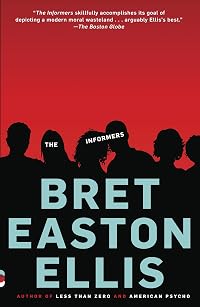
The Informers
by Bret Easton Ellis
On This Page
Description
Capturing the lives of a group of people in Los Angeles, 'The Informers' is an intense narrative that blurs genders, generations and even identities. They are connected in the only way people can be in LA - suffering from nothing less than the death of the soul.Tags
Recommendations
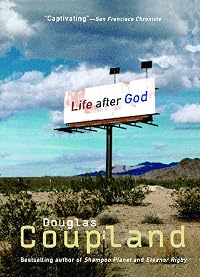
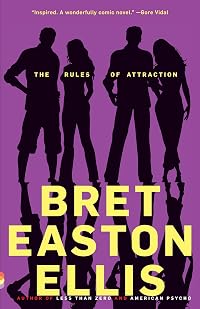
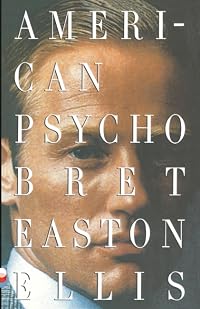
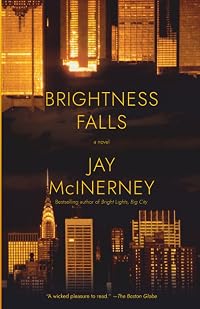




Member Recommendations
Member Reviews
A Pokol, Breat Easton Ellis univerzumában: Los Angeles. Valiumtól kába bukott angyalok korzóznak a pálmafák alatt, üres szemű, napbarnított szőkéket invitálnak egy italra, a hőségben remeg a levegő, a Porsche motorja agresszíven beböffen, és mindenki előre unja már az egészet, a beszélgetést, ami a dugás előtt van, a dugás utáni csendet, sőt, a dugást magát. Itt a szenvedés rafinált: kapsz végtelen sok pénzt, csak azon kapod magad, hogy nem tudsz mit kezdeni vele. Olyan ez, mint valami késő XX. századi Tantalusz-parafrázis, ahol eszközeid vannak egy jobb életre, csak kedved nincs, hogy élj velük.
(Megjegyzem, akkor szembesültem azzal, hogy Ellis micsoda pazar író, amikor olvasás közben show more elfelejtettem, hogy ez a szöveg voltaképpen irodalom, amit "csak" egy író írt. El tudja hitetni, hogy ezt a mérgező, szörnyű világot nem teremtette, hanem csak közvetíti. Kellemetlen, néha fájdalmas olvasni, minden porcikám tiltakozik, hogy akár csak közelítőleg valóságnak fogadjam el ezt a teret, de tekintve, hogy ez a vélelmezhető írói célnak tökéletesen megfelel, csak ámulni tudok Ellis képességein.) show less
I don't know how they make tranquilisers. Do they mine the ingredients? Lithium sounds like some sort of mineral one would chip out of the earth. But maybe they distil the vital ingredients from seawater, or hang around in the upper atmosphere, harvesting it by dangling from the wicker baskets of hot air balloons with huge butterfly nets or vacuum cleaners or something.
I'm fairly sure that the vital ingredient is not some sort of secretion you can only get from the gland of a baby baboon or something...because the characters in BEE's 'the informers' take so many drugs that if it's only one tenth as many chill pills as are actually taken in real life in LA then any animal that produced the goods would have been used to extinction by now show more and Los Angeles would be a lot more tense.
Let's assume then that there is a vast factory churning out millions of happy pills that make the city by the Pacific so placid.
In fact, the characters are so medicated that they are numb, disconnected from their surroundings and family by a chemical haze. If they stop taking their drugs they sober up long enough to realise that things have got even worse since whatever happened to get them on drugs in the first place happened.
This sense of numbness is communicated in three ways.
Firstly, the characters...talk in...broken…sentences. This indicates that for them the world is happening in slow motion, that their thoughts swim through their minds like lazy otters rather than the crazed electrons the rest of us have to put up with. This is incredibly annoying to read and does a fantastic job of conveying just how annoying it must be to actually experience. Just as one has an impulse to finish the sentences of a stutterer, so one has the urge to batter these dopey drugged up buggers to death with a coal scuttle.
Secondly, they wear their wayfairer sunglasses indoors at night. This means they are not only depressed and medicated, they are twats.
Thirdly, they completely freak out when their prescription is not renewed automatically and start mixing and matching other medication.
So the characters wander dream like through a LA landscape where the sunshine bleaches the vitality out of everything. But there is peril here - dark hints of dismembered bodies dumped in the desert, and also of bodies drained of blood.
That's right. Vampires. And once they turn up the numbness vanishes and the book becomes fang sharp.
BEE's vampires are pure predator. They move through the LA singles scene like sharks, top of the food chain they drain adults, kids, pets with less thought than a teenager draining an alcopop. They are though, thoroughly modern, with pimped out coffins and cleaning women adept at getting blood stains out of the carpet.
There is a very brief and very intriguing mention of a vampire killer after a pile of ash is found at the bottom of a disused swimming pool below where a stake, made from a whittled down baseball bat, has been driven into the wall of the pool, presumably through the vamp. I wanted to know more about that.
So there are tranqued out zombies, vampires and, of course, monsters in the form of weak, evil and despicable human beings.
The disconnection extends to the structure of the novel itself, which could be mistaken for a collection of short stories. Each chapter is about a different character and characters from one thread pop up in other chapters and BEE does a very good job of showing us the same character from a different perspective so that somebody who appeared merely dopey in one chapter is shown to be doped up to the eyeballs in another, hence their rather slow manner…of…talking, acting and affection for sporting wayfairers indoors, presumably because they consider that if they hide the size of their pupils, nobody will know that they’re baked on weed and pills.
It's a strange book this - a series of stories about characters that are not particularly likeable that shares no real connecting theme apart from disconnection with normality. But hey, vampires on drugs - what's not to like? show less
I'm fairly sure that the vital ingredient is not some sort of secretion you can only get from the gland of a baby baboon or something...because the characters in BEE's 'the informers' take so many drugs that if it's only one tenth as many chill pills as are actually taken in real life in LA then any animal that produced the goods would have been used to extinction by now show more and Los Angeles would be a lot more tense.
Let's assume then that there is a vast factory churning out millions of happy pills that make the city by the Pacific so placid.
In fact, the characters are so medicated that they are numb, disconnected from their surroundings and family by a chemical haze. If they stop taking their drugs they sober up long enough to realise that things have got even worse since whatever happened to get them on drugs in the first place happened.
This sense of numbness is communicated in three ways.
Firstly, the characters...talk in...broken…sentences. This indicates that for them the world is happening in slow motion, that their thoughts swim through their minds like lazy otters rather than the crazed electrons the rest of us have to put up with. This is incredibly annoying to read and does a fantastic job of conveying just how annoying it must be to actually experience. Just as one has an impulse to finish the sentences of a stutterer, so one has the urge to batter these dopey drugged up buggers to death with a coal scuttle.
Secondly, they wear their wayfairer sunglasses indoors at night. This means they are not only depressed and medicated, they are twats.
Thirdly, they completely freak out when their prescription is not renewed automatically and start mixing and matching other medication.
So the characters wander dream like through a LA landscape where the sunshine bleaches the vitality out of everything. But there is peril here - dark hints of dismembered bodies dumped in the desert, and also of bodies drained of blood.
That's right. Vampires. And once they turn up the numbness vanishes and the book becomes fang sharp.
BEE's vampires are pure predator. They move through the LA singles scene like sharks, top of the food chain they drain adults, kids, pets with less thought than a teenager draining an alcopop. They are though, thoroughly modern, with pimped out coffins and cleaning women adept at getting blood stains out of the carpet.
There is a very brief and very intriguing mention of a vampire killer after a pile of ash is found at the bottom of a disused swimming pool below where a stake, made from a whittled down baseball bat, has been driven into the wall of the pool, presumably through the vamp. I wanted to know more about that.
So there are tranqued out zombies, vampires and, of course, monsters in the form of weak, evil and despicable human beings.
The disconnection extends to the structure of the novel itself, which could be mistaken for a collection of short stories. Each chapter is about a different character and characters from one thread pop up in other chapters and BEE does a very good job of showing us the same character from a different perspective so that somebody who appeared merely dopey in one chapter is shown to be doped up to the eyeballs in another, hence their rather slow manner…of…talking, acting and affection for sporting wayfairers indoors, presumably because they consider that if they hide the size of their pupils, nobody will know that they’re baked on weed and pills.
It's a strange book this - a series of stories about characters that are not particularly likeable that shares no real connecting theme apart from disconnection with normality. But hey, vampires on drugs - what's not to like? show less
Did anything happen in this book? Interwoven short stories with Ellis' signature tone (immediately in the characters' present, dry satire, apathy, detachment) and subject (1980s wealthy elite, dark sex stained with gore and death). The tone is stronger than the action/plot of the title so I'm left wondering what happened. I also want to go buy myself some happiness, cocaine and ennui.
Ellis does show just how miserable materialism can make you, without being preachy or trite, while simultaneously making you want the privileges of materialism. You're left feeling uncomfortable and without a moral message.
I also wonder why he titled the book The Informers. Is it too simplistic to ask who are the informers and what are they informing us?
Ellis does show just how miserable materialism can make you, without being preachy or trite, while simultaneously making you want the privileges of materialism. You're left feeling uncomfortable and without a moral message.
I also wonder why he titled the book The Informers. Is it too simplistic to ask who are the informers and what are they informing us?
Collection of short stories set in LA in the early-mid 80s, using many of the same characters. Basically an inferior riff on the themes of Less Than Zero - the characters are drugged and bored out of any emotional connection with the world, which makes the book tough to engage with at first, until the later stories show what that state of affairs leads to and some outlandish horror occurs almost unnoticed. Decent enough by the end, but basically the same ground he covered in a far more impressive novel a decade earlier.
I love the way Brett Easton Ellis writes; I just don't like what he writes about.
He takes things too far.
I was fascinated by the world he created in The Informers — not so much a novel as a collection of overlapping stories, each vignette told in the first person by a different character — but a few of the later chapters conveyed more than I wanted to know about human nature.
The violence was too real, too depraved.
Worse, there was no hope. Not a shred of optimism anywhere.
That said, I did come away with one positive observation. It seemed to me that, without saying so, Ellis may have been trying to show us — in graphic and convincing detail — that riches, fame, and the ability to do whatever we want are not enough to satisfy.
Not show more unless we have better imaginations than his characters. show less
He takes things too far.
I was fascinated by the world he created in The Informers — not so much a novel as a collection of overlapping stories, each vignette told in the first person by a different character — but a few of the later chapters conveyed more than I wanted to know about human nature.
The violence was too real, too depraved.
Worse, there was no hope. Not a shred of optimism anywhere.
That said, I did come away with one positive observation. It seemed to me that, without saying so, Ellis may have been trying to show us — in graphic and convincing detail — that riches, fame, and the ability to do whatever we want are not enough to satisfy.
Not show more unless we have better imaginations than his characters. show less
This book is like a movie that comes on cable on a Saturday afternoon. You wouldn't see it in the theater, but you don't change the channel once it's started. Well, I suppose you might change the channel; it depends on which of these stories you happen upon. A few are really, pointlessly horrid, though I did rather like the bit about the vampires and the one about the trip to the zoo. The description of the zoo, in particular, has a nice wholesome nastiness to it (hissing kangaroos). Though he improved with Lunar Park, Ellis has a bad habit of writing prose so blank and neutral that it caves in on itself and reads as terribly affected and portentous. Pop nihilism in snack form.
I expected great things from this collection of interwoven stories after reading Bret's other novels, and I was not disappointed. Not all the stories are great, but most are trademark Ellis, written in a detached yet poignant manner that gave me a really cohesive vision of the time and place that he is trying to get at in the novel. 'The Up Escalator' is a particular favorite, as the sparse prose captures the modern banality of LA brilliantly. Ellis is one of my favorite authors, and this collection did nothing to change that.
Members
- Recently Added By
Lists

Read the book and saw the movie
1,170 works; 195 members

1990s
309 works; 17 members

American Lit for Eng 11 Research Project
368 works; 6 members

100 Hemskaste
81 works; 1 member

Books Read in 2010
631 works; 11 members

Books Set in Los Angeles
40 works; 8 members

living room bookshelf
150 works; 1 member

Gen X Library
245 works; 4 members
Author Information

26+ Works 38,058 Members
Bret Easton Ellis was born in Los Angeles, California on March 7, 1964. He attended Bennington College. In 1985, at the age of 23, his first novel, Less Than Zero, was published. His other works include The Rules of Attraction (1987), The Informers (1994), Glamorama (1998), Lunar Park (2005), and Imperial Bedrooms (2010). His most controversial show more book was American Psycho, a book for which he received an advance in the amount of $300,000 from Simon and Schuster, who then refused to publish the book while under attack from women's groups in regards to the content of the book. It was later made into a feature film. (Bowker Author Biography) show less
Series
Belongs to Publisher Series
Work Relationships
Is contained in
Contains
Has the adaptation
Common Knowledge
- Canonical title
- The Informers
- Original title
- The Informers
- Original publication date
- 1994
- People/Characters
- Bruce; Rosa (Maid); Julian
- Important places*
- Los Angeles, Californie, États-Unis
- Related movies
- The Informers (2008 | IMDb)
- Epigraph
- One night I was sitting in bed in my hotel room
on Bunker Hill, down in the middle of Los Angeles.
It was an important night in my life, because I had
to make a decision about the hotel. Either I paid up
or I got ... (show all)out: that was the note said, the note
the landlady had put under my door. A great
problem, deserving acute attention. I solved it
by turning out the lights and going to bed.
John Fante, 'Ask the dust' - First words*
- Bruce calls, stoned and sunburned, from Los Angeles and tells that he's sorry.
- Quotations
- I go to the other room, swallow some Valium, open up my coffin and take a little nap.
- Last words*
- (Click to show. Warning: May contain spoilers.)But I can't help it, I think to myself as we leave the zoo and get into my red BMW and he starts it up, I have faith in this man.
- Blurbers
- Self, Will
*Some information comes from Common Knowledge in other languages. Click "Edit" for more information.
Classifications
Statistics
- Members
- 2,185
- Popularity
- 9,278
- Reviews
- 20
- Rating
- (3.21)
- Languages
- 16 — Czech, Danish, Dutch, English, Finnish, French, German, Greek, Hungarian, Italian, Norwegian (Nynorsk), Norwegian (Bokmål), Polish, Portuguese, Spanish, Swedish
- Media
- Paper, Audiobook, Ebook
- ISBNs
- 62
- ASINs
- 9