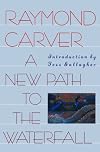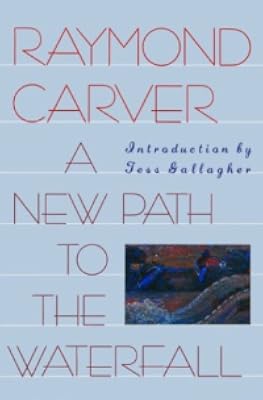
A New Path To The Waterfall
by Raymond Carver
On This Page
Description
Raymond Carver, author of Where I'm Calling From, is widely considered one of the great short story writers of our time. A New Path to the Waterfall was Carver's last book, and shows a writer telling the truth as best as he knows how in the time left to him. The sixty-odd poems in this collection are linked by Carver with selections from other writers, most notably Chekhov, whose work was an inspiration and a guide, and by the cumulative force of the life and death questions he poses in show more them. As Rilke's Letters to a Young Poet guided countless readers discovering their true love and work, Carver's book will guide those in the process of celebrating a limited life and mourning the inescapable end of it. A New Path to the Waterfall is an essential book for those who admire Carver's work, and testament to the transcendent strength of the human spirit. In her introductory essay, Tess Gallagher, Carver's companion and fellow writer, lays out the circumstances of their last years together with matter-of-fact grace. show lessTags
Recommendations







Member Reviews
I should read this book at least once every year; some years, more than once. It's slim enough to do so, and Carver's ear for conversational American English means even the longer poems scan quite fast. I went through about half the book on two 15-minute train rides.
But that's just it: it reads fast, and it's short, but there's a lot packed in there. It would ruin the experience for me to analyse it too closely, delve into the layers. But simply to read it once means I'll miss a lot. Some of the layers are thematic (linking historical readings of Alexander the Great or the siege at Thermopylae to everyday personal interactions), some are aesthetic (putting a poem about self-analysis and psychodynamics in a section devoted to fishing, or show more the mutual commentary of poems suggested by placing them near one another in the book). Multiple readings would help surface these layers without ruining the great conversational style, the easy flow.
And what's with the recurrent excerpts from Chekhov and Milosz? (I suspect Tess Gallagher gets to that in the introduction, but I'll read that after finishing the book.) They're brilliant, and are one display of the wide and historically deep reach of Carver's thinking.
I was first introduced to Carver when watching Altman's The Player, apparently loosely based on Carver's short stories. It took years before I realised that, though I'd become interested in Altman's work since. I've read one selection of Carver's short stories, and they're also deeply affecting. These poems distill a similar take on life, but in even pithier form. show less
But that's just it: it reads fast, and it's short, but there's a lot packed in there. It would ruin the experience for me to analyse it too closely, delve into the layers. But simply to read it once means I'll miss a lot. Some of the layers are thematic (linking historical readings of Alexander the Great or the siege at Thermopylae to everyday personal interactions), some are aesthetic (putting a poem about self-analysis and psychodynamics in a section devoted to fishing, or show more the mutual commentary of poems suggested by placing them near one another in the book). Multiple readings would help surface these layers without ruining the great conversational style, the easy flow.
And what's with the recurrent excerpts from Chekhov and Milosz? (I suspect Tess Gallagher gets to that in the introduction, but I'll read that after finishing the book.) They're brilliant, and are one display of the wide and historically deep reach of Carver's thinking.
I was first introduced to Carver when watching Altman's The Player, apparently loosely based on Carver's short stories. It took years before I realised that, though I'd become interested in Altman's work since. I've read one selection of Carver's short stories, and they're also deeply affecting. These poems distill a similar take on life, but in even pithier form. show less
This is the narrative of the end of Carver's career and life. The last sections of poems tell the story of his cancer and his last days. They do so without asking for any pity and without melodrama. The writing is clear and strong.
Perhaps the best review of this piece is in the poem "Ray" by Hayden Carruth which appears in Carruth's collected shorter poems. He nails it and reading Carruth's poem after reading Carver's book led me right back into Carver's book again. It's just tremendous writing to which I return again and again.
Perhaps the best review of this piece is in the poem "Ray" by Hayden Carruth which appears in Carruth's collected shorter poems. He nails it and reading Carruth's poem after reading Carver's book led me right back into Carver's book again. It's just tremendous writing to which I return again and again.
carver's poetry is much more fine and roughly beautiful than critics give it credit for.
purely meaningful, unpretentious writing. so good
Short-story writer and poet Carver, who died of cancer in 1988, wrote these poems during his last few months. Many of them are luminous flashes, poised and tender meditations, while others read like cathartic, unresolved statements by a man struggling to come to terms with his life in the little remaining time allotted to him. The verses range from story-poems to bone-bare nature lyrics to a sprawling allegory about "the two brothers, Sleep and Death." Carver tosses off word-portraits of a drunken Alexander the Great, Antonin Artaud, an encyclopedia salesman. A strain of bitterness runs through the entries dealing with his first marriage, while the touching love poems to his second wife, Tess Gallagher (who wrote the book's moving, show more highly personal introduction) carry a sense of finality that augments their meaning. Publishers Weekly show less
#880 in our old book database. Not rated.
Ratings
Members
- Recently Added By
Author Information

Born in 1938 in an Oregon logging town, Raymond Carver grew up in Yakima, From California he went to Iowa to attend the Iowa Writers Workshop. Soon, however, he returned to California, where he worked at a number of unskilled jobs before obtaining a teaching position. Widely acclaimed as the most important short story writer of his generation, show more Carver writes about the kind of lower-middle-class people whom he knew growing up. His characters are waitresses, mechanics, postmen, high school teachers, factory workers, door-to-door salesmen who lead drab lives because of limited funds. Critics have said that may have the most distinctive vision of the working class. Nominated posthumously for both a National Book Critics Circle Award (1988) and a Pulitzer Prize (1989) for Where I'm Calling From: New and Selected Stories (1988), Carver is one of a handful of writers credited with reviving the short story form. Some have put Carver in the tradition of Ernest Hemingway and Stephen Crane. Carver's stories tend to be brief, with enigmatic endings, although never erupting. Violence is often just below the surface. An air of quiet desperation pervades his stories, as Carver explores the collapse of human relationships in bleak circumstances. In later works, Carver strikes a note of redemption, unheard at the beginning of his career. But for readers who are not attuned to Carver's voice of resignation, these moments may sound sentimental and unconvincing. Carver died of lung cancer in 1988. (Bowker Author Biography) show less
Some Editions
Awards and Honors
Distinctions
Series
Belongs to Publisher Series
Harvill (71)
Common Knowledge
- Canonical title
- A New Path To The Waterfall
- Original title
- A New Path To The Waterfall
- Alternate titles
- A New Path To The Waterfall: Poems; A New Path To The Waterfall: Last Poems
- Original publication date
- 1989
- People/Characters
- Alexander VI, Pope (Rodrigo de Borja or Borgia, 1431-1503); Lucrezia Borgia (Lucrèce or Lucretia, 1480-1519); Cesare Borgia; John Burchard; Alexander the Great; Ezra Pound (show all 9); Jim Sears; Howard Sears (father of Jim Sears); Xerxes I
- Epigraph
- Gift
A day so happy.
Fog lifted early, I worked in the garden.
Hummingbirds were stopping over honeysuckle flowers.
There was no thing on earth I wanted to possess.
I knew no one worth my envying him.
Wh... (show all)atever evil I had suffered, I forgot.
To think that once I was the same man did not embarrass me.
In my body I felt no pain.
When straightening up, I saw the blue sea and sails.
- Czeslaw Milosz - Dedication
- Tess. Tess. Tess. Tess.
- First words
- This is a last book and last things, as we learn, have rights of their own. [Introduction]
Those beautiful days
when the city resembles a die, a fan and bird song
or a scallop shell on the seashore
-- goodbye, goodbye, pretty girls,
we met today
and will not e... (show all)ver meet again. - Last words
- (Click to show. Warning: May contain spoilers.)And did you get what
you wanted from this life, even so?
I did.
And what did you want?
To call myself beloved, to feel myself
beloved on the earth. - Original language
- English
Classifications
Statistics
- Members
- 397
- Popularity
- 78,671
- Reviews
- 6
- Rating
- (4.11)
- Languages
- English, German, Italian, Spanish
- Media
- Paper
- ISBNs
- 10
- ASINs
- 5