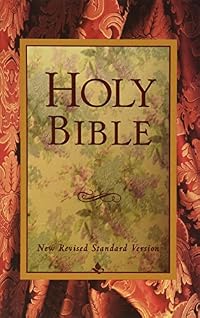
Holy Bible: New Revised Standard Version
by NRSV (Bible Translation)
On This Page
Description
Easy to Read. Easy to Carry. With a larger, easy-to-read typeface and a slim size, the NRSV Thinline Bible, Large Print invites you to deeply explore Scripture. Expertly designed for the New Revised Standard Version (NRSV) text, Zondervan's exclusive Comfort Print® typeface delivers a smooth reading experience that complements the foremost Bible translation vetted by Protestant, Catholic, Orthodox, Evangelical, and Jewish scholars. Renowned for its beautiful balance of scholarship and show more readability, the NRSV faithfully serves the church in personal spiritual formation, in the liturgy, and in the academy. Measuring at less than one inch thick, the large print edition of the NRSV Thinline Bible is an ideal way to carry the Word of God with you to work, school, or church. Features: The text of the New Revised Standard Version (Protestant canon), vetted by an ecumenical pool of Christian academics and renowned for its beautiful balance of scholarship and readability Less than one inch thick Double-column format Presentation page Two satin ribbon markers Leathersoft cover lays flat when open Exclusive Zondervan NRSV Comfort Print® typeface 12-point print size show lessTags
Recommendations




















Member Recommendations

lhungsbe My go-to version of the Bible. No additions or deletions. Easy to read.
lhungsbe My go-to version of the Bible. No additions or deletions. Easy to read.
lhungsbe My go-to version of the Bible. No additions or deletions. Easy to read.
divinepeacelutheran My go-to version of the Bible. No additions or deletions. Easy to read.
21
Member Reviews
http://nwhyte.livejournal.com/2011647.html
http://nwhyte.livejournal.com/2047769.html
First off, I don't think I actually would recommend reading the Old Testament (or indeed the Bible) through from start to finish as I did. It wasn't written or compiled to be read in that way, and it doesn't do the text any services to read as if it were a novel, a short story collection, or a book of essays and meditations. I chose this approach because I wanted to feel that I had control of what I was reading, and that I was not missing anything, but if you want to get a fair flavour of it, it's probably better to follow one of the many reading guides available online and elsewhere, which are designed both to showcase the good bits and to keep the show more reader interested.
Second, a lot of it is pretty dull, actually. 2 Chronicles in particular comes close to Mark Twain's description of the Book of Mormon, as "choroform in print". Large chunks of the Pentateuch are lists of laws and, even less exciting, census returns. The historical bits have an awful lot of tediously horrible ethnic cleansing and dynastic struggle, leavened by the occasional good bit (the Saul/David/Solomon succession in particular). The prophets are rather indistinguishable in tone of outrage. I recommend finding some way of skipping the dull bits.
Third, the good bits are indeed good. I've singled out the Book of Job in a previous post; I found the Psalms generally inspiring and uplifting, and I've always been a fan of Ecclesiastes. The narrative histories, which I thought I knew fairly well, still had some surprises for me - in Numbers 12, God smites Moses' sister with leprosy for racism towards Moses' black wife, for instance. There are some fun bits in the prophets - Jonah, and the deuterocanonical addenda to Daniel (Susanna, and Bel and the Dragon). I also rather liked Sirach, aka Ecclesiasticus, which again is deuterocanonical. And 2 Maccabees is a fairly lucid, if brutal, historical note to finish on.
Fourth, there were indeed a few themes running through the entire OT whose importance I hadn't perhaps fully grasped: the importance of God's endowing his people with the land, the importance of the cult of the Temple, and the trauma of the Babylonian exile (which of course shaped most of the text we have very directly). I'm not saying that these are the only or even the main main themes, but that these are the ones whose importance was enhanced for me by reading through the entire thing.
As for the New Testament: it falls rather naturally into three sections. The Gospels and Acts are among the most readable narratives in the Bible; the most striking things are that the three synoptic gospels are so very close to each other, leaving John as the outlier, and that Luke's better Greek prose style comes through in almost any translation of his gospel and Acts. I am also struck every time that the Feeding of the Five Thousand is the only miracle other than the Resurrection reported in all four gospels.
I was much less familiar with the various epistles. They are not as easy to read as the gospels, combining as they do advice on local disputed, personal salutations, declarations about correct practice and belief, and attempts to put words on the ineffable (Hebrews in particular is an attempt at a theological manifesto avant la lettre). I was struck by how hardline Paul is, particularly in the early letters, on the issues that hardliners still stick to today, and also on the question of justification by faith; but there is a significant counterbalance from some of the later letters, especially 1 Peter which seems to be a direct response in some ways. (And the Epistle of Jude seems strangely familiar after 2 Peter ch 2...)
Finally, Revelation is the most Old Testament-y of the New Testament books. (There is nothing like the letters in the Old Testament, and the gospels and Acts are quite different in style from the OT historical books.) Again, Revelation is an attempt to express in words that which cannot be expressed in words; it is clearly not meant to be taken literally, but as one person's attempt to concretise the underlying truths. show less
http://nwhyte.livejournal.com/2047769.html
First off, I don't think I actually would recommend reading the Old Testament (or indeed the Bible) through from start to finish as I did. It wasn't written or compiled to be read in that way, and it doesn't do the text any services to read as if it were a novel, a short story collection, or a book of essays and meditations. I chose this approach because I wanted to feel that I had control of what I was reading, and that I was not missing anything, but if you want to get a fair flavour of it, it's probably better to follow one of the many reading guides available online and elsewhere, which are designed both to showcase the good bits and to keep the show more reader interested.
Second, a lot of it is pretty dull, actually. 2 Chronicles in particular comes close to Mark Twain's description of the Book of Mormon, as "choroform in print". Large chunks of the Pentateuch are lists of laws and, even less exciting, census returns. The historical bits have an awful lot of tediously horrible ethnic cleansing and dynastic struggle, leavened by the occasional good bit (the Saul/David/Solomon succession in particular). The prophets are rather indistinguishable in tone of outrage. I recommend finding some way of skipping the dull bits.
Third, the good bits are indeed good. I've singled out the Book of Job in a previous post; I found the Psalms generally inspiring and uplifting, and I've always been a fan of Ecclesiastes. The narrative histories, which I thought I knew fairly well, still had some surprises for me - in Numbers 12, God smites Moses' sister with leprosy for racism towards Moses' black wife, for instance. There are some fun bits in the prophets - Jonah, and the deuterocanonical addenda to Daniel (Susanna, and Bel and the Dragon). I also rather liked Sirach, aka Ecclesiasticus, which again is deuterocanonical. And 2 Maccabees is a fairly lucid, if brutal, historical note to finish on.
Fourth, there were indeed a few themes running through the entire OT whose importance I hadn't perhaps fully grasped: the importance of God's endowing his people with the land, the importance of the cult of the Temple, and the trauma of the Babylonian exile (which of course shaped most of the text we have very directly). I'm not saying that these are the only or even the main main themes, but that these are the ones whose importance was enhanced for me by reading through the entire thing.
As for the New Testament: it falls rather naturally into three sections. The Gospels and Acts are among the most readable narratives in the Bible; the most striking things are that the three synoptic gospels are so very close to each other, leaving John as the outlier, and that Luke's better Greek prose style comes through in almost any translation of his gospel and Acts. I am also struck every time that the Feeding of the Five Thousand is the only miracle other than the Resurrection reported in all four gospels.
I was much less familiar with the various epistles. They are not as easy to read as the gospels, combining as they do advice on local disputed, personal salutations, declarations about correct practice and belief, and attempts to put words on the ineffable (Hebrews in particular is an attempt at a theological manifesto avant la lettre). I was struck by how hardline Paul is, particularly in the early letters, on the issues that hardliners still stick to today, and also on the question of justification by faith; but there is a significant counterbalance from some of the later letters, especially 1 Peter which seems to be a direct response in some ways. (And the Epistle of Jude seems strangely familiar after 2 Peter ch 2...)
Finally, Revelation is the most Old Testament-y of the New Testament books. (There is nothing like the letters in the Old Testament, and the gospels and Acts are quite different in style from the OT historical books.) Again, Revelation is an attempt to express in words that which cannot be expressed in words; it is clearly not meant to be taken literally, but as one person's attempt to concretise the underlying truths. show less
The NRSV: a revision of the RSV, itself a revision of the ASV, a revision of the KJV. A formal equivalence, "word-for-word" translation.
The NRSV is an excellent translation; there is a reason why many in scholarship use it. It faithfully renders the substance and meaning of the Hebrew and Greek texts but is not afraid to smooth out difficulties in the original in order to make the text meaningful to the English reader. In some instances this allows the reader of the NRSV to better grasp the meaning of a given passage than if they had read it in another version. The NRSV includes information from the Dead Sea Scrolls and other new discoveries, including in the text an addendum to 1 Samuel 10 (corroborated by Josephus) not provided in show more other translations.
The big criticism leveled at the NRSV involves its movement toward "gender-inclusive language." There is reason to critique the translation on this level since it ends up distorting the meaning of some texts in order to maintain that standard. Adelphoi, literally "brothers" but also translated in other versions as "brethren," is sometimes "brothers and sisters," but also at times is rendered as "friends" or even "comrades"! The latter two translations have implications and connotations foreign to the original Greek term. Thankfully, the editors have placed the literal rendering in the notes.
Even though it is often maligned, the NRSV remains a solid word-for-word, formal equivalence translation, and is worth consulting during serious Bible study. It would even be useful for frequent use in order to best ascertain the meaning of challenging texts as long as one keeps the translation's limitations and notes in mind.
Edition: The World compact edition of the NRSV features introductions to the major sections of the Bible, the essential notes of the text, a clear font type, and is compact and thus easily transportable. The text size is fairly small because of the compact size, but such is the nature of the beast. A one year Bible reading plan, a synopsis of the Gospels, and a list of prayers in the Bible are provided in the back; helpful resources and some not always found in compact editions of the Bible. This edition also provides the pronunciation markings for Hebrew and Greek names. On the whole, a nice, efficient, and easily used edition of the NRSV. show less
The NRSV is an excellent translation; there is a reason why many in scholarship use it. It faithfully renders the substance and meaning of the Hebrew and Greek texts but is not afraid to smooth out difficulties in the original in order to make the text meaningful to the English reader. In some instances this allows the reader of the NRSV to better grasp the meaning of a given passage than if they had read it in another version. The NRSV includes information from the Dead Sea Scrolls and other new discoveries, including in the text an addendum to 1 Samuel 10 (corroborated by Josephus) not provided in show more other translations.
The big criticism leveled at the NRSV involves its movement toward "gender-inclusive language." There is reason to critique the translation on this level since it ends up distorting the meaning of some texts in order to maintain that standard. Adelphoi, literally "brothers" but also translated in other versions as "brethren," is sometimes "brothers and sisters," but also at times is rendered as "friends" or even "comrades"! The latter two translations have implications and connotations foreign to the original Greek term. Thankfully, the editors have placed the literal rendering in the notes.
Even though it is often maligned, the NRSV remains a solid word-for-word, formal equivalence translation, and is worth consulting during serious Bible study. It would even be useful for frequent use in order to best ascertain the meaning of challenging texts as long as one keeps the translation's limitations and notes in mind.
Edition: The World compact edition of the NRSV features introductions to the major sections of the Bible, the essential notes of the text, a clear font type, and is compact and thus easily transportable. The text size is fairly small because of the compact size, but such is the nature of the beast. A one year Bible reading plan, a synopsis of the Gospels, and a list of prayers in the Bible are provided in the back; helpful resources and some not always found in compact editions of the Bible. This edition also provides the pronunciation markings for Hebrew and Greek names. On the whole, a nice, efficient, and easily used edition of the NRSV. show less
This edition is a standard mass market paperback. I find it extremely convenient as a travel bible in a standard paperback zippered book cover. It does not have any notes or references in it, but all I need it for is verse reference & it is good for that. The printing is not microscopic as in some smaller sized editions of the bible.
In addition, the NRSV is one of the better translations & I prefer it to ANY other translation.
This edition is not good for heavy use due to the paperback binding.
In addition, the NRSV is one of the better translations & I prefer it to ANY other translation.
This edition is not good for heavy use due to the paperback binding.
One of the most accurate modern-language Bibles without entirely losing the poetry. If you want a largely gender-neutral Bible with something of the style of the KJV, start here. This is probably not the exact edition I have.
This is the standard translation used in (Christian) seminary.
I especially love Romans and Hebrews in this version.
The original Revised Standard Version served as a standard for nearly forty years. The New Revised Standard Version with Apocrypha maintains the traditions of the older version with fresh new vocabulary and modern English construction.
Members
- Recently Added By
Lists

Newsweek's Top 100 Books: The Meta-List
100 works; 18 members

New York Public Library's Books of the Century
120 works; 20 members

New York Public Library's Books of the Century - All
170 works; 14 members

Bible Translations
15 works; 2 members

Angels
1 work; 1 member

The Great Courses: The Old Testament
78 works; 1 member

Books We'd Want on a Desert Island
203 works; 131 members
Bible Translations
56 works; 1 member
Author Information
54 Works 10,877 Members
Awards and Honors
Work Relationships
Is contained in
The Complete Parallel Bible with the Apocryphal/Deuterocanonical Books: New Revised Standard Version, Revised English Bible, New American Bible, New Jerusalem Bible by Publisher Oxford University Press (indirect)
The 1979 Book of Common Prayer and The New Revised Standard Version Bible with the Apocrypha by Church Publishing (indirect)
Is an adaptation of
Has the adaptation
Has as a reference guide/companion
Common Knowledge
- Canonical title
- Holy Bible: New Revised Standard Version (NRSV) (NRSV); Holy Bible: New Revised Standard Version
- People/Characters
- Aaron; Jesus Christ; Abel; Abraham; Adam; Andrew (show all 132); Annas, High Priest of Judea (also Ananus or Ananias, 23/22 BC/BCE to 40?); Baal; Bartholomew; Benjamin, son of Jacob; Caiaphas; Cain; Cyrus II, King of Persia; Dan, son of Jacob; Daniel; King David; Deborah; Delilah; Dorcas; Ehud; Eli; Elijah; Elisha; Elizabeth; Enoch; Esau; Esther; Ethiopian eunuch; Eve; Ezekiel; Ezra; Gabriel, the Angel (Saint, Archangel); Gideon; Goliath; Hagar; Ham; Hannah; Herod Agrippa I, King of Judea (Agrippa the Great, Marcus Julius Agrippa, 11 BC/BCE? to 44?); Herod Agrippa II; Herod Antipas; Herod the Great; Hezekiah; Holy Spirit; Isaac; Isaiah; Ishmael; Israel; Jacob; Jairus; James; Jehoshaphat; Jeremiah; Jesse; Jezebel; Job; John Mark; John the Apostle (Saint); John the Baptist; Jonah; Jonathan (son of Saul); Joseph, of Arimathea; Joseph (of Nazareth | Jesus' father); Joseph, son of Jacob; Joshua; Judah; Judas Iscariot; Jude, brother of James; Lazarus of Bethany; Leah; Levi; Lot; Lot's wife; Luke; Magi; Mark; Martha of Bethany; Mary Magdalene; Mary, mother of Jesus; Matthias; Melchizedek; Methuselah; Michael; Moses; Naaman; Nathanael; Nebuchadnezzar II; Nehemiah; Nicodemus; Noah; Orpah; Paul of Tarsus; Peter the Apostle (Saint, Simon Peter, Cephas); Pharaoh; Pharaoh's daughter; Philemon; Philip; Pontius Pilate; Potiphar; Priscilla; Quirinius (governor of Syria); Rachel; Rebekah; Reuben; Ruth; Samaritan woman; Samson; Samuel; Sanhedrin; Sapphira; Sarah; Sarai; Satan; Saul, King of Israel; Saul of Tarsus; Seth; Shadrach; Simon of Cyrene; Solomon; Stephen; Thomas; Tiberius Caesar Augustus, Emperor of Rome; Timothy; Uriah; Vashti; Widow of Nain; Xerxes I; Zacchaeus; Zebedee; Zechariah; John of Patmos; Mary of Bethany; Simeon
- Important places
- Mountains of Ararat; Bethlehem, Judea; Golgotha; Athens; Nazareth, Israel; Babel (show all 80); Babylon; Beersheba; Berea; Bethany; Bethesda; Bethlehem, Judea; Caesarea; Canaan; Cana, Galilee; Capernaum; Colossae; Corinth; Cappadocia; Crete, Greece; Cyprus; Damascus, Syria; Eden; Egypt; Ephesus; Galatia; Gethsemane; Gabbatha; Golgotha; Gomorrah; Greece; Gilead; Iconium; Israel; Jericho; Jerusalem; Joppa; Jordan River; Judah; Judea; Laodicea; Lebanon; Joppa; Lydda; Lystra; Macedonia; Mesopotamia; Mount Carmel; Mount Gerizim; Mount Gilead; Mount Hermon; Mount Horeb; Megiddo; Mount Nebo; Mount of Olives; Mount Sinai; Nazareth; Nineveh; Palestine; Patmos, Greece; Phillippi; Red Sea; Road to Emmaus; Persia; Rome, Italy; Salamis; Samaria; Pontus; Praetorium; Shiloh; Sidon; Sinai Peninsula, Egypt; Thessalonica; Thyatira; Tower of Siloam; Troas; Tyre; Valley of Jezreel; Yemen; Zebulun
- Disambiguation notice
- Please combine all printings and bindings of the complete Old and New Testaments of the New Revised Standard Version here. Versions including the Apocrypha should be combined into a separate work, as should versions with exte... (show all)nsive notes and study material. (Versions including just some notes and "helps" can be combined here.)
Classifications
Statistics
- Members
- 2,595
- Popularity
- 7,255
- Reviews
- 13
- Rating
- (3.98)
- Languages
- English
- Media
- Paper, Audiobook, Ebook
- ISBNs
- 253
- UPCs
- 16
- ASINs
- 88
