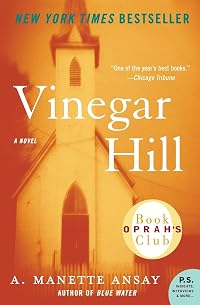
Vinegar Hill
by A. Manette Ansay
On This Page
Description
In a stark, troubling, yet ultimately triumphant celebration of self-determination, award-winning author A. Manette Ansay re-creates a stifling world of guilty and pain, and the tormented souls who inhabit it. It is 1972 when circumstance carries Ellen Grier and her family back to Holly's Field, Wisconsin. Dutifully accompanying her newly unemployed husband, Ellen has brought her two children into the home of her in-laws on Vinegar Hill -- a loveless house suffused with the settling dust of show more bitterness and routine -- where calculated cruelty is a way of life preserved and perpetuated in the service of a rigid, exacting and angry God. Behind a facade of false piety, there are sins and secrets in this place that could crush a vibrant young woman's passionate spirit. And here Ellen must find the straight to endure, change, and grow in the all-pervading darkness that threatens to destroy everything she is and everyone she loves. show lessTags
Recommendations


Member Reviews
I live in the Vinegar Hill neighborhood of Brooklyn, New York, so the title is what originally drew me to this book. It's set not in Brooklyn, but in a conservative, predominantly Catholic area of the Midwest in the 1970s.
If I wanted to be snide, I'd say this is a book about how being forced to move in with your in-laws will destroy your marriage, but that's obviously too glib. There are a few finely drawn characters and a real struggle to keep love alive in an atmosphere that seems determined to kill it.
Worth a read, but be warned that I would have much preferred some additional denouement; the suddenness of the ending dampened my enthusiasm for the book, which I had enjoyed up to that point.
If I wanted to be snide, I'd say this is a book about how being forced to move in with your in-laws will destroy your marriage, but that's obviously too glib. There are a few finely drawn characters and a real struggle to keep love alive in an atmosphere that seems determined to kill it.
Worth a read, but be warned that I would have much preferred some additional denouement; the suddenness of the ending dampened my enthusiasm for the book, which I had enjoyed up to that point.
I don't care what the description says, there is nothing "triumphant" about this.
I felt obligated to try an "Oprah's book club" book. I'm a woman, so these books are supposed to speak to me, right? Books I feel "obligated" to read are funny things. They either turn out to be amazing or dreadful. Guess which one this was.
I'm not sure what kind of audience this book was written for. It it bears any resemblance to your life, it's going to depress you further. If it doesn't, it's just going to depress you, end of story.
The one-dimensional characters plodded through their lives, lifting their heads long enough for a crop of flashback sequences that made it clear that their lives had always been full of the kind of bleak everyday horrors show more that made them the bleak horrible people they became. The story limps on to a conclusion that is no real conclusion at all. It just kind of stops. There is this vague suggestion that things are going to be better now, but it's almost impossible to believe it after the rest of the novel. show less
I felt obligated to try an "Oprah's book club" book. I'm a woman, so these books are supposed to speak to me, right? Books I feel "obligated" to read are funny things. They either turn out to be amazing or dreadful. Guess which one this was.
I'm not sure what kind of audience this book was written for. It it bears any resemblance to your life, it's going to depress you further. If it doesn't, it's just going to depress you, end of story.
The one-dimensional characters plodded through their lives, lifting their heads long enough for a crop of flashback sequences that made it clear that their lives had always been full of the kind of bleak everyday horrors show more that made them the bleak horrible people they became. The story limps on to a conclusion that is no real conclusion at all. It just kind of stops. There is this vague suggestion that things are going to be better now, but it's almost impossible to believe it after the rest of the novel. show less
This is a quietly powerful book. It's about a wife and mother and her extended family and her husband's extended family, set in the early 1970s. It's a statement about how cruelty and abuse affect each generation, and perhaps how difficult it is to break that cycle. It's about those who live with victims and how it affects everyone. And it's about a woman breaking free of this repression and madness. It's also about how twisted religion can be and has been in many lives. This book borders on 5 stars for me, but I selected 4 because in just a few places, it seemed disconnected. When I finished the book, I wanted to read it again to get the details I missed or didn't understand in the early reading. Other than that, I thought the writing show more was brilliant. show less
In a stark, troubling, yet ultimately triumphant celebration of self-determination, award-winning author A. Manette Ansay re-creates a stifling world of guilty and pain, and the tormented souls who inhabit it. It is 1972 when circumstance carries Ellen Grier and her family back to Holly's Field, Wisconsin. Dutifully accompanying her newly unemployed husband, Ellen has brought her two children into the home of her in-laws on Vinegar Hill--a loveless house suffused with the settling dust of bitterness and routine--where calculated cruelty is a way of life preserved and perpetuated in the service of a rigid, exacting and angry God. Behind a facade of false piety, there are sins and secrets in this place that could crush a vibrant young show more woman's passionate spirit. And here Ellen must find the straight to endure, change, and grow in the all-pervading darkness that threatens to destroy everything she is and everyone she loves. show less
The setting of this book was aptly named, Vinegar Hill. What a sour place it was! It tells the story of Ellen, who begins as a typical submissive Catholic wife. She goes with her husband and children to live with the husband's parents against her will. They are nasty and abusive and a trial to live with. Throughout the book I was hoping that Ellen would gather all her determination and courage and do something about her situation. The book shows how tradition can get in the way of common sense.
It took me a little while to realize that I loved this book. I found it easy enough to read and absorbing enough to keep me reading but I was well into it when I suddenly realized I really really liked it.
The main character is Ellen. The main action takes place in 1972, in a small town in middle America. She married James a while back because the two of them, on a date, had been caught in a snowstorm all night, and they knew that nobody would believe that nothing happened. They had to get married. Both are Catholic, but while James continues to preach the man-as-head-of-the-family story, Ellen is starting to think too much. A big theme in the book is the effects of this religion on people's lives. People who believe strongly.
Because of show more financial difficulties, the two moved in with James' father and agreed to save their earnings to get their own place later. Ellen works as a teacher, and all of her earnings go into the savings account, along with some of James', who works as a traveling salesman.
Friction within this extended family is enormous. James' father Fritz has always pinned James as "the weak one" and has a hard time saying anything nice about him or anyone else. Fritz's wife Mary Margaret is prone to shake her head at Ellen's cooking, always telling her how her mother cooked this or that. There are difficulties with the two children, Amy and Bert, as well, although not as pronounced as with the adults.
So I got to thinking about this as the anti-Waltons, and that pleased me. The strain tells on Ellen, who begins to take sleeping pills more and more often, hiding them in a porcelain ballet dancer (with a head that screws off). Marital relations between James and Ellen, never great, get worse. And it isn't enough that Ellen is making all the meals, cleaning, teaching full time. She has to bear the criticism of her sisters because she is not there at home fulltime for her children.
I guess it's a women's liberation tale too. No guessing about it. The author chose to change the point of view frequently so that we get into the heads of all of the main characters. Normally I find this distracting. I prefer to stick with one point of view. In this case, though,the technique works. We get insight into others while Ellen may never really know what they are thinking. It rounds out the tale. show less
The main character is Ellen. The main action takes place in 1972, in a small town in middle America. She married James a while back because the two of them, on a date, had been caught in a snowstorm all night, and they knew that nobody would believe that nothing happened. They had to get married. Both are Catholic, but while James continues to preach the man-as-head-of-the-family story, Ellen is starting to think too much. A big theme in the book is the effects of this religion on people's lives. People who believe strongly.
Because of show more financial difficulties, the two moved in with James' father and agreed to save their earnings to get their own place later. Ellen works as a teacher, and all of her earnings go into the savings account, along with some of James', who works as a traveling salesman.
Friction within this extended family is enormous. James' father Fritz has always pinned James as "the weak one" and has a hard time saying anything nice about him or anyone else. Fritz's wife Mary Margaret is prone to shake her head at Ellen's cooking, always telling her how her mother cooked this or that. There are difficulties with the two children, Amy and Bert, as well, although not as pronounced as with the adults.
So I got to thinking about this as the anti-Waltons, and that pleased me. The strain tells on Ellen, who begins to take sleeping pills more and more often, hiding them in a porcelain ballet dancer (with a head that screws off). Marital relations between James and Ellen, never great, get worse. And it isn't enough that Ellen is making all the meals, cleaning, teaching full time. She has to bear the criticism of her sisters because she is not there at home fulltime for her children.
I guess it's a women's liberation tale too. No guessing about it. The author chose to change the point of view frequently so that we get into the heads of all of the main characters. Normally I find this distracting. I prefer to stick with one point of view. In this case, though,the technique works. We get insight into others while Ellen may never really know what they are thinking. It rounds out the tale. show less
This is the story of the oppressiveness of religion and traditon on family live, particularly (but not exclusively) on women.
When Ellen's husband James loses his job, they and their two children move in with James's parents. The in-laws don't like Ellen; she is expected to do most of housework and they are not happy that she has a job rather then being a stay-home mother. James is not his father's favourite son, and was abused as a child. The cycle of dysfunction continues, as Ellen longs for a better life, James struggles with his emotions, and his parents argue or ignore each other.
The book is so well written. Just when I thought I had a good understanding of James, the focus switches and he becomes a much more complex character. show more
Set in the early 70s, the story takes place when Women were just beginning to expect more than a life of obeying their husbands and attending Sunday mass. Ellen's struggles are those many women faced. show less
When Ellen's husband James loses his job, they and their two children move in with James's parents. The in-laws don't like Ellen; she is expected to do most of housework and they are not happy that she has a job rather then being a stay-home mother. James is not his father's favourite son, and was abused as a child. The cycle of dysfunction continues, as Ellen longs for a better life, James struggles with his emotions, and his parents argue or ignore each other.
The book is so well written. Just when I thought I had a good understanding of James, the focus switches and he becomes a much more complex character. show more
Set in the early 70s, the story takes place when Women were just beginning to expect more than a life of obeying their husbands and attending Sunday mass. Ellen's struggles are those many women faced. show less
Members
- Recently Added By
Lists

Unread books
1,063 works; 82 members

Oprah's Book Club (original and 2.0)
91 works; 21 members
Talk Discussions
Past Discussions
Vinegar Hill in Book Fiend (February 2010)
Author Information

10+ Works 4,178 Members
Awards and Honors
Distinctions
Common Knowledge
- Canonical title
- Vinegar Hill
- Original publication date
- 1994-09-12
- People/Characters
- Ellen Grier; James Grier; Fritz Grier; Mary-Margaret Grier
- Important places
- Holly's Field, Wisconsin, USA
- Related movies
- Vinegar Hill (2005 | IMDb)
- Epigraph
- Pendant from her chain her cross swung as she leant out the sun struck it. How could she weigh herself down by that sleek symbol? How stamp herself so volatile, so vagrant, with that image? -Virginia Wolff, Between the Act... (show all)s
God isn't like a star that can go out. -Stewart O'Nan, In the Walled City - Dedication
- For Sylvia J. Ansay
- First words
- In the gray light of the kitchen,m Ellen sets the table for supper. keeping the chipped plate back for herself before lowering the rest in turn.
- Last words
- (Click to show. Warning: May contain spoilers.)But they reach the flat coin of the lake holding hands.
- Blurbers
- Bell, Madison Smartt; Tan, Amy
Classifications
Statistics
- Members
- 2,385
- Popularity
- 8,203
- Reviews
- 56
- Rating
- (3.11)
- Languages
- English, French, Italian
- Media
- Paper, Audiobook, Ebook
- ISBNs
- 31
- ASINs
- 13