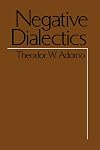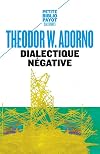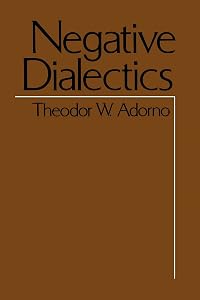
Negative Dialectics
by Theodor W. Adorno
On This Page
Description
The major work and Adorno's culminating achievement. Negative Dialectics is a critique of the philosophies of Kant, Hegel, and Heidegger, and a visionary elaboration of the author's own vision of dialectics.Tags
Recommendations















Member Reviews
This hard-as-hell philosophical work is a meta-critique of Kant and Hegel. Hegel explains in the Phenomenology of Spirit and throughout his body of work that anything that is real can be said or expressed in some way. Anything that is beyond the scope of logos, or reason, is therefore a non-entity. Adorno has problems with enlightenment reason in this form--it has taken instrumental and oppressive forms in modern history, particularly in the 20th century. He critiques here and elsewhere the basic tenets of the enlightenment project, that reason can achieve identity between subject and object, that words can express anything that is real, that the real is only that which can be expressed, that nothing is beyond the scope of reason so show more long as someone can conceive it, think it, interrogate it. Adorno "opens up" Hegel and says, no, reason is and must remain indeterminate. It must maintain a status of indeterminacy by undermining its own dialectical movement towards identity, and this is what Adorno calls 'non-identical thinking'. This is a philosophy which holds that there are things in the world that are beyond the scope of reason. There are things in the world which cannot be expressed yet still exist firmly in the universe and within us. Those things are "made known" to us through human suffering. It's not the same as Kant's "thing-in-itself" which is made known ultimately through the subject. Adorno will even deny the subject such status. Radically speaking, even the subject must be indeterminate, incomplete, "negative". The end of Negative Dialectics reminds me of Beckett's philosophy of art which is that the creative process is driven by perpetual failure on the part of the artist to express what he means; however, the writer, the artist, the narrator, must continue to express if it is expected to survive albeit negatively : "Yet the need in thinking is what makes us think. It asks to be negated by thinking. It must disappear in thought if it is to be really satisfied; and in this negation it survives." Unfortunately, without a so-so understanding of Hegelian dialectics and Kant's metaphysics, this concept of non-identity would be impossible to understand. Adorno is not trying to negate (as in do away with) a philosophical tradition that essentially began flexing its reason muscles since Descartes. He is trying to save it. In truth, my mind can barely grasp the concept of the non-indentical thinking because of the inherent aporia or logical impasse of its formulation. It might give you a headache. It's the hardest book I ever read. show less
So, this is great, but the translation is *horrific*. I'm not sure you can read this translation and have any idea what Adorno was getting at. Instead, try this free version:
http://www.efn.org/~dredmond/ndtrans.html
which works well enough as is.
Adorno's basic insight isn't even that hard to grasp, though: philosophy fails because it assumes the world must be consistent. But the world is 'contradictory,' or 'antagonistic.' We live in a social world which has been built up to provide humans with what we need, but over time that world itself has come to be an end, rather than a means. Hence, no matter how rational we make things (thankyou, econometricians) the whole is irrational, hence, 'contradictory.' So when philosophy claims that it show more has understood the consistent world, it is just covering up the antagonism. And this is bad. But it's also good, since it suggests that the world doesn't *have* to be antagonistic.
There's much more to it I guess, but that's good enough for one lifetime. Thankyou, Theo. show less
http://www.efn.org/~dredmond/ndtrans.html
which works well enough as is.
Adorno's basic insight isn't even that hard to grasp, though: philosophy fails because it assumes the world must be consistent. But the world is 'contradictory,' or 'antagonistic.' We live in a social world which has been built up to provide humans with what we need, but over time that world itself has come to be an end, rather than a means. Hence, no matter how rational we make things (thankyou, econometricians) the whole is irrational, hence, 'contradictory.' So when philosophy claims that it show more has understood the consistent world, it is just covering up the antagonism. And this is bad. But it's also good, since it suggests that the world doesn't *have* to be antagonistic.
There's much more to it I guess, but that's good enough for one lifetime. Thankyou, Theo. show less
For Adorno, the horrors of World War II (the Holocaust, the fire-bombing of Dresden, the atomic bombs in Japan, etc.) represented a kind of "rupture" in history. He thought the Hegelian idea of history as a kind of "progress" was no longer tenable, given the viciousness and destruction to which science and politics had brought western civilization. Thus this book is a kind of reaction to the failure of history to lead to progress and an attempt to rescue the Hegelian idea of dialectic in history from its teleology of progress. For Adorno, one must work dialectic backwards--splitting ideas up into their constituent parts--in order to recover any older or originary ideas which might still be salvageable for the contemporary world. He also show more has another definition for "negative dialectic" in mind--more like Socrates' method in Plato's dialogues: he means to use dialect to show what "is not" the truth, even if/when he does not claim himself to know what is the truth. The book is difficult to read, but rewards patience and re-reading. Despite Adorno's reputation for austerity, there is often humor in the book--especially when he disagrees or argues with his mentor Heideggger or Heidegger's mentor Husserl. The concluding section of the book is lyrically beautiful. show less
100 ADO 2
Ratings
Members
- Recently Added By
Author Information

327+ Works 14,355 Members
Theodor W. Adorno is the progenitor of critical theory, a central figure in aesthetics, and the century's foremost philosopher of music. He was born and educated in Frankfurt, Germany. After completing his Ph.D. in philosophy, he went to Vienna, where he studied composition with Alban Berg. He soon was bitterly disappointed with his own lack of show more talent and turned to musicology. In 1928 Adorno returned to Frankfurt to join the Institute for Social Research, commonly known as The Frankfurt School. At first a privately endowed center for Marxist studies, the school was merged with Frankfort's university under Adorno's directorship in the 1950s. As a refugee from Nazi Germany during World War II, Adorno lived for several years in Los Angeles before returning to Frankfurt. Much of his most significant work was produced at that time. Critics find Adorno's aesthetics to be rich in insight, even when they disagree with its broad conclusions. Although Adorno was hostile to jazz and popular music, he advanced the cause of contemporary music by writing seminal studies of many key composers. To the distress of some of his admirers, he remained pessimistic about the prospects for art in mass society. Adorno was a neo-Marxist who believed that the only hope for democracy was to be found in an interpretation of Marxism opposed to both positivism and dogmatic materialism. His opposition to positivisim and advocacy of a method of dialectics grounded in critical rationalism propelled him into intellectual conflict with Georg Hegel, Martin Heidegger, and Heideggerian hermeneutics. (Bowker Author Biography) show less
Some Editions
Series
Belongs to Publisher Series
Gesammelte Schriften in 20 Bänden (Band 6)
Work Relationships
Common Knowledge
- Canonical title
- Negative Dialectics
- Original title
- Negative Dialektik
- Original publication date
- 1966 (Frankfurt am Main, Suhrkamp) (Frankfurt am Main, Suhrkamp); 1970 (1. ed. it. Torino, Giulio Einaudi) (1. ed. it. Torino, Giulio Einaudi)
- First words
- Prologue
The formulation “negative dialectics” transgresses against tradition. Already in Plato dialectics intended to establish something positive through the thought-means of the negation; the figure of a nega... (show all)tion of the negation named this precisely. The book would like to emancipate dialectics from these types of affirmative essence, without relinquishing anything in terms of
determinacy. The development of its paradoxical title is one of its intentions. - Last words
- (Click to show. Warning: May contain spoilers.)The smallest innerworldly markings would be relevant to the absolute, for the micrological glance demolishes
the shells of that which is helplessly compartmentalized according to the measure of its subsuming master concept and explodes its identity, the deception, that it would be merely an exemplar. Such thinking is solidaristic with metaphysics in the
moment of the latter’s fall. - Original language
- German
Classifications
Statistics
- Members
- 573
- Popularity
- 51,604
- Reviews
- 4
- Rating
- (4.31)
- Languages
- 12 — Danish, Dutch, English, French, German, Italian, Polish, Portuguese, Russian, Spanish, Swedish, Turkish
- Media
- Paper, Ebook
- ISBNs
- 26
- ASINs
- 2