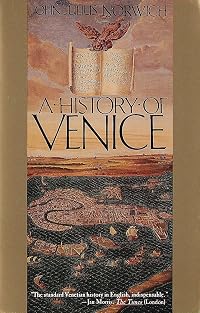
A History of Venice
by John Julius Norwich
On This Page
Description
Renowned historian, and author of A Short History of Byzantium, John Julius Norwich's classic history of Venice A History of Venice tells the story of this most remarkable of cities from its founding in the fifth century, through its unrivalled status for over a thousand years as one of the world's busiest and most powerful city states, until its fall at the hands of Napoleon in 1797. Rich in fascinating historical detail, populated by extraordinary characters and packed with a wealth of show more incident and intrigue, this is a brilliant testament to a great city - and a great and gripping read. 'Norwich has loved and understood Venice as well as any other Englishman has ever done' Sunday Times 'Will become the standard English work of Venetian history' Financial Times 'The standard Venetian history in English' The Times 'Norwich has the gift of historical perspective, as well as clarity and wit. Few can tell a good story better than he' Spectator John Julius Norwich was born in 1929. He was educated at Upper Canada College, Toronto, at Eton, at the University of Strasbourg and, after a spell of National Service in the Navy, at New College, Oxford, where he took a degree in French and Russian. In 1952 he joined the Foreign Service, where he remained for twelve years, serving at the embassies in Belgrade and Beirut. In 1964 he resigned from the service to write. He is the author of histories of Norman Sicily, the Republic of Venice and the Byzantine Empire. He has written and presented some thirty historical documentaries on television, and is a regular lecturer on Venice and numerous other subjects. show lessTags
Recommendations












Member Reviews
Although weighty in both the literal and metaphorical sense of the word, this turned out to be quite a worthwhile book. It covers the history of Venice from 421 CE to 1797 CE. The Most Serene Republic was therefore a republic longer than anywhere else on the planet – and, depending on how sticky you are about the term “republic”, quite possibly longer than all the others combined.
Author John Julius Norwich has an easy-to-read style, and considerable dry humor (although he often saves that for the footnotes). Nonetheless there’s far too much history to go over, so I’ll comment on some of the things that interested me:
To what extent was Venice actually a “republic”? It seemed to work fairly well, using a system of checks and show more balances. The legislative and executive branches were held by the nobility; the civil service and judiciary were controlled by the commoners. The Republic was almost morbidly afraid of any one noble family getting too much power, especially after the examples of the Medicis, Borgias, and Sforzas; hence the procedure for electing the Doge was as follows:
The youngest member of the Council of State went to St. Mark’s to pray, then;
He stopped the first boy he met and took him to the Doge’s palace, then;
The boy picked slips of paper from an urn, choosing 30 members of the Great Council, then;
Another round of lots reduced the 30 to 9, then;
The nine met and voted for 40, each of which had to receive at least seven votes, then;
The 40 were reduced by lot to 12, then;
The 12 voted for 25, each of whom had to get 9 votes, then;
The 25 were reduced by lot to 9, then;
The nine voted for 45, with seven votes each, then;
The 45 were reduced by lot to 11, then;
The 11 voted for 41, each of whom had to get at least 9 votes, then;
Each of the 41 voted for a Doge by secret ballot, then;
Everyone who had been nominated by the 41 got one lot, regardless of the number of nominations received, then;
A lot was drawn, the nominee was invited to answer questions, and a vote was taken. If he received 25 votes, he was Doge; if not a second name was drawn and so on until a Doge was elected.
And I thought the Electoral College was complicated. The interesting thing about this is that the Doge never really had any power. He got a vote on the Council of State, but that was it. On the other hand, he was very much a Head of State; he received visiting dignitaries in splendor, held State banquets, and was generally the visible symbol of Venice. Being elected Doge was often the reward for somebody who had devoted a lot of time to government service – sort of a retirement package.
Venice was one of the few places in medieval Europe where the nobility openly engaged in trade; and they seemed to take the attitude that what was good for business was good for Venice, and vice versa (and they seem to have been quite right). Venice was almost notoriously tolerant for the time; intolerance was bad for business. There were synagogues, an Orthodox church, a mosque, and Protestant churches when the time came. This got the Republic in trouble with the Papacy on several occasions; in other European countries a woman convicted of witchcraft was tied to a post and burned alive; in Venice she had to stand in a public square for an hour while wearing a witch’s hat. The brutes.
Norwich explains another thing that had puzzled me ever since I read a biography of courtesan/poetess Victoria Franco. Courtesans had to register; at one time in the 1500s where the register was preserved, there were 11564 of them out of a population of about 100000. This seemed amazing to me; if you consider that half of that 100000 is eliminated by gender, and of the remaining 50000 a good chunk must have been ineligible due to age or inclination, it would seem that about half of the potential women in Venice were in the business. I’m all for free trade, but that still seems a bit excessive. However, Norwich explains two factors that figured in. One was the nobility of Venice, which over the years developed multitudinous cadet branches and family linkages, adopted the policy of meeting in conclave and deciding who was going to carry on the family in each generation, avoiding endless subdivisions of the family wealth. Thus most of the nobility and probably most of the wealthier commoners never married; as an example, fully 60% of the Doges were bachelors. Well, men will be men and single women have to make a living. A second factor was Venice’s reputation as the Las Vegas of the day; tourists came from all over to partake. (One of the most interesting was Henry III of France, who had managed to get himself crowned King of Poland; however when his elder brother Charles died and left the throne vacant to him, he decided Paris was more attractive than Warsaw and fled in the middle of the night, taking the Polish state treasury with him. He managed to stop in Venice on the way home – not quite on the direct route – and was treated royally by the Venetians, choosing female companionship from a portfolio of paintings prepared for the purpose. See Dangerous Beauty and Queen Margot). All that activity made for a lot of orphans, but Venice even managed to turn that to advantage – Vivaldi and lesser musicians used the orphans as choirs and orchestras.
I can’t do justice to such a large book in a short review, but I recommend it highly; there’s a lot more of interest than just what I’ve commented on. show less
Author John Julius Norwich has an easy-to-read style, and considerable dry humor (although he often saves that for the footnotes). Nonetheless there’s far too much history to go over, so I’ll comment on some of the things that interested me:
To what extent was Venice actually a “republic”? It seemed to work fairly well, using a system of checks and show more balances. The legislative and executive branches were held by the nobility; the civil service and judiciary were controlled by the commoners. The Republic was almost morbidly afraid of any one noble family getting too much power, especially after the examples of the Medicis, Borgias, and Sforzas; hence the procedure for electing the Doge was as follows:
The youngest member of the Council of State went to St. Mark’s to pray, then;
He stopped the first boy he met and took him to the Doge’s palace, then;
The boy picked slips of paper from an urn, choosing 30 members of the Great Council, then;
Another round of lots reduced the 30 to 9, then;
The nine met and voted for 40, each of which had to receive at least seven votes, then;
The 40 were reduced by lot to 12, then;
The 12 voted for 25, each of whom had to get 9 votes, then;
The 25 were reduced by lot to 9, then;
The nine voted for 45, with seven votes each, then;
The 45 were reduced by lot to 11, then;
The 11 voted for 41, each of whom had to get at least 9 votes, then;
Each of the 41 voted for a Doge by secret ballot, then;
Everyone who had been nominated by the 41 got one lot, regardless of the number of nominations received, then;
A lot was drawn, the nominee was invited to answer questions, and a vote was taken. If he received 25 votes, he was Doge; if not a second name was drawn and so on until a Doge was elected.
And I thought the Electoral College was complicated. The interesting thing about this is that the Doge never really had any power. He got a vote on the Council of State, but that was it. On the other hand, he was very much a Head of State; he received visiting dignitaries in splendor, held State banquets, and was generally the visible symbol of Venice. Being elected Doge was often the reward for somebody who had devoted a lot of time to government service – sort of a retirement package.
Venice was one of the few places in medieval Europe where the nobility openly engaged in trade; and they seemed to take the attitude that what was good for business was good for Venice, and vice versa (and they seem to have been quite right). Venice was almost notoriously tolerant for the time; intolerance was bad for business. There were synagogues, an Orthodox church, a mosque, and Protestant churches when the time came. This got the Republic in trouble with the Papacy on several occasions; in other European countries a woman convicted of witchcraft was tied to a post and burned alive; in Venice she had to stand in a public square for an hour while wearing a witch’s hat. The brutes.
Norwich explains another thing that had puzzled me ever since I read a biography of courtesan/poetess Victoria Franco. Courtesans had to register; at one time in the 1500s where the register was preserved, there were 11564 of them out of a population of about 100000. This seemed amazing to me; if you consider that half of that 100000 is eliminated by gender, and of the remaining 50000 a good chunk must have been ineligible due to age or inclination, it would seem that about half of the potential women in Venice were in the business. I’m all for free trade, but that still seems a bit excessive. However, Norwich explains two factors that figured in. One was the nobility of Venice, which over the years developed multitudinous cadet branches and family linkages, adopted the policy of meeting in conclave and deciding who was going to carry on the family in each generation, avoiding endless subdivisions of the family wealth. Thus most of the nobility and probably most of the wealthier commoners never married; as an example, fully 60% of the Doges were bachelors. Well, men will be men and single women have to make a living. A second factor was Venice’s reputation as the Las Vegas of the day; tourists came from all over to partake. (One of the most interesting was Henry III of France, who had managed to get himself crowned King of Poland; however when his elder brother Charles died and left the throne vacant to him, he decided Paris was more attractive than Warsaw and fled in the middle of the night, taking the Polish state treasury with him. He managed to stop in Venice on the way home – not quite on the direct route – and was treated royally by the Venetians, choosing female companionship from a portfolio of paintings prepared for the purpose. See Dangerous Beauty and Queen Margot). All that activity made for a lot of orphans, but Venice even managed to turn that to advantage – Vivaldi and lesser musicians used the orphans as choirs and orchestras.
I can’t do justice to such a large book in a short review, but I recommend it highly; there’s a lot more of interest than just what I’ve commented on. show less
This book is another prime example of why Lord Norwich is one of my favourite current popular historians, and though a smaller work, is just as much of an achievement as his monumental History of Byzantium. Even though his book runs to something a little less than a page for each year of the existence of Venice as an independent city state, he still manages to cover in detail the sometimes tortuous twists and turns of Venetian politics with clarity and skill - there is no confusion between the four Doges who gloried in the name of Alvise Mocenigo, for example. Where Lord Norwich really comes into his own, however, is in his keen and sympathetic understanding of human nature, and the dry wit he likes to use when talking about this. When show more the history of a state is as complicated and as full of unexpected shifts as Venice's is, that really is a welcome asset.
The only slight complaints I would have with the book is that it focuses on the political and economic at the expense of the social and artistic. However, in fairness, Norwich does try to include some of the major artistic and social events when they bear on the events that he describes, and he does state - with a great amount of truth - that to have included all those things would have doubled, if not trebled, the size of an already large book. Another little niggling flaw is the tendency to include pieces from the original sources, but not always to translate them. While I have no problem with the French, I am really not able to puzzle my way through anything more than the most basic of basic inscriptions in Latin or Italian. I am aware this is a horrendous failing for a student of classical archaeology, but unfortunately I have neither the time nor the money required to take on an extra diploma so that I can learn Latin - certainly not in the near future, anyway. I'm always a little irked by the tendency of some historians to presume that anyone reading their work will have the ability to learn Latin - not everyone interested in history has that opportunity - and I would like to see that corrected.
Still, all in all, an excellent book, and an excellent scholarly work, and one that I am sure will become the standard English-language history of Venice. show less
The only slight complaints I would have with the book is that it focuses on the political and economic at the expense of the social and artistic. However, in fairness, Norwich does try to include some of the major artistic and social events when they bear on the events that he describes, and he does state - with a great amount of truth - that to have included all those things would have doubled, if not trebled, the size of an already large book. Another little niggling flaw is the tendency to include pieces from the original sources, but not always to translate them. While I have no problem with the French, I am really not able to puzzle my way through anything more than the most basic of basic inscriptions in Latin or Italian. I am aware this is a horrendous failing for a student of classical archaeology, but unfortunately I have neither the time nor the money required to take on an extra diploma so that I can learn Latin - certainly not in the near future, anyway. I'm always a little irked by the tendency of some historians to presume that anyone reading their work will have the ability to learn Latin - not everyone interested in history has that opportunity - and I would like to see that corrected.
Still, all in all, an excellent book, and an excellent scholarly work, and one that I am sure will become the standard English-language history of Venice. show less
This is an absolutely marvellous history of Venice, packed full of colourful incident and dramatic developments. It manages to combine both the grand historical sweep, with some great evocative writing, and a level of chronological detail which is informative but never overpowering enough to be tiresome. I deliberately read a relatively small amount each day over 5 weeks so as to savour this and not get bogged down. Wonderful, rich stuff by an author who genuinely loves his subject.
Another absolutely brilliant book by John Julius Norwich. Incredibly researched, full of amazing details (and the wisdom to have skipped all those details when they didn't contribute to the story), and beautifully written with just the right touch of wry wit. A book that one can return to many times and always come away from richer. Worth the investment in every way.
This is a beautifully-written book. Norwich writes of Venice's remarkable history with humour and affection for his subject. Despite wading through a great quantity of detail through the Republic's thousand-year history, Norwich managed to hold my interest throughout. The book was heavy going at times but this was more due to the multifarious cast of little-known (to me) characters than to any fault of the author. This is a fine introduction to a fascinating subject.
As usual, Norwich is an entertaining guide through an often-overlooked (in comparison to England, France, Spain) area of Eurpoean history.
His fondness for the city, resulting in copious footnotes marking where various tombs and monuments are now located, can get a bit oppressive.
Unlike Byzantium (to which I have to admit only having read the digest version; the three-colume epic is far down on the to-read), the history of Venice is rather dull, making this a slow but ultimately rewarding read.
His fondness for the city, resulting in copious footnotes marking where various tombs and monuments are now located, can get a bit oppressive.
Unlike Byzantium (to which I have to admit only having read the digest version; the three-colume epic is far down on the to-read), the history of Venice is rather dull, making this a slow but ultimately rewarding read.
The history of Venice right from when the community first left the mainland to seek refuge in the lagoon from the raving hordes to today. A wonderful, wide sweep through Venetian history, including such detail as to be amazing. A big tome, but one of those rare history books that reads like a novel, and can be read again and again.
I loved it.
I loved it.
Members
- Recently Added By
Lists

Trivia & travel : books Bill Bryson would love
16 works; 2 members

Europe
205 works; 6 members

Folio Society
831 works; 53 members

Books Read in 2005
174 works; 7 members

Five star books
1,767 works; 110 members
Talk Discussions
Past Discussions
Folio Archives 326: A History of Venice by John Julius Norwich 2007 in Folio Society Devotees (June 2023)
Author Information

100+ Works 12,646 Members
John Julius Norwich was born in the United Kingdom on September 15, 1929. He served in the Royal Navy before receiving a degree in French and Russian at New College, Oxford. After graduation, he joined the H. M. Foreign Service and served in Belgrade, Beirut, and as a member of British delegation to the Disarmament Conference in Geneva. In 1954, show more he inherited the title of Viscount Norwich. In 1964, he resigned from the Foreign Service to become a writer. He was a historian, travel writer, and television personality. His books included The Normans in the South, A History of Venice, The Italian World, Venice: A Traveller's Companion, 50 Years of Glyndebourne: An Illustrated History, A Short History of Byzantium, Absolute Monarchs: A History of the Papacy, Sicily: An Island at the Crossroads of History, and A History of France. He and H. C. Robbins Landon wrote Five Centuries of Music in Venice. Norwich was the host of the BBC radio panel game My Word! from 1978 to 1982. He wrote and presented more than 30 television documentaries including Maestro, The Fall of Constantinople, Napoleon's Hundred Days, Cortés and Montezuma, Maximilian of Mexico, The Knights of Malta, The Treasure Houses of Britain, and The Death of the Prince Imperial in the Zulu War. In 1993, he was appointed CVO for having curated an exhibition at the Victoria and Albert Museum to mark the 40th anniversary of the Queen's accession to the throne. In 2015, he was awarded the Biographers' Club award for his lifetime service to biography. He died on June 1, 2018 at the age of 88. (Bowker Author Biography) show less
Awards and Honors
Awards
Work Relationships
Common Knowledge
- Canonical title
- A History of Venice
- Original publication date
- 1977 (Volume 1) (Volume 1); 1981 (Volume 2) (Volume 2); 1982 (Combined edition) (Combined edition)
- Important places
- Venice, Veneto, Italy; Veneto, Italy
- Dedication
- For Jason
and in memory of the grandfather
he never knew who loved Venice
and should have written this book - First words
- The origins of Venice encircle her still.
- Last words
- (Click to show. Warning: May contain spoilers.)PAX TIBI MARCE EVANGELISTA MEUS
- Blurbers
- Trevor-Roper, Hugh
- Original language
- English
Classifications
Statistics
- Members
- 1,242
- Popularity
- 19,825
- Reviews
- 14
- Rating
- (4.23)
- Languages
- English, French, Italian, Spanish
- Media
- Paper, Ebook
- ISBNs
- 14
- ASINs
- 9