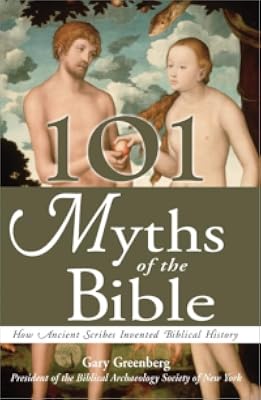
101 Myths of the Bible: How Ancient Scribes Invented Biblical History
by Gary Greenberg
On This Page
Description
In his startling book, Gary Greenberg exposes the reality behind the greatest story ever told. Learn about the Egyptian myths and ancient folklore that survive in one of history's most sacred texts, and discover how:-King David's bodyguard, not David, killed Goliath-Noah's Ark did not land on Mount Ararat-Samson did not pull down a Philistine temple-There are at least two versions of the Ten Commandments-The walls of Jericho were destroyed 300 years before Joshua arrived there-Sodom and show more Gomorrah were mythical cities that never existed-The story of Esther had nothing to do with the Jews of Persia-And much, much more101 Myths of the Bible provides a new dimension of biblical studies for believers, historians and anyone who has ever wondered about the facts behind the legends. By looking deeper into history, Greenberg shows that the true story makes the Bible more interesting than ever imagined! show lessTags
Recommendations







Member Reviews
I really didn't hold out much promise from this book. Any book that deals with 101 of anything, in my experience, has to try too hard to fit everything into the fixed number or is padding it out to reach the number. But I needn't have worried. Greenberg has done a pretty good job of tailoring his cases to the number without it becoming too repetitive or boring. I thought I knew the Bible pretty well....I've systematically read it from cover to cover twice and have read individual sections, probably, hundreds of times. But, even so I was oblivious to the fact that there are two different accounts in genesis of THE genesis. And they differ and are contradictory. And, I always have the dictum in the back of my mind that if two accounts show more agree then it's possible that they might both be true or both be in error. But if they contradict each other then at least one of the accounts has to be false. As Greenberg says, "structurally, Genesis 1-11 presents a fascinating insight into how the Bible evolved....At its core are two separate biblical source documents, P and J, each presenting contradictory accounts of events and very different points of view about deity.....and... the biblical editors tried to integrate the two sources into a single seamless narrative". For example in the first Genesis account of the creation it says that the fowl emerged from the waters. By contrast in the second version of Genesis attributable to the J source, it says.."and out of the ground the lord god did form every beast of the field and every fowl of the air" (Gen.2:19). The water based origins reflects Egyptian mythology about water being the source of life and the land based story reflect the Babylonian mythology in which land played a more significant role.
Apparently biblical scholars generally agree that there were at least two different source documents for the five books of Moses (though Deuteronomy describes the death and burial of Moses ...so it couldn't have been written by him). One of these source documents is known as the J document (because it refers to Jahweh..the name of the Hebrew god.....the other, the E document, because it uses Elohim as the word for god. However, later research has shown that there were at least 4 source documents integrated into the books of Moses...and there are many "doublets".......same story appearing twice with different wrinkles.The E document appears to have had two separate sources...and embedded in the E source is the P (or priestly) source....very much promoting the cause of Aronite wing of the Levites as priests.The other source document is the D source (from Deuteronomy) and it belongs to a much larger collection of works including the biblical books of Joshua, 1 & 2 Samuel, and 1 & 2 Kings which presents a history of the Hebrews from Moses (c.1300 BC to the Babylonian captivity c. 622 BC...and presumably was written during the reformist regime of King Josiah after the Hebrews (or some of them) returned from Babylon.
Greenberg cites 16 biblical authors specifically referring to reference works that they relied upon in composing their work...for example the Book of Jasher cited in Joshua 10:13 and 2 Samuel 1:18)....the first is the incident where Joshua commanded the sun to stand still and the second where David taught the children of Israel how to use the bow....More than 300 years separate the events. This tells us that the Book of Jasher was written no earlier than the time of King David yet has information about Joshua...300 years earlier. So where did the writer of Jasher get his information?
Anyway, the underlying theme is that some author or set of authors (redactors) have put together the work that we have as the bible by combining different documents (frequently with overlapping and conflicting stories reflecting political differences at the time) and they tried to make it into a coherent narrative. (Not always successfully).
A major thrust of Greenberg's thesis is that many of the stories in the bible can be traced either directly or indirectly to the myths of the Egyptians or the Babylonians. J's roots go back to the Egyptian city of Heliopolis. Joseph was married to the daughter of the Chief Priest The P document has adopted the creation philosophy associated with the Egyptian city of Thebes. For the most part the Egyptians shared certain common ideas about the creation....a universal flood from which emerged a mountain and on this mountain the process of creation moved forwards. The major cult centres of Egypt each associated their local deity with the first acts of creation. The Hebrews in essence engaged in a form of reverse-engineering to fashion a coherent cosmogony. Although polytheistic, the Egyptian myths were very philosophical and scientific. They tried to define the physical nature of the universe and explain how it evolved and was transformed into its present situation. So the Hebrew philosophers separated the deities from the phenomena and where for example the Egyptians had a flaming serpent upon the mountain emerging from out of the flood...the Hebrew replaced this with light appearing while a firmament arose out of the primal flood. Sometimes, I think, Greenberger has to press his arguments a bit far and maybe there are a few rather far-fetched calls in comparing the earlier Egyptian/Babylonian mythology with it's transformation into Jewish stories in the bible.....but on the whole...his claims seem reasonable and one can see the obvious linkages.
And, as Greenberg points out.....in 587 BC the remnants of the Hebrew kingdom were forcibly removed to Babylon where they became immersed in the learned culture of the Babylonians and had to meld (for example) their myth of the flood story with the equivalent Babylonian flood story....except they had to move the Hebrew version from the creation to the tenth generation of bibical humanity. But traces of the original polytheism escaped the sharp eyes of the redactors and remain embedded in the text. He suggests that the P creation story flows from images in the Theban creation myth...it unfolds with the same sequence of events.
Likewise through the whole of the 101 "myths" Greenberg draws parallels between the mythology of the Egyptians and the mythology of the babylonians superimposed on it......always interpreting the polytheistic gods actions as attributes of the monotheistic Hebrew god.
I've just been going through the King James Version of Genesis and comparing with the New International Version and comparing with what Greenberger is claiming about the creation of Adam and Eve. He suggests that there are conflicting stories between Genesis 1 and Genesis 2 and that seems correct. In Genesis 1 man and woman (Not necessarily Adam and Eve) are created on the 6th day (or maybe the 7th if you notice the strange omission in Genesis 1:25 of the formulaic ..."And God saw that it was good ...and the evening and the morning were the sixth day". As Greenberg points out that Genesis 2:2 says "On the seventh day God ended his work"......meaning that he was still working on the 7th day and (if the formulaic omission referred to above is real) presumably created man and woman on the 7th day and then rested....on the 8th day? But maybe the redactors were trying hard to reconcile these myths with the practice of a holy sabbath day...so had god rest on the seventh day, (How come an omnipotent God needs to rest?).
Greenberg draws attention to the fact that Genesis 1:11-12 has vegetation appearing before the sun....which has a few problems with a lack of photosynthesis......But he says that the reality is that the Genesis story just follows the Egyptian creation sequence in putting the appearance of vegetation before the sun.
The conflicts between Cain and Abel are recast as similar conflicts between Egyptian gods Set and Osiris but subsequently the story was influenced by Sumerian myths about the shepherd names Dumuzi.
Ok...sometimes Greenberg pushed the analogies fairly hard to make his case but overall it's a very believable story backed by a mountain of evidence and in most cases one can easily draw the parallels.....especially if one gives some credence to the way myths can morph over time. So what's the bottom line? Well, pretty clearly the early books of the Bible are very largely mythological in nature; they are the works of very human redactors trying to cobble together a bunch of source documents into a coherent whole....but with some obvious local political overtones and they are almost certainly not the inspired words of God handed to or written by Moses. So the consequences of Greenberger's debunking have severe implications for a number of the major religions.
Happy to give the book five stars. It certainly made me think. show less
Apparently biblical scholars generally agree that there were at least two different source documents for the five books of Moses (though Deuteronomy describes the death and burial of Moses ...so it couldn't have been written by him). One of these source documents is known as the J document (because it refers to Jahweh..the name of the Hebrew god.....the other, the E document, because it uses Elohim as the word for god. However, later research has shown that there were at least 4 source documents integrated into the books of Moses...and there are many "doublets".......same story appearing twice with different wrinkles.The E document appears to have had two separate sources...and embedded in the E source is the P (or priestly) source....very much promoting the cause of Aronite wing of the Levites as priests.The other source document is the D source (from Deuteronomy) and it belongs to a much larger collection of works including the biblical books of Joshua, 1 & 2 Samuel, and 1 & 2 Kings which presents a history of the Hebrews from Moses (c.1300 BC to the Babylonian captivity c. 622 BC...and presumably was written during the reformist regime of King Josiah after the Hebrews (or some of them) returned from Babylon.
Greenberg cites 16 biblical authors specifically referring to reference works that they relied upon in composing their work...for example the Book of Jasher cited in Joshua 10:13 and 2 Samuel 1:18)....the first is the incident where Joshua commanded the sun to stand still and the second where David taught the children of Israel how to use the bow....More than 300 years separate the events. This tells us that the Book of Jasher was written no earlier than the time of King David yet has information about Joshua...300 years earlier. So where did the writer of Jasher get his information?
Anyway, the underlying theme is that some author or set of authors (redactors) have put together the work that we have as the bible by combining different documents (frequently with overlapping and conflicting stories reflecting political differences at the time) and they tried to make it into a coherent narrative. (Not always successfully).
A major thrust of Greenberg's thesis is that many of the stories in the bible can be traced either directly or indirectly to the myths of the Egyptians or the Babylonians. J's roots go back to the Egyptian city of Heliopolis. Joseph was married to the daughter of the Chief Priest The P document has adopted the creation philosophy associated with the Egyptian city of Thebes. For the most part the Egyptians shared certain common ideas about the creation....a universal flood from which emerged a mountain and on this mountain the process of creation moved forwards. The major cult centres of Egypt each associated their local deity with the first acts of creation. The Hebrews in essence engaged in a form of reverse-engineering to fashion a coherent cosmogony. Although polytheistic, the Egyptian myths were very philosophical and scientific. They tried to define the physical nature of the universe and explain how it evolved and was transformed into its present situation. So the Hebrew philosophers separated the deities from the phenomena and where for example the Egyptians had a flaming serpent upon the mountain emerging from out of the flood...the Hebrew replaced this with light appearing while a firmament arose out of the primal flood. Sometimes, I think, Greenberger has to press his arguments a bit far and maybe there are a few rather far-fetched calls in comparing the earlier Egyptian/Babylonian mythology with it's transformation into Jewish stories in the bible.....but on the whole...his claims seem reasonable and one can see the obvious linkages.
And, as Greenberg points out.....in 587 BC the remnants of the Hebrew kingdom were forcibly removed to Babylon where they became immersed in the learned culture of the Babylonians and had to meld (for example) their myth of the flood story with the equivalent Babylonian flood story....except they had to move the Hebrew version from the creation to the tenth generation of bibical humanity. But traces of the original polytheism escaped the sharp eyes of the redactors and remain embedded in the text. He suggests that the P creation story flows from images in the Theban creation myth...it unfolds with the same sequence of events.
Likewise through the whole of the 101 "myths" Greenberg draws parallels between the mythology of the Egyptians and the mythology of the babylonians superimposed on it......always interpreting the polytheistic gods actions as attributes of the monotheistic Hebrew god.
I've just been going through the King James Version of Genesis and comparing with the New International Version and comparing with what Greenberger is claiming about the creation of Adam and Eve. He suggests that there are conflicting stories between Genesis 1 and Genesis 2 and that seems correct. In Genesis 1 man and woman (Not necessarily Adam and Eve) are created on the 6th day (or maybe the 7th if you notice the strange omission in Genesis 1:25 of the formulaic ..."And God saw that it was good ...and the evening and the morning were the sixth day". As Greenberg points out that Genesis 2:2 says "On the seventh day God ended his work"......meaning that he was still working on the 7th day and (if the formulaic omission referred to above is real) presumably created man and woman on the 7th day and then rested....on the 8th day? But maybe the redactors were trying hard to reconcile these myths with the practice of a holy sabbath day...so had god rest on the seventh day, (How come an omnipotent God needs to rest?).
Greenberg draws attention to the fact that Genesis 1:11-12 has vegetation appearing before the sun....which has a few problems with a lack of photosynthesis......But he says that the reality is that the Genesis story just follows the Egyptian creation sequence in putting the appearance of vegetation before the sun.
The conflicts between Cain and Abel are recast as similar conflicts between Egyptian gods Set and Osiris but subsequently the story was influenced by Sumerian myths about the shepherd names Dumuzi.
Ok...sometimes Greenberg pushed the analogies fairly hard to make his case but overall it's a very believable story backed by a mountain of evidence and in most cases one can easily draw the parallels.....especially if one gives some credence to the way myths can morph over time. So what's the bottom line? Well, pretty clearly the early books of the Bible are very largely mythological in nature; they are the works of very human redactors trying to cobble together a bunch of source documents into a coherent whole....but with some obvious local political overtones and they are almost certainly not the inspired words of God handed to or written by Moses. So the consequences of Greenberger's debunking have severe implications for a number of the major religions.
Happy to give the book five stars. It certainly made me think. show less
The author claims that much of the Old Testament is derived from Egyptian sources, including in particular the stories in Genesis. The claim is interesting, but this work fails to offer any corroborative evidence, nor does it consider alternative viewpoints from the large amount of available scholarship. In essence, one is expected to take the author's word for it that he has presented Egyptian stories accurately along with the parallels he draws between them and the Hebrew tales. Having given the book a couple of tries, I did not find it reliable and credible. Readers of even a minimal scholarly bent should and will expect more in terms of documentation, especially in light of the author's radical claims. I'm deleting the book from the show more collection, largely unread. show less
Interesting and likely to spark vigorous discussion, if anyone ever read it. Published in 2000, and found a couple of weeks ago at a HPB, I don't think its readership was wide. Greenberg does a nice job contrasting biblical positions/stories with other ancient stories and in many cases actual history, but he doesn't cite specifics in the text, so,academics might have a problem with his explanations. He does provide a "suggested reading" list at the end,but we don't benefit from his work in being able to cross check or dig further, because sometimes I either want to check...or pull the thread myself.
Many easy to read comparisons of biblical stories with older Egyptian and other myths. Accompanying sharp analyses of the biblical stories makes it pretty easy to establish that the nonbiblical myth came first and was re-written for another audience and cult. I especially love his earliest chapters comparing the Genesis creation with Egyptian creation myths. Includes also some biblical stories without pagan myth parallels but with analyses that argues strongly for less than straight forward origins.
Unfortunately I wonder if Greenberg has leaned to popular readability at the expense of giving some more historical explanation that might help readers understand how such borrowing could have taken place. Without this one can see show more died-in-the-wool bible believers simply dismissing the contents. But then again, I guess not too many of those would be reading a book with such a title anyway.
I would also liked to have seen at least some acknowledgement of other views beside his parallels and case for borrowing, but I suppose I am personally looking for something with stronger academic bite to it to salt its popular appeal.
And why does Greenberg stop with the Old Testament. I thought he was straining a bit sometimes in there to get his 101 for the title, but could easily have made up the number by flipping forward and giving the New Testament a similar treatment. Would that have been just too controversial for a presumably predominantly American readership? show less
Unfortunately I wonder if Greenberg has leaned to popular readability at the expense of giving some more historical explanation that might help readers understand how such borrowing could have taken place. Without this one can see show more died-in-the-wool bible believers simply dismissing the contents. But then again, I guess not too many of those would be reading a book with such a title anyway.
I would also liked to have seen at least some acknowledgement of other views beside his parallels and case for borrowing, but I suppose I am personally looking for something with stronger academic bite to it to salt its popular appeal.
And why does Greenberg stop with the Old Testament. I thought he was straining a bit sometimes in there to get his 101 for the title, but could easily have made up the number by flipping forward and giving the New Testament a similar treatment. Would that have been just too controversial for a presumably predominantly American readership? show less
This book wasn’t quite what I expected when I bought it, but I nevertheless enjoyed reading it. In my opinion, you won’t read conclusive evidence that the stories are myths; what you’ll read are possible explanations for 101 of the Bible’s legends, for scholarship has hardly settled upon many of the conclusions Greenberg draws. But he does make you think, and that’s the purpose of my writing as well. An occasional idea for my daily blog post originates from this book; yesterday’s post combines two such ideas from Greenberg.
Greenberg’s specialty may be Egyptian mythology, because in many of the Bible’s stories, he finds Egyptian roots. This is not a new line of thought; others have proposed that Christianity, at its core, show more derives from even more ancient Egyptian beliefs. Perhaps this can be explained by Israel being a breakaway nation from Egypt—Moses led the children of Israel out of slavery there. Some examples may be helpful.
The Myth: God planted a tree of life and a tree of knowledge. The Reality: These two special trees symbolically represent the Egyptian deities Shu and Tefnut.
The Myth: God formed Adam from the dust of the earth. The Reality: The biblical editors confused the birth of Atum in Egyptian mythology with the birth of the first human.
The Myth: Jacob wrestled with a stranger. The Reality: The wrestling story reflects the daily struggle between Egyptian figures Horus and Set.
For each of the 101 “myths,” Greenberg provides two or three pages of explanation. The result is a fascinating peek below the surface of the Bible’s stories, making them even more interesting than you had imagined! show less
Greenberg’s specialty may be Egyptian mythology, because in many of the Bible’s stories, he finds Egyptian roots. This is not a new line of thought; others have proposed that Christianity, at its core, show more derives from even more ancient Egyptian beliefs. Perhaps this can be explained by Israel being a breakaway nation from Egypt—Moses led the children of Israel out of slavery there. Some examples may be helpful.
The Myth: God planted a tree of life and a tree of knowledge. The Reality: These two special trees symbolically represent the Egyptian deities Shu and Tefnut.
The Myth: God formed Adam from the dust of the earth. The Reality: The biblical editors confused the birth of Atum in Egyptian mythology with the birth of the first human.
The Myth: Jacob wrestled with a stranger. The Reality: The wrestling story reflects the daily struggle between Egyptian figures Horus and Set.
For each of the 101 “myths,” Greenberg provides two or three pages of explanation. The result is a fascinating peek below the surface of the Bible’s stories, making them even more interesting than you had imagined! show less
This book traces the origins of Biblical Myths in the Persian, Egyptian, and Greek worlds prior to being written down in the Hebrew bible. The book takes the correct, but these days radical, step of using myth to simply mean story, not necessarily false story, but then goes on to contrast it with "The Reality", which implies that each myth is false, when some of them are true (at least, what people believe the Bible says is what it really says). Other than that, it was interesting, if a bit draggy in parts, and the author does a pretty good job of indicating places where the scholarship is not settled on an issue, such as whether or not the Hebrews were actually enslaved in Egypt. Overall, a decent introduction.
Interesting, but I don't agree with all of the author's conclusions - he forces Egyptian myth onto ancient Hebrew myth and I found that difficult to believe. It seemed the author had an idea in his head and he wanted to find facts to fit that idea.
Members
- Recently Added By
Author Information
9 Works 371 Members
Classifications
Statistics
- Members
- 284
- Popularity
- 113,903
- Reviews
- 9
- Rating
- (3.38)
- Languages
- English, Spanish
- Media
- Paper, Ebook
- ISBNs
- 8
- UPCs
- 1
- ASINs
- 3