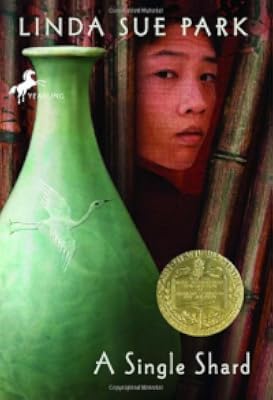
A Single Shard
by Linda Sue Park
On This Page
Description
Tree-ear, a thirteen-year-old orphan in medieval Korea, lives under a bridge in a potters' village, and longs to learn how to throw the delicate celadon ceramics himself.Tags
Recommendations








Member Reviews
Well, you certainly don't see many children's books about mass suicide. Throw in some other deaths that also occur, and this book has quite the body count for an otherwise gentle, uplifting, and well done story about an orphan boy becoming an apprentice to a master potter in 12th century Korea.
I do have a kind of out-there theory about the ending though.Crane-man tells Tree-ear about the women nobly committing suicide by throwing themselves from a cliff, and then later we are told that Crane-man has died by accidentally falling from a bridge in an encounter with a farmer's wagon. Now, in many ways, the happy ending of this story would not be possible if Crane-man were alive. First, the master potter would not have seen the impressive show more bit of ceramic work that Tree-ear had gifted to Crane-man and that Crane-man had literally tied to his body. Second, Tree-ear might not have willingly entered the potter's household as a foster child if Crane-man were still alive, in need of Tree-ear's support to scavenge food to survive, and would otherwise be all alone under the bridge where they squatted. Now, Crane-man is smart enough to know all the above, making the mass suicide story a sort of confession that when the time came, he too would do the noble thing. So my theory is that Crane-man actually and secretly committed suicide on that bridge to remove the biggest obstacle to Tree-ear's future happiness: himself. show less
I do have a kind of out-there theory about the ending though.
Tree-ear is an orphan who lives in a 12th century Korean village known for its pottery. He spends his days searching for food for himself and his friend, Crane-man, and he always stops to watch the potter, Min, as he works. Min is the best potter in the village, and Tree-ear dreams of learning to make pottery as fine as Min's. When Tree-ear accidentally breaks one of Min's works, it provides him with an unexpected opportunity to become Min's assistant in order to work off his debt. Tree-ear is gradually given more responsibilities. When he is called on to make a long journey on Min's behalf, Tree-ear must remember all he has learned from living with Crane-man and from watching Min in his work.
Some years I wonder what the judges were show more thinking when they selected the Newbery Medal winner. Not this time. Every element of the story works – plot, character, historical detail, and educational value. It could be used as supplemental reading for social studies or art. It will provide opportunities for discussing values such as honesty, patience, courage, kindness, respect, and friendship. Since the book transcends traditional childhood concerns and themes, it can be enjoyed equally by adults and children. Highly recommended. show less
Some years I wonder what the judges were show more thinking when they selected the Newbery Medal winner. Not this time. Every element of the story works – plot, character, historical detail, and educational value. It could be used as supplemental reading for social studies or art. It will provide opportunities for discussing values such as honesty, patience, courage, kindness, respect, and friendship. Since the book transcends traditional childhood concerns and themes, it can be enjoyed equally by adults and children. Highly recommended. show less
I was thoroughly enchanted with A Single Shard. It was a story imagined around a shard of early 12th century Korean celadon pottery and the hopes of an orphan boy to learn to make the pottery he admires. But in Korea a law had existed saying that sons of potters could only be potters. A tradition then grew that only sons of potters could be potters. This made Tree-ear's hope virtually impossible when his master Min states "You are not my son." And yet, Tree ear does not give up all hope. After all, his friend Crane Man tells him "When the wind blows one door closed, it often blows another open." Tree Ear is determined to find that other door.
This is an engaging coming of age story about a young boy who aspires to be a potter apprentice in 12th century Korea. Good writing, and I liked the description of the various processes involved in the clay, glaze, and firing. I appreciated the author's note which gave additional context to various details in the book.
Park's story of a homeless boy in ancient Korea started slowly for me, but once he began to hang around watching the great pottery artist Min, I was engaged entirely. Tree-ear worms his way into the pottery shop, doing menial tasks and soaking up information. He's an artist himself, but an artist without the opportunities to work with his medium. The ways around and through his problem are exquisitely imagined and warming to read. Perhaps my favorite part (which actually caused my eyes to fill with tears) is this passage:
"Tree-ear was rubbing the sediment between his fingers, as he always did. Suddenly, his fingertips tingled with a strange feeling. For some odd reason, he thought of a time when he had been on the mountainside, taking a show more break as he chopped wood. He had been staring into the forest greenery when a deer appeared in abrupt focus. It had been there all along, and he had been looking straight at it. But only at the last moment had he actually seen it.
It was the same now, only instead of seeing with his eyes, he was feeling with his hands. The clay felt good - fine, pliant, smooth - but not ready yet."
A wonderful book. show less
"Tree-ear was rubbing the sediment between his fingers, as he always did. Suddenly, his fingertips tingled with a strange feeling. For some odd reason, he thought of a time when he had been on the mountainside, taking a show more break as he chopped wood. He had been staring into the forest greenery when a deer appeared in abrupt focus. It had been there all along, and he had been looking straight at it. But only at the last moment had he actually seen it.
It was the same now, only instead of seeing with his eyes, he was feeling with his hands. The clay felt good - fine, pliant, smooth - but not ready yet."
A wonderful book. show less
When I read the summary and found that the setting of this book was in 12th century Korea, and about an orphan living under a bridge who was interested in making pottery, I wasn't sure I was going to like it. But, it turned out to be a beautiful book. The dreams and desires of the 12-year-old hero have that quality of timelessness that transcend centuries!
A long long time ago in a potters’ village in Korea there lived an orphan named Tree-ear. He lived under a bridge with Crain-man, who had taken him in as a toddler. Together they foraged for food, told stories, and kept each other company. Thirteen-year-old Tree-ear loved to watch an older potter at the wheel and see the pieces he made. One day while examining a ceramic box in the potter’s workshop, Tree-ear is startled and drops it. The potter, Min, is furious and berates Tree-ear. The piece is very valuable, and Tree-ear agrees to pay off the debt by working for Min. The work is hard, harder than Tree-ear ever imagined, but it's also satisfying. Tree-ear wants more than anything to learn to use the wheel and create his own pieces. show more But Min will not teach Tree-ear the craft, as it's passed down from father to son, and Tree-ear is only an orphan. News arrives that the royal court is coming to look at the potters’ pieces, and maybe pick one of the men and put his work on commission. Min hopes he's selected, but is another potter working on a new technique? What will become of Tree-ear if Min is selected? Will Tree-ear ever learn to use the wheel?
I didn’t know much about A Single Shard by Linda Sue Park. What a treat it turned out to be. I loved how the words flowed, and I felt like I was being told an elaborate bedtime story every time I picked it up. The relationship between Crain-man and Tree-ear was so special that it tugged at my heart. I was impressed by how hard Tree-ear worked and how driven he was to learn the ways of the potter.Tree-ear is respectful of others, and I liked the way he thought of their feelings. There are a couple of scenes that broke my heart, but I truly loved the way the story unfolded. I would recommend this book to readers fourth grade and up who like historical fiction and stories with amazing characters. You will be rooting for Tree-ear! show less
I didn’t know much about A Single Shard by Linda Sue Park. What a treat it turned out to be. I loved how the words flowed, and I felt like I was being told an elaborate bedtime story every time I picked it up. The relationship between Crain-man and Tree-ear was so special that it tugged at my heart. I was impressed by how hard Tree-ear worked and how driven he was to learn the ways of the potter.Tree-ear is respectful of others, and I liked the way he thought of their feelings. There are a couple of scenes that broke my heart, but I truly loved the way the story unfolded. I would recommend this book to readers fourth grade and up who like historical fiction and stories with amazing characters. You will be rooting for Tree-ear! show less
Members
- Recently Added By
Lists

Newbery Medal Winners - By Year
105 works; 7 members

Sonlight Books
1,487 works; 25 members

4th Grade Books
312 works; 5 members

Children's Literature, Briefly Historical Fiction Reading List
44 works; 4 members

Geek Dad Read to Your Kids Additions List
66 works; 4 members

Books Read in 2017
4,249 works; 129 members

Books Read in 2019
4,052 works; 108 members

Asia
178 works; 7 members

SYES Library Wishlist
1,080 works; 4 members

Books Read in 2021
5,361 works; 114 members

CC Cycle 1 Book List
23 works; 1 member

Best Audiobooks
240 works; 114 members

Precious People
119 works; 1 member

The Story of the World: Activity Book Four: The Modern Age
333 works; 2 members

AR Level 6 in cloudLibrary
77 works; 1 member
Talk Discussions
Past Discussions
(M62'12) A Single Shard, Linda Sue Park in World Reading Circle (September 2012)
Author Information

62+ Works 23,542 Members
Linda Sue Park was born in Urbana, Illinois on March 25, 1960. She received a B.A. in English from Stanford University. After graduating, she worked as a public-relations writer for a major oil company for two years. She obtained advanced degrees in literature from Trinity College, Dublin in Ireland and from the University of London. Before show more becoming a full-time author, she held numerous jobs including working for an advertising agency, teaching English as a second language to college students, and working as a food journalist. Her first book, Seesaw Girl, was published in 1999. Her other books include The Kite Fighters, Tap Dancing on the Roof: Sijo (Poems), and A Single Shard, which won the 2002 Newbery Medal. She also wrote Storm Warning, which is the ninth book in the 39 Clues series. Her title A Long Walk to Water made the New York Times bestseller list. (Bowker Author Biography) show less
Some Editions
Awards and Honors
Awards
Distinctions
Notable Lists
Series
Belongs to Publisher Series
Work Relationships
Has as a student's study guide
Common Knowledge
- Original publication date
- 2001
- People/Characters
- Tree-Ear; Crane-man; Min, a potter
- Important places
- Korea; Ch'ulp'o, Korea; Nakhwaam Rock, Korea (Rock of the Falling Flowers); Songdo, Korea
- Epigraph
- A small village on the west coast of Korea, mid- to late twelfth century.
- Dedication
- To Dinah, because she asked for another book.
- First words
- "Eh, Tree-ear! Have you hungered well today?" Crane-man called out as Tree-ear drew near the bridge.
- Quotations
- Work gives a man dignity, stealing takes it away.
...one hill, one valley, one day at a time. In that way, your spirit will not grow weary before you have even begun to walk.
...he would journey through the year... (show all)s until he came upon the perfect design. - Last words
- (Click to show. Warning: May contain spoilers.)Tree-ear leaned forward and pushed the cart up the mountain path.
(Click to show. Warning: May contain spoilers.)It is called the "Thousand Cranes Vase." Its maker is unknown. - Publisher's editor
- Stevenson, Dinah
- Original language
- English
Classifications
- Genres
- Children's Books, Kids, Fiction and Literature, Tween
- DDC/MDS
- 813.6 — Literature & rhetoric American literature in English American fiction in English 2000-
- LCC
- PZ7 .P22115 .S — Language and Literature Fiction and juvenile belles lettres Fiction and juvenile belles lettres Juvenile belles lettres
- BISAC
Statistics
- Members
- 5,889
- Popularity
- 2,196
- Reviews
- 161
- Rating
- (4.06)
- Languages
- 11 — Arabic, Chinese, English, French, German, Hungarian, Indonesian, Japanese, Korean, Spanish, Portuguese (Portugal)
- Media
- Paper, Audiobook, Ebook
- ISBNs
- 51
- UPCs
- 1
- ASINs
- 21