Articles of War
by Nick Arvin
On This Page
Description
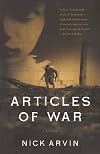
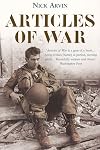
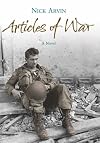
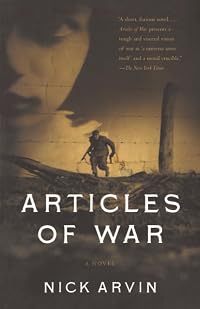
The boy they called Heck arrived at Omaha Beach in August 1944. Soon he would be sent to the front . . . George Tilson, an 18-year-old Iowa farm boy, is nicknamed Heck because he won't curse. Other than that, he's a typical soldier, willing to do his duty without much fuss or musing about grand goals. During his first horrific exposure to combat, Heck discovers a dark truth about himself: He is a coward. Shamed by his fear and tortured by the never-ending physical dangers around him, he show more struggles to survive, to live up to the ideal of the American fighting man, and to make sense of his feelings for a young French refugee. As the stark reality of combat - and the knowledge that he could cease to exist at any moment - presses in on him, he makes a series of choices that would be rational in every human situation except war. Writing with remorseless clarity in a starkly minimalist style, Arvin draws you into the unimaginable fear, violence, and chaos of the war zone - and creates one of the most disturbing and unforgettable accounts of a soldier's life ever written. show lessTags
Recommendations







Member Reviews
George Tilson leaves his Iowa home for Normandy as an eighteen-year-old recruit in World War II. Shy and unassuming, he keeps to himself and earns the nickname “Heck” because he doesn’t swear. He is muscled from summers of farm labor, and knows how to work long and hard without complaint. But combat is far more brutal than he imagined and fear consumes him.
This novella packs a big punch. The writing is at once reserved and intimately emotional. The reader witnesses the horrors of war along with Heck, who frequently seems removed from the battles due to his cautious nature. But his fear, terror, and horror are intensely felt, as is his shame at his perceived cowardice. The combat scenes capture perfectly the chaos and confusion of show more a major battle. The scenes at base camp capture the boredom and uncertainty of “waiting to be called,” and give the reader (and the combatants) a much-needed respite.
When I finished I was not sure I agreed with Heck’s self-assessment that he is a coward. I recognize that he is frightened to inaction at times, but that seems reasonable to me given the circumstances he finds himself in. I asked my husband (a combat infantry platoon leader in Vietnam) about this. His response is that it’s normal to be scared, but you have to face it. I think there are times when Heck definitely faces his fears and conducts himself well. But there are other incidents when he takes “the coward’s way out,” and those tend to be when he is alone and without someone to witness his cowardice. Internally, however, he is always looking to escape.
And that is what gives the ending such impact. Without giving anything away, I don’t see how he can escape that final scenario … and I’m not so sure he even wants to. show less
This novella packs a big punch. The writing is at once reserved and intimately emotional. The reader witnesses the horrors of war along with Heck, who frequently seems removed from the battles due to his cautious nature. But his fear, terror, and horror are intensely felt, as is his shame at his perceived cowardice. The combat scenes capture perfectly the chaos and confusion of show more a major battle. The scenes at base camp capture the boredom and uncertainty of “waiting to be called,” and give the reader (and the combatants) a much-needed respite.
When I finished I was not sure I agreed with Heck’s self-assessment that he is a coward. I recognize that he is frightened to inaction at times, but that seems reasonable to me given the circumstances he finds himself in. I asked my husband (a combat infantry platoon leader in Vietnam) about this. His response is that it’s normal to be scared, but you have to face it. I think there are times when Heck definitely faces his fears and conducts himself well. But there are other incidents when he takes “the coward’s way out,” and those tend to be when he is alone and without someone to witness his cowardice. Internally, however, he is always looking to escape.
And that is what gives the ending such impact. Without giving anything away, I don’t see how he can escape that final scenario … and I’m not so sure he even wants to. show less
Articles of War reminds me of a rare gem that has been finely and professionally cut and polished. It is a precise and narrow vision of one man's experience in the combat hell that was World War II. Although the protagonist's nickname is Heck, because he refused to use profanity of any kind (a promise to his dead mother), he quickly learned of Hell in the Hurtgen forest and the infamous Battle of the Bulge, enduring the bone-chilling winter cold, the short supply of congealed canned rations, and the caked filth of living in cramped close quarters of underground bunkers, hiding from German snipers and artillery strikes, cowering like burrowing animals, where the only advice he gets from a more seasoned comrade is:
"...when you need to show more move your bowels, when you absolutely can't help yourself, shit in your helmet, maybe a K-ration box. Then throw it out that opening. Do not go outside to shit. Please ... The last replacement I had insisted on going outside and died with his pants around his knees."
Other reviewers have commented on parallels to Stephen Crane's The Red Badge of Courage, and the similarities are indeed inescapable, because Heck's fears of being a coward make up a central theme throughout the book. I was also reminded of one of the earliest Vietnam novels, a short book by William Pelfrey called The Big V, now out of print and difficult to find. But there too were many of the same images and characters to be found in Crane - the accidental wound, the running away in the face of the enemy, followed by a courageous charge up a hill. The fearful, doubt-torn protagonist, as well as "the tall soldier" - in Arvin's book blown to bits before Heck's eyes. There is the cathedral-like clearing encountered in the forest, the impersonal disc of the sun watching over it all, uncaring, unmoved. All of these elements from the Crane classic were in the Pelfrey novel, and are also here in Arvin's. The US Civil War, WWII, and Vietnam. The quintessential test of manhood in time of war, the finding out - courage and cowardice, that confusing and terrifying mixture - it's all here.
And then the surprising and riveting turn taken in the final twenty-five pages of the Arvin book, all based on historical fact, that gives the story its own unique twist. Elaborating on this would spoil the story for future readers, so I won't. Suffice it to say that war fiction seldom rises to this level. I will recommend it highly. show less
"...when you need to show more move your bowels, when you absolutely can't help yourself, shit in your helmet, maybe a K-ration box. Then throw it out that opening. Do not go outside to shit. Please ... The last replacement I had insisted on going outside and died with his pants around his knees."
Other reviewers have commented on parallels to Stephen Crane's The Red Badge of Courage, and the similarities are indeed inescapable, because Heck's fears of being a coward make up a central theme throughout the book. I was also reminded of one of the earliest Vietnam novels, a short book by William Pelfrey called The Big V, now out of print and difficult to find. But there too were many of the same images and characters to be found in Crane - the accidental wound, the running away in the face of the enemy, followed by a courageous charge up a hill. The fearful, doubt-torn protagonist, as well as "the tall soldier" - in Arvin's book blown to bits before Heck's eyes. There is the cathedral-like clearing encountered in the forest, the impersonal disc of the sun watching over it all, uncaring, unmoved. All of these elements from the Crane classic were in the Pelfrey novel, and are also here in Arvin's. The US Civil War, WWII, and Vietnam. The quintessential test of manhood in time of war, the finding out - courage and cowardice, that confusing and terrifying mixture - it's all here.
And then the surprising and riveting turn taken in the final twenty-five pages of the Arvin book, all based on historical fact, that gives the story its own unique twist. Elaborating on this would spoil the story for future readers, so I won't. Suffice it to say that war fiction seldom rises to this level. I will recommend it highly. show less
The book follows Heck (it's his nickname because he doesn't swear), a boy from Iowa sent to fight in World War II. He's a quiet type, so unsurprisingly, the book is also spare. Heck is a hard worker, and doesn't have any problems taking orders, but his first experience in combat leaves him with the knowledge that he's not cut out for casual heroism - or really any sort of heroism.
It is an interesting counterpoint to the usual World War II story of young men who consistently did the right thing and found extreme reserves of courage within themselves. There had to be men who found they were paralyzed by their fear, who spent more time trying to figure out how to get out rather than go forward.
I wasn't much of a fan of the ending, which I show more found a little too open-ended for me. show less
It is an interesting counterpoint to the usual World War II story of young men who consistently did the right thing and found extreme reserves of courage within themselves. There had to be men who found they were paralyzed by their fear, who spent more time trying to figure out how to get out rather than go forward.
I wasn't much of a fan of the ending, which I show more found a little too open-ended for me. show less
We're currently reading this for a book group at work. It's not one any of us would pick up on our own. It's very well written and moving and provokes a lot of discussion. Very timely!
George "Heck" Tilson turns eighteen years old just in time to do a full turn of duty in WWII. This short novel is not the story of a hero, or even a patriot. It's the story of putting one foot in front of the other when all your instincts are telling to stop and run away. I thought the ending was a bit contrived (Heck's life becomes entwined with Pvt. Eddie Slovak's life), but until then, it was a good read.
George "Heck" Tilson turns eighteen years old just in time to do a full turn of duty in WWII. This short novel is not the story of a hero, or even a patriot. It's the story of putting one foot in front of the other when all your instincts are telling to stop and run away. I thought the ending was a bit contrived (Heck's life becomes entwined with Pvt. Eddie Slovak's life), but until then, it was a good read.
Nick Arvin's prose belies his involvement in the University of Iowa's writer's workshop, but the plot is less clich�� than the self-aware writing style. For me, that is; I don't read much war fiction. If the composition was careful, what he composed was remarkable. The protagonist's panic, horror, and ignorance in battle evoked a reaction similar to that of The Road. Not as universally horrifying, because (to someone who has never seen combat), World War II is a finite, self-contained, known quantity ��� unlike everything in the McCarthy.
This is for bookclub next week, and it's also the One City, One Book selection for Denver in 2008. It should be good for conversation.
This is for bookclub next week, and it's also the One City, One Book selection for Denver in 2008. It should be good for conversation.
Members
- Recently Added By
Author Information
4+ Works 299 Members
Awards and Honors
Common Knowledge
- Important events
- World War II
Classifications
Statistics
- Members
- 172
- Popularity
- 191,271
- Reviews
- 11
- Rating
- (3.62)
- Languages
- English
- Media
- Paper, Audiobook, Ebook
- ISBNs
- 11
- UPCs
- 1
- ASINs
- 2