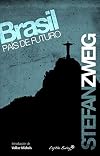
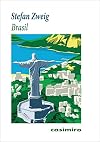
Brazil, Land of the Future
by Stefan Zweig
On This Page
Description
Text extracted from opening pages of book: BRAZIL LAND OF THE FUTURE Translated by Andrew St. James THE VIKING PRESS NEW YORK 1941 Introduction i History 14 Economy 80 Culture 134 Rio de Janeiro 166 Sao Paulo 211 A Visit to King Coffee 223 A Visit to the Lost Gold Towns 233 Flight over the North 253 Time-Table 280 IN THE old days the novelist, when placing a boo* on the market, frankly informed his prospective readers in a preface for which reasons, from what point of view, and with what show more intentions he had written it It was a good idea. It created by its informality and directness a basic understanding between the author and his public. And so I also want to state as honestly as possible what persuaded me to choose a theme which may seem far removed from the subjects about which I am accustomed to write. In 1936, when I was invited to go to the Argentine for the P. E. N. Club Congress in Buenos Aires, I received an in vitation at the same time to visit Brazil. I did not expect very much. My ideas of Brazil coincided with those of the average European and North American. It is only with an effort that I can reconstruct them today: it was very difficult to distinguish any one of these South American republics from the other; they all had a hot and unhealthy climate, political unrest, and desperate financial condi tions; they were badly governed, and semi-civilized, and only near the coastal cities. At the same time the scenery was beautiful and there were numerous unexplored possibili tiesin short, a land for desperate immigrants and settlers, 2 Brazil but never one from which to expect intellectual stimula tion. Being neither a professional geographer, collector of butterflies, sportsman, nor business man, I presumed that a visit of ten days would suffice. A week, ten days, then back again, I thought; and I am not ashamed to confess to this naive attitude of mine. I even consider it important, for this is the prevalent idea shared today by most Europeans and North Americans. From the cultural point of view Brazil is still as much the terra incognita as it was for the first seafaring men from the geographical point of view. I am always surprised anew to find that even educated and politically interested people have this confused and narrow minded attitude toward this country, which is destined undoubtedly to play one of the most important parts in the future development of our world. For instance, when on the boat a Boston business man talked rather disparag ingly of this small South American State and I tried to remind him that Brazil alone comprised a larger terri tory than the United States of America, he thought I was joking; and he could be convinced only when confronted with a map. Again, in the novel of a well-known English author I was amused to read of the hero being sent to Rio de Janeiro in order to learn Spanish. But this writer is but one of innumerable people who don't know that Portu guese is the language of Brazil. However, as I said before, if s not my business to be so presumptuous as to criticize others for their ignorance. I myself, when leaving Europe for the first time, knew nothing or nothing definite about Brazil. And then, finally arriving in Rio, I received one of the most powerful impressions of my whole life. I was fasci nated, and at the same time deeply moved. For what lay Introduction 3 before me here was not merely one of the mostmagnificent landscapes in the worlda unique combination of sea and mountain, city and tropical scenery but quite a new kind of civilization. Contrary to all my expectations, it was an entirely individual picture, with its orderly, clean-lined ar chitecture and city planning; there were courage and gener osity in all the modern things, and with all the traces of a well-preserved ancient culture. There were colour and move ment which fascinated and never tired the eye; and wher ever one looked there was a pleasant surprise. I was over whelmed by a rush of joy and beauty. My show lessTags
Recommendations



























Member Reviews
Tela editorial
Páginas amarillentas
Buen estado
Páginas amarillentas
Buen estado
Mar 26, 2025Spanish
Ratings
Members
- Recently Added By
Author Information

873+ Works 32,444 Members
Born in Vienna, the prolific Zweig was a poet in his early years. In the 1920s, he achieved fame with the many biographies he wrote of famous people including Balzac, Dostoevsky, Dickens and Freud. Erasmus with whom he closely identified, was the subject of a longer biography. He also wrote the novellas Amok (1922) and The Royal Game (1944). As show more Nazism spread, Zweig, a Jew, fled to the United States and then to Brazil. He hoped to start a new life there, but the haunting memory of Nazism, still undefeated, proved too much for him. He died with his wife in a suicide pact. (Bowker Author Biography) show less
Some Editions
Series
Belongs to Publisher Series
suhrkamp taschenbuch (984)
insel taschenbuch (4208)
Common Knowledge
- Canonical title
- Brazil, Land of the Future
- Important places*
- Brazilië
*Some information comes from Common Knowledge in other languages. Click "Edit" for more information.
Classifications
Statistics
- Members
- 142
- Popularity
- 229,400
- Reviews
- 2
- Rating
- (2.92)
- Languages
- 10 — English, Finnish, French, German, Hungarian, Italian, Portuguese (Portugal), Spanish, Swedish, Turkish
- Media
- Paper, Ebook
- ISBNs
- 33
- ASINs
- 11