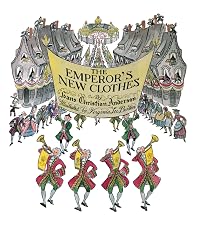
The Emperor's New Clothes
by Hans Christian Andersen
On This Page
Description
Two rascally weavers convince the emperor they are making him beautiful new clothes, visible only to those fit for their posts, but during a royal procession in which he first wears them, a child whispers that the emperor has nothing on.Tags
Recommendations





Member Reviews
The Emperor's New Clothes, illustrated by Angela Barrett.
Angela Barrett has always been one of my favorite fairy-tale illustrators - an artist whose work never fails to create a sense of depth and mystery, or to evoke an intense emotional response. Her Snow White was a masterpiece - a breathtakingly lovely book with luminous scenes that are simultaneously delicate and lush. So when a friend's review alerted me to the fact that Barrett had also done a version of The Emperor's New Clothes, I lost no time in locating a copy. How fortunate that I did!
This edition of Andersen's classic tale is translated by Naomi Lewis, who worked with Barrett on Proud Knight, Fair Lady, a children's edition of the lais of Marie de France. The humorous story show more of a rather silly emperor, who is conned by two rogue "tailors," the narrative reads smoothly, and is located by Barrett in an early twentieth-century European milieu. While as foreign to Andersen's time as it is to ours, somehow this back-drop seems just right. The emperor's many beloved dogs add a sense of visual whimsy that perfectly suits the humor. Highly recommended! show less
Angela Barrett has always been one of my favorite fairy-tale illustrators - an artist whose work never fails to create a sense of depth and mystery, or to evoke an intense emotional response. Her Snow White was a masterpiece - a breathtakingly lovely book with luminous scenes that are simultaneously delicate and lush. So when a friend's review alerted me to the fact that Barrett had also done a version of The Emperor's New Clothes, I lost no time in locating a copy. How fortunate that I did!
This edition of Andersen's classic tale is translated by Naomi Lewis, who worked with Barrett on Proud Knight, Fair Lady, a children's edition of the lais of Marie de France. The humorous story show more of a rather silly emperor, who is conned by two rogue "tailors," the narrative reads smoothly, and is located by Barrett in an early twentieth-century European milieu. While as foreign to Andersen's time as it is to ours, somehow this back-drop seems just right. The emperor's many beloved dogs add a sense of visual whimsy that perfectly suits the humor. Highly recommended! show less
I love this book because it takes a ridiculous situation and teaches a good moral from it. In the story, the Emperor is so vain and consumed with his wardrobe, that he hires two swindlers that claim to weave "the most wonderful cloth imaginable." Their cloth also "had the extraordinary quality of being invisible to anyone either badly suited for his position or unforgivably stupid." After multiple people go to check on the weavers and are too prideful to admit that they cannot see the fabric, the Emperor eventually wears his new "clothes" that are nonexistent out in the open and a child points out that the Emperor is not wearing any clothes. I like this book because the pictures have a mix of black and white and color, and they are very show more detailed. They nicely accompany the text. The message of the story is do not be so prideful that you pretend to see something that is not there. show less
The Emperor's New Clothes, illustrated by Virginia Lee Burton.
This edition of Hans Christian Andersen's classic tale, in which a vain emperor is taken in by two thieves posing as weavers, really takes me back! I'm not entirely sure, but I think it may be the version I had as a child, as Virginia Lee Burton's illustrations look so familiar. Then again, I had her Mike Mulligan and His Steam Shovel practically memorized as a girl, so perhaps it's simply that I know her style?
In any case, it is an engaging retelling, with an appealing, well-paced narrative, and charming illustrations set in the eighteenth century. Burton's paintings are colorful, and have an interesting "blurring" effect (perhaps because of the ink, or their small size?) show more that reminded me of Elizabeth Orton Jones' work in What Miranda Knew, my all-time favorite picture-book as a very young child. I wouldn't say that this style reflects my tastes as an adult, but there is no doubt that it has great nostalgic appeal for me. Those who feel the same will be delighted to know that this particular edition of The Emperor's New Clothes, first published in 1949, was reprinted in 2004. show less
This edition of Hans Christian Andersen's classic tale, in which a vain emperor is taken in by two thieves posing as weavers, really takes me back! I'm not entirely sure, but I think it may be the version I had as a child, as Virginia Lee Burton's illustrations look so familiar. Then again, I had her Mike Mulligan and His Steam Shovel practically memorized as a girl, so perhaps it's simply that I know her style?
In any case, it is an engaging retelling, with an appealing, well-paced narrative, and charming illustrations set in the eighteenth century. Burton's paintings are colorful, and have an interesting "blurring" effect (perhaps because of the ink, or their small size?) show more that reminded me of Elizabeth Orton Jones' work in What Miranda Knew, my all-time favorite picture-book as a very young child. I wouldn't say that this style reflects my tastes as an adult, but there is no doubt that it has great nostalgic appeal for me. Those who feel the same will be delighted to know that this particular edition of The Emperor's New Clothes, first published in 1949, was reprinted in 2004. show less
O conto narra a trajetória de um imperador vaidoso que gastava todo o seu dinheiro com trajes e roupas elegantes. Dois trapaceiros chegam ao reino e se oferecem para confeccionar um tecido único e maravilhoso, com uma peculiaridade: ele seria totalmente invisível para qualquer pessoa que fosse burra ou incompetente para o cargo que ocupava.
The Emperor's New Clothes is a funny book about an emperor who is fooled by weavers that were supposed to be making him beautiful clothes. All the adults in the book are tricked into thinking the weavers are really making beautiful clothes and they are all too prideful to say that they do not see any clothes being made. Worried that they might be looked at as stupid, is the main reason the adults go along with the tricksters. I loved the out spoken truth of the children at the end that yell "he's naked". Being too prideful and worrying too much about what others think, can lead to a pretty embarrassing situation. This is a funny story that can be used to teach a valuable lesson.
(Included in the Yellow Fairy Book)
An quite entertaining story that despite its age, stands pretty well today as a lesson/moral in regards to going along with whatever others are thinking/saying, even if the subject (or fad/clothing) is really stupid.
An quite entertaining story that despite its age, stands pretty well today as a lesson/moral in regards to going along with whatever others are thinking/saying, even if the subject (or fad/clothing) is really stupid.
Collections
Picture book
Grades: k-4
Traditional literature
The Emperor's New Clothes is a story that has been retold for years. I think the reason for this is it gives a great moral message in a comical way. In the story a self-absorbed emperor gets tricked by two deceiving fools. Had the emperor been honest with himself and others he would have found out the truth that there was no fabric, and that the "seamsters" were only pretending to make him an outfit. Since the emperor was too proud to admit that he could not see anything he ended up parading around the town wearing nothing but his birthday suit. It was only when one honest young boy pointed out that the emperor was naked that the people came to their senses. Many people are often show more too proud to admit that they do not know something. I think this story points out that it is better to ask than to be a real fool. show less
Picture book
Grades: k-4
Traditional literature
The Emperor's New Clothes is a story that has been retold for years. I think the reason for this is it gives a great moral message in a comical way. In the story a self-absorbed emperor gets tricked by two deceiving fools. Had the emperor been honest with himself and others he would have found out the truth that there was no fabric, and that the "seamsters" were only pretending to make him an outfit. Since the emperor was too proud to admit that he could not see anything he ended up parading around the town wearing nothing but his birthday suit. It was only when one honest young boy pointed out that the emperor was naked that the people came to their senses. Many people are often show more too proud to admit that they do not know something. I think this story points out that it is better to ask than to be a real fool. show less
Members
- Recently Added By
Lists

Favorite Childhood Books
1,651 works; 515 members
1001 Children's Books You Must Read Before You Grow Up
774 works; 101 members

Romalda Spalding's Writing Road To Reading
213 works; 3 members
Ambleside Books
459 works; 18 members

CCE 1000 Good Books List
1,033 works; 12 members

Books with Noble Titles
179 works; 11 members

Early Picture Books
467 works; 9 members

Vlogbrothers Book Recommendations
307 works; 4 members

Favorite Fairy Tales
269 works; 104 members
Author Information

3,963+ Works 54,239 Members
Hans Christian Andersen, one of the best known figures in literature, is best know for combining traditional folk tales with his own great imagination to produce fairy tales known to most children today. The Danish writer was born in the slums of Odense. Although he was raised in poverty, he eventually attended Copenhagen University. Although show more Andersen wrote poems, plays and books, he is best known for his Fairy Tales and Other Stories, written between 1835 and 1872. This work includes such famous tales as The Emperor's New Clothes, Little Ugly Duckling, The Tinderbox, Little Claus and Big Claus, Princess and the Pea, The Snow Queen, The Little Mermaid, The Nightingale, The Story of a Mother and The Swineherd. Andersen's greatest work is still influential today, helping mold some of the works of writers ranging from Charles Dickens to Oscar Wilde and inspiring many of the works of Disney and other motion pictures. Andersen, who traveled greatly during his life, died in his home in Rolighed on August 4, 1875. (Bowker Author Biography) show less
Some Editions
Awards and Honors
Awards
Series
Belongs to Publisher Series
Work Relationships
Is contained in
Has the adaptation
Is parodied in
Common Knowledge
- Canonical title
- The Emperor's New Clothes
- Original title
- Keiserens nye Klæder
- Original publication date
- 1837
- People/Characters
- Emperor's New Clothes
- Related movies
- The Emperor's New Clothes (1987 | IMDb)
- Original language
- Danish
Classifications
Statistics
- Members
- 1,737
- Popularity
- 12,774
- Reviews
- 32
- Rating
- (3.79)
- Languages
- 19 — Arabic, Catalan, Chinese, Danish, Dutch, English, Estonian, French, German, Italian, Lithuanian, Malay, Norwegian (Bokmål), Norwegian, Portuguese, Russian, Spanish, Swedish, Turkish
- Media
- Paper, Audiobook, Ebook
- ISBNs
- 254
- UPCs
- 6
- ASINs
- 36