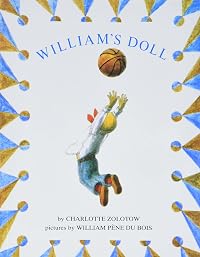
William's Doll
by Charlotte Zolotow
On This Page
Description
William's father gives him a basketball and a train but these do not make him want a doll less.Tags
Recommendations
Member Reviews
Written in 1972, this book was daring for the time.
I'd like to think that society is much more accepting of little boys who don't want to play rough and tumble sports, who don't care for basketball (even if they are good at it) and who want to play with a doll.
William longs for a doll to play with. All the taunting and teasing by his brother and neighborhood boy, naturally called names like sissy and creepy, did not take away the desire William had to possess a doll.
His grandmother understood him and purchased a beautiful blue eyed doll with a white dress and eyes that made a clicking noise when the closed.
In a mere 32 pages, the author affirmed that society can be wrong...oh so wrong at times.
And, I loved the strong message of a show more grandmother who unconditionally accepted, encouraged and loved William.
As a side note, I am a grandmother of a grandson who, from the time he was a wee little guy, loved to play with dolls. Each year his Christmas present is the doll of his choice. Last year's choice was the American Girl doll Molly.
And, yes, just like William, he was teased by a neighbor boy on the bus who loudly laughed and said "Oh, there is the kid who plays with girly dolls!"
To their immense credit, my daughter and son-in-law talked the the parents of that taunting boy and asked if in some way they were imparting these ideas in their child.
It lead to an eye opening experience. show less
I'd like to think that society is much more accepting of little boys who don't want to play rough and tumble sports, who don't care for basketball (even if they are good at it) and who want to play with a doll.
William longs for a doll to play with. All the taunting and teasing by his brother and neighborhood boy, naturally called names like sissy and creepy, did not take away the desire William had to possess a doll.
His grandmother understood him and purchased a beautiful blue eyed doll with a white dress and eyes that made a clicking noise when the closed.
In a mere 32 pages, the author affirmed that society can be wrong...oh so wrong at times.
And, I loved the strong message of a show more grandmother who unconditionally accepted, encouraged and loved William.
As a side note, I am a grandmother of a grandson who, from the time he was a wee little guy, loved to play with dolls. Each year his Christmas present is the doll of his choice. Last year's choice was the American Girl doll Molly.
And, yes, just like William, he was teased by a neighbor boy on the bus who loudly laughed and said "Oh, there is the kid who plays with girly dolls!"
To their immense credit, my daughter and son-in-law talked the the parents of that taunting boy and asked if in some way they were imparting these ideas in their child.
It lead to an eye opening experience. show less
WILLIAMS DOLL by Charlotte Zolotow is a story that goes against the typical boy standard of only wanting to play sports. Its about a young boy that has been wanting a doll for a while but instead gets gifts from his dad such as a basketball and a train set. When he gets the toys from his dad he enjoys playing with them but still wishes he could have his doll. Once his grandmother visits he tells her that he really wants a doll to hug and take care of. She ends up getting her one and his dad freaks out because he thinks that dolls are for sissy's and girls. My interpretation of this story is that not every boy wants to play in the mud or only play sports. Sometimes they want to play with other things. One way a teacher could use this in show more their classroom is to get their students to be less stereotypical. They could read this book and realize that it is ok to play with toys that they usually wouldn't play with. I believe that this book is a book that many parents should read to their kids because it gets to them to open up and find out themselves what they enjoy to play with show less
This is an incredible book about a boy who wants a doll, but is discouraged by the men in his life. HIs Grandma sheds light on the issue by pointing out that it would be a great tool for him to use in planning for his future with a family. The point to this story is to avoid gender stereotypes. I will be adding it to my shelf for just this reason. I want students to feel comfortable with themselves and the things that interest them.
This wonderful book by acclaimed children's book author Charlotte Zolotow is the story of a boy named William who wants a doll. The story describes the various responses that William gets when he tells people about his desire. These responses vary from outright mocking (calling him a "sissy") to diversionary tactics (buying him a basketball and a train set instead of a doll). The story ends on a very happy note, as William's grandmother realizes the importance of having a doll for future parents of all genders.
This book is delicately illustrated by William Pène de Bois' watercolor and pencil drawings. I especially appreciated the beginning illustrations which depict William's miming of parental actions, such as putting a baby to bed, show more and how these mimed actions are responded to with laughter by William's brother and neighbor. Here, we can see how insensitive these boys can be when a boy goes against gender norms. The illustrations in this story tell as much as the words do. The last illustration we see is of William, gingerly holding the doll that his grandmother bought for him. It's a wonderful image.
For its questioning of gendered playtime activities, this book is a fantastic read for young readers. The illustrations are great to look at, too. show less
This book is delicately illustrated by William Pène de Bois' watercolor and pencil drawings. I especially appreciated the beginning illustrations which depict William's miming of parental actions, such as putting a baby to bed, show more and how these mimed actions are responded to with laughter by William's brother and neighbor. Here, we can see how insensitive these boys can be when a boy goes against gender norms. The illustrations in this story tell as much as the words do. The last illustration we see is of William, gingerly holding the doll that his grandmother bought for him. It's a wonderful image.
For its questioning of gendered playtime activities, this book is a fantastic read for young readers. The illustrations are great to look at, too. show less
When William asks for a doll, his brother says, “Don’t be a creep.” His next-door neighbor chants, “Sissy, sissy, sissy.” His father offers him a basketball, attaches a net to the garage, and shows him how to jump and throw the ball into the net. William practices and practices, and gets good at throwing the ball into the net.
But he still wants a doll.
His father buys him an electric train and William plays with it a lot. He uses twigs for trees and builds bridges, tunnels, and stations from cardboard boxes.
But he still wants a doll.
And then, one day, William’s grandmother comes to visit.
Young readers will enjoy reading this book with their parents and discussing William’s wish for a doll. Sharing this story with children show more will provide parents with a perfect opportunity to discuss stereotypes associated with gender and to share their thoughts about William’s reason for wanting a doll.
Charmingly illustrated, the targeted audience for the book is ages four through eight; however, its Lexile Level of 840L places it at a skilled fourth grade or fifth grade level for independent reading. Nevertheless, whether read independently or read by a parent to a younger child, this is an important book to share with children.
Highly recommended. show less
But he still wants a doll.
His father buys him an electric train and William plays with it a lot. He uses twigs for trees and builds bridges, tunnels, and stations from cardboard boxes.
But he still wants a doll.
And then, one day, William’s grandmother comes to visit.
Young readers will enjoy reading this book with their parents and discussing William’s wish for a doll. Sharing this story with children show more will provide parents with a perfect opportunity to discuss stereotypes associated with gender and to share their thoughts about William’s reason for wanting a doll.
Charmingly illustrated, the targeted audience for the book is ages four through eight; however, its Lexile Level of 840L places it at a skilled fourth grade or fifth grade level for independent reading. Nevertheless, whether read independently or read by a parent to a younger child, this is an important book to share with children.
Highly recommended. show less
I did not know this book existed. I wish I'd known when I was younger. It explains so well why I think boys should play with dolls as well. Zolotow does an excellent job of presenting the story simply and logically. It doesn't disparage other kinds of play, just gets the reader to understand all children should be able to play with dolls, in order to practice becoming a good parent/aunt/uncle/big sister or brother/doctor/nurse and so on. The illustrations are also sparse with a white background, a thin blue box outline, and soft watercolor images.
William's father encourages his son to play with basketballs and toy trains, but all William really wants is a doll to take care of. This should be required reading for all children and their parents. People don't always fit the molds we've created for them, and asking them to deny their true selves is asking them to sacrifice their happiness.
Lovely illustrations, though I'm surprised William's father allowed him to wear the apricot ascot.
Lovely illustrations, though I'm surprised William's father allowed him to wear the apricot ascot.
Members
- Recently Added By
Lists

Honey For a Child's Heart
1,152 works; 25 members

Sonlight Books
1,487 works; 25 members

Blue Pyramid 1,276 Best Books of All Time
1,248 works; 32 members

Five star books
1,767 works; 109 members

Youth: Sexuality & Gender
119 works; 1 member

Early Picture Books
467 works; 9 members

Favorite Picture Books
479 works; 160 members
Author Information

98+ Works 12,376 Members
Charlotte Zolotow was born Charlotte Gertrude Shapiro on June 26, 1915 in Norfolk, Virginia. She studied at the University of Wisconsin, where she took classes in art, writing and child psychology. She began her publishing career in New York, in the adult trade-book division of what is now known as HarperCollins, but eventually took a job in the show more children's division. As an editor, she presided over her own imprint, Charlotte Zolotow Books. She was named publisher emerita at HarperCollins in 1991. Her first picture book, The Park Book, was published in 1944. During her lifetime, she wrote more than 90 children's books including Mr. Rabbit and the Lovely Present, My Grandson Lew, William's Doll, The Hating Book, and The Seashore Book. In 1998, the Cooperative Children's Book Center (CCBC) at the Univeristy of Wisconsin - Madison's School of Education established the Charlotte Zolotow Award, which is an American literary award presented annually for outstanding picture book writing published in the United States in the preceding year. Zolotow died on November 19, 2013 at the age of 98. show less
All Editions
Awards and Honors
Work Relationships
Common Knowledge
- Canonical title
- William's Doll
- Original publication date
- 1972
Classifications
Statistics
- Members
- 1,070
- Popularity
- 24,016
- Reviews
- 60
- Rating
- (4.16)
- Languages
- English, French, Italian
- Media
- Paper
- ISBNs
- 13
- ASINs
- 3