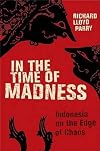
In the Time of Madness: Indonesia on the Edge of Chaos
by Richard Lloyd Parry
On This Page
Description
In the last years of the twentieth century, Richard Lloyd Parry found himself in the vast island nation of Indonesia, one of the most alluring, mysterious and violent countries in the world. For thirty-two years it had been paralysed by the grip of the dictator and mystic General Suharto. But now the age of Suharto was reaching its end, giving way to a new era of chaos and superstition - the 'time of madness' predicted centuries before by poets and seers. On the island of Borneo, tribesmen show more embarked on a savage war of head-hunting and cannibalism. Vast jungles burned uncontrollably; money lost its value; there were plane crashes and volcanic eruptions. After the tumultuous fall of Suharto came the vote of independence from Indonesia for the tiny occupied country of East Timor. And it was here, trapped in the besieged compound of the United Nations, that Lloyd Parry reached his own painful, personal crisis. show lessTags
Recommendations




































Member Reviews
Poor Richard Lloyd Parry! Every time he came to Indonesia it's always in the times of madness. But then again he's a journalist, and that's what journalists do - travel to countries experiencing troubles looking for interesting stories. After all, we are living in this weird world where bad news make more money than good news.
With so many atrocities he witnessed I wonder he's still sane, and I wonder what his views of Indonesians are. In fact I wonder how people reading this book would think of us Indonesians! Actually what worried me was the 'smiling busines'. Parry described the expression of the people he interviewed about the atrocities and many of the expression was 'smiling'. People not familiar with our people and our culture show more must be thinking that we are a horrible people, a nation of psychos, to be able to smile in the midst of horrific deaths like that. Not that I'm condoning the smiles of the Bali bombers or their police officers and jailers, but it has to be explained that for a lot of Indonesians a smile is not always a sign of happiness. Indonesians smile when they're embarrassed, when they can't answer your question, when they don't know what to do, when they are confused, when they are self conscious, when in front of people, to name just a few situations.
Ok, enough explanation and it's not meant to be an apology either. And I'm not mad at Parry. His book is good. To us Indonesians it's always good to see the events in our country as other people see or perceive it. We lived for far too long under a dictator who controled everything including information. What we usually heard, especially the earlier events that Parry witnessed, were the official version, which is usually far from the truth. Hence our thirst for other versions and hence why I read Parry's book.
Parry witnessed three different violent times in Indonesia - the killings and head chopping during the racial fights in Kalimantan in 1997 to 1999, the violent killing of student demonstrators and the aftermath riots in Jakarta in 1998 and the war in East Timor in 1998 to 1999. His stories shed light (at least for me) on the events, what led to them and all their complicatedness. In describing the East Timor war it's clear in whose side Parry stood, and I don't blame him. I too feel the same and in fact felt the same at the time even though then we only heard the official version. I am not proud of what my countrymen and government did there. But hopefully the wound has healed and peace has reigned. I wish all the best for our neighbour the Timor Leste people.
Parry did not shy away from describing the gruesome situations - blood and body parts peppered the stories and you wonder what had happened with humanity, and how come there are so many twisted people in the world. And for what. Sounds very hopeless and that's exactly the feeling you get after reading his book. show less
With so many atrocities he witnessed I wonder he's still sane, and I wonder what his views of Indonesians are. In fact I wonder how people reading this book would think of us Indonesians! Actually what worried me was the 'smiling busines'. Parry described the expression of the people he interviewed about the atrocities and many of the expression was 'smiling'. People not familiar with our people and our culture show more must be thinking that we are a horrible people, a nation of psychos, to be able to smile in the midst of horrific deaths like that. Not that I'm condoning the smiles of the Bali bombers or their police officers and jailers, but it has to be explained that for a lot of Indonesians a smile is not always a sign of happiness. Indonesians smile when they're embarrassed, when they can't answer your question, when they don't know what to do, when they are confused, when they are self conscious, when in front of people, to name just a few situations.
Ok, enough explanation and it's not meant to be an apology either. And I'm not mad at Parry. His book is good. To us Indonesians it's always good to see the events in our country as other people see or perceive it. We lived for far too long under a dictator who controled everything including information. What we usually heard, especially the earlier events that Parry witnessed, were the official version, which is usually far from the truth. Hence our thirst for other versions and hence why I read Parry's book.
Parry witnessed three different violent times in Indonesia - the killings and head chopping during the racial fights in Kalimantan in 1997 to 1999, the violent killing of student demonstrators and the aftermath riots in Jakarta in 1998 and the war in East Timor in 1998 to 1999. His stories shed light (at least for me) on the events, what led to them and all their complicatedness. In describing the East Timor war it's clear in whose side Parry stood, and I don't blame him. I too feel the same and in fact felt the same at the time even though then we only heard the official version. I am not proud of what my countrymen and government did there. But hopefully the wound has healed and peace has reigned. I wish all the best for our neighbour the Timor Leste people.
Parry did not shy away from describing the gruesome situations - blood and body parts peppered the stories and you wonder what had happened with humanity, and how come there are so many twisted people in the world. And for what. Sounds very hopeless and that's exactly the feeling you get after reading his book. show less
In the last years of the twentieth century, foreign correspondent Richard Lloyd Parry found himself in the vast island nation of Indonesia, one of the most alluring, mysterious, and violent countries in the world. For thirty-two years, it had been paralyzed by the grip of the dictator and mystic General Suharto, but now the age of Suharto was coming to an end. Would freedom prevail, or was the “time of madness” predicted centuries before now at hand? A book of hair-raising immediacy and a riveting account of a voyage into the abyss, In the Time of Madness is an accomplishment in the great tradition of Conrad, Orwell, and Ryszard Kapuscinski.
Richard Lloyd Parry, foreign correspondent for The Times, and thus perhaps to be taken relatively seriously, wrote "In the Time of Madness" (2005). He has three subjects, who are related by the timing of the events, all around the period of the regime change, from the final days of Suharto, to the chaos that came afterwards. They are also related by Mr. Parry's need to go into gory detail, whether describing ethnic violence in Kalimantan, including the alleged severing of heads and canibalism, or the mayhem that preceded, and ultimately forced the resignation of Suharto (with helpful further gory details from the 1965 regime change, just to complete the picture). The third subject, East Timor, I will leave for another day; there is only show more so much gory detail I can digest at any one time. Not sure whether this book is necessary reading for someone who wants to understand Indonesia - but Mr Parry's subjects are no doubt fascinating stuff. show less
A journalist follows stories of outbreaks of intercommunal violence in Indonesia in the 1990s.
This book was a bit of a disappointment. Despite some efforts to give background context, there was very little analysis, just the journalist author's personal observations and what he was told by different people. It felt like a re-hash of some of his newspaper reporting rather than adding anything new.
This book was a bit of a disappointment. Despite some efforts to give background context, there was very little analysis, just the journalist author's personal observations and what he was told by different people. It felt like a re-hash of some of his newspaper reporting rather than adding anything new.
Ratings
Members
- Recently Added By
Author Information

6+ Works 1,808 Members
Richard Lloyd Parry is Asia Editor of The Times and a foreign correspondent, based in Tokyo since 1995. He was born in 1969 and is an Oxford graduate. He has reported from all over Asia and in numerous war zones including Iraq, Afghanistan, Indonesia, East Timor and others. He is the author of In The Time of Madness: Indonesia on the Edge of show more Chaos, People Who Eat Darkness: The Fate of Lucie Blackman, and Ghosts of the Tsunami: Death and Life in Japan's Disaster Zone, for which he won the 2018 Rathbones Folio Prize. (Bowker Author Biography) show less
Awards and Honors
Awards
Distinctions
Notable Lists
Common Knowledge
- Important places
- East Timor; Kalimantan, Indonesia; Indonesia
- Original language
- English
Classifications
- Genres
- Nonfiction, History, General Nonfiction, Travel, Biography & Memoir, Politics and Government
- DDC/MDS
- 959.8039 — History & geography History of Asia Southeast Asia: Myanmar, Thailand, Laos, Cambodia, Vietnam Indonesia
- LCC
- DS620.2 .P37 — History of Europe, Asia, Africa and Oceania Asia History of Asia Indonesia (Dutch East Indies)
- BISAC
Statistics
- Members
- 140
- Popularity
- 233,140
- Reviews
- 4
- Rating
- (3.78)
- Languages
- Dutch, English
- Media
- Paper, Ebook
- ISBNs
- 7
- ASINs
- 3