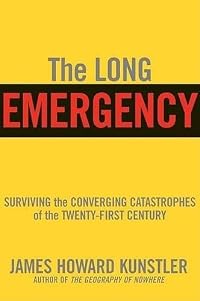
The Long Emergency: Surviving the End of Oil, Climate Change, and Other Converging Catastrophes of the Twenty-First Century
by James Howard Kunstler
On This Page
Description
A "frightening and important" look at our unsustainable future ( Time Out Chicago ). A controversial hit that has sparked debate among business leaders, environmentalists, and others, The Long Emergency is an eye-opening look at the unprecedented challenges we face in the years ahead, as oil runs out and the global systems built on it are forced to change radically. From the author of The Geography of Nowhere, it is a book that "should be read, digested, and acted upon by every conscientious show more U.S. politician and citizen" (Michael Shuman, author of Going Local: Creating Self-Reliant Communities in a Global Age ). show lessTags
Recommendations









Member Recommendations
Member Reviews
Okay, so you have to read this. Yes, you, person who is reading (or skimming or glancing at) my review. It is mandatory. However you will want to schedule regular hugs from solicitous people who buy you ice cream. I made the poor choice of reading this book while my boyfriend was several states away and could not provide these comforts.
Anyway, I am going to review this book before I read any of the other comments, so as to capture the experience of a relatively educated person who has a tenuous grasp on politics, economics, agriculture, and the physical sciences, and knows even less about manufacturing and energy production.
Throughout most of this book I was impressed at how credible and well-spoken the author is. His central argument show more - that there is simply no energy source on earth equal to oil - is compelling. As of now I feel at least moderately convinced that the singularity is not coming to save us and we are just going to have to limp along on coal, nuclear, water, solar, and wind, abandoning the aspects of our society that can't be supported by these fuels (i.e., most of them). I am more sanguine than the author in our ability, at least in the developed world, to get these technologies organized and ready to go before oil becomes an untenable fuel, but even if we do manage to built a post-oil world, it will not just be Suburbia 2.0.
I have no idea if his predictions of further war over diminishing oil, land ownership becoming feudalism, the possible collapse of American government, etc. etc. are likely - I think these things are very difficult to foresee and depend on how things unfold. I do think that Kunstler is irrationally down on technology. As long as we have electricity, it's at least conceivable that we can have the Internet, assuming that the infrastructure could be maintained or altered for our post-oil world. A global Internet in a local world would be quite a powerful force for good.
In the last chapter he lost me a little with his discussion of the fate of the U.S. His blase and sweeping characterizations of different regions of the United States were questionable (the South is characterized only by the Sunbelt, but the North isn't characterized by the Northeast megalopolis? What?) As a Northerner who has lived in the South, I completely sympathize with Southerners who were deeply offended by his portrait of the South. Yes, there are a lot of fundamentalists down here, but they do not all go to megachurches and long for violent theocracy. I really do believe that in the majority of cases, the only difference between cranky Sunbelt Southerners and cranky East Coast Northerners in a post-oil world is that the Southerners are more likely to own rifles. There is too much variety to make sweeping statements about regional psychology and destiny.
And goodness, the section on race. I do not believe that Kunstler intended to be offensive, just provocative, but his summary of the future of race relations was bizarrely victim-blaming and had the not-so-underlying message of, "You wacky people of color with your postmodern ideas of white privilege and your violent hip-hop, there will be no time for that nonsense in the Long Emergency." Blaming America's racial tensions on Malcolm X and Jay-Z is just... absurd, and while I can imagine a post-oil world being a place of strong social norms and no room for cultural difference or questioning of authority, this would be a bad thing. Kunstler acknowledges it would be a bad thing when discussing social class, but fails to make the connection to race. If he was going to attempt to address this topic in two pages, he should have done it in a much different way.
Those heartfelt criticisms aside, I think this is a compelling book that does an excellent job describing how we got to this point in history, what kind of world we live in now, and where we might end up. His sum-up of American and global history since industrialization is really fascinating, and his prediction of the sub-prime mortgage crisis (yes, he totally called it in 2005) infuriating.
Anyway, I hope the oil crisis won't be as bad as Kunstler predicts, because I will probably spend a good portion of my life living through it. However, I do look forward to cackling if big-box retail falls to pieces (a future poignant since most of the money here in beautiful Northwest Arkansas is sadly Walmart and J.B. Hunt money). And I admire his assertion that the universe is not a teleological object, that we are not necessarily on a trajectory for bigger and better things, but that we are simply going where we are going in this messy, chaotic, circling universe. show less
Anyway, I am going to review this book before I read any of the other comments, so as to capture the experience of a relatively educated person who has a tenuous grasp on politics, economics, agriculture, and the physical sciences, and knows even less about manufacturing and energy production.
Throughout most of this book I was impressed at how credible and well-spoken the author is. His central argument show more - that there is simply no energy source on earth equal to oil - is compelling. As of now I feel at least moderately convinced that the singularity is not coming to save us and we are just going to have to limp along on coal, nuclear, water, solar, and wind, abandoning the aspects of our society that can't be supported by these fuels (i.e., most of them). I am more sanguine than the author in our ability, at least in the developed world, to get these technologies organized and ready to go before oil becomes an untenable fuel, but even if we do manage to built a post-oil world, it will not just be Suburbia 2.0.
I have no idea if his predictions of further war over diminishing oil, land ownership becoming feudalism, the possible collapse of American government, etc. etc. are likely - I think these things are very difficult to foresee and depend on how things unfold. I do think that Kunstler is irrationally down on technology. As long as we have electricity, it's at least conceivable that we can have the Internet, assuming that the infrastructure could be maintained or altered for our post-oil world. A global Internet in a local world would be quite a powerful force for good.
In the last chapter he lost me a little with his discussion of the fate of the U.S. His blase and sweeping characterizations of different regions of the United States were questionable (the South is characterized only by the Sunbelt, but the North isn't characterized by the Northeast megalopolis? What?) As a Northerner who has lived in the South, I completely sympathize with Southerners who were deeply offended by his portrait of the South. Yes, there are a lot of fundamentalists down here, but they do not all go to megachurches and long for violent theocracy. I really do believe that in the majority of cases, the only difference between cranky Sunbelt Southerners and cranky East Coast Northerners in a post-oil world is that the Southerners are more likely to own rifles. There is too much variety to make sweeping statements about regional psychology and destiny.
And goodness, the section on race. I do not believe that Kunstler intended to be offensive, just provocative, but his summary of the future of race relations was bizarrely victim-blaming and had the not-so-underlying message of, "You wacky people of color with your postmodern ideas of white privilege and your violent hip-hop, there will be no time for that nonsense in the Long Emergency." Blaming America's racial tensions on Malcolm X and Jay-Z is just... absurd, and while I can imagine a post-oil world being a place of strong social norms and no room for cultural difference or questioning of authority, this would be a bad thing. Kunstler acknowledges it would be a bad thing when discussing social class, but fails to make the connection to race. If he was going to attempt to address this topic in two pages, he should have done it in a much different way.
Those heartfelt criticisms aside, I think this is a compelling book that does an excellent job describing how we got to this point in history, what kind of world we live in now, and where we might end up. His sum-up of American and global history since industrialization is really fascinating, and his prediction of the sub-prime mortgage crisis (yes, he totally called it in 2005) infuriating.
Anyway, I hope the oil crisis won't be as bad as Kunstler predicts, because I will probably spend a good portion of my life living through it. However, I do look forward to cackling if big-box retail falls to pieces (a future poignant since most of the money here in beautiful Northwest Arkansas is sadly Walmart and J.B. Hunt money). And I admire his assertion that the universe is not a teleological object, that we are not necessarily on a trajectory for bigger and better things, but that we are simply going where we are going in this messy, chaotic, circling universe. show less
"The Long Emergency" started life as a short essay posted online, predicting the changes to society that would come with the end of the cheap oil age. The book takes that idea further, looking at all of the politico-social ramifications, looking at possible solutions and ways in which the situation could get worse.
Kunstler has made this idea his own, in many respects. He goes into a respectable amount of detail about what exactly the "Long Emergency" is, and makes a point that can be quite startling, if you aren't expecting it: it isn't the end of oil per se that we should be worried about, but rather the end of cheap oil.
Kunstler seems to many to be something of a pessimist, but I think he is a realist, a pragmatist. The solutions show more suggested by many to the carbon problem - such as hydrogen fuel cells - are not simply dismissed out-of-hand, but rather attacked and picked apart. For instance, Kunstler argues that a change to our technologies is not sufficient - we need to change our very habits.
A very erudite argument. show less
Kunstler has made this idea his own, in many respects. He goes into a respectable amount of detail about what exactly the "Long Emergency" is, and makes a point that can be quite startling, if you aren't expecting it: it isn't the end of oil per se that we should be worried about, but rather the end of cheap oil.
Kunstler seems to many to be something of a pessimist, but I think he is a realist, a pragmatist. The solutions show more suggested by many to the carbon problem - such as hydrogen fuel cells - are not simply dismissed out-of-hand, but rather attacked and picked apart. For instance, Kunstler argues that a change to our technologies is not sufficient - we need to change our very habits.
A very erudite argument. show less
I gave this book 3 stars because I had a feeling while reading it that the author was pulling facts out of thin air. There's basically no appendix (if there is one, I can't remember) and yet the book is full of facts to support his thesis, which is basically that we are going to run out of oil and be forced into a lifestyle that resembles that of the Middle Ages. That said, I am really glad I read this book. It really made me consider that oil is NOT renewable energy, that we will run out of it someday (whether it's as soon as he predicts or not), and that we need to do something to prevent this and give our children hope for a better future. Even though there are flaws, I would still recommend this book. It definitely forces you to show more stop and think about what you're personally doing to the environmental destruction of our planet. show less
A bilious screed about the progression of our globalized economies based on fossil fuels. Laced with colorful speculative scenarios that may play out in the post-oil economic collapse; especially interesting is his take on the virulent paranoia, doom and chaos that a society without any sort of community purpose will engender. Very entertaining.
There are a few other Peak Oil resources I would recommend before 'The Long Emergency' to those who are new to the topic. However, once you've 'dipped your toes' into the waters and have a basic understanding of the theory, I defiantly endorse exploring this book.
The greatest strength of 'The Long Emergency' is Kunstler's unapologetic, unabashed pessimism. Given the gravity of the 'challenges' that Peak Oil represent, I find that far too many books on the subject are woefully optimistic. It is strangely refreshing to encounter an author who is willing to slap the reader in the face with the cold realities and dire implications of Peak Oil.
The sections on disease and climate change are less compelling than the predominant sections show more focused on Peak Oil. I appreciate Kunstler's attempt to address the various 'converging catastrophes' in a single volume; however, the book probably would have been most effective if its focus was not dispersed over such a wide range.
Keep in mind that skeptics or the otherwise uninitiated are likely to dismiss this book as "alarmist". Do not try to introduce Peak Oil to anyone by giving them this book. Otherwise recommended to those who are familiar with the subject. show less
The greatest strength of 'The Long Emergency' is Kunstler's unapologetic, unabashed pessimism. Given the gravity of the 'challenges' that Peak Oil represent, I find that far too many books on the subject are woefully optimistic. It is strangely refreshing to encounter an author who is willing to slap the reader in the face with the cold realities and dire implications of Peak Oil.
The sections on disease and climate change are less compelling than the predominant sections show more focused on Peak Oil. I appreciate Kunstler's attempt to address the various 'converging catastrophes' in a single volume; however, the book probably would have been most effective if its focus was not dispersed over such a wide range.
Keep in mind that skeptics or the otherwise uninitiated are likely to dismiss this book as "alarmist". Do not try to introduce Peak Oil to anyone by giving them this book. Otherwise recommended to those who are familiar with the subject. show less
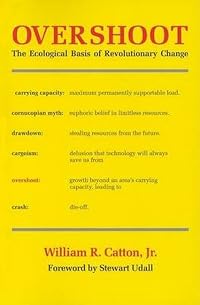
Kunstler is more current but no more informative than William Catton in [b:Overshoot: The Ecological Basis of Revolutionary Change|319810|Overshoot The Ecological Basis of Revolutionary Change|William R. Catton|http://photo.goodreads.com/books/1173735076s/319810.jpg|310571], and he certainly lacks the radical social awareness of Heinberg in [b:The Party's Over: Oil War and the Fate of Industrial Societies|138040|The Party's Over Oil, War and the Fate of Industrial Societies|Richard Heinberg|http://photo.goodreads.com/books/1172092006s/138040.jpg|448156]. He's a cynic. But there's no comparison where sense of humor and writing skill are concerned. For that, he earns an extra star.
Preliminary review:
Although a genius at hilariously critiquing American suburbia, Kunstler seems to me a bit out of his depth in geopolitics.
The book starts off strong discussing peak oil but then gets off track on a long discussion of Middle East politics with, well, a vastly oversimplified, naive, American-innocent and Islamic-fundamentalism-paranoid, Iraq-war-apologist view. I was actually quite disheartened that a man as obviously intelligent as Kunstler could have such an "Innocents Abroad" view of the situation. It's one of those cases that arises sometimes in books where the author would have been better off doing a couple paragraphs on the really important elements that are key to his book, and then pointing at other, better show more books for detailed explanations.
I had critiqued The Geography of Nowhere for being too American-centric but in retrospect perhaps it was for the best, given the shallowness of Kunstler's worldview outside of the United States. It's not that he doesn't get chunks of it right, and he does include disclaimers about some of the complexities, but there are layers and layers of events and history that he glosses over, while other parts are either exaggerated or ignored. If you think I'm overstating the case, here's an example of his analysis: "The avatars of inflamed Islam want to utterly destroy the infidel West, and its Great Satan seducer, the United States, and they mean down to the last beating heart."
With the above in mind, I advise skipping Chapter 3 "Geopolitics and the Global Oil Peak" altogether.
There is another system flaw in the book, which is that it is very weakly referenced, the chapter on Beyond Oil is good in that it discusses the lifecycle production issues for "alternative" energy systems, reminding the reader that a wind turbine doesn't just pop out of the ground one night, it requires a huge end-to-end system of mining, transporting, manufacturing, delivering and maintenance, all of which are currently oil-powered. However this chapter, like the others, has only a handful of footnoted references. It also has no mention of geothermal power.
He follows the chapter about alternative energy with one on basically everything that could possibly go wrong with Nature. While this catalogue is certainly depressing, again I'm not sure how useful it is. Something like "there is universal consensus that disruptive climate change is coming, along with other challenges from our natural environment such as disease" would have done just as well, rather than listing doomsday scenarios with little or no references and no indications of relative probability.
Towards the end he drifts into his own utopian fantasy, which is that life in the north-eastern American small town is the sustainable ideal.
The book also has no endnotes, bibliography, or index. show less
Although a genius at hilariously critiquing American suburbia, Kunstler seems to me a bit out of his depth in geopolitics.
The book starts off strong discussing peak oil but then gets off track on a long discussion of Middle East politics with, well, a vastly oversimplified, naive, American-innocent and Islamic-fundamentalism-paranoid, Iraq-war-apologist view. I was actually quite disheartened that a man as obviously intelligent as Kunstler could have such an "Innocents Abroad" view of the situation. It's one of those cases that arises sometimes in books where the author would have been better off doing a couple paragraphs on the really important elements that are key to his book, and then pointing at other, better show more books for detailed explanations.
I had critiqued The Geography of Nowhere for being too American-centric but in retrospect perhaps it was for the best, given the shallowness of Kunstler's worldview outside of the United States. It's not that he doesn't get chunks of it right, and he does include disclaimers about some of the complexities, but there are layers and layers of events and history that he glosses over, while other parts are either exaggerated or ignored. If you think I'm overstating the case, here's an example of his analysis: "The avatars of inflamed Islam want to utterly destroy the infidel West, and its Great Satan seducer, the United States, and they mean down to the last beating heart."
With the above in mind, I advise skipping Chapter 3 "Geopolitics and the Global Oil Peak" altogether.
There is another system flaw in the book, which is that it is very weakly referenced, the chapter on Beyond Oil is good in that it discusses the lifecycle production issues for "alternative" energy systems, reminding the reader that a wind turbine doesn't just pop out of the ground one night, it requires a huge end-to-end system of mining, transporting, manufacturing, delivering and maintenance, all of which are currently oil-powered. However this chapter, like the others, has only a handful of footnoted references. It also has no mention of geothermal power.
He follows the chapter about alternative energy with one on basically everything that could possibly go wrong with Nature. While this catalogue is certainly depressing, again I'm not sure how useful it is. Something like "there is universal consensus that disruptive climate change is coming, along with other challenges from our natural environment such as disease" would have done just as well, rather than listing doomsday scenarios with little or no references and no indications of relative probability.
Towards the end he drifts into his own utopian fantasy, which is that life in the north-eastern American small town is the sustainable ideal.
The book also has no endnotes, bibliography, or index. show less
Members
- Recently Added By
Author Information

James Howard Kunstler is the author of four nonfiction books and eleven novels. He has participated in TED conferences and lectured at Harvard, Yale, Columbia, Cornell, MIT, and many other colleges, and has appeared before professional organizations that include the American Institute of Architects, the American Psychological Association, and the show more National Trust for Historic Preservation. He lives in upstate New York. show less
Some Editions
Common Knowledge
- Original title
- The Long Emergency: Surviving the End of Oil, Climate Change, and Other Converging Catastrophes of the Twenty-First Century
- Alternate titles
- The Long Emergency: Surviving the End of Oil, Climate Change, and Other Converging Catastrophes of the 21st Century
- Original publication date
- 2005
- Important events
- Peak oil
- Epigraph
- The fatal metaphor of progress, which means leaving things behind us, has utterly obscured the real idea of growth, which mean leaving things inside us.
—G. K. Chesterton
Do the gods exist? I do not know, b... (show all)ut they sure act as if they did.
—R F - Dedication
- This book is for my friends' children
Benjamin Golden
Norabelle Greenberger
Oliver and Nicky Edsforth - First words
- Carl Jung, one of the fathers of psychology, famously remarked that "people cannot stand too much reality."
- Last words
- (Click to show. Warning: May contain spoilers.)How do we become a reality-based nation?
- Blurbers
- Nikiforuk, Andrew; Shuman, Michael; Turner, Frederick; Mieszkowski, Katharine; Gancarski, A. G.; Charlier, Jim
- Original language
- American English
Classifications
Statistics
- Members
- 1,066
- Popularity
- 23,950
- Reviews
- 29
- Rating
- (3.63)
- Languages
- 5 — English, French, Italian, Portuguese, Spanish
- Media
- Paper, Ebook
- ISBNs
- 9
- UPCs
- 1
- ASINs
- 3