90 Members (4.25)
On This Page
Description
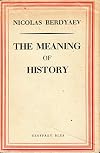
"In her brilliant new opening essay, Banerjee says of Berdyaev "he was never more than a curious but unwelcome guest in history. He fearlessly engaged it on the level of ideas while remaining alien to its means and ends, gifted with an incurable longing for transcendence." Witness to two world wars, Berdyaev observed the destruction of established cultures in the traumatic birth of new systems. Arrested on political suspicion-by Czarist and then by Bolshevik police--he died in exile in show more France in 1948, carrying forth his intellectual work until the end. Berdyaev considered the philosophy of history as a field that laid the foundations of the Russian national consciousness. Its disputes were centered on distinctions between Slavophiles and Westerners, East and West. The Meaning of History was an early effort, following World War I, that attempted to revive this perspective. With the removal of Communism as a ruling system in Russia, that nation returned to an elaboration of a religious philosophy of history as the specific mission of Russian thought. This volume thus has contemporary significance. Its sense of the apocalypse, which distinguishes Russian from Western thought, gives the book its specifically religious character. In order to grasp and oppose the complex phenomenon of social and cultural disintegration, Berdyaev shows that human beings must rely upon some internal dialectic. After the debacle of the war, the moment arrived to integrate Russian historical experiences into those of a Europe, which, although torn by schism, still claimed to be the descendant of Christendom. The book is remarkable for its powerful stylistic grace, and astonishingly contemporary feeling."--Provided by publisher. show lessTags
Recommendations







































Member Reviews
Members
- Recently Added By
Author Information

131+ Works 1,702 Members
The Russian Orthodox religious philosopher Nikolai A. Berdyaev was born into an aristocratic family in Kiev, Ukraine. At the turn of the century, the Czarist government exiled him for his Marxist views. After the revolution he founded the Free Academy of Spiritual Culture and was given the chair of philosophy at the University of Moscow. He was show more imprisoned for his defense of religion and was driven into exile, first to Berlin (1922), then to Paris (1934). In Berlin, Berdyaev founded the Academy of the Philosophy of Religion, which he later moved to Clamart near Paris. Although Berdyaev's early interest was in Marxism, his view insisted that only transcendental critical idealism can solve the problem of truth. Berdyaev later became interested in mystical and religious ideas, and developed a process cosmology and theology. Berdyaev's last testament The Realm of Spirit and the Realm of Caesar was found after his death and put into publishable form by a group of his friends. Berdyaev was strongly committed to freedom and individualism, which caused him great difficulty with ecclesiastical and political authorities. Berdyaev died in 1948. (Bowker Author Biography) show less
Series

Common Knowledge
- Canonical title
- The Meaning of History
- Original publication date
- 1936 [Charles Scribner's Sons edition]; 1923 [Russian edition]
- First words
- [The opening of Chapter I]
"Catastrophic moments in world history have always proved an incitement to speculation. They have stimulated attempts to define the historical process and to build up this or that philosophy ... (show all)of history. It has been so always. St. Augustine's was the first notable philosophy of history. It was worked out during the early Christian period and determined to a large extent the elaboration of future philosophies of history. Moreover, it coincided with one of the most catastrophic moments of world history--the collapse of the ancient world and the fall of Rome." - Last words
- (Click to show. Warning: May contain spoilers.)"Like all the peoples of the world today we lack culture and are destined to tread the path of civilization. But we shall never be so hidebound by either cultural symbolism of the pragmatism of civilization as the peoples of the West. The will of the Russian people has need of purification and tempering; and our people has a great expiation in store for it. Only then will its will to transfigure life give it the right to determine its mission in the world."
- Original language
- Russian
Classifications
Statistics
- Members
- 90
- Popularity
- 355,108
- Rating
- (4.25)
- Languages
- 8 — Czech, English, French, Italian, Romanian, Russian, Spanish, Swedish
- Media
- Paper, Ebook
- ISBNs
- 11
- ASINs
- 9