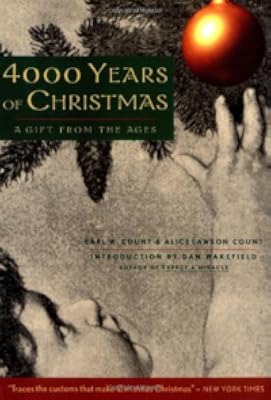
4000 Years of Christmas: A Gift from the Ages
by Earl W. Count, Alice Lawson Count
On This Page
Description
This modern holiday classic carries the reader around the globe and through the millennia. Beginning 2,000 years before Christ, it explains traditions like exchanging gifts for 12 days (it started in Babylon), decking the halls (part of the Roman Saturnalia festival), and believing in Saint Nick. "A wonderful way to express the meaning of Christmas to a child." - New York Daily NewsTags
Recommendations











Member Reviews
I found this book to be distasteful and disrespectful. In order to explain why, I am going to draw from a TV show that deals with a similar concept.
In one episode of M*A*S*H, Col. Potter says that he had chosen to get married on Groundhog's day so that he would never forget his anniversary. This is a sort of cute idea, and two special days -- one a holiday and the other a day of personal significance -- would coincide. Potter and his wife would celebrate both things on the same day, and it is possible that the festivities might blend together in his mind and in the minds of his friends and close family. For example, the phrase "six more weeks of winter" might remind him to buy a gift; "anniversary" might call to mind furry little show more rodents.
However, these two different occasions are not, could not possibly be, one and the same. His daughter is married, for instance, and it would be ridiculous to suggest that she checked the whether, glanced at a rat, and called it a wedding. Just because two events coincide does not mean that they are interchangeable, and that is the central flaw of this book.
Most people today recognize that the day we celebrate as Christmas coincides with (or, at least, comes within a few days of) many ancient pagan festivals. This does not mean that Christmas IS a pagan festival, although book claims that it is; specifically, it claims that Christmas is a version of Saturnalia [an ancient Roman festival]. Count writes, "The habit of Saturnalia was too strong to be left behind. At first the Church forbade it, but in vain. When a river meets a boulder which will not be moved, the river flows around it. If the Saturnalia would not be forbidden, let it be tamed. The Church Fathers now sought to point the festival toward the Christian Sun of Righteousness." Ouch.
He also claims that Christmas celebrations today are a watered-down version of the Babylonian and Persian annual tradition of human sacrifice, called Sacaea. I am not kidding. He writes, "One and the same basic idea . . . has . . . caught up with itself wearing another guise." Yes, this tradition occurred close to the same time of year. And sure, when different events happen at the same time, some ways of celebrating may be shared. This might be what happened with Saturnalia, with some minor traditions such as lighting candles being shared. On the other hand, this was before electricity -- didn't everyone use candles anyway? And Sacaea? Human sacrifice?!?
Count's evidence for these brash claims are sketchy at best. He says that the inspiration for "Santa Claus" is only partly St. Nicholas, and that Santa is really a blend between the Christian saint and the Norse god Odin. He supports this claim, in part, by saying that Odin's symbol was a boar. Then he quotes the Christmas tune known as "The Boar's Head Carol." Okay, so Christians ate boar. Among other things. Big deal! I eat bacon--does that mean that I worship Odin's great-aunt Edna? No! And this carol was one of many that focuses on festivities rather than religious doctrine. There are Christmas songs about decorating, building snowmen, shopping for gifts, and eating figgy pudding. Wait! Maybe I should write a book revealing how snowmen are actually a testament to the marble statues of ancient Greece, and we're all really just honoring Athena and Aphrodite without realizing it! Or maybe it's just a snowman . . . .
I feel really bad for slamming this book, as the author clearly has done a great deal of research, and there are several chapters that are nice to read. He also includes the words to some early Christmas carols, and they were a pleasure to read. However, he could have tracked some Christmas traditions without pushing his own agenda so forcefully and tactlessly. And he did, in places. For example, some people believed that evergreen plants brought the life of summer into the winter. Count writes, "Box, bay, ivy, holly, yew, larch, juniper, pine, spruce, fir--all are shields against the witches and demons [of winter]." That's interesting. That's history. Why couldn't the rest of the book be like that. show less
In one episode of M*A*S*H, Col. Potter says that he had chosen to get married on Groundhog's day so that he would never forget his anniversary. This is a sort of cute idea, and two special days -- one a holiday and the other a day of personal significance -- would coincide. Potter and his wife would celebrate both things on the same day, and it is possible that the festivities might blend together in his mind and in the minds of his friends and close family. For example, the phrase "six more weeks of winter" might remind him to buy a gift; "anniversary" might call to mind furry little show more rodents.
However, these two different occasions are not, could not possibly be, one and the same. His daughter is married, for instance, and it would be ridiculous to suggest that she checked the whether, glanced at a rat, and called it a wedding. Just because two events coincide does not mean that they are interchangeable, and that is the central flaw of this book.
Most people today recognize that the day we celebrate as Christmas coincides with (or, at least, comes within a few days of) many ancient pagan festivals. This does not mean that Christmas IS a pagan festival, although book claims that it is; specifically, it claims that Christmas is a version of Saturnalia [an ancient Roman festival]. Count writes, "The habit of Saturnalia was too strong to be left behind. At first the Church forbade it, but in vain. When a river meets a boulder which will not be moved, the river flows around it. If the Saturnalia would not be forbidden, let it be tamed. The Church Fathers now sought to point the festival toward the Christian Sun of Righteousness." Ouch.
He also claims that Christmas celebrations today are a watered-down version of the Babylonian and Persian annual tradition of human sacrifice, called Sacaea. I am not kidding. He writes, "One and the same basic idea . . . has . . . caught up with itself wearing another guise." Yes, this tradition occurred close to the same time of year. And sure, when different events happen at the same time, some ways of celebrating may be shared. This might be what happened with Saturnalia, with some minor traditions such as lighting candles being shared. On the other hand, this was before electricity -- didn't everyone use candles anyway? And Sacaea? Human sacrifice?!?
Count's evidence for these brash claims are sketchy at best. He says that the inspiration for "Santa Claus" is only partly St. Nicholas, and that Santa is really a blend between the Christian saint and the Norse god Odin. He supports this claim, in part, by saying that Odin's symbol was a boar. Then he quotes the Christmas tune known as "The Boar's Head Carol." Okay, so Christians ate boar. Among other things. Big deal! I eat bacon--does that mean that I worship Odin's great-aunt Edna? No! And this carol was one of many that focuses on festivities rather than religious doctrine. There are Christmas songs about decorating, building snowmen, shopping for gifts, and eating figgy pudding. Wait! Maybe I should write a book revealing how snowmen are actually a testament to the marble statues of ancient Greece, and we're all really just honoring Athena and Aphrodite without realizing it! Or maybe it's just a snowman . . . .
I feel really bad for slamming this book, as the author clearly has done a great deal of research, and there are several chapters that are nice to read. He also includes the words to some early Christmas carols, and they were a pleasure to read. However, he could have tracked some Christmas traditions without pushing his own agenda so forcefully and tactlessly. And he did, in places. For example, some people believed that evergreen plants brought the life of summer into the winter. Count writes, "Box, bay, ivy, holly, yew, larch, juniper, pine, spruce, fir--all are shields against the witches and demons [of winter]." That's interesting. That's history. Why couldn't the rest of the book be like that. show less
A slim little volume which discusses briefly (and somewhat selectively) the history of Christmas traditions including Santa Claus/Saint Nicholas/Father Christmas, gift-giving, Christmas trees, and candles/light. Not particularly rigorous and the author's biases are plain, but a pleasant read which serves fairly nicely to introduce one to or remind one of the traditions behind some of our traditions. Lovely reproduced illustrations in red and white, too.
A bit of this was new to me, having read may other books on the "history" of Christmas. No major disagreements with most of the other books. A very light read, taking me only a couple of hours.
On the second reading, what I feel is missing is tieing the facts of each chapter to the literature. There is a bibliography, but no work is cited in the text.
On the second reading, what I feel is missing is tieing the facts of each chapter to the literature. There is a bibliography, but no work is cited in the text.
this read like a very boring essay
Ratings
Members
- Recently Added By
Lists

Christmas Books
370 works; 40 members
Author Information
5 Works 155 Members
1 Work 97 Members
All Editions
Classifications
- Genres
- Nonfiction, History, Religion & Spirituality
- DDC/MDS
- 394.2663 — Society, government, & culture Customs, etiquette & folklore General customs Special Occasions Holidays Christian holidays Christmas
- LCC
- GT4985 .C65 — Geography, Anthropology and Recreation Manners and customs (General) Manners and customs (General) Customs relative to public and social life
- BISAC
Statistics
- Members
- 97
- Popularity
- 331,073
- Reviews
- 4
- Rating
- (3.18)
- Languages
- English
- Media
- Paper
- ISBNs
- 3
- ASINs
- 3