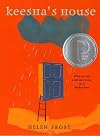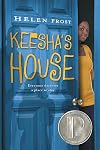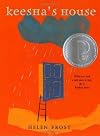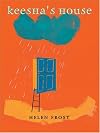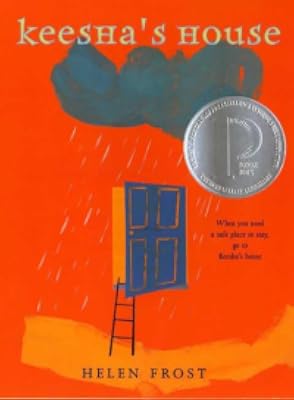
Keesha's House
by Helen Frost
On This Page
Description
Seven teens facing such problems as pregnancy, closeted homosexuality, and abuse each describe in poetic forms what caused them to leave home and where they found home again.Tags
Recommendations












Member Reviews
5Q, 4P Seven teenagers each tell their story comprised of disappointment, discovery, homelessness, fear, and hope for happiness. What makes the story so unique the poetic stanzas which capture so much detail and emotion in such short prose. Hard to put the book down because the reader looks forward to the next character's update and of course, the interest in how their lives are intertwined. I especially appreciated part three, featuring the parent or guardian's point of view, emphasizing love and concern for the young adult. The writing is beautiful and gives the reader clear feelings of how teens manage movement to maturity.
Keesha’s House is the perfect book for illustrating the importance of awards. When it won a Printz Honor, I picked the book up and discovered that it was another verse novel (anyone else noticing the recent abundance of verse novels?). Quite frankly I was prepared to dislike the book. On page 80 I read:
The juvenile system is set up
to protect kids and the community at large.
I don’t see it as either “pass a cup
of kindness” or “put the monsters behind bars.”
The final two lines of this fourteen-line poem end, “child. I believe Carmen will be okay./ I’ll talk straight, then send her on her way.” Immediately I started re-reading the book. It hit me! I was so involved with the narratives of Stephie, Jason, Dontay, Carmen, show more Harris, Katie, Joe, Keesha, that I forgot to notice the very careful attention to form. Stephie’s troublesome pregnancy is carefully crafted within a sestina. Her boyfriend, Jason, struggles within his own sestina of responsibility and basketball dreams. Dontay, Harris, Carmen, and Katie deal with abandonment, sexuality, addiction, and abuse within the strict confines of other poetic forms. Keesha and Joe are like the concluding envoi that hold together these broken pieces and make them work. I was so pleased to discover the structure of this novel while reading that the note at the end of the book, explaining the poetic forms used, almost made me angry.
Joe speaks in sonnets that vary between Shakespearean and Petrarchan sonnets. English teachers will have a field day analyzing these poems, teaching poetic structure, and arguing over the meaning of using different poetic forms to distinguish among characters’ voices. Students, however, may be too busy enjoying the story to notice the forms! And to think that I would have missed this book without the Printz Award! show less
The juvenile system is set up
to protect kids and the community at large.
I don’t see it as either “pass a cup
of kindness” or “put the monsters behind bars.”
The final two lines of this fourteen-line poem end, “child. I believe Carmen will be okay./ I’ll talk straight, then send her on her way.” Immediately I started re-reading the book. It hit me! I was so involved with the narratives of Stephie, Jason, Dontay, Carmen, show more Harris, Katie, Joe, Keesha, that I forgot to notice the very careful attention to form. Stephie’s troublesome pregnancy is carefully crafted within a sestina. Her boyfriend, Jason, struggles within his own sestina of responsibility and basketball dreams. Dontay, Harris, Carmen, and Katie deal with abandonment, sexuality, addiction, and abuse within the strict confines of other poetic forms. Keesha and Joe are like the concluding envoi that hold together these broken pieces and make them work. I was so pleased to discover the structure of this novel while reading that the note at the end of the book, explaining the poetic forms used, almost made me angry.
Joe speaks in sonnets that vary between Shakespearean and Petrarchan sonnets. English teachers will have a field day analyzing these poems, teaching poetic structure, and arguing over the meaning of using different poetic forms to distinguish among characters’ voices. Students, however, may be too busy enjoying the story to notice the forms! And to think that I would have missed this book without the Printz Award! show less
As beautifully written as Helen Frost's stories always are, I love the fact that she includes thorough notes about the various poetic forms she uses. She is a true artist in the way she shapes and molds and plays with her words.
in a sentence: A poetic journey through the challenging lives of 7 teenagers.
Coming from a non-poetry fan, this book was incredibly easy to read and follow. Each poem is written by a different teenager (as portrayed by Helen Frost), but they are all connected. They write about their struggles at home, school, and work in a way that is easy to follow and keeps the reader interested and hanging on for more. I was sucked in immediately by the use of language, conversation, and range of emotion expressed in the different poems. All of the poems are unique to the teenager's character they express, and is consistent throughout the novel.
The use of the open-ended poem to keep the story moving was interesting at first. I thought I would have a show more hard time keeping the characters straight and their situations in order, but I had no problem at all. The writing is clear, the poems are excellent, and the emotions expressed through them is awesome. An interesting twist that came twice in the novel were the poems from the parents or concerned adults. Their point of view was presented in poetic form as well, and up to that point the reader had only heard the teen point of view. The author's use of Keesha's house as an image to represent safety and acceptance was interesting, considering from all other viewpoints it would be seen as dangerous (the man who owns the house) and unsafe (teens living alone) and illegal. The author touches on the hardships and different scenarios faced by teens, and the impossible struggle they are asked to face - all while giving them a completely unique voice. show less
Coming from a non-poetry fan, this book was incredibly easy to read and follow. Each poem is written by a different teenager (as portrayed by Helen Frost), but they are all connected. They write about their struggles at home, school, and work in a way that is easy to follow and keeps the reader interested and hanging on for more. I was sucked in immediately by the use of language, conversation, and range of emotion expressed in the different poems. All of the poems are unique to the teenager's character they express, and is consistent throughout the novel.
The use of the open-ended poem to keep the story moving was interesting at first. I thought I would have a show more hard time keeping the characters straight and their situations in order, but I had no problem at all. The writing is clear, the poems are excellent, and the emotions expressed through them is awesome. An interesting twist that came twice in the novel were the poems from the parents or concerned adults. Their point of view was presented in poetic form as well, and up to that point the reader had only heard the teen point of view. The author's use of Keesha's house as an image to represent safety and acceptance was interesting, considering from all other viewpoints it would be seen as dangerous (the man who owns the house) and unsafe (teens living alone) and illegal. The author touches on the hardships and different scenarios faced by teens, and the impossible struggle they are asked to face - all while giving them a completely unique voice. show less
This book is a double edged sword for me.
Although I believe in the spirit of the book - the idea that "Joe" would be so open with these kids and willing to give all he had in order to help them.
BUT, I have a tough time believing that so many people would be willing to give for these kids. First, what he's doing isn't exactly legal, right? Does that alone make it wrong? Ugh, it's hard. And so often, many of the adults that would be willing to do something like this (rescue these kids) aren't doing it from the goodness of their heart. I was glad Joe clarified "too old to be her man, too young to be her old man". Exactly, but so many adults who would do this would blur that line, would expect a "form" of payment.
I wish the American social show more services was better. i wish I knew the answers to fix it. I wish this WAS the answer, but sadly I just don't think it's all that realistic.
Reading is verse was a nice way to read so many different perspectives. show less
Although I believe in the spirit of the book - the idea that "Joe" would be so open with these kids and willing to give all he had in order to help them.
BUT, I have a tough time believing that so many people would be willing to give for these kids. First, what he's doing isn't exactly legal, right? Does that alone make it wrong? Ugh, it's hard. And so often, many of the adults that would be willing to do something like this (rescue these kids) aren't doing it from the goodness of their heart. I was glad Joe clarified "too old to be her man, too young to be her old man". Exactly, but so many adults who would do this would blur that line, would expect a "form" of payment.
I wish the American social show more services was better. i wish I knew the answers to fix it. I wish this WAS the answer, but sadly I just don't think it's all that realistic.
Reading is verse was a nice way to read so many different perspectives. show less
I wouldn't consider myself a fan of contemporary poetry, but Keesha's House blew me away. Helen Frost really accomplishes something amazing in this work that explores the lives of seven teenagers facing a wide range of challenges and difficulties. The work explores issues of teen pregnancy, alcoholism, death, sexuality, belonging, acceptance, and the difficulties of having less than encouraging/capable parents. The issues are relevant though heavy in nature and Keesha's House would be best for those on the older or mature side of the young adult audience. Stylistically this work is amazing and would serve as a great introduction to those unfamiliar or skeptical of poetic works. The only aspect of the book that I did not care for was in show more the choice of organization. Each "chapter" contains a poem exploring each of the seven characters' lives. This rapid introduction of characters makes it difficult to engage the overarching narrative at first, but midway through the book everything clears up to reveal an engaging story centered on the only refuge that these teens have--Keesha's House. show less
Told from many viewpoints, each character's story is told through poems - specifically the classical forms of Sonnet and the Sestina. Not just the main characters speak, but also the adults surrounding them - parents, coaches, social workers, teachers, guardians. Keesha found safety and stability in the house own by a man named Joe (who lets troubled kids stay at his home without payment or official sanction). She reaches out to others, kids like herself, those whose home and life have crumbled around them, who need a place to stay. Each comes with their pain, their own fear, their own troubles, and each find the healing and safety they need at Keesha's House.
While most of the story is through the eyes of the kids, there is a part told show more through the eyes of the adults. This gives the story a unique depth, helping the reader to see the parents as more then just stock characters. Instead, it speaks to the frequent communication issues between adults and children, and reminds us that adults are often as lost as the kids they try to guide. While race and gender are touched upon, the real topic is the idea of hope, help, and healing.
Because of the format and subject matter, this book is a excellent choice for educational purposes. I would recommend it for high school students (and mature middle school age). There is reference to sex (both consensual and non), abuse, abortion, homosexuality, drugs, and crime, but all in passing (no glory details), and isn't anything that teenagers don't already have detailed knowledge about.
For my part, I found this book enlightening, educational, thought-provoking, and bittersweet. I highly recommend. show less
While most of the story is through the eyes of the kids, there is a part told show more through the eyes of the adults. This gives the story a unique depth, helping the reader to see the parents as more then just stock characters. Instead, it speaks to the frequent communication issues between adults and children, and reminds us that adults are often as lost as the kids they try to guide. While race and gender are touched upon, the real topic is the idea of hope, help, and healing.
Because of the format and subject matter, this book is a excellent choice for educational purposes. I would recommend it for high school students (and mature middle school age). There is reference to sex (both consensual and non), abuse, abortion, homosexuality, drugs, and crime, but all in passing (no glory details), and isn't anything that teenagers don't already have detailed knowledge about.
For my part, I found this book enlightening, educational, thought-provoking, and bittersweet. I highly recommend. show less
Members
- Recently Added By
Author Information

137+ Works 8,674 Members
Author Helen Frost was born in Brookings, South Dakota in 1949. She received a Bachelors degree in Elementary Education with an English concentration from Syracuse University and a Masters degree in English from Indiana University. She has taught writing from pre-school through university and has published poetry, children's books, anthologies, a show more play, and a book about teaching writing. Skin of a Fish, Bones of a Bird, a collection of poetry, won the Women Poets Series Competition in 1993. Poems from that collection were awarded the Robert H. Winner Memorial Award and the Mary Carolyn Davies Memorial Award by the Poetry Society of America. She worked with the Fort Wayne YWCA and the Fort Wayne Youtheatre to help high school students write about how they had been affected by violence. This workshop led to a play and an anthology of student writing, both entitled Why Darkness Seems So Light. Keesha's House was awarded a Michael L. Printz Honor from the American Library Association in 2004. (Bowker Author Biography) show less
Awards and Honors
Awards
Distinctions
Notable Lists
Classifications
- Genres
- Poetry, Fiction and Literature, Teen
- DDC/MDS
- 322 — Society, government, & culture Political science Relation of the state to organized groups and their members
- LCC
- PZ7 .F9205 .K — Language and Literature Fiction and juvenile belles lettres Fiction and juvenile belles lettres Juvenile belles lettres
- BISAC
Statistics
- Members
- 425
- Popularity
- 72,635
- Reviews
- 22
- Rating
- (3.94)
- Languages
- English
- Media
- Paper, Audiobook, Ebook
- ISBNs
- 10
- ASINs
- 7