There is 1 current discussion about this work.
On This Page
Description
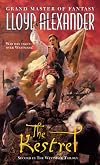
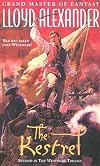
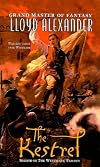
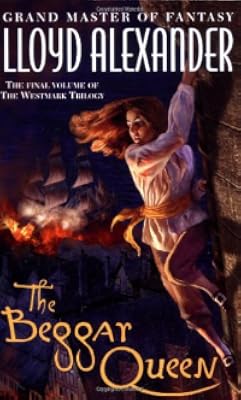
With war in Westmark and the assumption of the throne by Mickle, all Theo's talents are needed, as well as those of his former companions.Tags
Recommendations

Member Reviews
War comes to Westmark just as King Augustine dies.
This was another excellent entry in the trilogy. Alexander has crafted a shocking, brutal and utterly real depiction of war and its effects on men and women. His imagery is never very graphic - this is, after all, a novel for younger readers - but it conveys a great deal nonetheless.
The "glory of war" has no place in this story. Characters who expect to discover it are quickly disillusioned. People suffer and starve and die as the war carves its way through their lives. Characters move in different directions as the war affects them. They are forced to reevaluate all their previous views even as their place in the world shifts and changes. It can be dense stuff; I sometimes found it show more difficult to read. It's worth sticking with, though. This is a powerful story about a subject that most children are either shelted from or exposed to in comic fashion. While Alexander does include a fair measure of humor in the form of the two water rats, their comedic views only serve to highlight the horror around them. It's nicely done, and keeps the book from becoming overwhelming.
Highly recommended. While it's probably best that you read Westmark first, I don't think it's absolutely essential. show less
This was another excellent entry in the trilogy. Alexander has crafted a shocking, brutal and utterly real depiction of war and its effects on men and women. His imagery is never very graphic - this is, after all, a novel for younger readers - but it conveys a great deal nonetheless.
The "glory of war" has no place in this story. Characters who expect to discover it are quickly disillusioned. People suffer and starve and die as the war carves its way through their lives. Characters move in different directions as the war affects them. They are forced to reevaluate all their previous views even as their place in the world shifts and changes. It can be dense stuff; I sometimes found it show more difficult to read. It's worth sticking with, though. This is a powerful story about a subject that most children are either shelted from or exposed to in comic fashion. While Alexander does include a fair measure of humor in the form of the two water rats, their comedic views only serve to highlight the horror around them. It's nicely done, and keeps the book from becoming overwhelming.
Highly recommended. While it's probably best that you read Westmark first, I don't think it's absolutely essential. show less
Theo is traveling through Westmark, learning about the country of which he will soon be Prince Consort. He is not surprised to find great poverty-Mickle (now known as Princess Augusta) could have told him that from her years on the street. His friend Florian could have told him about the aristocracy's graft and corruption. But neither could have foreseen a loaded pistol in the practiced hand of the assassin Skeit. The echoes of that shot ring from the muskets and cannons of a Westmark suddenly at war-a war that turns simple, honest men into cold-blooded killers, Mickle into a military commander, and Theo himself into a stranger...
Enjoyable but not a story I loved. It was hard to keep track of the separate storylines for the first 2/3, although I was THRILLED to hang out with every individual character, especially Sparrow & Weasel. Loved Theo's transformation into Kestrel -- especially Alexander's dry remark about how he thinks he & Justin are having a reasonable, calm discussion and really they're screaming at each other -- and Mickle never ceases to amuse, along with Count La Bombas.
Hunh. Maybe I liked this more than I thought I did. Maybe it is a story that is good to *have read* rather than a story I enjoyed *reading*.
Hunh. Maybe I liked this more than I thought I did. Maybe it is a story that is good to *have read* rather than a story I enjoyed *reading*.
This book ventures into unusually grim territory for Alexander. Invasion, resistance, and reprisals is the main part of the story; every subplot is a relief.
Alexander's venture into historical fiction in a fictional county is remniscent of Ursula LeGuin's with Malafrena.
Alexander's venture into historical fiction in a fictional county is remniscent of Ursula LeGuin's with Malafrena.
Quite a bit darker and bloodier than the first book in this series (one of the main characters in particular becomes much more savage until he finally snaps out of it), and with much more social commentary and fewer fun scenes. So this wasn't as enjoyable as the first, but Alexander is still a very good writer and tells an absorbing story.
This is the second book in the Westmark Trilogy and starts up a short time after the last book left off. It was a solid young adult fantasy; I didn't like it quite as much as the first book but it was still a very well put together fantasy.
Theo is assigned with going exploring around the kingdom and reporting the findings back to the Queen and King. While he is out news comes to him from Florian that one of the kingdom's main generals may be a traitor; right after Theo gets this news he receives news that the king has died...now Mickle is Queen of the realm. Theo sets off to find Mickle but instead gets embroiled in fighting and it is fighting that brings out the more violent side of his nature. Mickle, meanwhile, has other ideas of show more what a Queen should be doing and takes off to find Theo.
This book switches perspective a lot more than the first book. We hear things from Theo's view, Mickle's view, Kellner's view, the Chief Magistrate's view, Prince Connie's view, and the water-rats' view. All that switching around breaks up the story a little, but for the most part things flow very well.
As in the first book, the plot is very engaging as are the characters. This book is a bit of a tougher read because you have to read carefully to follow the plot and all the people; in that it is typical of most epic fantasies. The style of the writing is very similar to the first book.
There were a couple this about this book that were a bit "off" for me. The first was that there was so much discussion of politics; I personally prefer reading about adventuring versus politics...the politics are well done but there are a lot of them. The second thing was Mickle's character. It bothered me how she spent most of her childhood as a beggar and then she is Queen and suddenly she understands military strategy and is super strong and proficient. I think if I were a younger reader this wouldn't bug me as much; but as an adult I want to know where she learned all these military tactics...I know she is smart, but still.
Outside of the above mentioned quibbles, this was a very well done novel. You definitely need to read the first book first. I would recommend this for young adults and older, it is not that content is inappropriate for younger children...it is just that I don't think younger children will be all into the politics going on here. I am eager to read the third (and final) book in the trilogy Beggar Queen (Westmark Trilogy). show less
Theo is assigned with going exploring around the kingdom and reporting the findings back to the Queen and King. While he is out news comes to him from Florian that one of the kingdom's main generals may be a traitor; right after Theo gets this news he receives news that the king has died...now Mickle is Queen of the realm. Theo sets off to find Mickle but instead gets embroiled in fighting and it is fighting that brings out the more violent side of his nature. Mickle, meanwhile, has other ideas of show more what a Queen should be doing and takes off to find Theo.
This book switches perspective a lot more than the first book. We hear things from Theo's view, Mickle's view, Kellner's view, the Chief Magistrate's view, Prince Connie's view, and the water-rats' view. All that switching around breaks up the story a little, but for the most part things flow very well.
As in the first book, the plot is very engaging as are the characters. This book is a bit of a tougher read because you have to read carefully to follow the plot and all the people; in that it is typical of most epic fantasies. The style of the writing is very similar to the first book.
There were a couple this about this book that were a bit "off" for me. The first was that there was so much discussion of politics; I personally prefer reading about adventuring versus politics...the politics are well done but there are a lot of them. The second thing was Mickle's character. It bothered me how she spent most of her childhood as a beggar and then she is Queen and suddenly she understands military strategy and is super strong and proficient. I think if I were a younger reader this wouldn't bug me as much; but as an adult I want to know where she learned all these military tactics...I know she is smart, but still.
Outside of the above mentioned quibbles, this was a very well done novel. You definitely need to read the first book first. I would recommend this for young adults and older, it is not that content is inappropriate for younger children...it is just that I don't think younger children will be all into the politics going on here. I am eager to read the third (and final) book in the trilogy Beggar Queen (Westmark Trilogy). show less
Sequel to Westmark, this chronicles the two main characters as their country undergoes some significant upheaval. (Giving more detail would be a bit of a spoiler.) I found it a bit darker and heavier on the social commentary than the first, but still enjoyable.
Members
- Recently Added By
Lists

Princess Tales
130 works; 4 members

Best books read in 2011
200 works; 51 members

Honey For a Child's Heart
1,152 works; 25 members

Animals in the Title
498 works; 11 members

Newbery Adjacent
747 works; 3 members
Talk Discussions
Current Discussions
Found: Prince (?) flees after usurpation, joins rival army in Name that Book (December 2025)
Author Information

95+ Works 55,693 Members
Lloyd Alexander, January 30, 1924 - May 17, 2007 Born Lloyd Chudley Alexander on January 30, 1924, in Philadelphia, Pennsylvania to Allan Audley and Edna Chudley Alexander, Lloyd knew from a young age that he wanted to write. He was reading by the time he was 3, and though he did poorly in school, at the age of fifteen, he announced that he wanted show more to become a writer. At the age of 19 in 1942, Alexander dropped out of the West Chester State Teachers College in Pennsylvania after only one term. In 1943, he attended Lafayette College in Easton, PA, before dropping out again and joining the United States Army during World War II. Alexander served in the Intelligence Department, stationed in Wales, and then went on to Counter-Intelligence in Paris, where he was promoted to Staff Sergeant. When the war ended in '45, Alexander applied to the Sorbonne, but returned to the States in '46, now married. Alexander worked as an unpublished writer for seven years, accepting positions such as cartoonist, advertising copywriter, layout artist, and associate editor for a small magazine. Directly after the war, he had translated works for such artists as Jean Paul Sartre. In 1955, "And Let the Credit Go" was published, Alexander's first book which led to 10 years of writing for an adult audience. He wrote his first children's book in 1963, entitled "Time Cat," which led to a long career of writing for children and young adults. Alexander is best known for his "Prydain Chronicles" which consist of "The Book of Three" in 1964, "The Black Cauldron" in 1965 which was a Newbery Honor Book, as well as an animated motion picture by Disney which appeared in 1985, "The Castle of Llyr" in 1966, "Taran Wanderer" in 1967, a School Library Journal's Best Book of the Year and "The High King" which won the Newberry Award. Many of his other books have also received awards, such as "The Fortune Tellers," which was a Boston Globe Horn Book Award winner. In 1986, Alexander won the Regina Medal for Lifetime Achievement from the Catholic Library Association. His titles have been translated into many languages including, Dutch, Spanish, French, German, Hebrew, Italian, Japanese, Norwegian, Serbo-Croation and Swedish. He died on May 17, 2007. (Bowker Author Biography) show less

Lloyd Alexander has a Legacy Library. Legacy libraries are the personal libraries of famous readers, entered by LibraryThing members from the Legacy Libraries group.
Some Editions
Awards and Honors
Awards
Distinctions
Series

Work Relationships
Is contained in
Common Knowledge
- Original publication date
- 1982
- People/Characters
- Theo [Westmark] (Colonel Kestrel); Mickle [Westmark] (Princess Augusta/Queen Mickle); Florian [Westmark] (Peregrine); Count Las Bombas; Justin [Westmark] (Shrike); Luther/Raven (show all 23); Zara [Westmark] (Firedrake); Stock (Phoenix); Chief Minister Torrens; Caroline, Queen of Westmark; General Erzcour; Baron Montmollin; Musket; King Constantine IX of Regia/Connie; Kopple; Skeit; Captain/Colonel Witz; Rina [Westmark] (Lapwing); the Monkey; Weasel [Westmark]; Sparrow [Westmark]; Keller [Westmark]; Madame Bertha
- Important places
- Westmark; Regia; Mull; Marianstat; Juliana Palace; Altus-Birkenfeld (show all 10); Vespara; Carlsbruch; Eschbach; La Jolie
- Dedication
- For those who know that they are only human but who try not to be any less
- First words
- Spring in the Carla River valley was a matter of opinion.
- Last words
- (Click to show. Warning: May contain spoilers.)"That's one of your better qualities."
Classifications
- Genres
- Fiction and Literature, Fantasy, Teen, Young Adult
- DDC/MDS
- 813.54 — Literature & rhetoric American literature in English American fiction in English 1900-1999 1945-1999
- LCC
- PZ7 .A3774 .K — Language and Literature Fiction and juvenile belles lettres Fiction and juvenile belles lettres Juvenile belles lettres
- BISAC
Statistics
- Members
- 991
- Popularity
- 26,450
- Reviews
- 15
- Rating
- (3.90)
- Languages
- English, German, Swedish
- Media
- Paper
- ISBNs
- 14
- ASINs
- 3