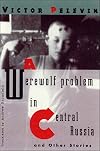
A Werewolf Problem in Central Russia and Other Stories
by Viktor Pelevin
On This Page
Description
Satirical stories by a Russian writer. The story, Vera Pavlovna's Ninth Dream, is on the transition from communism to capitalism as experienced by the cleaner of a public toilet, Bulldozer Driver's Day is on a hydrogen bomb assembly line, while The Ontology of Childhood compares childhood to prison. By the author of The Blue Lantern.Tags
Recommendations





































Member Reviews
“Just for a moment Sasha thought that the battered Zil would stop for him: it was so old and rattled so loudly, and was so obviously ready for the scrap heap, that it should have stopped—if only the law by which old people who have been rude and inconsiderate all their lives suddenly become helpful and obliging shortly before they die had applied to the world of automobiles—but it didn’t. With a bucket clanking beside its gas tank with a drunken, senile insolence, the Zil rattled past him, struggled up a small hill, giving vent to a whoop of indecent triumph and a jet of gray smoke at the summit, and disappeared silently behind the asphalt rise. Sasha stepped off the road, dropped his small backpack on to the grass and sat down show more on it. Something in it bent and cracked and Sasha felt the spiteful satisfaction of a person in trouble who learns that someone or something else is also having a hard time. He was just beginning to realize how serious his own situation was.”
—“A Werewolf Problem in Central Russia”
Pelevin is easily my favorite modern Russian author. This title story from his collection is an example of his unique power, voice, and fearlessness in shifting between states and beings as if matter and concepts and situations were all plasma at the irreducible core. The next two stories, “Vera Pavlovna’s Ninth Dream” and “Sleep”, were also strong examples of his singular slant on human existence and mankind’s almost universal lack of comprehending its own predicament. After this, however, the stories seem to meander. I don’t know if it was just a repetition of a theme without a new hook, but the pervasive absurdity ran out of viability early on. Maybe that’s why Kharms typically wrote in extremely short form. And yet Gogol was able to pull it off. And Beckett.
For what the rest of the book had to offer, and for the dollops of greatness in the first three stories, it was an instructive and insightful glimpse into the tensile strength of absurdity as a theme. I needed this example. The good, the ugly, and the flat-out boring. Whether boundaries to my current absurdist novella or merely an understanding of just what colors I’ll choose from the palette, I know better now how far I can stretch my fiction—that I’d previously thought boundless—and will obey the muted basement warnings of how to approach 𝘗𝘦𝘰𝘱𝘭𝘦 𝘖𝘶𝘳 𝘚𝘰𝘭𝘪𝘵𝘶𝘥𝘦. Not so much lessons learned as much as watching another’s trials and errors help shape how I’ll stretch that plasma in my own voice.
Victor Pelevin’s worst is still better than most surrealists’ best. And his best . . . well, Gogol himself could hardly have done better.
“This time everything came in reverse order—first Vera heard his high, challenging tenor ringing out on the staircase, answered condescendingly by a gruff bass, and then the curtains parted. But instead of the hand and the dark glasses, what appeared was a denim-clad back that wasn’t so much hunched over as folded. Vera’s boss came backing in, trying to explain something as he went, and striding in after him came a fat elderly gnome with a big red beard, wearing a red cap and a red foreign T-shirt, on which Vera read the words: WHAT I REALLY NEED IS LESS SHIT FROM YOU PEOPLE.”
—“Vera Pavlovna’s Ninth Dream” show less
—“A Werewolf Problem in Central Russia”
Pelevin is easily my favorite modern Russian author. This title story from his collection is an example of his unique power, voice, and fearlessness in shifting between states and beings as if matter and concepts and situations were all plasma at the irreducible core. The next two stories, “Vera Pavlovna’s Ninth Dream” and “Sleep”, were also strong examples of his singular slant on human existence and mankind’s almost universal lack of comprehending its own predicament. After this, however, the stories seem to meander. I don’t know if it was just a repetition of a theme without a new hook, but the pervasive absurdity ran out of viability early on. Maybe that’s why Kharms typically wrote in extremely short form. And yet Gogol was able to pull it off. And Beckett.
For what the rest of the book had to offer, and for the dollops of greatness in the first three stories, it was an instructive and insightful glimpse into the tensile strength of absurdity as a theme. I needed this example. The good, the ugly, and the flat-out boring. Whether boundaries to my current absurdist novella or merely an understanding of just what colors I’ll choose from the palette, I know better now how far I can stretch my fiction—that I’d previously thought boundless—and will obey the muted basement warnings of how to approach 𝘗𝘦𝘰𝘱𝘭𝘦 𝘖𝘶𝘳 𝘚𝘰𝘭𝘪𝘵𝘶𝘥𝘦. Not so much lessons learned as much as watching another’s trials and errors help shape how I’ll stretch that plasma in my own voice.
Victor Pelevin’s worst is still better than most surrealists’ best. And his best . . . well, Gogol himself could hardly have done better.
“This time everything came in reverse order—first Vera heard his high, challenging tenor ringing out on the staircase, answered condescendingly by a gruff bass, and then the curtains parted. But instead of the hand and the dark glasses, what appeared was a denim-clad back that wasn’t so much hunched over as folded. Vera’s boss came backing in, trying to explain something as he went, and striding in after him came a fat elderly gnome with a big red beard, wearing a red cap and a red foreign T-shirt, on which Vera read the words: WHAT I REALLY NEED IS LESS SHIT FROM YOU PEOPLE.”
—“Vera Pavlovna’s Ninth Dream” show less
The dust jacket compares Victor Pelevin's work with Kafka, Bulgakov, Philip K Dick and Joseph Heller, but the comparisons that came to mind for me were with Nikolai Gogol and the Strugatskii brothers. My favourite stories in this book were the title story, and the concluding novella "Prince of Gosplan", which reimagines late-Soviet life as a bunch of computer games: the hero is like a male Lara Croft with worse resolution. If you like surrealism, absurdism and the convolutions in time and space caused by bureaucracy gone mad, this is the book for you.
It may seem a bit bizarre but I've always liked the jacket cover of Pelevin's A werewolf problem in Central Russia. More than anything else that was probably the reason I bought it in the first place. In any case it's sat around my house for years--neglected and unread. On occasion I'd pick it up and consider and then something else always seemed to scream just a little louder--'Read me! Read me!.
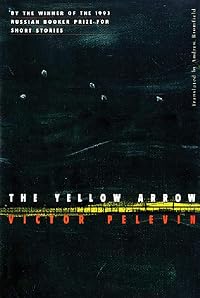
And then--having run into some commentary about the book here in recent weeks I decided to finally give it its chance. I have Pelevin a couple times before--underwhelmed with Omon Ra but giving him a second chance I thought his Yellow Arrow was quite good.
Anyway to the werewolf problem of the title story--which is quite the humdinger of a show more short story and in and of itself it's worth the price of the book. Very ingenious--it reminded me of Bulgakov at his best. Other than that two other stories stand out Vera Pavlovna's ninth dream (2nd story of the collection--there are 8 altogether) and the Prince of Gosplan (the last). Neither of those however quite reach the level of the title story. The rest is kind of patchy--not bad but nothing really all that memorable.
A final few words--Pelevin is very much a social critic of Russia and/or what once was the Soviet empire. That can also be said of many of the best Russian writers of the past 2-3 centuries. Up to this point he has not really connected like a Dostoevsky, Tolstoy or Solzenhitsyn-- at least not in the west. His title story here makes it clear to me that at least the talent is there. Whether he lives up to it or not only time will tell. show less
And then--having run into some commentary about the book here in recent weeks I decided to finally give it its chance. I have Pelevin a couple times before--underwhelmed with Omon Ra but giving him a second chance I thought his Yellow Arrow was quite good.
Anyway to the werewolf problem of the title story--which is quite the humdinger of a show more short story and in and of itself it's worth the price of the book. Very ingenious--it reminded me of Bulgakov at his best. Other than that two other stories stand out Vera Pavlovna's ninth dream (2nd story of the collection--there are 8 altogether) and the Prince of Gosplan (the last). Neither of those however quite reach the level of the title story. The rest is kind of patchy--not bad but nothing really all that memorable.
A final few words--Pelevin is very much a social critic of Russia and/or what once was the Soviet empire. That can also be said of many of the best Russian writers of the past 2-3 centuries. Up to this point he has not really connected like a Dostoevsky, Tolstoy or Solzenhitsyn-- at least not in the west. His title story here makes it clear to me that at least the talent is there. Whether he lives up to it or not only time will tell. show less
Here's a collection of stories that has stuck with me.
I am not sure what to say about Pelevin and his books.
Ratings
Members
- Recently Added By
Lists

Top Five Books of 2013
1,562 works; 721 members

O, those Russians (as Boney M sang)
16 works; 1 member

short stories / novella
23 works; 1 member
Author Information

Some Editions
Common Knowledge
- Original publication date
- 1994 (Russian) (Russian); 1998 (English) (English)
- People/Characters
- Zil; Sasha; Nikita Dozakin; Pyotr Petrovich
- Original language
- Russian
Classifications
- Genres
- Fiction and Literature, General Fiction, Fantasy
- DDC/MDS
- 813 — Literature & rhetoric American literature in English American fiction in English
- LCC
- PG3485 .E38 .A23 — Language and Literature Slavic languages and literatures. Baltic languages. Albanian language Slavic. Baltic. Albanian Russian literature Individual authors and works 1961-2000
- BISAC
Statistics
- Members
- 268
- Popularity
- 121,208
- Reviews
- 5
- Rating
- (3.58)
- Languages
- English, Italian
- Media
- Paper
- ISBNs
- 5