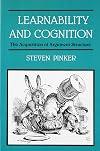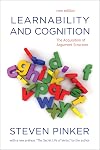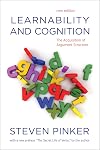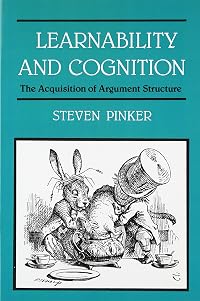
Learnability and Cognition: The Acquisition of Argument Structure
by Steven Pinker
71 Members (4.25)
On This Page
Description
Before Steven Pinker wrote bestsellers on language and human nature, he wrote several technical monographs on language acquisition that have become classics in cognitive science. Learnability and Cognition, first published in 1989, brought together two big topics: how do children learn their mother tongue, and how does the mind represent basic categories of meaning such as space, time, causality, agency, and goals? The stage for this synthesis was set by the fact that when children learn a show more language, they come to make surprisingly subtle distinctions: pour water into the glass and fill the glass with water sound natural, but pour the glass with water and fill water into the glass sound odd. How can this happen, given that children are not reliably corrected for uttering odd sentences, and they don't just parrot back the correct ones they hear from their parents? Pinker resolves this paradox with a theory of how children acquire the meaning and uses of verbs, and explores that theory's implications for language, thought, and the relationship between them. As Pinker writes in a new preface, "The Secret Life of Verbs," the phenomena and ideas he explored in this book inspired his 2007 bestseller The Stuff of Thought: Language as a Window into Human Nature. These technical discussions, he notes, provide insight not just into language acquisition but into literary metaphor, scientific understanding, political discourse, and even the conceptions of sexuality that go into obscenity. show lessTags
Recommendations




































Member Reviews
Members
- Recently Added By
Author Information

43+ Works 31,968 Members
Steven Pinker is an authority on language and the mind. He is Peter de Florez professor of psychology in the department of brain and cognitive sciences at the Massachusetts Institute of Technology. He lives in Cambridge, Massachusetts. Steven Arthur Pinker was born on September 18, 1954 in Canada. He is an experimental psychologist, cognitive show more scientist, linguist, and author. He is a psychology professor at Harvard University. He is the author of several non-fiction books including The Language Instinct, How the Mind Works, Words and Rules, The Blank Slate, The Stuff of Thought, and The Sense of Style: The Thinking Person's Guide to Writing in the 21st Century. His research in cognitive psychology has won the Early Career Award in 1984 and Boyd McCandless Award in 1986 from the American Psychological Association, the Troland Research Award in 1993 from the National Academy of Sciences, the Henry Dale Prize in 2004 from the Royal Institution of Great Britain, and the George Miller Prize in 2010 from the Cognitive Neuroscience Society. He was twice a finalist for the Pulitzer Prize, in 1998 and in 2003. In 2006, he received the American Humanist Association's Humanist of the Year award for his contributions to public understanding of human evolution. (Bowker Author Biography) show less
Series
Belongs to Publisher Series
Common Knowledge
- Canonical title
- Learnability and Cognition: The Acquisition of Argument Structure
Classifications
- Genres
- Nonfiction, Science & Nature, General Nonfiction
- DDC/MDS
- 401.9 — Language Language Philosophy and theory; international languages Psychological principles, language acquisition, speech perception
- LCC
- P118 .P555 — Language and Literature Philology. Linguistics Language. Linguistic theory. Comparative grammar Language acquisition
- BISAC
Statistics
- Members
- 71
- Popularity
- 443,782
- Rating
- (4.25)
- Languages
- English
- Media
- Paper, Ebook
- ISBNs
- 8
- ASINs
- 2