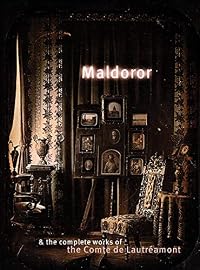
Complete Works
by Comte de Lautréamont
On This Page
Description
Andre Breton wrote that MALDOROR is the expression of a revelation so complete it seems to exceed human potential.' First published in 1869, MALDOROR is the work of a mysterious genius about whom little is known aside from his birth in Uruguay, 1846, and his early death in Paris, 1870. His writings, published under the pseudonym Comte de Lautreamont, bewildered his contemporaries but have since taken their place alongside other French classics of transgression such as Sade, Baudelaire, show more Rimbaud. A unique translation.' show lessTags
Recommendations


























Member Reviews
There's a certain way to approach this book.
If you try to read it like a normal book, like a regular piece of prose, you'll have to get out a notebook, and then reread the same paragraphs over and over again. It took me a long time to get through this work, because of the nature in which this was written.
This book is extremely beautiful, and very well crafted. However, when you read it, you need to look at it like you would a piece of abstract art. See the whole picture first, then look closer, move away and look at it from far away again, move closer and begin to inspect the smaller working parts.
Looking at abstract art is a lot like meditation for me, which is what this piece felt like. I had to let go of my preconceived notions as show more a reader. Often you go into a book, trying to guess ahead what will happen, what it all means. I tend to do this a lot, and because of that, I had to work slower towards it's completion.
If like me, you MUST find meaning in things, then this will be slow progress for you as it was for me. And one reading is nowhere near enough. I will be reading this book for a long time. Just as I would meditate on a painting.
Parts of this book are revolting to look at. Horrifying even. I felt like it was staining my soul as I read it, but the narrator warns us of this before we even begin. It's one of the reasons that I see genius running through this piece.
It reminds me of House of Leaves in the sense that it's construction is very much psychological, and a lot of careful thought went into how things were placed in this book.
Highly recommended, but not an easy, quick, or happy read. show less
If you try to read it like a normal book, like a regular piece of prose, you'll have to get out a notebook, and then reread the same paragraphs over and over again. It took me a long time to get through this work, because of the nature in which this was written.
This book is extremely beautiful, and very well crafted. However, when you read it, you need to look at it like you would a piece of abstract art. See the whole picture first, then look closer, move away and look at it from far away again, move closer and begin to inspect the smaller working parts.
Looking at abstract art is a lot like meditation for me, which is what this piece felt like. I had to let go of my preconceived notions as show more a reader. Often you go into a book, trying to guess ahead what will happen, what it all means. I tend to do this a lot, and because of that, I had to work slower towards it's completion.
If like me, you MUST find meaning in things, then this will be slow progress for you as it was for me. And one reading is nowhere near enough. I will be reading this book for a long time. Just as I would meditate on a painting.
Parts of this book are revolting to look at. Horrifying even. I felt like it was staining my soul as I read it, but the narrator warns us of this before we even begin. It's one of the reasons that I see genius running through this piece.
It reminds me of House of Leaves in the sense that it's construction is very much psychological, and a lot of careful thought went into how things were placed in this book.
Highly recommended, but not an easy, quick, or happy read. show less
I really need to add some mediocre books, these starry books eat on the authenticity of my shelf. Then again, I give away the books that give me little or nothing... -- I knew a long time I must read Comte de Lautréamont. When I came across a promising Finnish translation the other year, I went for it, and my goodness what a ride I was given, starting from the first chapter that tells about a hair. A hair! From there it went onward, downward, in concentric circles, a vertigo, a drunken stupor into the shadowside of man, into hate, delusion, and the beauty of horror or the horror of beauty? Surely the grimness that the young author revelled in (describing himself thirty in the book, in reality being little more than 20) will turn off show more many as mere scandal-seeking, mere effects -- but I don't agree. Sometimes the form ("You think I'm mad?")
repeats itself a bit, but these drawbacks are by far outweighed by the mere surreality of it all -- and this in the 1860s when surreality didn't even exist! It's no wonder Dalí and his friends embraced this young visionary long afterwards. I think it would be unfair to not mention that Isidore Ducasse a.k.a. Comte de Lautréamont intended to follow this tribute to evil with a following volume that would be a tribute to good -- had not war come in between, causing his premature death. The Finnish volume can obviously not be found on Shelfari, but this is an English edition I came across in Naples that also features other fragments. These I'm yet to read (as well as "Maldoror" in English). show less
repeats itself a bit, but these drawbacks are by far outweighed by the mere surreality of it all -- and this in the 1860s when surreality didn't even exist! It's no wonder Dalí and his friends embraced this young visionary long afterwards. I think it would be unfair to not mention that Isidore Ducasse a.k.a. Comte de Lautréamont intended to follow this tribute to evil with a following volume that would be a tribute to good -- had not war come in between, causing his premature death. The Finnish volume can obviously not be found on Shelfari, but this is an English edition I came across in Naples that also features other fragments. These I'm yet to read (as well as "Maldoror" in English). show less
Lykiard's translation of Maldoror is a profoundly puzzling yet mesmerizing work. It's content is some of the strangest and most shocking in the history of literature. A misanthropic protagonist leads us through tales replete with murder, degradation, and sexual deviance (The oddly tender and intimate copulation with a female shark springs to mind immediately). Contrarily, the language that conveys this madness is often poetic, and at times humorous and conversational. The work explores different narrative structures, often switching between first and third person.
Poesies is the exact opposite of Maldoror. The straight forward language condemns writers such as Hugo and Milton for wallowing in sorrow and shame, and argues that literature show more must always convey hope and that man is by his nature driven to do good. It is hard to tell if this work is a satire or, conversely, if Maldoror is a warning against the very attitudes its protagonist displays. These two works; along with a selection of letters, apocryphal writings, critical fragments, and reminisces by Ducasse's (AKA Lautremont) peers provide us with an insightful portrait of this literary enigma whose work greatly inspired the Surrealist movement. show less
Poesies is the exact opposite of Maldoror. The straight forward language condemns writers such as Hugo and Milton for wallowing in sorrow and shame, and argues that literature show more must always convey hope and that man is by his nature driven to do good. It is hard to tell if this work is a satire or, conversely, if Maldoror is a warning against the very attitudes its protagonist displays. These two works; along with a selection of letters, apocryphal writings, critical fragments, and reminisces by Ducasse's (AKA Lautremont) peers provide us with an insightful portrait of this literary enigma whose work greatly inspired the Surrealist movement. show less
While I don't pretend to be an expert on 19th century Gothicism, Maldoror seems to me to be a unique presentation of evil in its most refined and unbridled form. A whole stream of 20th century experimental literature finds in source in these dark pages.
A comedy of blasphemy and evil. Beware "the monstrous snail of idiocy." (p. 128)
P.S. The Guy Wernham translation looks like more fun.
P.S. The Guy Wernham translation looks like more fun.
This is where surrealism begins. It is a dream within a dream. This along with other symbolists - Verlaine, Beaudelaire, and Germaine Nerval are essential to freeing the confines of one's imagination.
The Chants of Maldoror: epic, grandiose, ludicrous, blasphemous, and foul. This book launched the Surrealist Movement.
Members
- Recently Added By
Published Reviews
ThingScore 92
Maldoror. Samlade verk i Elias Wraaks översättning utkom första gången 2002 men sålde snabbt slut. Nu har förlaget gett ut den på nytt och dessutom tillfogat andra smärre verk av Lautréamont, samt återger några av hans brev och några samtida vittnesbörder om hans person, för att nu inte tala om en förträfflig kommentardel i slutet av utgåvan. Akribin är imponerande.
added by Jannes
Jag recenserade förlaget Alastors utgåva av Lautréamonts "Samlade verk" 2002 och var salig av förtjusning inför Elias Wraaks översättning. Den svarta juvelen i kronan är "Maldorors sånger" - 60 lyriska, prosapoetiska sånger om mänsklig ondska som först förbjöds, därefter publicerades 1874, fyra år efter författarens död.
added by Jannes
Med "Maldorors sånger" kom Isidore Ducasse en bra bit längre på den väg som de Sade mutat in: att skriva en litteratur som i sig själv är en handling. Vart Ducasse egentligen tänkte ta vägen får vi aldrig veta.
added by Jannes
Lists

1001 Books You Must Read Before You Die
1,448 works; 1,132 members

Poésie (recueils)
10 works; 1 member
Author Information

66+ Works 2,828 Members
Some Editions
Awards and Honors
Work Relationships
Common Knowledge
- Canonical title
- Complete Works
- Original title
- Oeuvres complètes
- People/Characters
- Maldoror
Classifications
Statistics
- Members
- 1,086
- Popularity
- 23,429
- Reviews
- 14
- Rating
- (4.04)
- Languages
- 11 — Czech, Danish, Dutch, English, French, German, Italian, Portuguese, Serbian, Spanish, Swedish
- Media
- Paper
- ISBNs
- 29
- ASINs
- 12