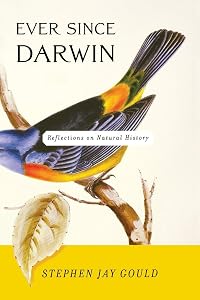
Ever Since Darwin: Reflections in Natural History
by Stephen Jay Gould
Reflections in Natural History (1)
On This Page
Description
Provides information on developments in evolutionary theory, discussing such topics as the Cambrian population explosion, Velikovsky's theories, and others.Tags
Recommendations










Member Reviews
This is the first collection of Stephen Jay Gould's essays on evolutionary science from Natural History Magazine, featuring pieces originally published in the 1970s.
They are, naturally, very dated, and I wasn't certain for a while whether they would still be worth reading for that reason. (Indeed, in one essay on human evolution, Gould suggests that the field was moving so fast the essay might be out of date by the time it was published, never mind five decades later.) Honestly, though, there's something in their very datedness that itself helped to give me an interesting and worthwhile shift in perspective. It was, for instance, something of a jolt to see Gould talking about this new idea of plate tectonics and how it so quickly come show more to be accepted over the previous decade. I grew up with that idea being taught to me as if it were ancient scientific wisdom, but I'd already been born when Gould was writing this. Between that and also realizing that he was writing only 120 years after On the Origin of Species and only a few decades into the firm and widespread acceptance in science of natural selection as the mechanism of evolution, it really brought home to me just how short a timespan and how few links in the chain of human discovery lie between me, sitting here in 2025, and the days when people were arguing over whether or not Adam and Eve had contained within them the tiny homunculi of every subsequent human generation. (Which, yes, was a real theory that was taken seriously, and which Gould talks about in one of these essays.)
So, that was interesting. And so were the essays, overall, just as I've found all the others of his I've read.
There are certain repeating themes here. One is that it's wrong to regard evolution as a process of life climbing an inevitable ladder of progress, or even the idea of "progress" as a thing in evolution at all. Which is point worth hammering home, as misconceptions on this score are still rampant among the public and cause a lot of serious misunderstanding. Another is that science itself is not all climbing ladders of inevitable progress, either, as scientists are always working within their own cultural contexts and hampered by their own biases. He describes, for example a number of people trying very hard to reach for rational explanations, but whose conclusions were distorted by operating within a world of Biblical literalism. Gould has a lot of sympathy and often real respect for these folks, but he is relentless in his criticism of those using bad scientific reasoning to justify racism or to paint current social structures as inevitable and right (something that always seems to end up with the guy doing the justifying sitting at the top of the hierarchy). And in those criticisms, both in terms of scientific reasoning and simple humanity, he seems not dated at all, but, indeed, if anything a bit ahead of his time. show less
They are, naturally, very dated, and I wasn't certain for a while whether they would still be worth reading for that reason. (Indeed, in one essay on human evolution, Gould suggests that the field was moving so fast the essay might be out of date by the time it was published, never mind five decades later.) Honestly, though, there's something in their very datedness that itself helped to give me an interesting and worthwhile shift in perspective. It was, for instance, something of a jolt to see Gould talking about this new idea of plate tectonics and how it so quickly come show more to be accepted over the previous decade. I grew up with that idea being taught to me as if it were ancient scientific wisdom, but I'd already been born when Gould was writing this. Between that and also realizing that he was writing only 120 years after On the Origin of Species and only a few decades into the firm and widespread acceptance in science of natural selection as the mechanism of evolution, it really brought home to me just how short a timespan and how few links in the chain of human discovery lie between me, sitting here in 2025, and the days when people were arguing over whether or not Adam and Eve had contained within them the tiny homunculi of every subsequent human generation. (Which, yes, was a real theory that was taken seriously, and which Gould talks about in one of these essays.)
So, that was interesting. And so were the essays, overall, just as I've found all the others of his I've read.
There are certain repeating themes here. One is that it's wrong to regard evolution as a process of life climbing an inevitable ladder of progress, or even the idea of "progress" as a thing in evolution at all. Which is point worth hammering home, as misconceptions on this score are still rampant among the public and cause a lot of serious misunderstanding. Another is that science itself is not all climbing ladders of inevitable progress, either, as scientists are always working within their own cultural contexts and hampered by their own biases. He describes, for example a number of people trying very hard to reach for rational explanations, but whose conclusions were distorted by operating within a world of Biblical literalism. Gould has a lot of sympathy and often real respect for these folks, but he is relentless in his criticism of those using bad scientific reasoning to justify racism or to paint current social structures as inevitable and right (something that always seems to end up with the guy doing the justifying sitting at the top of the hierarchy). And in those criticisms, both in terms of scientific reasoning and simple humanity, he seems not dated at all, but, indeed, if anything a bit ahead of his time. show less
Note: I wrote this review sometime before Gould's death.
How does one write about a book of essays? Ever Since Darwin is a collection of essays drawn from Natural History magazine for which Gould wrote a monthly column entitled "This View of Life." While not especially easy reading, all the essays provide an intellectual delight that make them well worth the effort. A common thread running through all is the wonder and amazement Gould has for the extraordinary variation and adaptability of nature. One can see in these essays the development of ideas more fully defined in [b:Wonderful Life The Burgess Shale and the Nature of History|36475|Wonderful Life The Burgess Shale and the Nature of History|Stephen Jay show more Gould|http://photo.goodreads.com/books/1228161229s/36475.jpg|55914]
His examples are most absorbing and occasionally bizarre. He explains how the tiny gall midge reproduces in two ways: either normally from eggs as sexually reproducing flies; or without the aid of a father, i.e., via parthenogenesis, otherwise known as virgin birth. When food is abundant (midges feed primarily on mushrooms) the young grow in the mother's body feeding on her flesh. After she has been consumed they emerge and within two days their own children begin to feed off the parent. This matricide which at first glance might appear somewhat foolish is not just a disgusting freak of nature. As Gould points out, in light of evolutionary theory, the behavior is truly efficient and adaptive. As long as food is plentiful reproduction remains parthenogenetic. As food inevitably becomes scarcer the flies reproduce normally (hate to use the word normal in this context) at which point they can fly and scout out new food sources. "The flightless parthenogenic female stays on the mushroom and feeds. When it exhausts its resources it produces winged descendants to find new mushrooms." This still does not answer the question of why matricide? Gould explains better than I (read the essay entitled "Why should a fly eat its mother?;" but, basically it has to do with adaptability to environments which impose irregular catastrophic mortality (fairly common in nature,) or where food sources are hard to find but abundant when located. The best adaptability is to "reproduce like hell while you have the ephemeral resource, for it will not last long and some of your progeny must survive to find the next one." Whether this lesson should be applied to Man I will not hazard a guess.
Gould recognizes the social and cultural influences of the scientific imagination. Theories, at their best, should free us from our prejudices, at their worst they support the biases of their creators (witness Wolcott and his misinterpretation of the Burgess Shale), illustrated also in the attempts to find parallels between individual development and evolutionary history. (Gould has another book Ontoqeny and Phyloqeny dealing with just this issue which I have not yet read, but will soon?) Gould is very skeptical of biological determinism. (At a recent conference I witnessed E.O. Wilson, author of [b:Sociobiology The New Synthesis, Twenty-fifth Anniversary Edition|183819|Sociobiology The New Synthesis, Twenty-fifth Anniversary Edition|Edward O. Wilson|http://photo.goodreads.com/books/1172521072s/183819.jpg|177649] , a proponent of biological determinism, and Gould argue these points, much to the fascination of the audience.
Gould argues for biological potentiality.) Biological determinism has become popular in Gould's mind because it allows us to escape responsibility, e.g. the homeless are inevitably thus because they inherited the wrong genes; we can fob off responsibility for war to man's inherent aggressiveness rather than to blame the political structures we have created. Several essays deal with just such issues. Obviously I have not come close to doing justice to this richly diverse and fascinating collection of essays. Read the book, I guarantee you will be fascinated. show less
How does one write about a book of essays? Ever Since Darwin is a collection of essays drawn from Natural History magazine for which Gould wrote a monthly column entitled "This View of Life." While not especially easy reading, all the essays provide an intellectual delight that make them well worth the effort. A common thread running through all is the wonder and amazement Gould has for the extraordinary variation and adaptability of nature. One can see in these essays the development of ideas more fully defined in [b:Wonderful Life The Burgess Shale and the Nature of History|36475|Wonderful Life The Burgess Shale and the Nature of History|Stephen Jay show more Gould|http://photo.goodreads.com/books/1228161229s/36475.jpg|55914]
His examples are most absorbing and occasionally bizarre. He explains how the tiny gall midge reproduces in two ways: either normally from eggs as sexually reproducing flies; or without the aid of a father, i.e., via parthenogenesis, otherwise known as virgin birth. When food is abundant (midges feed primarily on mushrooms) the young grow in the mother's body feeding on her flesh. After she has been consumed they emerge and within two days their own children begin to feed off the parent. This matricide which at first glance might appear somewhat foolish is not just a disgusting freak of nature. As Gould points out, in light of evolutionary theory, the behavior is truly efficient and adaptive. As long as food is plentiful reproduction remains parthenogenetic. As food inevitably becomes scarcer the flies reproduce normally (hate to use the word normal in this context) at which point they can fly and scout out new food sources. "The flightless parthenogenic female stays on the mushroom and feeds. When it exhausts its resources it produces winged descendants to find new mushrooms." This still does not answer the question of why matricide? Gould explains better than I (read the essay entitled "Why should a fly eat its mother?;" but, basically it has to do with adaptability to environments which impose irregular catastrophic mortality (fairly common in nature,) or where food sources are hard to find but abundant when located. The best adaptability is to "reproduce like hell while you have the ephemeral resource, for it will not last long and some of your progeny must survive to find the next one." Whether this lesson should be applied to Man I will not hazard a guess.
Gould recognizes the social and cultural influences of the scientific imagination. Theories, at their best, should free us from our prejudices, at their worst they support the biases of their creators (witness Wolcott and his misinterpretation of the Burgess Shale), illustrated also in the attempts to find parallels between individual development and evolutionary history. (Gould has another book Ontoqeny and Phyloqeny dealing with just this issue which I have not yet read, but will soon?) Gould is very skeptical of biological determinism. (At a recent conference I witnessed E.O. Wilson, author of [b:Sociobiology The New Synthesis, Twenty-fifth Anniversary Edition|183819|Sociobiology The New Synthesis, Twenty-fifth Anniversary Edition|Edward O. Wilson|http://photo.goodreads.com/books/1172521072s/183819.jpg|177649] , a proponent of biological determinism, and Gould argue these points, much to the fascination of the audience.
Gould argues for biological potentiality.) Biological determinism has become popular in Gould's mind because it allows us to escape responsibility, e.g. the homeless are inevitably thus because they inherited the wrong genes; we can fob off responsibility for war to man's inherent aggressiveness rather than to blame the political structures we have created. Several essays deal with just such issues. Obviously I have not come close to doing justice to this richly diverse and fascinating collection of essays. Read the book, I guarantee you will be fascinated. show less
This collection, Gould's first, has gotten a bit dated over the years, but his style comes through even here. While I don't agree with all of his conclusions, his essays are just about always worth the read, and some of them (as on Darwin's role aboard the Beagle and about the Irish elk) are simply delightful.
http://nwhyte.livejournal.com/1446321.html
Another collection of Gould's essays from Natural History Magazine, this time dating from the mid-1970s; as ever, nicely constructed and argued pieces, though it is something of a shock to realise that, say, continental drift had only recently become orthodox, or indeed (when considering his comments on the Permian / Triassic extinction) that the Alvarez proposal that the Cretaceous ended in a massive impact event was still several years in the future. He is also terrifically good, and humane, in warning against the casual adoption of Darwin's ideas to support racist theories, including past examples of where even liberal scholars got it badly wrong. It has dated a bit more than The Panda's show more Thumb, but I think is slightly better. show less
Another collection of Gould's essays from Natural History Magazine, this time dating from the mid-1970s; as ever, nicely constructed and argued pieces, though it is something of a shock to realise that, say, continental drift had only recently become orthodox, or indeed (when considering his comments on the Permian / Triassic extinction) that the Alvarez proposal that the Cretaceous ended in a massive impact event was still several years in the future. He is also terrifically good, and humane, in warning against the casual adoption of Darwin's ideas to support racist theories, including past examples of where even liberal scholars got it badly wrong. It has dated a bit more than The Panda's show more Thumb, but I think is slightly better. show less
Simply divided, this book makes out of a broad and complex topic (evolutionary science) an entertaining and accessible subject.
Some articles are more interesting than others, an unavoidable imbalance for such a collection but, all in all it's clever, very well written, witty at times and, always relevant.
As this was my first Stephen Jay Gould, I would particularly recommend it to whose not knowing where to start with such a prolific writer.
Some articles are more interesting than others, an unavoidable imbalance for such a collection but, all in all it's clever, very well written, witty at times and, always relevant.
As this was my first Stephen Jay Gould, I would particularly recommend it to whose not knowing where to start with such a prolific writer.
I read this before and will certainly read it again. Excellent essays that make evolution clear and plausible. A fun aspect of Gould's essays are his commentaries on historical figures in science and how some of the oddities, not to say absurdities, of the history of science fit into its progress. Chapters on midges who grow by consuming the mother, the Irish Elk's antlers (formed by sexual selection), criticism of the genetic basis of IQ, how Engels argued correctly that human upright posture preceded our large brain (sharing with John Dewey a criticism of the dominant prejudice against work that favors thinking over work). Gould is for the most part congruent with the Kuhn's _Structures of Scientific Revolutions_, however, there are show more times when his exposition of science could use some correction of Richard Rorty's concept of cultural politics. show less
I do enjoy Gould's essays, but this is very very clearly his first collection. Two things stood out - the title (it's not bad, but no match for The Panda's Thumb or The Lying Stones of Marrakech or...) and the fact that he accepts and references some of the 'myths of science' that he debunks later - for instance, he makes casual reference to "the meeting where Huxley demolished 'Soapy Sam' Wilberforce...". In a later book (can't remember which), he's examined the actual records and contemporary references to said meeting, and discovered that it didn't happen that way. No comments about being descended from an ape, and no snappy comeback. Since I've read almost all his essay collections and a good many others he's written, I've come to show more expect that any time he mentions a convenient myth like that it's only for the purpose of debunking it - it quite startled me when he merely referred to it as a fact and moved on. It's still a good book, with a lot of familiar themes and interesting insights into them. Just a little odd to someone thoroughly familiar with Gould's work. show less
Members
- Recently Added By
Lists

al.vick-parents books
301 works; 1 member

Books to Read
95 works; 2 members
Author Information

116+ Works 30,493 Members
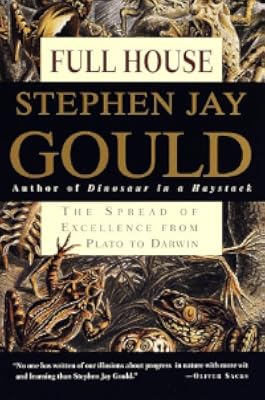
Born in New York City in 1941, Stephen Jay Gould received his B.A. from Antioch College in New York in 1963 and a Ph.D. in paleontology from Columbia University in 1967. Gould spent most of his career as a professor at Harvard University and curator of invertebrate paleontology at Harvard's Museum of Comparative Zoology. His research was mainly in show more the evolution and speciation of land snails. Gould was a leading proponent of the theory of punctuated equilibrium. This theory holds that few evolutionary changes occur among organisms over long periods of time, and then a brief period of rapid changes occurs before another long, stable period of equilibrium sets in. Gould also made significant contributions to the field of evolutionary developmental biology, most notably in his work, Ontogeny and Phylogeny. An outspoken advocate of the scientific outlook, Gould had been a vigorous defender of evolution against its creation-science opponents in popular magazines focusing on science. He wrote a column for Natural History and has produced a remarkable series of books that display the excitement of science for the layperson. Among his many awards and honors, Gould won the National Book Award and the National Book Critics Circle Award. His titles include; Ever Since Darwin, The Panda's Thumb, Hen's Teeth and Horse's Toes, Time's Arrow, Time's Cycle, Wonderful Life: The Burgess Shale and the Nature of History, The Structure of Evolutionary Theory and Full House: The Spread of Excellence from Plato to Darwin. Stephen Jay Gould died on May 20, 2002, following his second bout with cancer. (Bowker Author Biography) show less
Some Editions
Series

Belongs to Publisher Series
Common Knowledge
- Canonical title*
- Ever Since Darwin: Reflections on Natural History
- Original title
- Ever Since Darwin: Reflections on Natural History
- Original publication date
- 1977
- Dedication
- For My Father who took me to see the Tyrannosaurus when I was five
- First words
- One hundred years without Darwin are enough, grumbled the noted American geneticist H. J. Muller in 1952.
- Last words
- (Click to show. Warning: May contain spoilers.)I will rejoice in the multifariousness of nature and leave the chimera of certainty to politicians and preachers.
- Blurbers
- Walsten, David M.; Medawar, P. B.; Sagan, Carl; Montagu, Ashley
- Original language
- English
*Some information comes from Common Knowledge in other languages. Click "Edit" for more information.
Classifications
Statistics
- Members
- 1,971
- Popularity
- 10,738
- Reviews
- 28
- Rating
- (4.07)
- Languages
- 11 — Chinese, Dutch, English, French, German, Italian, Japanese, Portuguese, Spanish, Swedish, Turkish
- Media
- Paper, Audiobook, Ebook
- ISBNs
- 25
- ASINs
- 12