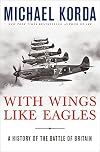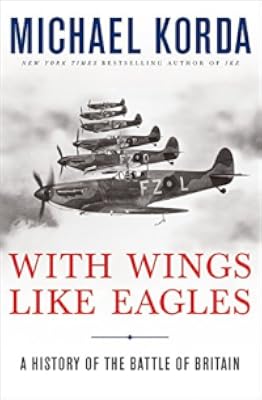
With Wings Like Eagles: A History of the Battle of Britain
by Michael Korda
On This Page
Description
History. Nonfiction. HTML:Michael Korda’s brilliant work of history takes the reader back to the summer of 1940, when fewer than three thousand young fighter pilots of the Royal Air Force–often no more than nine hundred on any given day–stood between Hitler and the victory that seemed almost within his grasp.As Nazi Germany rearmed swiftly after 1933, building up its bomber force, only one man, Air Chief Marshal Sir Hugh Dowding, the eccentric, infuriating, obstinate, difficult, and show more astonishingly foresighted creator and leader of RAF Fighter Command, did not believe that the bomber would always get through and was determined to provide Britain with a weapon few people wanted to believe was needed or even possible. Dowding persevered–despite opposition, shortage of funding, and bureaucratic infighting–to perfect the British fighter force just in time to meet and defeat the German onslaught.
Korda brings to life the extraordinary men and women on both sides of the conflict, from such major historical figures as Winston Churchill, Neville Chamberlain, and Reichsmarschall Herman Göring (and his disputatious and bitterly feuding generals) to the British and German pilots, the American airmen who joined the RAF just in time for the Battle of Britain, the young airwomen of the RAF, the ground crews who refueled and rearmed the fighters in the middle of heavy German raids, and such heroic figures as Douglas Bader, Josef František, and the Luftwaffe aces Adolf Galland and his archrival Werner Mölders.
From the Compact Disc edition.. show less
Tags
Recommendations

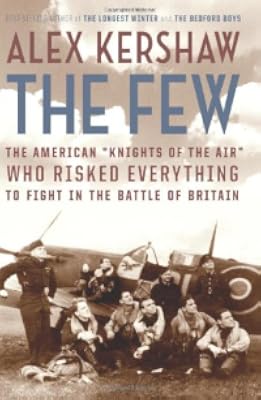

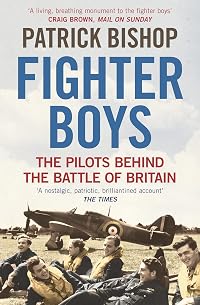
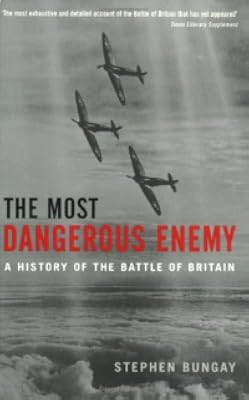


















Member Recommendations

Member Reviews
There is a great romanticism to the Battle of Britain. In the summer of 1940, at the height of Nazi power, all that stood between England and invasion were the pilots of RAF Fighter Command. Contrails traced labyrinths in the blue summer sky miles above the Earth as Spitfire and Messerschmidt tangled. The war fell from the sky on picnickers; shell casings, flaming wreckage, men, bombs. And of course, the good guys won. "This was their finest hour." Roll credits.
The real story is more complicated, of course, and Korda centers the battle as conflict between Air Marshall Hugh Dowding of the RAF, and Herman Goering for the Luftwaffe. Dowding is cast as a visionary. In the 1930s, when prevailing wisdom was that 'the bomber would always get show more through', Dowding pushed for the creation of the world's first integrated air defense network, a combination of radar, spotters, hardened telephones lines, centralized dispatch rooms where maps and indicator lights which enabled command of an air battle in real time, and fast and powerful monoplane fighters to do the killing. This was not going to be a random brawl, but a carefully planned battle of attrition. In the 21st century, with NASA Mission Control, the Star Trek bridge, and network-centric warfare, this is common stuff, but Dowding invented it all.
The Churchill Bunker, with the big board
Against this, Goering's Luftwaffe was the most powerful airforce in the world at the time. But the Bf-109 had the range to stay over England for mere minutes, the medium bombers lacked accuracy and destructive power, and the Stuka and Me-110 were sitting ducks for modern fighters. The Nazis were also hampered by terrible intelligence, that continually predicted the RAF was at the breaking point, and political problems, when a retaliatory strike on Berlin lead to bombers being pulled off of airfields and factories to punish Berlin.
In one sense, the outcome was never in doubt. Dowding just had to contest control of the air through the first week of October, after which storms would make Operation Sea Lion impossible. On the other hand, RAF fighter command sacrificed immensely, taking tremendous casualties in the process of bleeding the Luftwaffe white. Dowding himself was never a political player, and had to turn over his command in November 1940. But Britain had been saved. As Churchill put it, "Never in the history of mankind has so much been owed by so many to so few."
With Wings Like Eagles is an erudite popular history that rises above the pack through a novel, and well-founded thesis around the command of Air Marshall Dowding. show less
The real story is more complicated, of course, and Korda centers the battle as conflict between Air Marshall Hugh Dowding of the RAF, and Herman Goering for the Luftwaffe. Dowding is cast as a visionary. In the 1930s, when prevailing wisdom was that 'the bomber would always get show more through', Dowding pushed for the creation of the world's first integrated air defense network, a combination of radar, spotters, hardened telephones lines, centralized dispatch rooms where maps and indicator lights which enabled command of an air battle in real time, and fast and powerful monoplane fighters to do the killing. This was not going to be a random brawl, but a carefully planned battle of attrition. In the 21st century, with NASA Mission Control, the Star Trek bridge, and network-centric warfare, this is common stuff, but Dowding invented it all.
The Churchill Bunker, with the big board
Against this, Goering's Luftwaffe was the most powerful airforce in the world at the time. But the Bf-109 had the range to stay over England for mere minutes, the medium bombers lacked accuracy and destructive power, and the Stuka and Me-110 were sitting ducks for modern fighters. The Nazis were also hampered by terrible intelligence, that continually predicted the RAF was at the breaking point, and political problems, when a retaliatory strike on Berlin lead to bombers being pulled off of airfields and factories to punish Berlin.
In one sense, the outcome was never in doubt. Dowding just had to contest control of the air through the first week of October, after which storms would make Operation Sea Lion impossible. On the other hand, RAF fighter command sacrificed immensely, taking tremendous casualties in the process of bleeding the Luftwaffe white. Dowding himself was never a political player, and had to turn over his command in November 1940. But Britain had been saved. As Churchill put it, "Never in the history of mankind has so much been owed by so many to so few."
With Wings Like Eagles is an erudite popular history that rises above the pack through a novel, and well-founded thesis around the command of Air Marshall Dowding. show less
If only all history books could be written by Michael Korda (or David McCullough or Doris Kearns Goodwin or Candace Millard or Stephen E. Ambrose or a handful of other writers with a gift for making history come alive). Enthralled as I was last year reading Korda's "Ike," a biography of Dwight D. Eisenhower, with its primary focus on the D-Day invasion, I was eager to read his 2009 book "With Wings Like Eagles: The Untold Story of the Battle of Britain." What a fine book it is.
The "untold story" has to do with Air Chief Marshal Sir Hugh Dowding, whom few Americans have even heard of and whom may not even be that highly regarded in Great Britain. Korda says the official history of the Battle of Britain, which sold more than 6 million show more copies, did not even mention Dowding's name. Yet Korda calls Dowding "the architect of this victory." It was he, more than anyone (with the possible exception of Winston Churchill, who instilled in the British the will to resist Hitler) who prevented a German invasion of Britain in 1940.
The German bombing raids that came to be known as the Battle of Britain were intended to weaken British resistance to an invasion during the summer of 1940. Destroying the Royal Air Force was a major part of that plan. Dowding began developing Britain's fighter planes long before the war started, at a time when most other military authorities thought bombers, not fighters, were where the money should go. When large numbers of German bombers began flying across the English Channel, however, it was Dowding's fighters that intercepted and destroyed so many of them.
Some military strategists try to convince the enemy he faces a larger force than he actually does. Dowding had the opposite strategy. He convinced the Germans the British had fewer fighter planes than it did, so the German kept sending bombers and fighters to try to destroy those remaining fighters, but Dowding brought more and more of them into the fight, weakening the German air force all the while. By the time late September arrived, it was too late in the year to count on favorable weather for an invasion, and Hitler called it off, for good as it turned out. "Perhaps without even realizing it, in mid-September 1940 Hitler lost the war, defeated by the efforts of perhaps 1,000 young men," Korda writes.
Yet in another aspect to this "unknown story," Korda gives credit to the many young British women who played major roles in the victory. Female pilots delivered new fighter planes, ready for combat, to the bases around Britain. Women worked as radar plotters and radio operators, continuing to work even as German bombs dropped all around them. (It was Dowding who insisted back in 1937 that telephone lines be buried deep underground to protect them during any possible airstrike.) Women deciphered German codes and defused bombs and dragged them off runways so British planes could take off and land.
Introverted and not one to build friendships or promote his own causes, Dowding was a controversial figure whose many rivals were always trying to replace. They succeeded long before the end of the war. Even Churchill didn't like Dowding and, according to Korda, never forgave him for being right about sending more fighter planes to France during the German invasion of that country. Churchill wanted to send more and more planes, while Dowding insisted France was a lost cause and those planes were needed to protect England. That Dowding was able to protect as many fighters as he did went a long way to making victory possible. show less
The "untold story" has to do with Air Chief Marshal Sir Hugh Dowding, whom few Americans have even heard of and whom may not even be that highly regarded in Great Britain. Korda says the official history of the Battle of Britain, which sold more than 6 million show more copies, did not even mention Dowding's name. Yet Korda calls Dowding "the architect of this victory." It was he, more than anyone (with the possible exception of Winston Churchill, who instilled in the British the will to resist Hitler) who prevented a German invasion of Britain in 1940.
The German bombing raids that came to be known as the Battle of Britain were intended to weaken British resistance to an invasion during the summer of 1940. Destroying the Royal Air Force was a major part of that plan. Dowding began developing Britain's fighter planes long before the war started, at a time when most other military authorities thought bombers, not fighters, were where the money should go. When large numbers of German bombers began flying across the English Channel, however, it was Dowding's fighters that intercepted and destroyed so many of them.
Some military strategists try to convince the enemy he faces a larger force than he actually does. Dowding had the opposite strategy. He convinced the Germans the British had fewer fighter planes than it did, so the German kept sending bombers and fighters to try to destroy those remaining fighters, but Dowding brought more and more of them into the fight, weakening the German air force all the while. By the time late September arrived, it was too late in the year to count on favorable weather for an invasion, and Hitler called it off, for good as it turned out. "Perhaps without even realizing it, in mid-September 1940 Hitler lost the war, defeated by the efforts of perhaps 1,000 young men," Korda writes.
Yet in another aspect to this "unknown story," Korda gives credit to the many young British women who played major roles in the victory. Female pilots delivered new fighter planes, ready for combat, to the bases around Britain. Women worked as radar plotters and radio operators, continuing to work even as German bombs dropped all around them. (It was Dowding who insisted back in 1937 that telephone lines be buried deep underground to protect them during any possible airstrike.) Women deciphered German codes and defused bombs and dragged them off runways so British planes could take off and land.
Introverted and not one to build friendships or promote his own causes, Dowding was a controversial figure whose many rivals were always trying to replace. They succeeded long before the end of the war. Even Churchill didn't like Dowding and, according to Korda, never forgave him for being right about sending more fighter planes to France during the German invasion of that country. Churchill wanted to send more and more planes, while Dowding insisted France was a lost cause and those planes were needed to protect England. That Dowding was able to protect as many fighters as he did went a long way to making victory possible. show less
The First Major Victory
As Winston Churchill once proclaimed: "Never was so much owed by so many to so few." From a counterfactual perspective, the Allied victory in the Battle of Britain was perhaps the most important event in changing the course of history. If Hitler had succeeded in gaining air superiority, then successfully launching Operation Sea Lion to invade the British Isles, the geo-political reconfiguration would have tilted dramatically towards Hitler and the Nazis.
Michael Korda's new book is a refreshing overview of the major factors which allowed British to win the Battle of Britain. Reflecting historically, it is easy to point to the advantages of the British and the follies of the Luftwaffe, but it still doesn't take away show more from the background significance that led to those fateful decisions. Korda doesn't necessarily offer any new analysis, but rather he synthesizes much of the historiography and presents a clear above the clouds (pardon the pun) overview of the why.
Factually, much of the book's content is accurate. If there was one criticism it would be Korda's over-emphasis on the so-called "Miracle at Dunkirk" which wasn't really a miracle at all as Hitler at the time held out hope for a Nazi-British pact, certainly he could have destroyed the BEF had he really wanted to.
Korda highlights the major reasons why the British prevailed: airplane technology; the use of radar; ULTRA intelligence resulting from the decoding of enigma; Dowding's successful pinprick strategy and baiting the Nazis to bomb the cities instead of industry; and the reverse intention of increasing British morale instead of destroying it.
All in all, this a highly readable, well-researched, well-illustrated book about one of the most important battles in the history of World War II. Definitely recommend for anyone currently studying or wanting to learn more about the war. show less
As Winston Churchill once proclaimed: "Never was so much owed by so many to so few." From a counterfactual perspective, the Allied victory in the Battle of Britain was perhaps the most important event in changing the course of history. If Hitler had succeeded in gaining air superiority, then successfully launching Operation Sea Lion to invade the British Isles, the geo-political reconfiguration would have tilted dramatically towards Hitler and the Nazis.
Michael Korda's new book is a refreshing overview of the major factors which allowed British to win the Battle of Britain. Reflecting historically, it is easy to point to the advantages of the British and the follies of the Luftwaffe, but it still doesn't take away show more from the background significance that led to those fateful decisions. Korda doesn't necessarily offer any new analysis, but rather he synthesizes much of the historiography and presents a clear above the clouds (pardon the pun) overview of the why.
Factually, much of the book's content is accurate. If there was one criticism it would be Korda's over-emphasis on the so-called "Miracle at Dunkirk" which wasn't really a miracle at all as Hitler at the time held out hope for a Nazi-British pact, certainly he could have destroyed the BEF had he really wanted to.
Korda highlights the major reasons why the British prevailed: airplane technology; the use of radar; ULTRA intelligence resulting from the decoding of enigma; Dowding's successful pinprick strategy and baiting the Nazis to bomb the cities instead of industry; and the reverse intention of increasing British morale instead of destroying it.
All in all, this a highly readable, well-researched, well-illustrated book about one of the most important battles in the history of World War II. Definitely recommend for anyone currently studying or wanting to learn more about the war. show less
This is an excellent account of the Battle of Britain, fought in the air over Kent in 1940. I recently read one of Churchill's books that dealt with the same event and it was interesting to get another viewpoint, this one primarily in support of Hugh Dowding who was about to retire when war started. When the Air Ministry tried to remove him from Fighter Command in 1940, Churchill fought to keep him, recognizing that he was "one of their best men". His exceptional organization enabled him to maintain supply of replacement aircraft and air crew, as well as a fighter reserve during the battle. He has rightly been given credit for the victory of the Battle of Britain, which has developed legendary status, joining the Armada, Trafalgar, and show more Waterloo.
My version was an audiobook with outstanding narration by John Lee. show less
My version was an audiobook with outstanding narration by John Lee. show less
First, I'd like to say my speciality isn't aviation. That said, over the years I have read a few BoB classics, Deighton's "FIGHTER" and Collier, and more recently Overy's "Battle of Britain". I have just purchased, read and enjoyed With Wings Like Eagles: A History of the Battle of Britain. I like Korda's writing, having purchased his Ike: An American Hero and Ulysses S. Grant: The Unlikely Hero in the past. I thoroughly enjoyed "With Wings", especially his explanation of how Hugh Dowding put together Britain's very advanced air defense system and formulated an attritional strategy to defeat the Germans. I did not enjoy revisiting the shabby way in which Dowding was treated after the battle (reminds me of Joe Rochefort after Midway!). I show more look forward to seeing the experts Rudel & Shrike comments on this one.
An extremely readable book recommended by me. show less
An extremely readable book recommended by me. show less
With Wings like Eagles by Michael Korda is a thoughtful look at what is arguable one of the greatest air battles in history – the Battle of Britain. Every time I think that there simply cannot be anything else written about this particular battle, I am taken back in the fact that every few years someone comes out with a new work, with a little different slant on things. Some of these books are great, some not so great and some are absolutely horrid. This work by Korda falls into the first category.
This account of The Battle of Britain is not one of those “shoot-em-up bang, bang books” filled with the personal narratives and recollections of the pilots who took part in this battle; rather it is an overall view of the battle and the show more sequence of events, really starting before the fall of France and the evacuation at Dunkirk. This work concentrates more on the planning, preparation and mechanics of the battle than some past offerings by others, and it certainly does a wonderful job of examining and assessing the tremendous egos of the leaders of all countries involved (England, Germany and France, along with the supporting cast). I found the account of infighting on the British General Staff and German High Command as fascinating as the actually physical battle.
There are always reasons for everything, and the result of this battle certainly had many factors at play, some planned, some purely opportunistic and then there was the sheer luck involved. The author has given fare nods to all. This works takes a close look at the battle from both the British and the German perspective and has done quite a nice job of it. Now I cannot make the claim as some that “this is a well researched book,” as I simply do not know if it was or was not. I will say that what I read pretty well agrees with the many other accounts of the battle, and as far as I could tell the time line was quite accurate. When the author speculates, he goes to great pains in pointing this fact out. What I am trying to say is that I am far from an expert on this particular battle, but from what I do know of it (which is actually quite a lot for a pure armature reader of history) all seemed to be in order. I am quite sure that someone who has a more extensive background in this area could probably nit-pick the book to death…but to what ends?
The author does give us some food for thought in this work. The primary aspect of this battle is one that I had never considered. It is the author’s opinion that the appeasers, Chamberlain being the led dog in this pack, actually helped England in some rather unexpected ways. The author speculates had not these men gone through their appeasement process, England never would have had the time to ready themselves for a battle which was absolutely inevitable in one form or another. Now whether this was done on purpose (a fact I doubt), or whether it was foresight on the part of Chamberlain is indeed pure speculation.
This book of course strongly features Churchill, and rightfully so, but also includes the thoughts and actions of Air Chief Marshal Sir Hugh Dowding, the real architect of the English victory, and that of his opposite Goring. We also get an insightful look at the developers of the weapon platforms used; Williy Messerschmitt, R.J. Mitchell, Sidney Cam and the rest of the engineers involved. The author discusses the old argument that “the bomber will always get through’ verses the tactical and strategically use of the fighter type aircraft. This was of course the central augment of the time and the author has addressed this at length.
It is also gratifying to read an author who points out the fact that times were changing and that the ineptitude shown by both the British and German high commands during the First World War were starting to change somewhat even though many were still caught up in the entire Old World social class thing. Many of the fighters, junior officers and NCOs where from solid middle class stock, practical and well grounded, as well as educated, rather than the rather effete, and frankly who were completely drained, by this time, thanks to the First World War, drained upper classes.
This is a good solid piece of popular history and is a very welcome addition to my library. I do recommend it highly for those that have an interest in this area and do recommend it for those who want a nice, not too technical account of one of the more important battles in our time.
Don Blankenship
The Ozarks show less
This account of The Battle of Britain is not one of those “shoot-em-up bang, bang books” filled with the personal narratives and recollections of the pilots who took part in this battle; rather it is an overall view of the battle and the show more sequence of events, really starting before the fall of France and the evacuation at Dunkirk. This work concentrates more on the planning, preparation and mechanics of the battle than some past offerings by others, and it certainly does a wonderful job of examining and assessing the tremendous egos of the leaders of all countries involved (England, Germany and France, along with the supporting cast). I found the account of infighting on the British General Staff and German High Command as fascinating as the actually physical battle.
There are always reasons for everything, and the result of this battle certainly had many factors at play, some planned, some purely opportunistic and then there was the sheer luck involved. The author has given fare nods to all. This works takes a close look at the battle from both the British and the German perspective and has done quite a nice job of it. Now I cannot make the claim as some that “this is a well researched book,” as I simply do not know if it was or was not. I will say that what I read pretty well agrees with the many other accounts of the battle, and as far as I could tell the time line was quite accurate. When the author speculates, he goes to great pains in pointing this fact out. What I am trying to say is that I am far from an expert on this particular battle, but from what I do know of it (which is actually quite a lot for a pure armature reader of history) all seemed to be in order. I am quite sure that someone who has a more extensive background in this area could probably nit-pick the book to death…but to what ends?
The author does give us some food for thought in this work. The primary aspect of this battle is one that I had never considered. It is the author’s opinion that the appeasers, Chamberlain being the led dog in this pack, actually helped England in some rather unexpected ways. The author speculates had not these men gone through their appeasement process, England never would have had the time to ready themselves for a battle which was absolutely inevitable in one form or another. Now whether this was done on purpose (a fact I doubt), or whether it was foresight on the part of Chamberlain is indeed pure speculation.
This book of course strongly features Churchill, and rightfully so, but also includes the thoughts and actions of Air Chief Marshal Sir Hugh Dowding, the real architect of the English victory, and that of his opposite Goring. We also get an insightful look at the developers of the weapon platforms used; Williy Messerschmitt, R.J. Mitchell, Sidney Cam and the rest of the engineers involved. The author discusses the old argument that “the bomber will always get through’ verses the tactical and strategically use of the fighter type aircraft. This was of course the central augment of the time and the author has addressed this at length.
It is also gratifying to read an author who points out the fact that times were changing and that the ineptitude shown by both the British and German high commands during the First World War were starting to change somewhat even though many were still caught up in the entire Old World social class thing. Many of the fighters, junior officers and NCOs where from solid middle class stock, practical and well grounded, as well as educated, rather than the rather effete, and frankly who were completely drained, by this time, thanks to the First World War, drained upper classes.
This is a good solid piece of popular history and is a very welcome addition to my library. I do recommend it highly for those that have an interest in this area and do recommend it for those who want a nice, not too technical account of one of the more important battles in our time.
Don Blankenship
The Ozarks show less
I thought it was a good book regarding the Battle of Britain. Korda discusses the history of the organizations (Luftwaffe & RAF Fighter Command), the machines that would do most of the fighting (Hurricane, Spitfire, ME109), and the personalities (mainly Goering & Dowding), as well as covering the major events of what we now think of as the Battle of Britain. Korda's writing does get rather detailed and a bit confusing at times, and he does tend to overkill the Dowding-worship. I haven't read a lot of Battle of Britain-only books, so perhaps much of what is in this book is repeated in others, but I thought overall it was very good.
Members
- Recently Added By
Author Information

50+ Works 5,303 Members
Michael Korda was born on October 8, 1933 in London, England. He was educated at Le Rosey in Switzerland and at Magdalen College, Oxford. While serving in the Royal Air Force, he took part in the Hungarian Revolution of 1956. On its fiftieth anniversary, he was awarded the Order of Merit of the People's Republic of Hungary. He is the former editor show more in chief of Simon & Schuster. He is also the author of numerous books including Hero: The Life and Legend of Lawrence of Arabia, With Wings Like Eagles: A History of the Battle of Britain, Clouds of Glory: The Life and Legend of Robert E. Lee, and Cat People, co-authored with his wife Margaret. (Bowker Author Biography) show less
Common Knowledge
- Original publication date
- 2009
- People/Characters
- Hugh Dowding
- Important events
- World War II (1939 | 1945); Battle of Britain (1940)
Classifications
- Genres
- History, Nonfiction, General Nonfiction
- DDC/MDS
- 940.54211 — History & geography History of Europe History of Europe 1918- Military history of World War II Campaigns and battles by theatre European theatre
- LCC
- D756.5 .B7 .K67 — History of Europe, Asia, Africa and Oceania History (General) World War II (1939-1945)
- BISAC
Statistics
- Members
- 488
- Popularity
- 62,065
- Reviews
- 18
- Rating
- (3.85)
- Languages
- English, Portuguese, Spanish
- Media
- Paper, Audiobook, Ebook
- ISBNs
- 16
- UPCs
- 1
- ASINs
- 5