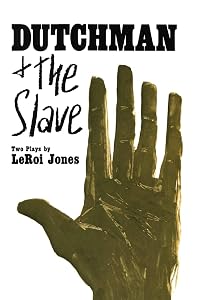
Dutchman and The Slave: Two Plays
by Amiri Baraka
On This Page
Description
"Centered squarely on the Negro-white conflict, both 'Dutchman' and 'The Slave' are literally shocking plays -- in ideas, in language, in honest anger. They illuminate as with a flash of lightning a deadly serious problem -- and they bring an eloquent and exceptionally powerful voice to the American theatre. 'Dutchman ' opened in NYC on March 24, 1964, to perhaps the most excited acclaim ever accorded an off-Boradway production and shortly thereafter received the 'Village Voice's' Obie show more Award. 'The Slave, ' which was produced off-Boradway the following fall, continues to be the subject of heated critical controversy." show lessTags
Recommendations
























Member Reviews
The Dutchman and the Slave are two plays by Leroi Jones (Amiri Baraka) from 1964. Both plays deal with black/white relations, specifically slave heritage and oppressor heritage respectively. Also, both make the point that sexual relations across racial lines does not increase understanding, nor should it contribute to any sense of authority about the life of the other.
In the Dutchman, we witness a subway ride with Clay, a early-20s middle class black man, and Lula, a closer to 30, provocative white woman. Throughout the play Lula teases Clay, hints towards the prospect of sex, claims to know about his "type", then later moves towards insults and "Uncle Tom" derisions, escalating the scene significantly. Basically, at its core, Clay is show more representative of black assimilationists, and Lula could be any white liberal who claims to know how black people are and how they should be, and Amiri Baraka ultimately seems to have no patience for either one of them.
If the Dutchman is full of hatred, the Slave takes that theme to a whole different level. In this play, we have 3 characters Grace and Easley, a white liberal couple; and Walker a black man that we are first introduced to as drunk with a gun, but later find out that he is the ex-husband of Grace. In the background explosions indicate a present or future war between blacks and whites. Walker is the leader of a violent radical black liberation movement whose ultimate goal seems to be to kill all white people. We learn that Grace had left Walker years before for the very simple reason that if his goal was to kill all white people, and she happened to be white, then she couldn't consider herself safe. Even though Walker is a murderer, he is still clearly a victim in this play, since the need for violent racial war could only arise out of decades of oppression without relief. The vitriol builds in this play in such a way that there is only one inevitable conclusion.
These are shocking, angry plays, but especially for the time, gestures such as these were probably the only things that could wake up some people. show less
In the Dutchman, we witness a subway ride with Clay, a early-20s middle class black man, and Lula, a closer to 30, provocative white woman. Throughout the play Lula teases Clay, hints towards the prospect of sex, claims to know about his "type", then later moves towards insults and "Uncle Tom" derisions, escalating the scene significantly. Basically, at its core, Clay is show more representative of black assimilationists, and Lula could be any white liberal who claims to know how black people are and how they should be, and Amiri Baraka ultimately seems to have no patience for either one of them.
If the Dutchman is full of hatred, the Slave takes that theme to a whole different level. In this play, we have 3 characters Grace and Easley, a white liberal couple; and Walker a black man that we are first introduced to as drunk with a gun, but later find out that he is the ex-husband of Grace. In the background explosions indicate a present or future war between blacks and whites. Walker is the leader of a violent radical black liberation movement whose ultimate goal seems to be to kill all white people. We learn that Grace had left Walker years before for the very simple reason that if his goal was to kill all white people, and she happened to be white, then she couldn't consider herself safe. Even though Walker is a murderer, he is still clearly a victim in this play, since the need for violent racial war could only arise out of decades of oppression without relief. The vitriol builds in this play in such a way that there is only one inevitable conclusion.
These are shocking, angry plays, but especially for the time, gestures such as these were probably the only things that could wake up some people. show less
My first time reading Baraka. Where the Dutchman has a mounting tension the Slave is an all out bombardment. I'm still sorting through so much of what he engaged in both. I was particularly impressed with the way he engaged the somatic experience, the body.
Both these plays are provocative and politically charged. Regardless of publication date, they're still relevant and worth reading, and contain some great monologues for anyone interested. If you read drama or have any interest in smart literature that contains social commentary, I recommend this. There's also an interesting section of The Dutchman that brings to mind echoes of Ginsberg's Howl, which is an interesting aside in itself. In general? These are smart and well written--highly recommended.
I really want to see this play now. The dialogue drills RIGHT into your skull. Dutchman is like a hammer to the brain. I can't describe it more.
For a white woman to review these plays would seem an adventure in irony, considering the content of the plays. I will leave it at that.
aka LeRoi Jones
A peça Dutchman parte de uma premissa interessante, com um negro, Clay e uma branca, Lula, dentro do metrô. Eles flertam um com o outro, mas Lula age de modo muito estranho. Ri, tira sarro de Clay, parece volátil e leviana. Finge que sabe muita coisa sobre Clay e fala de sua vida e de sua família. Brinca com ele sobre o que farão juntos, não para de comer maçãs, chama-o várias vezes de mentiroso e finalmente diz-lhe que é um assassino. Clay acaba aborrecendo-se e começa a gritar, falando do comportamento lunático de Lula. Persegue-a. Ela foge e, quando o vagão do trem escurece, apunhala e mata Clay. Mais tarde, vemo-la noutro metrô com outro negro e sabemos que ela vai fazer o mesmo, novamente! Francamente, a peça é show more terrível (e não no bom sentido) porque o diálogo se arrasta sem nenhum propósito aparente. Não se tem ideia do que acontece até o final. Às vezes, adiar o entendimento do enredo até o final funciona, mas aqui só entedia. Jones não traz qualquer mensagem de tipo relativo a relações raciais e, se é que a traz, somente no final da peça é que a gente se liga nisso. show less
May 20, 2016Portuguese
Members
- Recently Added By
Lists

Schomburg Centennial Reading List
100 works; 4 members
Author Information

110+ Works 3,911 Members
Awards and Honors
Series
Belongs to Publisher Series
Apollo Editions (122)
Work Relationships
Contains
Classifications
Statistics
- Members
- 668
- Popularity
- 43,107
- Reviews
- 7
- Rating
- (3.68)
- Languages
- English
- Media
- Paper
- ISBNs
- 2
- ASINs
- 9