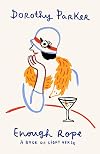
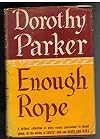
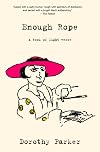
Enough Rope
by Dorothy Parker
On This Page
Description
"Known as the wittiest woman in America and a founder of the fabled Algonquin Round Table, Dorothy Parker was also one of the Jazz Age's most beloved poets. Her verbal dexterity and cynical humor were on full display in the many poems she published in Vanity Fair, The New Yorker, and Life and collected in her first book in 1926. Now available as a stand-alone edition, the famous humorist's debut collection--a runaway bestseller in 1926--ranges from lighthearted self-deprecation to show more acid-tongued satire, all the while gleefully puncturing sentimental cliches about relations between men and women." show lessTags
Recommendations
























Member Recommendations

Member Reviews
This originally appeared at The Irresponsible Reader.
---
WHAT'S ENOUGH ROPE?
It's Dorothy Parker's debut collection of poems, I think ninety of them--but I ran out of fingers and toes and had to make a guess.
Some are flat out funny, some are sweet (okay, not really that many), some are acidic, some are witty, some are ascerbic, some are lightly self-mocking--some are self-hating. It's quite the range. Some are just somber and sober, without any species of humor (I think)--but those are few and far between. All show a degree of wit that too many poems I read don't show (which is why I don't read many.)
I should just go onto the next section because I guess I've slipped into answering:
SO, WHAT DID I THINK ABOUT ENOUGH ROPE?
I enjoyed it. Some show more of these were just delightful. Some made me think a little. I know that Parker can tend toward dark thinking, but there were one or two that could give Plath a run for her money.
Some of the poems by her that I knew already, like "Résumé" or "One Perfect Rose" were part of this collection and were just as good as it was when I discovered it in High School. "Verse for a Certain Dog" is going to be a favorite of mine for quite a while.
One that I don't think I've read before is called "Finis." It struck me as something akin to Auden's "Funeral Blues," in lamenting a lost love--until the final couplet which turns the whole thing into a jab at the man.
Overall, you get the sense of someone who is a jaded romantic. She understands love--she's wary of it, knowing the pain it can bring--but she also knows the highs that come with it, and longs for it. And through the highs, lows, bliss, and agony--has kept her sense of humor and a perspective that all things will pass. After all, you might as well live.
It occurs to me (seconds before I hit "publish"), that this is possibly best exemplified in the last poem in the collection:
The Burned Child
Love has had his way with me.
This my heart is torn and maimed
Since he took his play with me.
Cruel well the bow-boy aimed,
Shot, and saw the feathered shaft
Dripping bright and bitter red.
He that shrugged his wings and laughed—
Better had he left me dead.
Sweet, why do you plead me, then,
Who have bled so sore of that?
Could I bear it once again? ...
Drop a hat, dear, drop a hat! show less
---
WHAT'S ENOUGH ROPE?
It's Dorothy Parker's debut collection of poems, I think ninety of them--but I ran out of fingers and toes and had to make a guess.
Some are flat out funny, some are sweet (okay, not really that many), some are acidic, some are witty, some are ascerbic, some are lightly self-mocking--some are self-hating. It's quite the range. Some are just somber and sober, without any species of humor (I think)--but those are few and far between. All show a degree of wit that too many poems I read don't show (which is why I don't read many.)
I should just go onto the next section because I guess I've slipped into answering:
SO, WHAT DID I THINK ABOUT ENOUGH ROPE?
I enjoyed it. Some show more of these were just delightful. Some made me think a little. I know that Parker can tend toward dark thinking, but there were one or two that could give Plath a run for her money.
Some of the poems by her that I knew already, like "Résumé" or "One Perfect Rose" were part of this collection and were just as good as it was when I discovered it in High School. "Verse for a Certain Dog" is going to be a favorite of mine for quite a while.
One that I don't think I've read before is called "Finis." It struck me as something akin to Auden's "Funeral Blues," in lamenting a lost love--until the final couplet which turns the whole thing into a jab at the man.
Overall, you get the sense of someone who is a jaded romantic. She understands love--she's wary of it, knowing the pain it can bring--but she also knows the highs that come with it, and longs for it. And through the highs, lows, bliss, and agony--has kept her sense of humor and a perspective that all things will pass. After all, you might as well live.
It occurs to me (seconds before I hit "publish"), that this is possibly best exemplified in the last poem in the collection:
The Burned Child
Love has had his way with me.
This my heart is torn and maimed
Since he took his play with me.
Cruel well the bow-boy aimed,
Shot, and saw the feathered shaft
Dripping bright and bitter red.
He that shrugged his wings and laughed—
Better had he left me dead.
Sweet, why do you plead me, then,
Who have bled so sore of that?
Could I bear it once again? ...
Drop a hat, dear, drop a hat! show less
Enough Rope has established Dorothy Parker as one of my favorite poets. She's a scream and everything I like in a poet: funny, relatable, rhyming and metered poems, etc. She writes mainly about boys and her lot in life. Dorothy is the one who came up with "Men seldom make passes/At girls who wear glasses." I love her and I loved this book.
Estava fazendo 30 anos que a Jennifer Jason Leigh encarnou a Dorothy Parker no filme do Alan Rudolph e resolvi ler Enough Rope, livro de poemas escrito por Parker no período do Algonquin Round Table retratado no filme.
Publicado originalmente em 1926, tem tudo que a gente gosta na Dottie: humor, sagacidade e melancolia, me foi particularmente difícil escolher os poemas que mais gostei porque amei quase todos.
Acho que a minha geração millennial deveria redescobrir os poemas dela, acho que tem muito em comum com o nosso tipo de humor melancólico.
Publicado originalmente em 1926, tem tudo que a gente gosta na Dottie: humor, sagacidade e melancolia, me foi particularmente difícil escolher os poemas que mais gostei porque amei quase todos.
Acho que a minha geração millennial deveria redescobrir os poemas dela, acho que tem muito em comum com o nosso tipo de humor melancólico.
Much sadder than I had anticipated. There are some very clever gems in here. One, called "Men", I thought could just as easily be called "Women". Well said though either way. This contains "Resume" and some other old standbys. There were a lot on lost love. The second part was lighter than the first.
Poems, some in fixed forms (e.g. Ballade at Thirty-Five, Roundel (passing fair --grade D-) . often very short quatrains etc, almost always slightly acidic, some witty, others merely sad, often about unhappy love. When young, I wrote a reply to "song of One of theGrls, tyng to match all her references e.g. "Here I my heart I am Helen... with "Here in my heart I am Hector...
Parker's first poetry collection. Contains the very well known "News Item" (Men don't make passes/ At girls who wear glasses).
great modern poetry, best read with a bottle of red.
Members
- Recently Added By
Lists

Best Books of 1926-1935
403 works; 10 members
Author Information

147+ Works 10,284 Members
Poet and short story writer Dorothy Parker was born in New Jersey on August 22, 1893. When she was 5, her mother died and her father, a clothes salesman, remarried. Parker had a great antipathy toward her stepmother and refused to speak to her. She attended parochial school and Miss Dana's school in Morristown, New Jersey, for a brief time before show more dropping out at age 14. A voracious reader, she decided to pursue a career in literature. She began her career by writing verse as well as captions for a fashion magazine. During the years of her greatest fame, Dorothy Parker was known primarily as a writer of light verse, an essential member of the Algonquin Round Table, and a caustic and witty critic of literature and society. She is remembered now as an almost legendary figure of the 1920s and 1930s. Her reviews and staff contributions to three of the most sophisticated magazines of this century, Vanity Fair, the New Yorker, and Esquire, were notable for their put-downs. For all her highbrow wit, however, Dorothy Parker was liberal, even radical, in her political views, and the hard veneer of brittle toughness that she showed to the world was often a shield for frustrated idealism and soft sensibilities. The best of her fiction is marked by a balance of ironic detachment and sympathetic compassion, as in "Big Blonde," which won the O. Henry Award for 1929 and is still her best-remembered and most frequently anthologized story. The best of Dorothy Parker is readily and compactly accessible in The Portable Dorothy Parker. Her own selection of stories and verse for the original edition of that compilation, published in 1944, remains intact in the revised edition, but included also are additional stories, reviews, and articles. Parker died of a heart attack at the age of 73 in 1967. In her will, she bequeathed her estate to the Dr. Martin Luther King, Jr. foundation. Following King's death, her estate was passed on to the NAACP. (Bowker Author Biography) show less
Series
Belongs to Publisher Series
Common Knowledge
- Canonical title
- Enough Rope
- Original title
- Enough Rope
- Alternate titles
- Enough Rope: A Book of Light Verse
- Original publication date
- 1926
- People/Characters
- Dorothy Parker
- Dedication
- To Elinor Wylie
- First words
- Lilacs blossom just as sweet / Now my heart is shattered.
- Last words
- (Click to show. Warning: May contain spoilers.)Could I bear it once again? ... / Drop a hat, dear, drop a hat!
Classifications
Statistics
- Members
- 268
- Popularity
- 120,253
- Reviews
- 8
- Rating
- (4.18)
- Languages
- English
- Media
- Paper, Audiobook, Ebook
- ISBNs
- 14
- ASINs
- 22