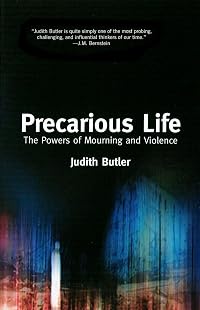
Precarious Life: The Powers of Mourning and Violence
by Judith Butler
On This Page
Description
In her most impassioned and personal book to date, Judith Butler responds in this profound appraisal of post-9/11 America to the current US policies to wage perpetual war, and calls for a deeper understanding of how mourning and violence might instead inspire solidarity and a quest for global justice.Tags
Recommendations



































Member Reviews
In this profound appraisal of post-September 11, 2001 America, Judith Butler considers the conditions of heightened vulnerability and aggression that followed from the attack on the US, and US retaliation. Judith Butler critiques the use of violence that has emerged as a response to loss, and argues that the dislocation of first-world privilege offers instead a chance to imagine a world in which that violence might be minimized and in which interdependency becomes acknowledged as the basis for a global political community.
Butler considers the means by which some lives become grief-worthy, while others are perceived as undeserving of grief or even incomprehensible as lives. She discusses the political implications of sovereignty in light show more of the prisoners in Guantanamo Bay. She argues against the anti-intellectual current of contemporary US patriotism and the power of censorship during times of war. Finally, she takes on the question of when and why anti-semitism is leveled as a charge against those who voice criticisms of the Israeli state. She counters that we have a responsibility to speak out against both Israeli injustices and anti-semitism, and argues against the rhetorical use of the charge of anti-semitism to quell public debate.
In her most impassioned and personal book to date, Judith Butler responds to the current US policies to wage perpetual war, and calls for a deeper understanding of how mourning and violence might instead inspire solidarity and a quest form global justice. show less
Butler considers the means by which some lives become grief-worthy, while others are perceived as undeserving of grief or even incomprehensible as lives. She discusses the political implications of sovereignty in light show more of the prisoners in Guantanamo Bay. She argues against the anti-intellectual current of contemporary US patriotism and the power of censorship during times of war. Finally, she takes on the question of when and why anti-semitism is leveled as a charge against those who voice criticisms of the Israeli state. She counters that we have a responsibility to speak out against both Israeli injustices and anti-semitism, and argues against the rhetorical use of the charge of anti-semitism to quell public debate.
In her most impassioned and personal book to date, Judith Butler responds to the current US policies to wage perpetual war, and calls for a deeper understanding of how mourning and violence might instead inspire solidarity and a quest form global justice. show less
An interesting collection. I think some topics maybe haven't aged well, or at least are really more like sources for a specific time than necessarily have the staying power of other work. The essay about anti-semitism especially feels like it has been more ably taken up, including more recently by Butler herself in her essay about Bari Weiss's book, though both have an element of something missing in their articulations.
The title essay and "Violence, Mourning, Politics," were my favorites; the former also has a kind of incompleteness about it, and I think for me makes the most sense as the staging area for Butler's book about non-violence that came out this year (2020,) though it definitely leaves a lot to chew over. "Violence, show more Mourning, Politics" is the essay I'm most familiar with via citation, and it was good to read it in its entirety; it's clear why it's so heavily cited, and it's an essay I will definitely come back to. The other essays are fine, just didn't hit as much as those two, or felt like they have not aged as well/are not maybe as groundbreaking as they were in 2004. show less
The title essay and "Violence, Mourning, Politics," were my favorites; the former also has a kind of incompleteness about it, and I think for me makes the most sense as the staging area for Butler's book about non-violence that came out this year (2020,) though it definitely leaves a lot to chew over. "Violence, show more Mourning, Politics" is the essay I'm most familiar with via citation, and it was good to read it in its entirety; it's clear why it's so heavily cited, and it's an essay I will definitely come back to. The other essays are fine, just didn't hit as much as those two, or felt like they have not aged as well/are not maybe as groundbreaking as they were in 2004. show less
A strange book to read in 2009, as much of it concerns the limits of the sayable in public life (Chapter 1: "Explanation and Exoneration, or What We Can Hear") and the empty status of detainees ("Indefinite Detention"); Butler includes several remarks about "the shambles into which presidential address has fallen" (131) and the bloody dynamic of white men saving brown women from brown men (see: the moral justification for the Afganistan invasion). It's easy, then, to relegate Precarious Life to the status of a historical document, a set of primary texts for some future one writing an intellectual history the Bush II era [HEY: This is me coming back to this review in 2012, post OWS, and with indefinite detention ongoing. Looks as though show more I spoke too soon!]. Nonetheless, some points still stick: given what AIPAC did to Freeman, the chapter on "The Charge of Anti-Semitism," as repetitive and obvious as it is, still needs to be said (and, as an awful bonus, the first figure she discusses is Lawrence Summers (!), who on 9.17.2002 conflated opposition to the policies of Israel w/ antisemitism: I can only hope he's not advising our current president on foreign as well as financial policy).
Chiefly useful to me for, first, for its *excellent* discussion of the Levinasian "face," which, pace the reviews below, I found clear enough for classroom use: I've never quite understood the impossibility of killing the Other until now [basically, the Other as Other exceeds all assimilation to Self, all representation, all understanding; if a self believes he or she has killed an Other, he or she believes the Other to be mastered, contained, delimited, which is to say, that the killed Other has not be met AS an Other:].
I've also made much use of the chapter "Violence, Mourning, Politics," about which I've written:
Chiefly useful to me for, first, for its *excellent* discussion of the Levinasian "face," which, pace the reviews below, I found clear enough for classroom use: I've never quite understood the impossibility of killing the Other until now [basically, the Other as Other exceeds all assimilation to Self, all representation, all understanding; if a self believes he or she has killed an Other, he or she believes the Other to be mastered, contained, delimited, which is to say, that the killed Other has not be met AS an Other:].
I've also made much use of the chapter "Violence, Mourning, Politics," about which I've written:
Judith Butler has written about the exclusions that mark certain lives as “grievable” and exclude others from the community of concern. “Each of us,” she writes, “is constituted politically in part by virtue of the social vulnerability of our bodies.” Those not recognized as belonging to the community have no social vulnerability. They are not recognized as vulnerable insofar as they are not recognized as belonging to the community of those whose lives matter and thus who are understood as being fully alive. They, who “cannot be mourned because they are always already lost, or, rather, never ‘were.’” They possess only what Agamben terms “bare life,” a life included within the boundaries of a meaningful life or death only in its complete vulnerability, which is, simultaneously, not a vulnerability, since these unmournable lives cannot be recognized as being wounded, since no one feels any outrage or sense of shared suffering for what they suffer. Thus, “if violence is done against those who are unreal...from the perspective of violence, it fails [from the perspective of the dominant community:] to injure or negate those lives since those lives are already negated.” This exclusion of some—most—lives from the community of sympathy helps constitute the human, for, as Butler writes, “I am as much constituted by those I do grieve for as by those whose deaths I disavow.” Butler emphasizes that therefore obituaries should be understood as acts of community formation; as Chloë Taylor insisted in a recent reading of Butler, the obituary should also be understood as an act by which animals lives become forgotten. After all, no casualty list ever records massacres of beasts; they have no memorial.This of course isn't the whole picture, since it doesn't get at the political realm she imagines founded on a more inclusive sense of mutual vulnerability. Note also that I'm told that Bryan S. Turner has dealt with much of these matters already: it would help, then, if Butler had made reference to his work. show less
More accessible than I was anticipating, particularly strong on dehumanisation post-9/11 America and the horrific treatment of "detainees" in Guantanamo Bay.
Ratings
Members
- Recently Added By
Lists

04
34 works; 1 member
Author Information

56+ Works 10,833 Members
Judith Butler was born in 1956. She is nationally known for her writings on gender and sexuality. She argues that men and women are not dissimilar and that the notion they are is cultural not biological in books such as Bodies That Matter: On The Discursive Limits Of "Sex" (1993), Excitable Speech: Contemporary Scenes Of Politics (1996), and The show more Psychic Life Of Power: Theories In Subjection (1997). In Gender Trouble (1990), the title a play on John Waters' camp classic Female Trouble (1975), Butler claims that both gender and drag are a kind of imitation for which there is no original. A professor of philosophy at University of California at Berkeley, Butler attended Yale, receiving a B.A. in 1978 and a Ph.D. in philosophy in 1984. (Bowker Author Biography) show less
Series
Belongs to Publisher Series
Classifications
- Genres
- Nonfiction, Philosophy, Literature Studies and Criticism, General Nonfiction, Sexuality and Gender Studies
- DDC/MDS
- 363.32515610973 — Society, government, & culture Social problems and social services Public Safety - Police, Crime Investigation Terrorism, Disasters, Civil Defense Social conflict Terrorism
- LCC
- HV6432 .B88 — Social sciences Social pathology. Social and public welfare. Criminology Social pathology. Social and public welfare. Criminology Crimes and offenses
- BISAC
Statistics
- Members
- 597
- Popularity
- 49,200
- Reviews
- 4
- Rating
- (3.89)
- Languages
- 6 — Chinese, English, French, German, Portuguese (Portugal), Spanish
- Media
- Paper, Ebook
- ISBNs
- 13
- ASINs
- 3