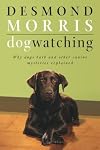
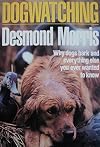
Dogwatching
by Desmond Morris
On This Page
Description
Morris turns his anthropological eye to dogs, answering a host of common--and uncommon--questions in his witty style. Companion volume to Catwatching. Line art throughout.Tags
Recommendations


































Member Reviews
DOGWATCHING (1986) is a mildly interesting artifact of the eighties that caught my attention at a library sale, for an attractive cover, but mostly for its author, Desmond Morris, whose book THE NAKED APE was an international bestseller about fifty years ago. Here Morris offered answers to a number of mundane questions like, why do dogs drag their butts; or why do male dogs cock their legs to pee. Or do dogs feel remorse; or why do they bark, howl or pant. He also discusses dew claws and tails and why are they cut off. And heat cycles and mating also get their due. Some of this is interesting, other parts are a yawn. There are also a number of very spare line drawings of dogs by Edward Coleridge.
The entire book can be read in about an show more hour or two, and is probably best suited for first time dog owners, or older children. So recommended.
- Tim Bazzett, author of the memoir, BOOKLOVER show less
The entire book can be read in about an show more hour or two, and is probably best suited for first time dog owners, or older children. So recommended.
- Tim Bazzett, author of the memoir, BOOKLOVER show less
The author is the former curator of the London Zoo, and writer of popular science books, including "The Naked Ape", "Human Zoo", and "Manwatching".
Morris provides an Introduction rich with context and clarity about his subject, dogs. He is a keen observer, and at the outset he notes the "special relationship" humans and dogs maintain, as "an ancient contract with quite specific terms of agreement". The book lobbies us to attend the terms of a contract too often broken "by us". [1]
Morris approaches this relationship by asking questions and seeking answers from keen observation. He assures us that dogs are only considered food in some Eastern countries, where the delicacy is even yet "becoming less common". In China, "the name of the show more edible dog was the same as the slang word for food: CHOW." [2]
The growth of the stray dog population is "One of the unfortunate side effects of the great popularity of dogs in all human societies". In turn, the rise of a "disease-ridden scavenging horde" seems to have given all dogs a bad name. English seems to preserve contempt in the terms "dirty dog, filthy cur, pit-dog, and dogsbody". The Pariah dogs of the Middle East, in particular, are singled out. [2] The doctrines of several religions consider dogs "unclean". Morris notes that the strongest survival of this attitude is found in Muslim cultures. [The observed prejudice is reflected in behavior and the teachings of the Hadith. However, True Islam notes that the Quran expressly provides quite the opposite attitude. Q Sura 18, and 68 which depicts a guardian dog in prayer posture.]
Morris notes that the "companion dog" is emerging as a happy development. [3] This functional relationship explains the new breeds refined since the Industrial Revolution. Indeed, the competitive showing of pedigree breeds has become big business. Morris admonishes the extremes of overbreeding and neglect. Citing 1985 data, London's Battersea Dog's Home takes in 10,889 strays of which 76% were mongrels.
[UPDATE: In 2010, Battersea re-homed 3,000 dogs, and over 2,800 dogs were put to sleep. In the US approximately 1.5 million shelter animals are annually euthanized (670,000 dogs and 860,000 cats) in 3500 shelters.]
As for breaking our part of the contract by performing cruelties in the name of "scientific research", Morris notes the "vast majority of all painful experiments carried out on long-suffering dogs fail to advance human knowledge in any appreciable way". [5]
This insight brings us to Morris' primary purpose in writing. He seeks to demonstrate "that by simple, direct observation" it is possible "to understand and appreciate these remarkable animals in great and surprising detail". His theme here is "companions". Dogs are playful fun, loving, health-giving, calming, and protective. "People who keep dogs (or cats) live longer on average than those who do not." [6]
Above all, if we ask questions, we find even more fascinating dimensions of this noble companionship. For example, Dogs do not pat one another on the back, so what can this action mean to them when we do it? [44] show less
Morris provides an Introduction rich with context and clarity about his subject, dogs. He is a keen observer, and at the outset he notes the "special relationship" humans and dogs maintain, as "an ancient contract with quite specific terms of agreement". The book lobbies us to attend the terms of a contract too often broken "by us". [1]
Morris approaches this relationship by asking questions and seeking answers from keen observation. He assures us that dogs are only considered food in some Eastern countries, where the delicacy is even yet "becoming less common". In China, "the name of the show more edible dog was the same as the slang word for food: CHOW." [2]
The growth of the stray dog population is "One of the unfortunate side effects of the great popularity of dogs in all human societies". In turn, the rise of a "disease-ridden scavenging horde" seems to have given all dogs a bad name. English seems to preserve contempt in the terms "dirty dog, filthy cur, pit-dog, and dogsbody". The Pariah dogs of the Middle East, in particular, are singled out. [2] The doctrines of several religions consider dogs "unclean". Morris notes that the strongest survival of this attitude is found in Muslim cultures. [The observed prejudice is reflected in behavior and the teachings of the Hadith. However, True Islam notes that the Quran expressly provides quite the opposite attitude. Q Sura 18, and 68 which depicts a guardian dog in prayer posture.]
Morris notes that the "companion dog" is emerging as a happy development. [3] This functional relationship explains the new breeds refined since the Industrial Revolution. Indeed, the competitive showing of pedigree breeds has become big business. Morris admonishes the extremes of overbreeding and neglect. Citing 1985 data, London's Battersea Dog's Home takes in 10,889 strays of which 76% were mongrels.
[UPDATE: In 2010, Battersea re-homed 3,000 dogs, and over 2,800 dogs were put to sleep. In the US approximately 1.5 million shelter animals are annually euthanized (670,000 dogs and 860,000 cats) in 3500 shelters.]
As for breaking our part of the contract by performing cruelties in the name of "scientific research", Morris notes the "vast majority of all painful experiments carried out on long-suffering dogs fail to advance human knowledge in any appreciable way". [5]
This insight brings us to Morris' primary purpose in writing. He seeks to demonstrate "that by simple, direct observation" it is possible "to understand and appreciate these remarkable animals in great and surprising detail". His theme here is "companions". Dogs are playful fun, loving, health-giving, calming, and protective. "People who keep dogs (or cats) live longer on average than those who do not." [6]
Above all, if we ask questions, we find even more fascinating dimensions of this noble companionship. For example, Dogs do not pat one another on the back, so what can this action mean to them when we do it? [44] show less
Gives answers to fascinating fundamental questions about our canine companions - questions often overlooked by standard dog books and even dog owners. He clears up many misconceptions and half-truths about these loyal animals, who give us a curious place in their own packs, join in with ours, and try so valiantly to comprehend our wishes, whether they be expressed in Polish, Japanese, or English.
He has some interesting canine theories but they seem largely speculative and anthropomorphic, though stated as factual. Okay, so he was curator of mammals at a zoo...but no mention of his educational background or other qualifications.
8401374014
En el conjunto de la historia humana sólo dos animales han tenido libertad para en nuestros hogares: el perro y el gato, se les ha permitido errar de habitación en habitación e ir y venir a su propio antojo. En Occidente la vida de los perros ha tenido un desarrollo más bien feliz, las primeras tereas encomendadas han ido perdiendo importancia y viene realizando un nuevo papel. El perro con tareas de labor ha sido mayormente reemplazado por el perro doméstico. No se trata de ninguna fantasía para alentar una campaña a favor de los canes, sino de un simple hecho médico: la influencia tranquilizadora de la compañía de un amistoso animal doméstico reduce la presión sanguínea y, por ende, los riesgos de un ataque cardíaco. Dar show more palmaditas a un perro, acariciar a un gato o acunar a cualquier clase de peludo animal doméstico tiene un poder antiestrés, actúa directamente en las raíces de muchas de las dolencias culturales de hoy. Sufrimos de una tensión excesiva y padecemos el estrés causado el ajetreo de la moderna vida urbana, en la que hay que tomar decisiones cada minuto, con frecuencia complejas y que exigen coordinar conflictos constantes. En contraste, el amistoso contacto de un perro casero sirve para recordarnos la inocencia sencilla y directa, incluso en la alocada vorágine de lo que consideramos civilización avanzada. El libro consiste en comprender mejor al perro intentando responder a una serie de cuestiones de manera breves y simples: ¿Por qué un perro menea la cola? ¿Por qué levantan la pata los perros? ¿Por qué un perro asustado mete la cola entre las patas? ¿Por qué los perros pastores son tan buenos cuidando el ganado? ¿Por qué los perros comen hierva? ¿Por qué los perros arrastran algunas veces el trasero por el suelo? ¿Por qué algunos perros tratan de copular con la pierna de su amo? ¿Por que los perros quieren dormir en la cama de sus amos? ¿Por qué algunos perros se persiguen la cola? ¿Por qué los perros de algunas razas son tan pequeños? ¿Por qué a los perros les desagradan algunos desconocidos más que otros? ¿Tienen los perros un sexto sentido? ¿Por qué empleamos la frase “época de canícula”? Etc., etc. show less
Mar 23, 2023Spanish
Ratings
Members
- Recently Added By
Author Information

83+ Works 10,083 Members
Desmond Morris was born January 24, 1928 in Purton, North Wiltshire, United Kingdom. He is a British zoologist, ethologist, author, and surrealist painter. After Morris' military service, he attended the University of Birmingham and graduated in 1951 with a First Class Honours Degree in Zoology. In 1954, he received a D.Phil from Oxford show more University. After graduation, Morris was a Curator of Mammals at the London Zoo until 1966. Morris was a presenter of the ITV television program "Zoo Time" in the 1950s, but may be best-known for his 1967 best-selling book, The Naked Ape, which describes the evolution of human behavior from a zoological point-of-view. Morris has authored nearly fifty scientific publications. show less
Awards and Honors
Common Knowledge
- Canonical title*
- Le Chien révélé
- Original title
- Dogwatching
- Original publication date
- 1987
*Some information comes from Common Knowledge in other languages. Click "Edit" for more information.
Classifications
Statistics
- Members
- 398
- Popularity
- 78,632
- Reviews
- 6
- Rating
- (3.45)
- Languages
- 15 — Dutch, English, Finnish, French, German, Hungarian, Italian, Norwegian (Bokmål), Polish, Portuguese, Slovenian, Spanish, Swedish, Thai, Turkish
- Media
- Paper, Audiobook
- ISBNs
- 34
- ASINs
- 6